Q1421.Which of the following species is not stable?
निम्नलिखित में से कौन-सी स्पीशीज़ स्थायी नहीं है?
- A[SiF6]2–
- B[GeCl6]2–
- C[Sn(OH)6]2–
- D[SiCl6]2–
Show answer
Concept: NCERT: Si (small atom) can accommodate six small F atoms, but [SiCl6]2− is not known.
- Six large Cl atoms cannot fit around the small Si atom (steric crowding), and the lone pairs of Cl interact weakly with Si → [SiCl6]2− is unstable ✓.
- [SiF6]2− (small F), [GeCl6]2− (larger Ge) and [Sn(OH)6]2− (large Sn) are all known stable species.
Short trick: Small Si + small F = fine; small Si + big Cl = overcrowded.
Answer: (D) [SiCl6]2–
अवधारणा: NCERT: Si (छोटा परमाणु) छह छोटे F परमाणुओं को समायोजित कर सकता है, किंतु [SiCl6]2− ज्ञात नहीं है।
- छह बड़े Cl परमाणु छोटे Si परमाणु के चारों ओर नहीं समा सकते (त्रिविम भीड़), तथा Cl के एकाकी युग्म Si से दुर्बल अन्योन्यक्रिया करते हैं → [SiCl6]2− अस्थायी ✓।
- [SiF6]2− (छोटा F), [GeCl6]2− (बड़ा Ge) तथा [Sn(OH)6]2− (बड़ा Sn) सभी ज्ञात स्थायी स्पीशीज़ हैं।
शॉर्ट ट्रिक: छोटा Si + छोटा F = ठीक; छोटा Si + बड़ा Cl = अत्यधिक भीड़।
उत्तर: (D) [SiCl6]2–
NEET UGChemistryp-Block elements – group 14 complexesNEET UG 2019 · 5 May Shift 1
Q1422.For a cell involving one electron V at 298 K, the equilibrium constant for the cell reaction is :
एक इलेक्ट्रॉन वाले सेल के लिए 298 K पर V है, सेल अभिक्रिया का साम्य स्थिरांक है :
[दिया है, T = 298 K पर V]
- A1.0 × 102
- B1.0 × 105
- C1.0 × 1010
- D1.0 × 1030
Show answer
Concept: At equilibrium , so .
- .
- .
Short trick: Every 0.059 V per electron = one power of 10 in K: 0.59 V → 10 powers.
Answer: (C) 1.0 × 10¹⁰
अवधारणा: साम्य पर , अतः ।
- ।
- ।
शॉर्ट ट्रिक: प्रति इलेक्ट्रॉन प्रत्येक 0.059 V = K में 10 की एक घात: 0.59 V → 10 घातें।
उत्तर: (C) 1.0 × 10¹⁰
NEET UGChemistryElectrochemistry – EMF and equilibrium constantNEET UG 2019 · 5 May Shift 1
Q1423.Which of the following is an amphoteric hydroxide?
निम्नलिखित में से कौन-सा उभयधर्मी (amphoteric) हाइड्रॉक्साइड है?
- ASr(OH)2
- BCa(OH)2
- CMg(OH)2
- DBe(OH)2
Show answer
Concept: Be (small size, high polarising power) behaves differently from other group 2 metals; BeO and Be(OH)2 are amphoteric.
- Be(OH)2 + 2HCl → BeCl2 + 2H2O (acts as base).
- Be(OH)2 + 2OH− → [Be(OH)4]2− (acts as acid) ✓.
- Mg(OH)2, Ca(OH)2, Sr(OH)2 are basic only.
Short trick: Diagonal relationship: Be ≈ Al → both hydroxides amphoteric.
Answer: (D) Be(OH)2
अवधारणा: Be (छोटा आकार, उच्च ध्रुवण क्षमता) वर्ग 2 की अन्य धातुओं से भिन्न व्यवहार करता है; BeO तथा Be(OH)2 उभयधर्मी हैं।
- Be(OH)2 + 2HCl → BeCl2 + 2H2O (क्षारक की भाँति)।
- Be(OH)2 + 2OH− → [Be(OH)4]2− (अम्ल की भाँति) ✓।
- Mg(OH)2, Ca(OH)2, Sr(OH)2 केवल क्षारकीय हैं।
शॉर्ट ट्रिक: विकर्ण संबंध: Be ≈ Al → दोनों के हाइड्रॉक्साइड उभयधर्मी।
उत्तर: (D) Be(OH)2
NEET UGChemistrys-Block elements – amphoteric hydroxideNEET UG 2019 · 5 May Shift 1
Q1424.A gas at 350 K and 15 bar has molar volume 20 percent smaller than that for an ideal gas under the same conditions. The correct option about the gas and its compressibility factor (Z) is :
एक गैस का 350 K तथा 15 bar पर मोलर आयतन समान परिस्थितियों में आदर्श गैस की अपेक्षा 20 प्रतिशत कम है। गैस तथा उसके संपीड्यता गुणांक (Z) के बारे में सही विकल्प है :
- AZ > 1 and attractive forces are dominantZ > 1 तथा आकर्षण बल प्रभावी हैं
- BZ > 1 and repulsive forces are dominantZ > 1 तथा प्रतिकर्षण बल प्रभावी हैं
- CZ < 1 and attractive forces are dominantZ < 1 तथा आकर्षण बल प्रभावी हैं
- DZ < 1 and repulsive forces are dominantZ < 1 तथा प्रतिकर्षण बल प्रभावी हैं
Show answer
Concept: at the same T and p.
- Vreal = 0.8 Videal → Z = 0.8 < 1.
- Z < 1 means the gas is more compressible than ideal – intermolecular attractions dominate.
Short trick: Z < 1 ↔ attraction ("pulls molecules closer"); Z > 1 ↔ repulsion.
Answer: (C) Z < 1 and attractive forces are dominant
अवधारणा: समान T तथा p पर ।
- Vreal = 0.8 Videal → Z = 0.8 < 1।
- Z < 1 का अर्थ है गैस आदर्श की अपेक्षा अधिक संपीड्य है – अंतराअणुक आकर्षण प्रभावी है।
शॉर्ट ट्रिक: Z < 1 ↔ आकर्षण ("अणुओं को पास खींचता है"); Z > 1 ↔ प्रतिकर्षण।
उत्तर: (C) Z < 1 तथा आकर्षण बल प्रभावी हैं
NEET UGChemistryStates of matter – compressibility factorNEET UG 2019 · 5 May Shift 1
Q1425.A compound is formed by cation C and anion A. The anions form hexagonal close packed (hcp) lattice and the cations occupy 75% of octahedral voids. The formula of the compound is :
एक यौगिक धनायन C तथा ऋणायन A से बनता है। ऋणायन षट्कोणीय निविड संकुलित (hcp) जालक बनाते हैं तथा धनायन 75% अष्टफलकीय रिक्तियों को घेरते हैं। यौगिक का सूत्र है :
- AC2A3
- BC3A2
- CC3A4
- DC4A3
Show answer
Concept: In a close-packed lattice of N atoms there are N octahedral voids and 2N tetrahedral voids.
- Let anions = N → octahedral voids = N.
- Cations = 0.75 N = 3N/4.
- C : A = 3/4 : 1 = 3 : 4 → C3A4.
Short trick: Fraction of octahedral voids filled = cation : anion ratio directly (75% → 3 : 4).
Answer: (C) C3A4
अवधारणा: N परमाणुओं के निविड संकुलित जालक में N अष्टफलकीय तथा 2N चतुष्फलकीय रिक्तियाँ होती हैं।
- माना ऋणायन = N → अष्टफलकीय रिक्तियाँ = N।
- धनायन = 0.75 N = 3N/4।
- C : A = 3/4 : 1 = 3 : 4 → C3A4।
शॉर्ट ट्रिक: भरी अष्टफलकीय रिक्तियों का अंश सीधे धनायन : ऋणायन अनुपात देता है (75% → 3 : 4)।
उत्तर: (C) C3A4
NEET UGChemistrySolid state – voids and formulaNEET UG 2019 · 5 May Shift 1
Q1426.In which case change in entropy is negative?
किस स्थिति में एन्ट्रॉपी परिवर्तन ऋणात्मक है?
- AEvaporation of waterजल का वाष्पन
- BExpansion of a gas at constant temperatureनियत ताप पर गैस का प्रसार
- CSublimation of solid to gasठोस का गैस में ऊर्ध्वपातन
- D2H(g) → H2(g)
Show answer
Concept: Entropy decreases when the number of gaseous particles decreases or the system becomes more ordered.
- (D) 2 mol of gaseous atoms → 1 mol of gas molecules: Δng = −1, fewer particles → ΔS < 0 ✓.
- (A) liquid → vapour, (B) larger volume, (C) solid → gas: all increase disorder → ΔS > 0 ✗.
Short trick: Look for the process where gas moles DEcrease – that is the negative-ΔS one.
Answer: (D) 2H(g) → H2(g)
अवधारणा: जब गैसीय कणों की संख्या घटती है या निकाय अधिक व्यवस्थित होता है तो एन्ट्रॉपी घटती है।
- (D) 2 mol गैसीय परमाणु → 1 mol गैस अणु: Δng = −1, कण कम → ΔS < 0 ✓।
- (A) द्रव → वाष्प, (B) अधिक आयतन, (C) ठोस → गैस: सभी में अव्यवस्था बढ़ती है → ΔS > 0 ✗।
शॉर्ट ट्रिक: वह प्रक्रम खोजिए जिसमें गैस के मोल घटते हों – वही ऋणात्मक ΔS वाला है।
उत्तर: (D) 2H(g) → H2(g)
NEET UGChemistryThermodynamics – entropy changeNEET UG 2019 · 5 May Shift 1
Q1427.Which of the following series of transitions in the spectrum of hydrogen atom falls in visible region?
हाइड्रोजन परमाणु के स्पेक्ट्रम में संक्रमणों की निम्नलिखित में से कौन-सी श्रेणी दृश्य क्षेत्र में आती है?
- ALyman seriesलाइमैन श्रेणी
- BBalmer seriesबामर श्रेणी
- CPaschen seriesपाशन श्रेणी
- DBrackett seriesब्रैकेट श्रेणी
Show answer
Concept: Spectral series of H are named by the lower level n1 of the transition.
- Balmer (n1 = 2): its lines Hα 656 nm, Hβ 486 nm, Hγ 434 nm, Hδ 410 nm lie in the visible region ✓.
- Lyman (n1 = 1) → ultraviolet; Paschen (n1 = 3), Brackett (n1 = 4) → infrared ✗.
Short trick: "Lyman-UV, Balmer-Visible, then Paschen-Brackett-Pfund all IR" – only n1 = 2 gives visible lines.
Answer: (B) Balmer series
अवधारणा: H की स्पेक्ट्रमी श्रेणियाँ संक्रमण के निम्न स्तर n1 के अनुसार नामित होती हैं।
- बामर (n1 = 2): इसकी रेखाएँ Hα 656 nm, Hβ 486 nm, Hγ 434 nm, Hδ 410 nm दृश्य क्षेत्र में हैं ✓।
- लाइमैन (n1 = 1) → पराबैंगनी; पाशन (n1 = 3), ब्रैकेट (n1 = 4) → अवरक्त ✗।
शॉर्ट ट्रिक: "लाइमैन-UV, बामर-दृश्य, फिर पाशन-ब्रैकेट-फुंड सभी IR" – केवल n1 = 2 दृश्य रेखाएँ देता है।
उत्तर: (B) बामर श्रेणी
NEET UGChemistryAtomic structure – hydrogen spectrumNEET UG 2019 · 5 May Shift 1
Q1428.The method used to remove temporary hardness of water is :
जल की अस्थायी कठोरता दूर करने के लिए प्रयुक्त विधि है :
- ACalgon's methodकैलगॉन विधि
- BClark's methodक्लार्क विधि
- CIon-exchange methodआयन-विनिमय विधि
- DSynthetic resins methodसंश्लेषित रेज़िन विधि
Show answer
Concept: Temporary hardness is due to Ca/Mg hydrogencarbonates; it is removed by boiling or by Clark’s method.
- Clark’s method: a calculated amount of lime is added – Ca(HCO3)2 + Ca(OH)2 → 2CaCO3↓ + 2H2O ✓.
- Calgon, ion-exchange (zeolite) and synthetic resin methods are used for permanent hardness (chlorides/sulphates) ✗.
Short trick: Clark = "Calcium hydrogencarbonate + lime" – the only method specific to temporary hardness.
Answer: (B) Clark's method
अवधारणा: अस्थायी कठोरता Ca/Mg के हाइड्रोजनकार्बोनेटों के कारण होती है; इसे उबालकर अथवा क्लार्क विधि से दूर किया जाता है।
- क्लार्क विधि: परिकलित मात्रा में चूना मिलाया जाता है – Ca(HCO3)2 + Ca(OH)2 → 2CaCO3↓ + 2H2O ✓।
- कैलगॉन, आयन-विनिमय (ज़िओलाइट) तथा संश्लेषित रेज़िन विधियाँ स्थायी कठोरता (क्लोराइड/सल्फ़ेट) के लिए प्रयुक्त होती हैं ✗।
शॉर्ट ट्रिक: क्लार्क = "कैल्सियम हाइड्रोजनकार्बोनेट + चूना" – केवल अस्थायी कठोरता की विशिष्ट विधि।
उत्तर: (B) क्लार्क विधि
NEET UGChemistryHydrogen – hardness of waterNEET UG 2019 · 5 May Shift 1
Q1429.Which one is malachite from the following?
निम्नलिखित में से मैलेकाइट कौन-सा है?
- ACuFeS2
- BCu(OH)2
- CFe3O4
- DCuCO3.Cu(OH)2
Show answer
Concept: Malachite is the green basic copper carbonate ore of copper.
- Malachite = CuCO3·Cu(OH)2 ✓.
- CuFeS2 = copper pyrites (chalcopyrite); Fe3O4 = magnetite; Cu(OH)2 is not an ore ✗.
Short trick: "Malachite is green like verdigris" – green basic copper carbonate; azurite (blue) is 2CuCO3·Cu(OH)2.
Answer: (D) CuCO3.Cu(OH)2
अवधारणा: मैलेकाइट ताँबे का हरा क्षारकीय कॉपर कार्बोनेट अयस्क है।
- मैलेकाइट = CuCO3·Cu(OH)2 ✓।
- CuFeS2 = कॉपर पाइराइट (कैल्कोपाइराइट); Fe3O4 = मैग्नेटाइट; Cu(OH)2 अयस्क नहीं है ✗।
शॉर्ट ट्रिक: "मैलेकाइट हरा" – हरा क्षारकीय कॉपर कार्बोनेट; ऐज़ुराइट (नीला) 2CuCO3·Cu(OH)2 है।
उत्तर: (D) CuCO3.Cu(OH)2
NEET UGChemistryMetallurgy – ores and mineralsNEET UG 2019 · 5 May Shift 1
Q1430.The correct order of the basic strength of methyl substituted amines in aqueous solution is :
जलीय विलयन में मेथिल प्रतिस्थापित ऐमीनों की क्षारकीय सामर्थ्य का सही क्रम है :
- A(CH3)2NH > CH3NH2 > (CH3)3N
- B(CH3)3N > CH3NH2 > (CH3)2NH
- C(CH3)3N > (CH3)2NH > CH3NH2
- DCH3NH2 > (CH3)2NH > (CH3)3N
Show answer
Concept: In water, basicity of amines depends on +I effect, solvation (H-bonding) of the ammonium ion and steric hindrance together.
- For methyl amines: (CH3)2NH (pKb 3.27) > CH3NH2 (3.38) > (CH3)3N (4.22).
- 3° amine: its cation (CH3)3NH+ has only one N–H for H-bonding → poorly solvated → weakest base in water.
- (B), (C), (D) ignore the solvation effect (the gas-phase order would be 3° > 2° > 1°).
Short trick: Methyl series in water: "2 > 1 > 3"; ethyl series: "2 > 3 > 1".
Answer: (A) (CH3)2NH > CH3NH2 > (CH3)3N
अवधारणा: जल में ऐमीनों की क्षारकता +I प्रभाव, अमोनियम आयन के विलायकन (हाइड्रोजन आबंधन) तथा त्रिविम बाधा – तीनों पर एक साथ निर्भर करती है।
- मेथिल ऐमीनों के लिए: (CH3)2NH (pKb 3.27) > CH3NH2 (3.38) > (CH3)3N (4.22)।
- 3° ऐमीन: इसके धनायन (CH3)3NH+ में हाइड्रोजन आबंधन के लिए केवल एक N–H है → कम विलायकन → जल में सबसे दुर्बल क्षारक।
- (B), (C), (D) विलायकन प्रभाव की उपेक्षा करते हैं (गैस प्रावस्था में क्रम 3° > 2° > 1° होता)।
शॉर्ट ट्रिक: जल में मेथिल श्रेणी: "2 > 1 > 3"; एथिल श्रेणी: "2 > 3 > 1"।
उत्तर: (A) (CH3)2NH > CH3NH2 > (CH3)3N
NEET UGChemistryAmines – basic strength in waterNEET UG 2019 · 5 May Shift 1
Q1431.The Earth Summit held in Rio de Janeiro in 1992 was called
रियो डी जेनेरो में 1992 में आयोजित पृथ्वी सम्मेलन (Earth Summit) बुलाया गया था
- Ato reduce CO2 emissions and global warmingCO2 उत्सर्जन तथा भूमंडलीय तापन (global warming) को कम करने के लिए
- Bfor conservation of biodiversity and sustainable utilization of its benefitsजैव विविधता के संरक्षण तथा इसके लाभों के सतत उपयोग के लिए
- Cto assess threat posed to native species by invasive weed speciesआक्रामक खरपतवार जातियों द्वारा देशज जातियों को उत्पन्न खतरे के आकलन के लिए
- Dfor immediate steps to discontinue use of CFCs that were damaging the ozone layerओज़ोन परत को क्षति पहुँचा रहे CFCs का उपयोग तुरंत बंद करने के कदम उठाने के लिए
Show answer
Concept: NCERT (Biodiversity and Conservation): at the historic Convention on Biological Diversity (“The Earth Summit”), Rio de Janeiro, 1992, all nations were called upon to take measures for conservation of biodiversity and sustainable utilisation of its benefits.
- Earth Summit, Rio 1992 → Convention on Biological Diversity → conservation + sustainable use of biodiversity – option (B).
- (A) CO2/global-warming reduction is the theme of the Kyoto Protocol (1997).
- (C) Invasive-species assessment was not the purpose of the summit.
- (D) Phasing out CFCs is the Montreal Protocol (1987).
Short trick: Rio = “Bio” (biodiversity); Kyoto = CO2; Montreal = Ozone/CFC. Follow-up: World Summit on Sustainable Development, Johannesburg 2002.
Answer: (B) for conservation of biodiversity and sustainable utilization of its benefits
अवधारणा: NCERT (जैव विविधता एवं संरक्षण): रियो डी जेनेरो (1992) में हुए ऐतिहासिक जैव विविधता सम्मेलन (“पृथ्वी सम्मेलन”) में सभी राष्ट्रों से जैव विविधता के संरक्षण तथा इसके लाभों के सतत उपयोग हेतु उपाय करने का आह्वान किया गया।
- पृथ्वी सम्मेलन, रियो 1992 → जैव विविधता सम्मेलन (CBD) → जैव विविधता का संरक्षण + सतत उपयोग – विकल्प (B)।
- (A) CO2/भूमंडलीय तापन कम करना क्योटो प्रोटोकॉल (1997) का विषय है।
- (C) आक्रामक जातियों का आकलन इस सम्मेलन का उद्देश्य नहीं था।
- (D) CFCs को समाप्त करना मॉन्ट्रियल प्रोटोकॉल (1987) है।
शॉर्ट ट्रिक: रियो = “बायो” (जैव विविधता); क्योटो = CO2; मॉन्ट्रियल = ओज़ोन/CFC। अगला: सतत विकास पर विश्व सम्मेलन, जोहान्सबर्ग 2002।
उत्तर: (B) जैव विविधता के संरक्षण तथा इसके लाभों के सतत उपयोग के लिए
NEET UGBiologyBiodiversity – conservation (Earth Summit)NEET UG 2019 · 5 May Shift 1
Q1432.Colostrum the yellowish fluid, secreted by mother during the initial days of lactation is very essential to impart immunity to the new born infants because it contains :
स्तनपान के प्रारम्भिक दिनों में माता द्वारा स्रावित पीला-सा तरल खीस (colostrum) नवजात शिशुओं को प्रतिरक्षा प्रदान करने के लिए अत्यंत आवश्यक है क्योंकि इसमें होता है :
- ANatural killer cellsप्राकृतिक मारक कोशिकाएँ (Natural killer cells)
- BMonocytesएककेंद्रकाणु (Monocytes)
- CMacrophagesमहाभक्षकाणु (Macrophages)
- DImmunoglobulin Aइम्यूनोग्लोबुलिन A (IgA)
Show answer
Concept: Colostrum is rich in antibodies of the IgA type; these ready-made antibodies give the infant natural passive immunity.
- NCERT: “The yellowish fluid colostrum secreted by mother during the initial days of lactation has abundant antibodies (IgA) to protect the infant.”
- (A) NK cells, (B) monocytes and (C) macrophages are cells of innate immunity in blood/tissues – they are not what colostrum supplies to give immunity.
Short trick: Colostrum → IgA (“A for Amma / milk”); placenta → IgG (“G crosses the Gap”).
Answer: (D) Immunoglobulin A
अवधारणा: खीस में IgA प्रकार की प्रतिरक्षियाँ (antibodies) प्रचुर मात्रा में होती हैं; ये पहले से बनी प्रतिरक्षियाँ शिशु को प्राकृतिक निष्क्रिय प्रतिरक्षा देती हैं।
- NCERT: “स्तनपान के प्रारम्भिक दिनों में माता द्वारा स्रावित पीले तरल खीस में शिशु की रक्षा के लिए प्रचुर प्रतिरक्षियाँ (IgA) होती हैं।”
- (A) NK कोशिकाएँ, (B) मोनोसाइट तथा (C) मैक्रोफेज रक्त/ऊतकों की सहज प्रतिरक्षा की कोशिकाएँ हैं – खीस प्रतिरक्षा देने के लिए इन्हें प्रदान नहीं करता।
शॉर्ट ट्रिक: खीस → IgA (“A = अम्मा का दूध”); अपरा (placenta) → IgG (“G गैप पार करता है”)।
उत्तर: (D) इम्यूनोग्लोबुलिन A (IgA)
NEET UGBiologyHuman health – immunity (passive immunity, colostrum)NEET UG 2019 · 5 May Shift 1
Q1433.Grass leaves curl inwards during very dry weather. Select the most appropriate reason from the following :
अत्यधिक शुष्क मौसम में घास की पत्तियाँ अंदर की ओर मुड़ जाती हैं। निम्नलिखित में से सबसे उपयुक्त कारण चुनिए :
- AClosure of stomataरंध्रों का बंद होना
- BFlaccidity of bulliform cellsआवर्ध त्वक् कोशिकाओं (bulliform cells) का श्लथ (flaccid) होना
- CShrinkage of air spaces in spongy mesophyllस्पंजी पर्णमध्योतक में वायु-अवकाशों का सिकुड़ना
- DTyloses in vesselsवाहिकाओं में टाइलोसिस (tyloses)
Show answer
Concept: In grasses some adaxial epidermal cells along the veins are large, empty, colourless bulliform cells.
- When turgid they keep the leaf surface exposed (leaf flat).
- Under water stress they lose water and become flaccid → the leaf rolls/curls inwards → less surface exposed → less transpiration.
- (A) Stomatal closure reduces transpiration but does not roll the leaf.
- (C) Grass (monocot) leaf has no distinct spongy mesophyll, and air-space shrinkage does not curl leaves.
- (D) Tyloses block old xylem vessels (heartwood) – unrelated to leaf rolling.
Short trick: “Bulliform = bull-dozer of leaf folding”: turgid → open, flaccid → curl.
Answer: (B) Flaccidity of bulliform cells
अवधारणा: घासों में शिराओं के साथ ऊपरी (adaxial) बाह्यत्वचा की कुछ कोशिकाएँ बड़ी, रिक्त और रंगहीन आवर्ध त्वक् (bulliform) कोशिकाएँ होती हैं।
- स्फीत (turgid) होने पर ये पत्ती की सतह को खुला (पत्ती को चपटा) रखती हैं।
- जल की कमी में ये जल खोकर श्लथ हो जाती हैं → पत्ती अंदर की ओर लिपट/मुड़ जाती है → कम सतह खुली → कम वाष्पोत्सर्जन।
- (A) रंध्रों के बंद होने से वाष्पोत्सर्जन घटता है, पर पत्ती नहीं मुड़ती।
- (C) घास (एकबीजपत्री) की पत्ती में स्पष्ट स्पंजी पर्णमध्योतक नहीं होता, और वायु-अवकाश सिकुड़ने से पत्ती नहीं मुड़ती।
- (D) टाइलोसिस पुरानी जाइलम वाहिकाओं (अंतःकाष्ठ) को अवरुद्ध करते हैं – पत्ती मुड़ने से इनका संबंध नहीं।
शॉर्ट ट्रिक: “बुलिफॉर्म = पत्ती मोड़ने वाली कोशिका”: स्फीत → खुली, श्लथ → मुड़ी।
उत्तर: (B) आवर्ध त्वक् कोशिकाओं (bulliform cells) का श्लथ (flaccid) होना
NEET UGBiologyAnatomy of flowering plants – monocot leaf (bulliform cells)NEET UG 2019 · 5 May Shift 1
Q1434.The shorter and longer arms of a submetacentric chromosome are referred to as
एक उपमध्यकेंद्री (submetacentric) गुणसूत्र की छोटी और लंबी भुजाओं को कहा जाता है
- As-arm and l-arm respectivelyक्रमशः s-भुजा और l-भुजा
- Bp-arm and q-arm respectivelyक्रमशः p-भुजा और q-भुजा
- Cq-arm and p-arm respectivelyक्रमशः q-भुजा और p-भुजा
- Dm-arm and n-arm respectivelyक्रमशः m-भुजा और n-भुजा
Show answer
Concept: In a submetacentric chromosome the centromere is slightly away from the middle, giving one shorter and one longer arm.
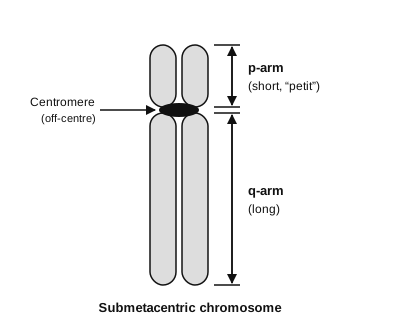
- Short arm = p-arm (from French petit = small).
- Long arm = q-arm (the next letter after p).
- So the order “shorter, longer” = p-arm, q-arm → (B); (C) is the reverse; s/l and m/n are not used terms.
Short trick: p = petit (small); q comes after p → longer arm.
Answer: (B) p-arm and q-arm respectively
अवधारणा: उपमध्यकेंद्री गुणसूत्र में गुणसूत्र बिंदु (centromere) मध्य से थोड़ा हटकर होता है, जिससे एक भुजा छोटी तथा एक लंबी होती है।
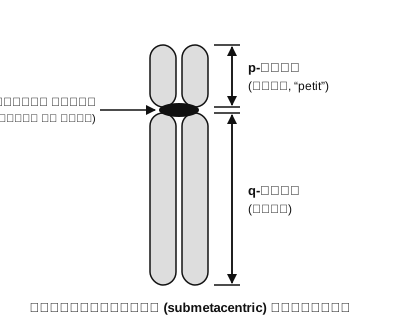
- छोटी भुजा = p-भुजा (फ्रेंच petit = छोटा)।
- लंबी भुजा = q-भुजा (p के बाद का अक्षर)।
- अतः “छोटी, लंबी” का क्रम = p-भुजा, q-भुजा → (B); (C) उलटा है; s/l तथा m/n प्रयुक्त शब्द नहीं हैं।
शॉर्ट ट्रिक: p = petit (छोटा); q, p के बाद आता है → लंबी भुजा।
उत्तर: (B) क्रमशः p-भुजा और q-भुजा
NEET UGBiologyCell cycle & chromosomes – types of chromosomesNEET UG 2019 · 5 May Shift 1
Q1435.Respiratory Quotient (RQ) value of tripalmitin is
ट्राइपामिटिन का श्वसन गुणांक (RQ) मान है
- A0.9
- B0.7
- C0.07
- D0.09
Show answer
Concept: RQ = volume of CO2 evolved / volume of O2 consumed.
- 2(C51H98O6) + 145 O2 → 102 CO2 + 98 H2O + energy (tripalmitin).
- RQ = 102 CO2 / 145 O2 = 0.703 ≈ 0.7.
- Fats are poor in oxygen, so they need more O2 → RQ < 1. 0.9 is near protein; 0.07/0.09 are impossibly low.
Short trick: RQ: carbohydrate = 1, protein ≈ 0.9, fat ≈ 0.7, organic acids > 1 (malic acid 1.33).
Answer: (B) 0.7
अवधारणा: RQ = निकली CO2 का आयतन / उपभुक्त O2 का आयतन।
- 2(C51H98O6) + 145 O2 → 102 CO2 + 98 H2O + ऊर्जा (ट्राइपामिटिन)।
- RQ = 102 CO2 / 145 O2 = 0.703 ≈ 0.7।
- वसा में ऑक्सीजन कम होती है, अतः अधिक O2 लगती है → RQ < 1। 0.9 प्रोटीन के निकट है; 0.07/0.09 असंभव रूप से कम हैं।
शॉर्ट ट्रिक: RQ: कार्बोहाइड्रेट = 1, प्रोटीन ≈ 0.9, वसा ≈ 0.7, कार्बनिक अम्ल > 1 (मैलिक अम्ल 1.33)।
उत्तर: (B) 0.7
NEET UGBiologyRespiration in plants – respiratory quotientNEET UG 2019 · 5 May Shift 1
Q1436.Which of the following is a commercial blood cholesterol lowering agent?
निम्नलिखित में से कौन-सा एक व्यावसायिक रक्त कोलेस्टेरॉल कम करने वाला कारक है?
- ACyclosporin Aसाइक्लोस्पोरिन A
- BStatinस्टैटिन
- CStreptokinaseस्ट्रेप्टोकाइनेज़
- DLipasesलाइपेज़
Show answer
Concept: Statins, produced by the yeast Monascus purpureus, competitively inhibit the enzyme of cholesterol synthesis and are used as blood-cholesterol-lowering agents.
- (A) Cyclosporin A (Trichoderma polysporum) – immunosuppressant in organ transplant.
- (C) Streptokinase (Streptococcus) – “clot buster”, dissolves blood clots.
- (D) Lipases – used in detergents to remove oily stains.
Short trick: Statin = static cholesterol; Monascus → Minus cholesterol.
Answer: (B) Statin
अवधारणा: स्टैटिन यीस्ट Monascus purpureus द्वारा बनाए जाते हैं; ये कोलेस्टेरॉल संश्लेषण के एंजाइम का स्पर्धी संदमन करते हैं और रक्त-कोलेस्टेरॉल घटाने वाले कारक के रूप में प्रयुक्त होते हैं।
- (A) साइक्लोस्पोरिन A (Trichoderma polysporum) – अंग प्रत्यारोपण में प्रतिरक्षा-निरोधक।
- (C) स्ट्रेप्टोकाइनेज़ (Streptococcus) – “थक्का नाशक”, रक्त के थक्के घोलता है।
- (D) लाइपेज़ – अपमार्जकों में तैलीय धब्बे हटाने में प्रयुक्त।
शॉर्ट ट्रिक: स्टैटिन = कोलेस्टेरॉल “स्थिर/कम”; Monascus → Minus कोलेस्टेरॉल।
उत्तर: (B) स्टैटिन
NEET UGBiologyMicrobes in human welfare – bioactive moleculesNEET UG 2019 · 5 May Shift 1
Q1437.Match the following structures with their respective location in organs
| Structure | Location |
|---|
| (a) Crypts of Lieberkuhn | (i) Pancreas |
| (b) Glisson's Capsule | (ii) Duodenum |
| (c) Islets of Langerhans | (iii) Small intestine |
| (d) Brunner's Glands | (iv) Liver |
Select the correct option from the following
निम्नलिखित संरचनाओं का उनके अंगों में संबंधित स्थान से मिलान कीजिए
| संरचना | स्थान |
|---|
| (a) लीबरकुन की प्रगुहिकाएँ (Crypts of Lieberkuhn) | (i) अग्न्याशय |
| (b) ग्लिसन का संपुट (Glisson's Capsule) | (ii) ग्रहणी (Duodenum) |
| (c) लैंगरहैंस की द्वीपिकाएँ | (iii) छोटी आँत |
| (d) ब्रूनर की ग्रंथियाँ | (iv) यकृत |
निम्नलिखित में से सही विकल्प चुनिए
- A(a)-(iii), (b)-(i), (c)-(ii), (d)-(iv)
- B(a)-(ii), (b)-(iv), (c)-(i), (d)-(iii)
- C(a)-(iii), (b)-(iv), (c)-(i), (d)-(ii)
- D(a)-(iii), (b)-(ii), (c)-(i), (d)-(iv)
Show answer
Concept: Each structure belongs to one specific digestive organ.
- (a) Crypts of Lieberkuhn – tubular glands between the villi of the small intestine → (iii).
- (b) Glisson's capsule – connective-tissue sheath around each hepatic lobule of the liver → (iv).
- (c) Islets of Langerhans – endocrine part of the pancreas → (i).
- (d) Brunner's glands – submucosal glands of the duodenum → (ii).
- So a-iii, b-iv, c-i, d-ii = option (C).
Short trick: Only (c) = Pancreas is certain → options (B), (C) and (D) remain; Brunner = “B for Beginning of intestine” (duodenum) → only (C).
Answer: (C) (a)-(iii), (b)-(iv), (c)-(i), (d)-(ii)
अवधारणा: प्रत्येक संरचना किसी एक विशिष्ट पाचक अंग में पाई जाती है।
- (a) लीबरकुन की प्रगुहिकाएँ – छोटी आँत के रसांकुरों के बीच की नलिकाकार ग्रंथियाँ → (iii)।
- (b) ग्लिसन का संपुट – यकृत की प्रत्येक यकृत पालिका को घेरने वाला संयोजी ऊतक आवरण → (iv)।
- (c) लैंगरहैंस की द्वीपिकाएँ – अग्न्याशय का अंतःस्रावी भाग → (i)।
- (d) ब्रूनर की ग्रंथियाँ – ग्रहणी की अधःश्लेष्मिका ग्रंथियाँ → (ii)।
- अतः a-iii, b-iv, c-i, d-ii = विकल्प (C)।
शॉर्ट ट्रिक: केवल (c) = अग्न्याशय निश्चित → (B), (C), (D) बचे; ब्रूनर = “B = आँत की शुरुआत” (ग्रहणी) → केवल (C)।
उत्तर: (C) (a)-(iii), (b)-(iv), (c)-(i), (d)-(ii)
NEET UGBiologyDigestion – structures and their locationNEET UG 2019 · 5 May Shift 1
Q1438.Which of the following is the most important cause for animals and plants being driven to extinction?
निम्नलिखित में से कौन-सा जंतुओं और पादपों के विलुप्ति की ओर धकेले जाने का सबसे महत्वपूर्ण कारण है?
- AHabitat loss and fragmentationआवासीय क्षति तथा विखंडन
- BDrought and floodsसूखा और बाढ़
- CEconomic exploitationआर्थिक शोषण (अति-दोहन)
- DAlien species invasionविदेशी जातियों का आक्रमण
Show answer
Concept: NCERT “evil quartet” of biodiversity loss: habitat loss & fragmentation, over-exploitation, alien species invasions, co-extinctions.
- NCERT: “Habitat loss and fragmentation – this is the most important cause driving animals and plants to extinction” (e.g. tropical rain forests reduced from 14% to 6% of land surface).
- (C) over-exploitation and (D) alien species are also causes of the quartet, but secondary.
- (B) Drought and floods are natural events, not listed as the main cause.
Short trick: Evil quartet in order of importance = “H O A C” – Habitat, Over-exploitation, Alien, Co-extinction.
Answer: (A) Habitat loss and fragmentation
अवधारणा: जैव विविधता ह्रास की NCERT “दुष्ट चौकड़ी”: आवासीय क्षति व विखंडन, अति-दोहन, विदेशी जातियों का आक्रमण, सह-विलुप्तता।
- NCERT: “आवासीय क्षति तथा विखंडन – जंतुओं और पादपों को विलुप्ति की ओर ले जाने वाला यह सबसे महत्वपूर्ण कारण है” (जैसे उष्णकटिबंधीय वर्षा वन भू-सतह के 14% से घटकर 6% रह गए)।
- (C) अति-दोहन और (D) विदेशी जातियाँ भी चौकड़ी के कारण हैं, पर गौण।
- (B) सूखा और बाढ़ प्राकृतिक घटनाएँ हैं, मुख्य कारण के रूप में सूचीबद्ध नहीं।
शॉर्ट ट्रिक: महत्व के क्रम में दुष्ट चौकड़ी = “आ-अ-वि-स” – आवास, अति-दोहन, विदेशी, सह-विलुप्तता।
उत्तर: (A) आवासीय क्षति तथा विखंडन
NEET UGBiologyBiodiversity – causes of loss (evil quartet)NEET UG 2019 · 5 May Shift 1
Q1439.Which part of the brain is responsible for thermoregulation?
मस्तिष्क का कौन-सा भाग ताप-नियमन (thermoregulation) के लिए उत्तरदायी है?
- ACerebrumप्रमस्तिष्क (Cerebrum)
- BHypothalamusअधश्चेतक (Hypothalamus)
- CCorpus callosumमहासंयोजिका (Corpus callosum)
- DMedulla oblongataमेडुला ऑब्लांगेटा (Medulla oblongata)
Show answer
Concept: The hypothalamus (base of the forebrain/diencephalon) contains centres that control body temperature, hunger and thirst, and it secretes hypothalamic hormones.
- (A) Cerebrum – intelligence, memory, voluntary actions, sensory perception.
- (C) Corpus callosum – tract of nerve fibres connecting the two cerebral hemispheres.
- (D) Medulla – centres for respiration, cardiovascular reflexes and gastric secretion.
Short trick: Hypothalamus = body's “thermostat” + hunger/thirst switch (“HOT” – Hypothalamus Owns Temperature).
Answer: (B) Hypothalamus
अवधारणा: अधश्चेतक (हाइपोथैलेमस) (अग्रमस्तिष्क/डाइएनसेफेलॉन का आधार) में शरीर-ताप, भूख और प्यास नियंत्रित करने वाले केंद्र होते हैं, तथा यह हाइपोथैलेमिक हॉर्मोन स्रावित करता है।
- (A) प्रमस्तिष्क – बुद्धि, स्मृति, ऐच्छिक क्रियाएँ, संवेदी अनुभूति।
- (C) महासंयोजिका – दोनों प्रमस्तिष्क गोलार्धों को जोड़ने वाला तंत्रिका-तंतु पथ।
- (D) मेडुला – श्वसन, हृद्-संवहनी प्रतिवर्तों तथा जठर स्राव के केंद्र।
शॉर्ट ट्रिक: हाइपोथैलेमस = शरीर का “थर्मोस्टैट” + भूख/प्यास का स्विच।
उत्तर: (B) अधश्चेतक (Hypothalamus)
NEET UGBiologyNeural control – parts of brain (hypothalamus)NEET UG 2019 · 5 May Shift 1
Q1440.Consider following features
(a) Organ system level of organisation
(b) Bilateral symmetry
(c) True coelomates with segmentation of body
Select the correct option of animal groups which possess all the above characteristics
निम्नलिखित लक्षणों पर विचार कीजिए
(a) अंग तंत्र स्तर का संगठन
(b) द्विपार्श्व सममिति
(c) शरीर के खंडीभवन सहित वास्तविक प्रगुहीय (true coelomates)
उन प्राणि समूहों का सही विकल्प चुनिए जिनमें उपर्युक्त सभी लक्षण पाए जाते हैं
- AAnnelida, Arthropoda and Chordataऐनेलिडा, आर्थ्रोपोडा तथा कॉर्डेटा
- BAnnelida, Arthropoda and Molluscaऐनेलिडा, आर्थ्रोपोडा तथा मोलस्का
- CArthropoda, Mollusca and Chordataआर्थ्रोपोडा, मोलस्का तथा कॉर्डेटा
- DAnnelida, Mollusca and Chordataऐनेलिडा, मोलस्का तथा कॉर्डेटा
Show answer
Concept: All coelomate phyla (Annelida → Chordata) are organ-system level and bilateral (adult echinoderms radial); the deciding feature is metameric segmentation.
- Segmented phyla (NCERT): Annelida, Arthropoda and Chordata – all three are true coelomates, bilateral, organ-system level → (A).
- Mollusca are coelomate and bilateral but unsegmented → (B), (C), (D) each contain Mollusca, so all are wrong.
Short trick: Segmentation = “A A C” – Annelida, Arthropoda, Chordata; any option with Mollusca is out.
Answer: (A) Annelida, Arthropoda and Chordata
अवधारणा: सभी प्रगुही संघ (ऐनेलिडा → कॉर्डेटा) अंग तंत्र स्तर के तथा द्विपार्श्व सममित हैं (वयस्क एकाइनोडर्म अरीय); निर्णायक लक्षण विखंडीय खंडीभवन (metameric segmentation) है।
- खंडित संघ (NCERT): ऐनेलिडा, आर्थ्रोपोडा तथा कॉर्डेटा – तीनों वास्तविक प्रगुही, द्विपार्श्व, अंग तंत्र स्तर के → (A)।
- मोलस्का प्रगुही व द्विपार्श्व हैं परंतु अखंडित → (B), (C), (D) प्रत्येक में मोलस्का है, अतः सभी गलत।
शॉर्ट ट्रिक: खंडीभवन = “A A C” – ऐनेलिडा, आर्थ्रोपोडा, कॉर्डेटा; मोलस्का वाला हर विकल्प बाहर।
उत्तर: (A) ऐनेलिडा, आर्थ्रोपोडा तथा कॉर्डेटा
NEET UGBiologyAnimal kingdom – basis of classificationNEET UG 2019 · 5 May Shift 1

