Q1461.Select the incorrect statement.
गलत कथन चुनिए।
- AMale fruit fly is heterogameticनर फल मक्खी विषमयुग्मकी (heterogametic) होती है
- BIn male grasshoppers 50% of sperms have no sex-chromosomeनर टिड्डों में 50% शुक्राणुओं में कोई लिंग-गुणसूत्र नहीं होता
- CIn domesticated fowls, sex of progeny depends on the type of sperm rather than eggपालतू मुर्गियों में संतति का लिंग अंडाणु के स्थान पर शुक्राणु के प्रकार पर निर्भर करता है
- DHuman males have one of their sex-chromosome much shorter than the otherमानव नरों में उनका एक लिंग-गुणसूत्र दूसरे से बहुत छोटा होता है
Show answer
Concept: Birds (fowl) show ZW–ZZ sex determination: the female (ZW) is heterogametic, so the egg decides the sex of the progeny.
- (A) Correct – Drosophila male is XY (heterogametic).
- (B) Correct – grasshopper male is XO, so half the sperms carry X and half carry no sex chromosome.
- (C) Incorrect – males are ZZ (all sperms carry Z); the egg (Z or W) decides the sex → answer.
- (D) Correct – the human Y chromosome is much shorter than X.
Short trick: Birds = “Mother decides” (ZW female); humans/fruit fly = father decides (XY male).
Answer: (C) In domesticated fowls, sex of progeny depends on the type of sperm rather than egg
अवधारणा: पक्षियों (मुर्गी) में ZW–ZZ लिंग निर्धारण होता है: मादा (ZW) विषमयुग्मकी होती है, अतः संतति का लिंग अंडाणु तय करता है।
- (A) सही – Drosophila का नर XY (विषमयुग्मकी) है।
- (B) सही – टिड्डे का नर XO है, अतः आधे शुक्राणुओं में X और आधों में कोई लिंग गुणसूत्र नहीं होता।
- (C) गलत – नर ZZ हैं (सभी शुक्राणुओं में Z); अंडाणु (Z या W) लिंग तय करता है → उत्तर।
- (D) सही – मानव Y गुणसूत्र X से बहुत छोटा होता है।
शॉर्ट ट्रिक: पक्षी = “माँ तय करती है” (ZW मादा); मनुष्य/फल मक्खी = पिता तय करता है (XY नर)।
उत्तर: (C) पालतू मुर्गियों में संतति का लिंग अंडाणु के स्थान पर शुक्राणु के प्रकार पर निर्भर करता है
NEET UGBiologyPrinciples of inheritance – sex determinationNEET UG 2019 · 5 May Shift 1
Q1462.DNA precipitation out of a mixture of biomolecules can be achieved by treatment with
जैव अणुओं के मिश्रण से DNA का अवक्षेपण किसके उपचार द्वारा प्राप्त किया जा सकता है?
- AIsopropanolआइसोप्रोपेनॉल
- BChilled ethanolद्रुतशीतित (chilled) एथेनॉल
- CMethanol at room temperatureकमरे के ताप पर मेथेनॉल
- DChilled chloroformद्रुतशीतित क्लोरोफॉर्म
Show answer
Concept: NCERT (isolation of DNA): after removing RNA (ribonuclease) and proteins (protease), “purified DNA ultimately precipitates out after the addition of chilled ethanol” – seen as fine threads (spooling).
- (A) Isopropanol can also precipitate DNA in labs, but the NCERT/standard answer for this question is chilled ethanol.
- (C) Methanol at room temperature is not used.
- (D) Chloroform is used to extract proteins/lipids (phenol-chloroform), not to precipitate DNA.
Short trick: “Cold alcohol makes DNA come out” – chilled ethanol → spooling.
Answer: (B) Chilled ethanol
अवधारणा: NCERT (DNA का पृथक्करण): RNA (राइबोन्यूक्लिएज़) व प्रोटीन (प्रोटिएज़) हटाने के बाद “द्रुतशीतित एथेनॉल मिलाने पर शुद्ध DNA अंततः अवक्षेपित हो जाता है” – महीन धागों के रूप में दिखता है (स्पूलिंग)।
- (A) प्रयोगशाला में आइसोप्रोपेनॉल से भी DNA अवक्षेपित हो सकता है, किंतु इस प्रश्न का NCERT/मानक उत्तर द्रुतशीतित एथेनॉल है।
- (C) कमरे के ताप पर मेथेनॉल प्रयुक्त नहीं होता।
- (D) क्लोरोफॉर्म प्रोटीन/लिपिड निष्कर्षण (फीनॉल-क्लोरोफॉर्म) में प्रयुक्त होता है, DNA अवक्षेपण में नहीं।
शॉर्ट ट्रिक: “ठंडा ऐल्कोहॉल DNA को बाहर निकालता है” – द्रुतशीतित एथेनॉल → स्पूलिंग।
उत्तर: (B) द्रुतशीतित (chilled) एथेनॉल
NEET UGBiologyBiotechnology – isolation of DNANEET UG 2019 · 5 May Shift 1
Q1463.Select the correct group of biocontrol agents.
जैव नियंत्रण कारकों का सही समूह चुनिए।
- ABacillus thuringiensis, Tobacco mosaic virus, AphidsBacillus thuringiensis, तंबाकू मोज़ेक वायरस, ऐफिड
- BTrichoderma, Baculovirus, Bacillus thuringiensis
- COscillatoria, Rhizobium, Trichoderma
- DNostoc, Azospirillum, NucleopolyhedrovirusNostoc, Azospirillum, न्यूक्लियोपॉलीहेड्रोवायरस
Show answer
Concept: Biocontrol agents (NCERT): Bacillus thuringiensis (Bt – butterfly caterpillars), Trichoderma (fungus against plant pathogens), Baculoviruses of genus Nucleopolyhedrovirus (insects), ladybird, dragonflies.
- (B) all three are biocontrol agents → correct.
- (A) TMV is a plant pathogen and aphids are pests, not biocontrol agents.
- (C) Oscillatoria and Rhizobium are biofertilisers (N2-fixers).
- (D) Nostoc and Azospirillum are biofertilisers.
Short trick: Biocontrol “B-T-B”: Bt, Trichoderma, Baculovirus; biofertilisers: Rhizobium, Azospirillum, Nostoc, Anabaena, Oscillatoria.
Answer: (B) Trichoderma, Baculovirus, Bacillus thuringiensis
अवधारणा: जैव नियंत्रण कारक (NCERT): Bacillus thuringiensis (Bt – तितली के इल्लियाँ), Trichoderma (पादप रोगजनकों के विरुद्ध कवक), Nucleopolyhedrovirus वंश के बैक्युलोवायरस (कीट), लेडीबर्ड, ड्रैगनफ्लाई।
- (B) तीनों जैव नियंत्रण कारक हैं → सही।
- (A) TMV पादप रोगजनक है तथा ऐफिड पीड़क हैं, जैव नियंत्रण कारक नहीं।
- (C) Oscillatoria और Rhizobium जैव उर्वरक (N2-स्थिरीकारक) हैं।
- (D) Nostoc और Azospirillum जैव उर्वरक हैं।
शॉर्ट ट्रिक: जैव नियंत्रण “B-T-B”: Bt, Trichoderma, बैक्युलोवायरस; जैव उर्वरक: Rhizobium, Azospirillum, Nostoc, Anabaena, Oscillatoria।
उत्तर: (B) Trichoderma, Baculovirus, Bacillus thuringiensis
NEET UGBiologyMicrobes in human welfare – biocontrol agentsNEET UG 2019 · 5 May Shift 1
Q1464.Select the incorrect statement.
गलत कथन चुनिए।
- AInbreeding increases homozygosityअंतःप्रजनन समयुग्मजता बढ़ाता है
- BInbreeding is essential to evolve purelines in any animal.किसी भी जंतु में शुद्ध वंशक्रम (purelines) विकसित करने के लिए अंतःप्रजनन आवश्यक है।
- CInbreeding selects harmful recessive genes that reduce fertility and productivityअंतःप्रजनन उन हानिकारक अप्रभावी जीनों का चयन करता है जो जननक्षमता और उत्पादकता घटाते हैं
- DInbreeding helps in accumulation of superior genes and elimination of undesirable genesअंतःप्रजनन श्रेष्ठ जीनों के संचय और अवांछनीय जीनों के निष्कासन में सहायक है
Show answer
Concept: NCERT: inbreeding increases homozygosity, is necessary to evolve a pureline, and “exposes harmful recessive genes that are eliminated by selection”; it helps accumulate superior genes.
- (A) True – mating of closely related individuals increases homozygosity.
- (B) True – NCERT line.
- (C) Incorrect – inbreeding does not select harmful recessive genes; it exposes them so that they can be eliminated by selection. (Continued inbreeding may cause inbreeding depression, but that is not “selection” of such genes.)
- (D) True.
Short trick: Inbreeding exposes, selection eliminates – never “selects” the harmful gene.
Answer: (C) Inbreeding selects harmful recessive genes that reduce fertility and productivity
अवधारणा: NCERT: अंतःप्रजनन समयुग्मजता बढ़ाता है, शुद्ध वंशक्रम विकसित करने हेतु आवश्यक है, और “हानिकारक अप्रभावी जीनों को अनावृत करता है जिन्हें चयन द्वारा निष्कासित किया जाता है”; यह श्रेष्ठ जीनों के संचय में सहायक है।
- (A) सत्य – निकट संबंधी जीवों के संगम से समयुग्मजता बढ़ती है।
- (B) सत्य – NCERT पंक्ति।
- (C) गलत – अंतःप्रजनन हानिकारक अप्रभावी जीनों का चयन नहीं करता; यह उन्हें अनावृत करता है ताकि चयन द्वारा उन्हें हटाया जा सके। (लगातार अंतःप्रजनन से अंतःप्रजनन अवसादन हो सकता है, पर वह ऐसे जीनों का “चयन” नहीं है।)
- (D) सत्य।
शॉर्ट ट्रिक: अंतःप्रजनन अनावृत करता है, चयन हटाता है – हानिकारक जीन का “चयन” कभी नहीं।
उत्तर: (C) अंतःप्रजनन उन हानिकारक अप्रभावी जीनों का चयन करता है जो जननक्षमता और उत्पादकता घटाते हैं
NEET UGBiologyStrategies for enhancement in food production – inbreedingNEET UG 2019 · 5 May Shift 1
Q1465.Match the following organisms with the products they produce
| Organism | Product |
|---|
| (a) Lactobacillus | (i) Cheese |
| (b) Saccharomyces cerevisiae | (ii) Curd |
| (c) Aspergillus niger | (iii) Citric Acid |
| (d) Acetobacter aceti | (iv) Bread |
| (v) Acetic Acid |
Select the
correct option.
निम्नलिखित जीवों का उनके द्वारा उत्पन्न उत्पादों से मिलान कीजिए
| जीव | उत्पाद |
|---|
| (a) Lactobacillus | (i) पनीर (Cheese) |
| (b) Saccharomyces cerevisiae | (ii) दही |
| (c) Aspergillus niger | (iii) सिट्रिक अम्ल |
| (d) Acetobacter aceti | (iv) ब्रेड |
| (v) ऐसीटिक अम्ल |
सही विकल्प चुनिए।
- A(a)-(ii), (b)-(iv), (c)-(v), (d)-(iii)
- B(a)-(ii), (b)-(iv), (c)-(iii), (d)-(v)
- C(a)-(iii), (b)-(iv), (c)-(v), (d)-(i)
- D(a)-(ii), (b)-(i), (c)-(iii), (d)-(v)
Show answer
Concept: NCERT examples of microbial products.
- (a) Lactobacillus (LAB) converts milk into curd → (ii).
- (b) Saccharomyces cerevisiae (baker's yeast) – dough fermentation for bread → (iv).
- (c) Aspergillus niger (fungus) → citric acid → (iii).
- (d) Acetobacter aceti (bacterium) → acetic acid → (v).
- a-ii, b-iv, c-iii, d-v = (B). (Cheese (i) is the distractor.)
Short trick: Organic acids: “Aspergillus – citric, Acetobacter – acetic, Clostridium – butyric, Lactobacillus – lactic”.
Answer: (B) (a)-(ii), (b)-(iv), (c)-(iii), (d)-(v)
अवधारणा: सूक्ष्मजीवी उत्पादों के NCERT उदाहरण।
- (a) Lactobacillus (LAB) दूध को दही में बदलता है → (ii)।
- (b) Saccharomyces cerevisiae (बेकर यीस्ट) – ब्रेड के लिए आटे का किण्वन → (iv)।
- (c) Aspergillus niger (कवक) → सिट्रिक अम्ल → (iii)।
- (d) Acetobacter aceti (जीवाणु) → ऐसीटिक अम्ल → (v)।
- a-ii, b-iv, c-iii, d-v = (B)। (पनीर (i) भ्रामक विकल्प है।)
शॉर्ट ट्रिक: कार्बनिक अम्ल: “Aspergillus – सिट्रिक, Acetobacter – ऐसीटिक, Clostridium – ब्यूटिरिक, Lactobacillus – लैक्टिक”।
उत्तर: (B) (a)-(ii), (b)-(iv), (c)-(iii), (d)-(v)
NEET UGBiologyMicrobes in human welfare – household and industrial productsNEET UG 2019 · 5 May Shift 1
Q1466.What is the direction of movement of sugars in phloem?
फ्लोएम में शर्कराओं की गति की दिशा क्या है?
- ANon-multidirectionalअबहुदिशीय (Non-multidirectional)
- BUpwardऊपर की ओर
- CDownwardनीचे की ओर
- DBi-directionalद्विदिशीय (Bi-directional)
Show answer
Concept: Phloem moves sugars from source to sink; since source and sink can be reversed with season (e.g. stored food in roots mobilised in spring), the movement is bi-directional.
- Xylem flow is unidirectional (upward); phloem flow can be upward or downward → bi-directional (D).
- (B) only upward and (C) only downward are each half the truth; (A) is not a recognised term.
Short trick: Xylem = one-way lift; Phloem = two-way traffic (source ⇄ sink).
Answer: (D) Bi-directional
अवधारणा: फ्लोएम शर्कराओं को स्रोत (source) से कुंड (sink) की ओर ले जाता है; क्योंकि मौसम के अनुसार स्रोत और कुंड उलट सकते हैं (जैसे वसंत में जड़ों में संचित भोजन का उपयोग), गति द्विदिशीय होती है।
- जाइलम प्रवाह एकदिशीय (ऊपर की ओर) है; फ्लोएम प्रवाह ऊपर या नीचे दोनों ओर हो सकता है → द्विदिशीय (D)।
- (B) केवल ऊपर और (C) केवल नीचे – दोनों आधा सत्य हैं; (A) कोई मान्य शब्द नहीं है।
शॉर्ट ट्रिक: जाइलम = एकतरफ़ा लिफ़्ट; फ्लोएम = दोतरफ़ा यातायात (स्रोत ⇄ कुंड)।
उत्तर: (D) द्विदिशीय (Bi-directional)
NEET UGBiologyTransport in plants – phloem transportNEET UG 2019 · 5 May Shift 1
Q1467.In some plants, the female gamete develops into embryo without fertilization. This phenomenon is known as
कुछ पादपों में मादा युग्मक बिना निषेचन के भ्रूण में विकसित हो जाता है। यह परिघटना कहलाती है
- AAutogamyस्वयुग्मन (Autogamy)
- BParthenocarpyअनिषेकफलन (Parthenocarpy)
- CSyngamyयुग्मक संलयन (Syngamy)
- DParthenogenesisअनिषेकजनन (Parthenogenesis)
Show answer
Concept: Parthenogenesis – development of the female gamete (egg) into a new individual/embryo without fertilisation (e.g. rotifers, honeybee drones, some plants).
- (A) Autogamy – transfer of pollen to the stigma of the same flower (self-pollination).
- (B) Parthenocarpy – formation of fruit without fertilisation (seedless banana).
- (C) Syngamy – fusion of male and female gametes (fertilisation itself).
- So (D).
Short trick: Partheno = virgin: -genesis → embryo/organism; -carpy → fruit (carpel).
Answer: (D) Parthenogenesis
अवधारणा: अनिषेकजनन – मादा युग्मक (अंडाणु) का बिना निषेचन के नए जीव/भ्रूण में विकसित होना (जैसे रोटिफर, मधुमक्खी के ड्रोन, कुछ पादप)।
- (A) स्वयुग्मन – उसी पुष्प के वर्तिकाग्र पर परागकणों का स्थानांतरण (स्व-परागण)।
- (B) अनिषेकफलन – बिना निषेचन के फल बनना (बीजरहित केला)।
- (C) युग्मक संलयन – नर और मादा युग्मकों का संलयन (स्वयं निषेचन)।
- अतः (D)।
शॉर्ट ट्रिक: पार्थेनो = कुमारी: -जेनेसिस → भ्रूण/जीव; -कार्पी → फल (अंडप)।
उत्तर: (D) अनिषेकजनन (Parthenogenesis)
NEET UGBiologyReproduction – parthenogenesisNEET UG 2019 · 5 May Shift 1
Q1468.Persistent nucellus in the seed is known as
बीज में स्थायी बीजांडकाय (nucellus) कहलाता है
- AChalazaनिभाग (Chalaza)
- BPerispermपरिभ्रूणपोष (Perisperm)
- CHilumनाभिका (Hilum)
- DTegmenअंतःकवच (Tegmen)
Show answer
Concept: NCERT: “Occasionally, in some seeds such as black pepper and beet, remnants of nucellus are also persistent. This residual, persistent nucellus is the perisperm.”
- (A) Chalaza – basal part of the ovule opposite the micropyle where integuments arise.
- (C) Hilum – scar on the seed where it was attached to the funicle.
- (D) Tegmen – inner seed coat (from inner integument).
- So (B).
Short trick: Perisperm = Pepper & beet keep the nucellus (“Nucellus → Perisperm”).
Answer: (B) Perisperm
अवधारणा: NCERT: “कभी-कभी कुछ बीजों जैसे काली मिर्च और चुकंदर में बीजांडकाय के अवशेष भी स्थायी रहते हैं। यह अवशिष्ट, स्थायी बीजांडकाय परिभ्रूणपोष (perisperm) है।”
- (A) निभाग – बीजांडद्वार के विपरीत बीजांड का आधारी भाग, जहाँ से अध्यावरण निकलते हैं।
- (C) नाभिका – बीज पर वह चिह्न जहाँ वह बीजांडवृंत से जुड़ा था।
- (D) अंतःकवच (टेग्मेन) – भीतरी बीजावरण (भीतरी अध्यावरण से)।
- अतः (B)।
शॉर्ट ट्रिक: पेरीस्पर्म = काली मिर्च और चुकंदर बीजांडकाय रखते हैं (“बीजांडकाय → परिभ्रूणपोष”)।
उत्तर: (B) परिभ्रूणपोष (Perisperm)
NEET UGBiologySexual reproduction in flowering plants – seed (perisperm)NEET UG 2019 · 5 May Shift 1
Q1469.What map unit (Centimorgan) is adopted in the construction of genetic maps?
आनुवंशिक मानचित्रों के निर्माण में कौन-सी मानचित्र इकाई (सेंटीमॉर्गन) अपनाई जाती है?
- AA unit of distance between two expressed genes representing 10% cross over.दो अभिव्यक्त जीनों के बीच की दूरी की इकाई जो 10% जीन विनिमय (cross over) दर्शाती है।
- BA unit of distance between two expressed genes representing 100% cross over.दो अभिव्यक्त जीनों के बीच की दूरी की इकाई जो 100% जीन विनिमय दर्शाती है।
- CA unit of distance between genes on chromosomes, representing 1% cross over.गुणसूत्रों पर जीनों के बीच की दूरी की इकाई, जो 1% जीन विनिमय दर्शाती है।
- DA unit of distance between genes on chromosomes, representing 50% cross over.गुणसूत्रों पर जीनों के बीच की दूरी की इकाई, जो 50% जीन विनिमय दर्शाती है।
Show answer
Concept: Sturtevant used the frequency of recombination (crossing over) between gene pairs on the same chromosome as a measure of the distance between them; 1 map unit = 1 centimorgan (cM) = 1% recombination/crossing over.
- Hence a 1 cM distance means 1 recombinant in 100 gametes → (C).
- 10% and 100% are wrong values; 50% recombination is the maximum (genes behave as unlinked), not one unit.
Short trick: Centimorgan → centi = 1/100 → 1% crossing over.
Answer: (C) A unit of distance between genes on chromosomes, representing 1% cross over.
अवधारणा: स्टुर्टेवेंट ने एक ही गुणसूत्र पर स्थित जीन-युग्मों के बीच पुनर्योजन (जीन विनिमय) की आवृत्ति को उनकी दूरी का माप माना; 1 मानचित्र इकाई = 1 सेंटीमॉर्गन (cM) = 1% पुनर्योजन/जीन विनिमय।
- अतः 1 cM दूरी का अर्थ है 100 युग्मकों में 1 पुनर्योगज → (C)।
- 10% और 100% गलत मान हैं; 50% पुनर्योजन अधिकतम है (जीन असहलग्न की भाँति व्यवहार करते हैं), एक इकाई नहीं।
शॉर्ट ट्रिक: सेंटीमॉर्गन → सेंटी = 1/100 → 1% जीन विनिमय।
उत्तर: (C) गुणसूत्रों पर जीनों के बीच की दूरी की इकाई, जो 1% जीन विनिमय दर्शाती है।
NEET UGBiologyPrinciples of inheritance – linkage and genetic mapsNEET UG 2019 · 5 May Shift 1
Q1470.What would be the heart rate of a person if the cardiac output is 5 L, blood volume in the ventricles at the end of diastole is 100 mL and at the end of ventricular systole is 50 mL?
यदि किसी व्यक्ति का हृद् निर्गम (cardiac output) 5 L है, अनुशिथिलन (diastole) के अंत में निलयों में रक्त का आयतन 100 mL तथा निलय प्रकुंचन (systole) के अंत में 50 mL है, तो उसकी हृदय दर क्या होगी?
- A50 beats per minute50 स्पंदन प्रति मिनट
- B75 beats per minute75 स्पंदन प्रति मिनट
- C100 beats per minute100 स्पंदन प्रति मिनट
- D125 beats per minute125 स्पंदन प्रति मिनट
Show answer
Concept: Cardiac output = stroke volume × heart rate; stroke volume = end-diastolic volume − end-systolic volume.
- Stroke volume = 100 mL − 50 mL = 50 mL per beat.
- Cardiac output = 5 L/min = 5000 mL/min.
- Heart rate = 5000 ÷ 50 = 100 beats per minute → (C).
Short trick: Normal: 70 mL × 72 ≈ 5 L. Same 5 L with a smaller stroke (50 mL) needs a faster rate: 5000/50 = 100.
Answer: (C) 100 beats per minute
अवधारणा: हृद् निर्गम = प्रवाह आयतन (stroke volume) × हृदय दर; प्रवाह आयतन = अनुशिथिलन-अंत आयतन − प्रकुंचन-अंत आयतन।
- प्रवाह आयतन = 100 mL − 50 mL = 50 mL प्रति स्पंदन।
- हृद् निर्गम = 5 L/मिनट = 5000 mL/मिनट।
- हृदय दर = 5000 ÷ 50 = 100 स्पंदन प्रति मिनट → (C)।
शॉर्ट ट्रिक: सामान्य: 70 mL × 72 ≈ 5 L। छोटे प्रवाह आयतन (50 mL) से वही 5 L पाने के लिए तेज़ दर चाहिए: 5000/50 = 100।
उत्तर: (C) 100 स्पंदन प्रति मिनट
NEET UGBiologyBody fluids and circulation – cardiac outputNEET UG 2019 · 5 May Shift 1
Q1471.Thiobacillus is a group of bacteria helpful in carrying out
Thiobacillus जीवाणुओं का एक समूह है जो किसे संपन्न करने में सहायक है?
- ANitrogen fixationनाइट्रोजन स्थिरीकरण
- BChemoautotrophic fixationरसायन-स्वपोषी स्थिरीकरण
- CNitrificationनाइट्रीकरण
- DDenitrificationविनाइट्रीकरण
Show answer
Concept: NCERT (Mineral Nutrition): “Nitrate present in the soil is also reduced to nitrogen by the process of denitrification, carried out by bacteria Pseudomonas and Thiobacillus.”
- (A) N2 fixation – Rhizobium, Azotobacter, Anabaena, Nostoc.
- (C) Nitrification – Nitrosomonas/Nitrococcus (NH3 → NO2−) and Nitrobacter (NO2− → NO3−).
- (B) Although Thiobacillus is chemoautotrophic, “chemoautotrophic fixation” is not the process it is cited for in the nitrogen cycle.
- Hence (D).
Short trick: Denitrifiers “P-T” = Pseudomonas, Thiobacillus (they “Put The N2 back”).
Answer: (D) Denitrification
अवधारणा: NCERT (खनिज पोषण): “मृदा में उपस्थित नाइट्रेट का विनाइट्रीकरण द्वारा नाइट्रोजन में अपचयन भी होता है, जिसे Pseudomonas और Thiobacillus जीवाणु संपन्न करते हैं।”
- (A) N2 स्थिरीकरण – Rhizobium, Azotobacter, Anabaena, Nostoc।
- (C) नाइट्रीकरण – Nitrosomonas/Nitrococcus (NH3 → NO2−) तथा Nitrobacter (NO2− → NO3−)।
- (B) यद्यपि Thiobacillus रसायन-स्वपोषी है, नाइट्रोजन चक्र में इसका उल्लेख “रसायन-स्वपोषी स्थिरीकरण” के लिए नहीं होता।
- अतः (D)।
शॉर्ट ट्रिक: विनाइट्रीकारक “P-T” = Pseudomonas, Thiobacillus (N2 को वायु में वापस भेजते हैं)।
उत्तर: (D) विनाइट्रीकरण
NEET UGBiologyMineral nutrition – nitrogen cycle (denitrification)NEET UG 2019 · 5 May Shift 1
Q1472.Which of the following factors is responsible for the formation of concentrated urine?
निम्नलिखित में से कौन-सा कारक सांद्र मूत्र के निर्माण के लिए उत्तरदायी है?
- ALow levels of antidiuretic hormoneप्रतिमूत्रल हॉर्मोन (ADH) का निम्न स्तर
- BMaintaining hyperosmolarity towards inner medullary interstitium in the kidneys.वृक्कों में आंतरिक मध्यांश अंतराकाश (inner medullary interstitium) की ओर अतिपरासरणता बनाए रखना।
- CSecretion of erythropoietin by Juxtaglomerular complexजक्स्टा-गुच्छ सम्मिश्र द्वारा एरिथ्रोपोइटिन का स्राव
- DHydrostatic pressure during glomerular filtrationगुच्छीय निस्यंदन के दौरान द्रवस्थैतिक दाब
Show answer
Concept: The counter-current mechanism (Henle's loop + vasa recta) maintains an increasing osmolarity in the medullary interstitium – from 300 mOsmol/L in the cortex to about 1200 mOsmol/L in the inner medulla; this gradient draws water out of the collecting duct and concentrates the urine.
- (B) is exactly this gradient → correct.
- (A) Low ADH → less water reabsorption → dilute (more) urine.
- (C) Erythropoietin stimulates RBC formation – unrelated to urine concentration.
- (D) Glomerular hydrostatic pressure drives filtration, not concentration.
Short trick: Concentrated urine = “Salty medulla + high ADH”.
Answer: (B) Maintaining hyperosmolarity towards inner medullary interstitium in the kidneys.
अवधारणा: प्रतिधारा क्रियाविधि (हेनले लूप + वासा रेक्टा) मध्यांश अंतराकाश में बढ़ती परासरणता बनाए रखती है – वल्कुट में 300 mOsmol/L से आंतरिक मध्यांश में लगभग 1200 mOsmol/L तक; यह प्रवणता संग्रह नलिका से जल खींचती है और मूत्र को सांद्र करती है।
- (B) ठीक यही प्रवणता है → सही।
- (A) ADH कम → जल का कम पुनरवशोषण → तनु (अधिक) मूत्र।
- (C) एरिथ्रोपोइटिन RBC निर्माण उत्तेजित करता है – मूत्र सांद्रता से संबंध नहीं।
- (D) गुच्छीय द्रवस्थैतिक दाब निस्यंदन कराता है, सांद्रण नहीं।
शॉर्ट ट्रिक: सांद्र मूत्र = “नमकीन मध्यांश + उच्च ADH”।
उत्तर: (B) वृक्कों में आंतरिक मध्यांश अंतराकाश (inner medullary interstitium) की ओर अतिपरासरणता बनाए रखना।
NEET UGBiologyExcretory products – counter-current mechanismNEET UG 2019 · 5 May Shift 1
Q1473.Which of the following statements regarding mitochondria is incorrect?
माइटोकॉन्ड्रिया के संबंध में निम्नलिखित में से कौन-सा कथन गलत है?
- AOuter membrane is permeable to monomers of carbohydrates, fats and proteins.बाह्य झिल्ली कार्बोहाइड्रेट, वसा और प्रोटीन के एकलकों के लिए पारगम्य है।
- BEnzymes of electron transport are embedded in outer membrane.इलेक्ट्रॉन परिवहन के एंजाइम बाह्य झिल्ली में धँसे होते हैं।
- CInner membrane is convoluted with infoldings.भीतरी झिल्ली अंतर्वलनों (infoldings) सहित वलित होती है।
- DMitochondrial matrix contains single circular DNA molecule and ribosomes.माइटोकॉन्ड्रियल आधात्री (matrix) में एकल वृत्ताकार DNA अणु तथा राइबोसोम होते हैं।
Show answer
Concept: The electron transport system (complexes I–IV) and ATP synthase are located in the inner mitochondrial membrane (cristae).
- (A) True – the outer membrane has porins, so it is freely permeable to small monomers.
- (B) Incorrect – ETS enzymes are in the inner membrane, not the outer → answer.
- (C) True – the inner membrane forms cristae (infoldings) to increase surface area.
- (D) True – matrix has a single circular DNA, 70S ribosomes and Krebs cycle enzymes.
Short trick: ETS lives where the folds are – inner membrane/cristae.
Answer: (B) Enzymes of electron transport are embedded in outer membrane.
अवधारणा: इलेक्ट्रॉन परिवहन तंत्र (सम्मिश्र I–IV) और ATP सिंथेज़ माइटोकॉन्ड्रिया की भीतरी झिल्ली (क्रिस्टी) में स्थित होते हैं।
- (A) सत्य – बाह्य झिल्ली में पोरिन होते हैं, अतः यह छोटे एकलकों के लिए मुक्त रूप से पारगम्य है।
- (B) गलत – ETS एंजाइम भीतरी झिल्ली में होते हैं, बाह्य में नहीं → उत्तर।
- (C) सत्य – भीतरी झिल्ली सतह क्षेत्र बढ़ाने हेतु क्रिस्टी (अंतर्वलन) बनाती है।
- (D) सत्य – आधात्री में एकल वृत्ताकार DNA, 70S राइबोसोम तथा क्रेब्स चक्र के एंजाइम होते हैं।
शॉर्ट ट्रिक: ETS वहाँ रहता है जहाँ वलन हैं – भीतरी झिल्ली/क्रिस्टी।
उत्तर: (B) इलेक्ट्रॉन परिवहन के एंजाइम बाह्य झिल्ली में धँसे होते हैं।
NEET UGBiologyCell – mitochondriaNEET UG 2019 · 5 May Shift 1
Q1474.Xylem translocates.
जाइलम स्थानांतरित करता है।
- AWater onlyकेवल जल
- BWater and mineral salts onlyकेवल जल और खनिज लवण
- CWater, mineral salts and some organic nitrogen onlyकेवल जल, खनिज लवण और कुछ कार्बनिक नाइट्रोजन
- DWater, mineral salts, some organic nitrogen and hormonesजल, खनिज लवण, कुछ कार्बनिक नाइट्रोजन और हॉर्मोन
Show answer
Concept: NCERT (Transport in Plants): “Xylem is associated with translocation of mainly water, mineral salts, some organic nitrogen and hormones, from roots to the aerial parts.”
- So xylem carries all four → (D).
- (A), (B), (C) each stop short with “only” and leave out items that xylem does carry.
Short trick: In “only” questions, the option with the longest complete NCERT list wins: water + minerals + organic N + hormones.
Answer: (D) Water, mineral salts, some organic nitrogen and hormones
अवधारणा: NCERT (पादपों में परिवहन): “जाइलम मुख्यतः जल, खनिज लवण, कुछ कार्बनिक नाइट्रोजन और हॉर्मोनों का जड़ों से वायवीय भागों तक स्थानांतरण करता है।”
- अतः जाइलम चारों का वहन करता है → (D)।
- (A), (B), (C) प्रत्येक “केवल” के साथ अधूरा है और उन पदार्थों को छोड़ देता है जिनका जाइलम वहन करता है।
शॉर्ट ट्रिक: “केवल” वाले प्रश्नों में सबसे पूर्ण NCERT सूची वाला विकल्प सही: जल + खनिज + कार्बनिक N + हॉर्मोन।
उत्तर: (D) जल, खनिज लवण, कुछ कार्बनिक नाइट्रोजन और हॉर्मोन
NEET UGBiologyTransport in plants – xylem transportNEET UG 2019 · 5 May Shift 1
Q1475.Cell in G0 phase :
G0 प्रावस्था में कोशिका :
- Aexit the cell cycleकोशिका चक्र से बाहर निकल जाती है
- Benter the cell cycleकोशिका चक्र में प्रवेश करती है
- Csuspend the cell cycleकोशिका चक्र को स्थगित करती है
- Dterminate the cell cycleकोशिका चक्र को समाप्त करती है
Show answer
Concept: NCERT: “Some cells in the adult animals do not appear to exhibit division … cells that do not divide further exit G1 phase to enter an inactive stage called quiescent stage (G0) of the cell cycle.” Such cells remain metabolically active but no longer proliferate unless called upon.
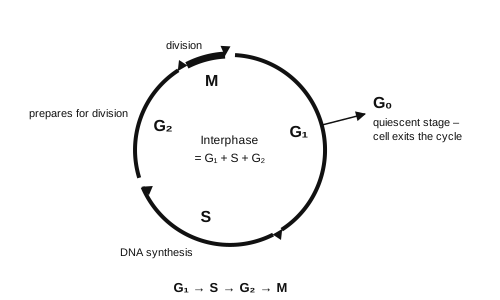
- G0 cells have exited the cell cycle → (A).
- (B) Entering the cycle is the opposite (G0 → G1 happens only on stimulation).
- (C) “Suspend” is not the NCERT description; (D) “terminate” implies the cell cycle ends/dies – G0 cells are alive and can re-enter.
Short trick: G0 = “Gone 0ut” of the cycle (e.g. heart muscle cells, neurons).
Answer: (A) exit the cell cycle
अवधारणा: NCERT: “वयस्क जंतुओं की कुछ कोशिकाएँ विभाजित होती प्रतीत नहीं होतीं … जो कोशिकाएँ आगे विभाजित नहीं होतीं वे G1 प्रावस्था से बाहर निकलकर कोशिका चक्र की एक निष्क्रिय अवस्था, प्रशांत अवस्था (G0), में प्रवेश करती हैं।” ऐसी कोशिकाएँ उपापचयी रूप से सक्रिय रहती हैं परंतु आवश्यकता पड़ने तक प्रचुरोद्भवन नहीं करतीं।
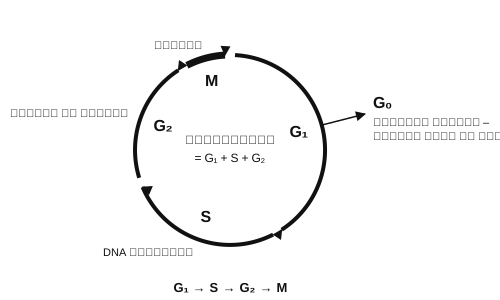
- G0 कोशिकाएँ कोशिका चक्र से बाहर निकल चुकी हैं → (A)।
- (B) चक्र में प्रवेश इसका उलटा है (G0 → G1 केवल उद्दीपन पर होता है)।
- (C) “स्थगित” NCERT का वर्णन नहीं है; (D) “समाप्त” का अर्थ है कोशिका चक्र का अंत/मृत्यु – G0 कोशिकाएँ जीवित रहती हैं और पुनः प्रवेश कर सकती हैं।
शॉर्ट ट्रिक: G0 = चक्र से “बाहर” (जैसे हृद पेशी कोशिकाएँ, तंत्रिका कोशिकाएँ)।
उत्तर: (A) कोशिका चक्र से बाहर निकल जाती है
NEET UGBiologyCell cycle – quiescent stage (G₀)NEET UG 2019 · 5 May Shift 1
Q1476.Which of the statements given below is not true about formation of Annual Rings in trees?
वृक्षों में वार्षिक वलयों (Annual Rings) के बनने के संबंध में नीचे दिए गए कथनों में से कौन-सा सत्य नहीं है?
- AAnnual ring is a combination of spring wood and autumn wood produced in a yearवार्षिक वलय एक वर्ष में उत्पन्न वसंत दारु (spring wood) और शरद दारु (autumn wood) का संयोजन है
- BDifferential activity of cambium causes light and dark bands of tissue early and late wood respectively.कैम्बियम की असमान सक्रियता के कारण क्रमशः अगेती (early) और पछेती (late) दारु के हल्के और गहरे ऊतक-पट्ट बनते हैं।
- CActivity of cambium depends upon variation in climate.कैम्बियम की सक्रियता जलवायु में परिवर्तन पर निर्भर करती है।
- DAnnual rings are not prominent in trees of temperate region.शीतोष्ण क्षेत्र के वृक्षों में वार्षिक वलय स्पष्ट नहीं होते।
Show answer
Concept: In temperate regions the climate changes sharply between seasons, so cambium is very active in spring (wide, light early wood) and less active in winter/autumn (narrow, dark late wood). One light + one dark band = one annual ring.
- (A) True – spring wood + autumn wood of one year form one ring.
- (B) True – early wood is light (wide vessels), late wood is dark (narrow, dense vessels).
- (C) True – cambial activity is regulated by climate (temperature, water).
- (D) Not true – annual rings are most prominent in temperate trees; it is in tropical trees (uniform climate all year) that rings are indistinct.
Short trick: Distinct seasons → distinct rings. Temperate = clear rings; tropical = faint rings. Counting rings = dendrochronology (age of tree).
Answer: (D) Annual rings are not prominent in trees of temperate region.
अवधारणा: शीतोष्ण क्षेत्रों में ऋतुओं के बीच जलवायु तीव्रता से बदलती है, इसलिए कैम्बियम वसंत में अधिक सक्रिय (चौड़ी, हल्की अगेती दारु) और शीत/शरद में कम सक्रिय (संकरी, गहरी पछेती दारु) रहता है। एक हल्का + एक गहरा पट्ट = एक वार्षिक वलय।
- (A) सत्य – एक वर्ष की वसंत दारु + शरद दारु मिलकर एक वलय बनाती हैं।
- (B) सत्य – अगेती दारु हल्की (चौड़ी वाहिकाएँ), पछेती दारु गहरी (संकरी, सघन वाहिकाएँ) होती है।
- (C) सत्य – कैम्बियम की सक्रियता जलवायु (ताप, जल) से नियंत्रित होती है।
- (D) असत्य – वार्षिक वलय शीतोष्ण वृक्षों में सबसे स्पष्ट होते हैं; उष्णकटिबंधीय वृक्षों (पूरे वर्ष समान जलवायु) में वलय अस्पष्ट होते हैं।
शॉर्ट ट्रिक: स्पष्ट ऋतुएँ → स्पष्ट वलय। शीतोष्ण = साफ वलय; उष्णकटिबंधीय = धुँधले वलय। वलयों की गिनती = डेंड्रोक्रोनोलॉजी (वृक्ष की आयु)।
उत्तर: (D) शीतोष्ण क्षेत्र के वृक्षों में वार्षिक वलय स्पष्ट नहीं होते।
NEET UGBiologyAnatomy of flowering plants – secondary growth, annual ringsNEET UG 2019 · 5 May Shift 1
Q1477.Which of the following ecological pyramids is generally inverted?
निम्नलिखित में से कौन-सा पारिस्थितिक पिरामिड सामान्यतः उल्टा (inverted) होता है?
- APyramid of numbers in grasslandघास-स्थल में संख्या का पिरामिड
- BPyramid of energyऊर्जा का पिरामिड
- CPyramid of biomass in a forestवन में जैवभार का पिरामिड
- DPyramid of biomass in a seaसमुद्र में जैवभार का पिरामिड
Show answer
Concept: In the sea, the biomass of phytoplankton at any instant (standing crop) is small but they multiply very fast, so it supports a larger biomass of zooplankton and fish – the pyramid of biomass is inverted.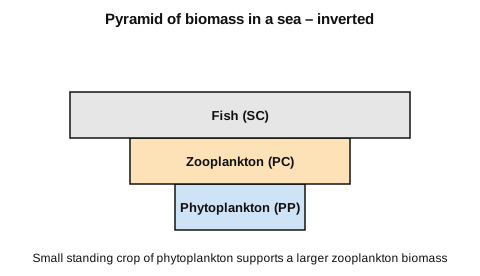
- (A) Grassland – many grasses → fewer herbivores → fewer carnivores: upright.
- (B) Pyramid of energy is always upright (10% law; energy is lost as heat at each level).
- (C) Forest biomass – huge tree biomass at base: upright.
- (D) Sea – small phytoplankton biomass, larger zooplankton/fish biomass: inverted.
Short trick: Energy pyramid – never inverted. Biomass inverted → "sea". Number inverted → "tree with insects / parasites".
Answer: (D) Pyramid of biomass in a sea
अवधारणा: समुद्र में किसी क्षण पादपप्लवकों (phytoplankton) का जैवभार (खड़ी फसल) कम होता है, पर वे बहुत तेज़ी से गुणन करते हैं, इसलिए वे प्राणिप्लवकों और मछलियों के अधिक जैवभार को सहारा देते हैं – जैवभार का पिरामिड उल्टा होता है।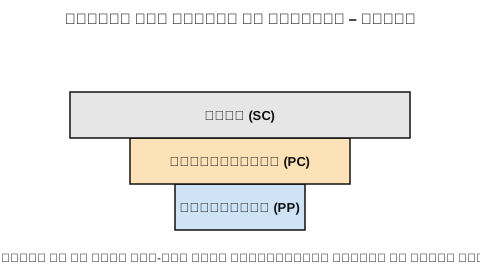
- (A) घास-स्थल – अनेक घासें → कम शाकाहारी → और कम मांसाहारी: सीधा।
- (B) ऊर्जा का पिरामिड सदैव सीधा होता है (10% नियम; प्रत्येक स्तर पर ऊर्जा ऊष्मा के रूप में नष्ट होती है)।
- (C) वन का जैवभार – आधार पर वृक्षों का विशाल जैवभार: सीधा।
- (D) समुद्र – पादपप्लवकों का कम जैवभार, प्राणिप्लवक/मछलियों का अधिक जैवभार: उल्टा।
शॉर्ट ट्रिक: ऊर्जा पिरामिड – कभी उल्टा नहीं। जैवभार उल्टा → "समुद्र"। संख्या उल्टी → "पेड़ पर कीट / परजीवी"।
उत्तर: (D) समुद्र में जैवभार का पिरामिड
NEET UGBiologyEcosystem – ecological pyramidsNEET UG 2019 · 5 May Shift 1
Q1478.Placentation in which ovules develop on the inner wall of the ovary or in peripheral part, is
वह बीजांडन्यास (placentation) जिसमें बीजांड अंडाशय की भीतरी भित्ति पर या परिधीय भाग में विकसित होते हैं, है
- ABasalआधारी (Basal)
- BAxileस्तंभीय (Axile)
- CParietalभित्तीय (Parietal)
- DFree centralमुक्त स्तंभीय (Free central)
Show answer
Concept: Placentation = arrangement of ovules inside the ovary. In parietal placentation the ovules are borne on the inner wall (periphery) of the ovary, e.g. mustard, Argemone.
- (A) Basal – single ovule at the base of a unilocular ovary (sunflower, marigold).
- (B) Axile – ovules on a central axis of a multilocular ovary (china rose, tomato, lemon).
- (C) Parietal – ovules on the inner wall/periphery ✔.
- (D) Free central – ovules on a central axis with no septa (Dianthus, primrose).
Short trick: "Parietal" = "wall" (paries = wall in Latin) → ovules on the wall.
Answer: (C) Parietal
अवधारणा: बीजांडन्यास = अंडाशय के भीतर बीजांडों की व्यवस्था। भित्तीय बीजांडन्यास में बीजांड अंडाशय की भीतरी भित्ति (परिधि) पर लगे होते हैं, जैसे सरसों, Argemone।
- (A) आधारी – एककोष्ठी अंडाशय के आधार पर एक बीजांड (सूरजमुखी, गेंदा)।
- (B) स्तंभीय – बहुकोष्ठी अंडाशय के केंद्रीय अक्ष पर बीजांड (गुड़हल, टमाटर, नींबू)।
- (C) भित्तीय – भीतरी भित्ति/परिधि पर बीजांड ✔।
- (D) मुक्त स्तंभीय – पट-रहित केंद्रीय अक्ष पर बीजांड (Dianthus, प्रिमरोज़)।
शॉर्ट ट्रिक: "Parietal" = "भित्ति" (लैटिन paries = दीवार) → बीजांड दीवार पर।
उत्तर: (C) भित्तीय (Parietal)
NEET UGBiologyMorphology of flowering plants – placentationNEET UG 2019 · 5 May Shift 1
Q1479.Which of the following protocols did aim for reducing emission of chlorofluorocarbons into the atmosphere?
निम्नलिखित में से किस प्रोटोकॉल का उद्देश्य वायुमंडल में क्लोरोफ्लोरोकार्बनों के उत्सर्जन को कम करना था?
- AMontreal Protocolमॉन्ट्रियल प्रोटोकॉल
- BKyto Protocolक्योटो प्रोटोकॉल
- CGothenburg Protocolगोथेनबर्ग प्रोटोकॉल
- DGeneva Protocolजिनेवा प्रोटोकॉल
Show answer
Concept: CFCs release Cl atoms in the stratosphere that destroy ozone. The Montreal Protocol (Canada, 1987; effective 1989) was signed to control emission of ozone-depleting substances such as CFCs.
- (A) Montreal – ozone-depleting substances (CFCs) ✔.
- (B) Kyoto (1997) – greenhouse gases / global warming.
- (C) Gothenburg (1999) – acidification, eutrophication and ground-level ozone (SO2, NOx, NH3).
- (D) Geneva Protocol (1925) – ban on chemical and biological weapons.
Short trick: "M" for Montreal = "M"inus ozone-killers (CFCs); "K" for Kyoto = "K"arbon (CO2, warming).
Answer: (A) Montreal Protocol
अवधारणा: CFC समताप मंडल में Cl परमाणु मुक्त करते हैं जो ओज़ोन को नष्ट करते हैं। ओज़ोन-क्षयकारी पदार्थों (जैसे CFC) के उत्सर्जन को नियंत्रित करने हेतु मॉन्ट्रियल प्रोटोकॉल (कनाडा, 1987; 1989 से प्रभावी) पर हस्ताक्षर किए गए।
- (A) मॉन्ट्रियल – ओज़ोन-क्षयकारी पदार्थ (CFC) ✔।
- (B) क्योटो (1997) – ग्रीनहाउस गैसें / वैश्विक तापन।
- (C) गोथेनबर्ग (1999) – अम्लीकरण, सुपोषण और भू-स्तरीय ओज़ोन (SO2, NOx, NH3)।
- (D) जिनेवा प्रोटोकॉल (1925) – रासायनिक एवं जैविक हथियारों पर प्रतिबंध।
शॉर्ट ट्रिक: Montreal का "M" = ओज़ोन-घातक (CFC) "माइनस"; Kyoto का "K" = "कार्बन" (CO2, तापन)।
उत्तर: (A) मॉन्ट्रियल प्रोटोकॉल
NEET UGBiologyEnvironmental issues – ozone depletionNEET UG 2019 · 5 May Shift 1
Q1480.Which of the following contraceptive methods do involve a role of hormone?
निम्नलिखित में से किन गर्भनिरोधक विधियों में हॉर्मोन की भूमिका होती है?
- ALactational amenorrhea, Pills Emergency contraceptives.दुग्धस्रावी अनार्तव (Lactational amenorrhea), गोलियाँ, आपातकालीन गर्भनिरोधक।
- BBarrier method, Lactational amenorrhea, Pills.रोध (Barrier) विधि, दुग्धस्रावी अनार्तव, गोलियाँ।
- CCuT, Pills, Emergency contraceptives.CuT, गोलियाँ, आपातकालीन गर्भनिरोधक।
- DPills, Emergency contraceptives, Barrier methods.गोलियाँ, आपातकालीन गर्भनिरोधक, रोध विधियाँ।
Show answer
Concept: Pick the set in which every method acts through hormones.
- Lactational amenorrhea – high prolactin during intense breast-feeding suppresses GnRH/LH, so ovulation does not occur → hormonal.
- Pills – progestogen/progestogen–oestrogen; emergency contraceptives – high-dose progestogens (within 72 h) → hormonal.
- Barrier methods (condom, diaphragm, cervical cap, vault) – only a physical block → no hormone; so (B) and (D) fail.
- CuT – Cu ions suppress sperm motility and fertilising capacity (non-hormonal IUD) → (C) fails.
- Only (A) has all three hormonal.
Short trick: Strike out any option containing "Barrier" or "Cu" – they are purely mechanical/chemical; what remains is the answer.
Answer: (A) Lactational amenorrhea, Pills Emergency contraceptives.
अवधारणा: वह समूह चुनिए जिसमें प्रत्येक विधि हॉर्मोन के माध्यम से कार्य करती है।
- दुग्धस्रावी अनार्तव – गहन स्तनपान के दौरान उच्च प्रोलैक्टिन GnRH/LH को दबाता है, अतः अंडोत्सर्ग नहीं होता → हॉर्मोनी।
- गोलियाँ – प्रोजेस्टोजन/प्रोजेस्टोजन–एस्ट्रोजन; आपातकालीन गर्भनिरोधक – उच्च मात्रा प्रोजेस्टोजन (72 घंटे के भीतर) → हॉर्मोनी।
- रोध विधियाँ (कंडोम, डायाफ्राम, गर्भाशय-ग्रीवा टोपी, वॉल्ट) – केवल भौतिक अवरोध → कोई हॉर्मोन नहीं; अतः (B) और (D) गलत।
- CuT – Cu आयन शुक्राणु की गतिशीलता और निषेचन क्षमता घटाते हैं (गैर-हॉर्मोनी IUD) → (C) गलत।
- केवल (A) में तीनों हॉर्मोनी हैं।
शॉर्ट ट्रिक: "रोध" या "Cu" वाला कोई भी विकल्प काट दीजिए – वे केवल यांत्रिक/रासायनिक हैं; जो बचे वही उत्तर।
उत्तर: (A) दुग्धस्रावी अनार्तव (Lactational amenorrhea), गोलियाँ, आपातकालीन गर्भनिरोधक।
NEET UGBiologyReproductive health – contraceptive methodsNEET UG 2019 · 5 May Shift 1

