NEET UG · 2,240 questions

NEET UG 2015, 2016, 2017, 2018, 2019, 2020, 2021, 2022, 2023, 2024, 2025, 2026 PYQs

Real previous year questions, subject-wise. Try the question, then open the answer and the explanation in Hindi & English – free, no login.

Courses – airGurukul

2,240 questions.

Q1861.
Artificial selection to obtain cows yielding higher milk output represents
अधिक दूध देने वाली गायें प्राप्त करने हेतु कृत्रिम वरण किसे निरूपित करता है?
  1. AStabilizing selection as it stabilizes this character in the populationस्थायीकारी वरण, क्योंकि यह समष्टि में इस लक्षण को स्थिर करता है
  2. BDirectional as it pushes the mean of the character in one directionदिशात्मक, क्योंकि यह लक्षण के माध्य को एक दिशा में धकेलता है
  3. CDisruptive as it splits the population into two one yielding higher output and the other lower outputविदारक, क्योंकि यह समष्टि को दो भागों में बाँटता है – एक अधिक उत्पादन वाला और दूसरा कम उत्पादन वाला
  4. DStabilizing followed by disruptive as it stabilizes the population to produce higher yielding cowsस्थायीकारी के बाद विदारक, क्योंकि यह समष्टि को अधिक उपज वाली गायें उत्पन्न करने हेतु स्थिर करता है
Show answer

Concept: In selection, the distribution curve of a trait shifts depending on which individuals are favoured. Breeders always pick the highest-yielding cows, so the population mean moves towards higher milk yield – directional selection.
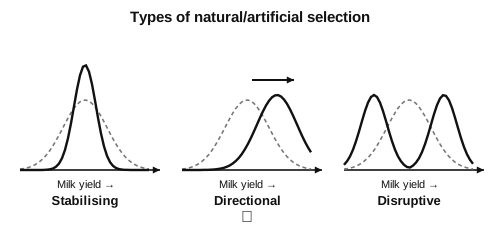
  1. (B) ✔ One extreme (high yield) favoured → peak shifts in one direction.
  2. (A) ✘ Stabilising favours the mean value and narrows the curve.
  3. (C) ✘ Disruptive favours both extremes giving two peaks – breeders do not keep low-yielders.
  4. (D) ✘ No such combined process is involved.

Short trick: Ask “which individuals are kept?” – only one end → directional; middle → stabilising; both ends → disruptive.

Answer: (B) Directional

अवधारणा: वरण में, किन जीवों को वरीयता मिलती है इसके अनुसार लक्षण का वितरण वक्र खिसकता है। प्रजनक सदैव सबसे अधिक दूध देने वाली गायें चुनते हैं, अतः समष्टि का माध्य अधिक दूध-उत्पादन की ओर बढ़ता है – दिशात्मक वरण।
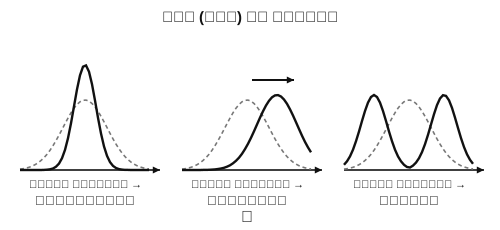
  1. (B) ✔ एक छोर (अधिक उत्पादन) को वरीयता → शिखर एक दिशा में खिसकता है।
  2. (A) ✘ स्थायीकारी वरण माध्य मान को वरीयता देता है और वक्र को संकरा करता है।
  3. (C) ✘ विदारक वरण दोनों छोरों को वरीयता देकर दो शिखर बनाता है – प्रजनक कम उत्पादन वाली गायें नहीं रखते।
  4. (D) ✘ ऐसी कोई संयुक्त प्रक्रिया शामिल नहीं है।

शॉर्ट ट्रिक: पूछें “कौन-से जीव रखे गए?” – केवल एक छोर → दिशात्मक; मध्य → स्थायीकारी; दोनों छोर → विदारक।

उत्तर: (B) दिशात्मक
NEET UGBiologyEvolution – types of selectionNEET UG 2017 · 7 May Shift 1
Q1862.
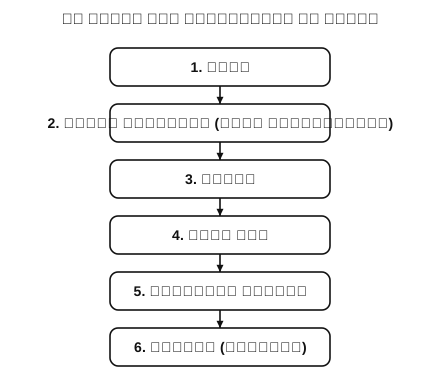
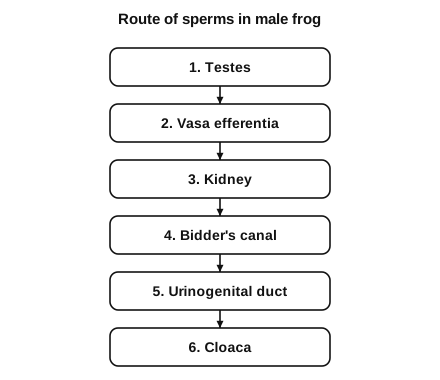
Select the correct route for the passage of sperms in male frogs :
नर मेंढकों में शुक्राणुओं के मार्ग का सही क्रम चुनिए :
  1. ATestes → Bidder's canal → Kidney → Vasa efferentia → Urinogenital duct → Cloacaवृषण → बिडर नाल → वृक्क → शुक्र वाहिकाएँ → मूत्रजनन वाहिनी → अवस्कर
  2. BTestes → Vasa efferentia → Kidney → Seminal Vesicle → Urinogenital duct → Cloacaवृषण → शुक्र वाहिकाएँ → वृक्क → शुक्राशय → मूत्रजनन वाहिनी → अवस्कर
  3. CTestes → Vasa efferentia → Bidder's canal → Ureter → Cloacaवृषण → शुक्र वाहिकाएँ → बिडर नाल → मूत्रवाहिनी → अवस्कर
  4. DTestes → Vasa efferentia → Kidney → Bidder's canal → Urinogenital duct → Cloacaवृषण → शुक्र वाहिकाएँ → वृक्क → बिडर नाल → मूत्रजनन वाहिनी → अवस्कर
Show answer

Concept: NCERT: in male frog, 10–12 vasa efferentia arise from each testis, enter the kidney on their side and open into Bidder’s canal, which communicates with the urinogenital duct; this opens into the cloaca.

  1. (D) ✔ Testes → vasa efferentia → kidney → Bidder’s canal → urinogenital duct → cloaca.
  2. (A) ✘ Bidder’s canal is inside the kidney – sperms cannot reach it before vasa efferentia.
  3. (B) ✘ Leaves out Bidder’s canal and puts the seminal vesicle before the urinogenital duct.
  4. (C) ✘ Skips the kidney; in male frog the ureter itself acts as urinogenital duct.

Short trick: Order “T-V-K-B-U-C”: The Very Keen Boy Uses Cloaca.

Answer: (D)

अवधारणा: NCERT: नर मेंढक में प्रत्येक वृषण से 10–12 शुक्र वाहिकाएँ निकलकर अपनी ओर के वृक्क में प्रवेश करती हैं और बिडर नाल में खुलती हैं, जो मूत्रजनन वाहिनी से जुड़ी होती है; यह वाहिनी अवस्कर में खुलती है।

  1. (D) ✔ वृषण → शुक्र वाहिकाएँ → वृक्क → बिडर नाल → मूत्रजनन वाहिनी → अवस्कर।
  2. (A) ✘ बिडर नाल वृक्क के अंदर होती है – शुक्राणु शुक्र वाहिकाओं से पहले वहाँ नहीं पहुँच सकते।
  3. (B) ✘ इसमें बिडर नाल नहीं है और शुक्राशय को मूत्रजनन वाहिनी से पहले रखा गया है।
  4. (C) ✘ वृक्क छोड़ दिया गया है; नर मेंढक में मूत्रवाहिनी स्वयं मूत्रजनन वाहिनी का कार्य करती है।

शॉर्ट ट्रिक: क्रम “T-V-K-B-U-C” (Testes-Vasa-Kidney-Bidder-UG duct-Cloaca): “The Very Keen Boy Uses Cloaca”।

उत्तर: (D)

NEET UGBiologyStructural organisation in animals – frog reproductive systemNEET UG 2017 · 7 May Shift 1
Q1863.
Which of the following options best represents the enzyme composition of pancreatic juice?
निम्नलिखित में से कौन-सा विकल्प अग्न्याशयी रस के एंज़ाइम संघटन को सर्वोत्तम रूप से दर्शाता है?
  1. AAmylase, peptidase, trypsinogen, renninऐमाइलेज़, पेप्टिडेज़, ट्रिप्सिनोजन, रेनिन
  2. BAmylase, pepsin, trypsinogen, maltaseऐमाइलेज़, पेप्सिन, ट्रिप्सिनोजन, माल्टेज़
  3. CPeptidase, amylase, pepsin, renninपेप्टिडेज़, ऐमाइलेज़, पेप्सिन, रेनिन
  4. DLipase, amylase, trypsinogen, procarboxypeptidaseलाइपेज़, ऐमाइलेज़, ट्रिप्सिनोजन, प्रोकार्बोक्सीपेप्टिडेज़
Show answer

Concept: NCERT: pancreatic juice contains inactive trypsinogen, chymotrypsinogen, procarboxypeptidases, and amylases, lipases and nucleases.

  1. (D) ✔ Lipase, amylase, trypsinogen, procarboxypeptidase – all pancreatic.
  2. (A), (C) ✘ Rennin is a gastric enzyme (infants).
  3. (B), (C) ✘ Pepsin is a gastric enzyme.
  4. (B) ✘ Maltase is an intestinal (brush-border/succus entericus) enzyme.

Short trick: Strike out stomach words (pepsin, rennin) and intestine words (maltase) – only (D) survives.

Answer: (D) Lipase, amylase, trypsinogen, procarboxypeptidase

अवधारणा: NCERT: अग्न्याशयी रस में निष्क्रिय ट्रिप्सिनोजन, काइमोट्रिप्सिनोजन, प्रोकार्बोक्सीपेप्टिडेज़ तथा ऐमाइलेज़, लाइपेज़ और न्यूक्लिएज़ होते हैं।

  1. (D) ✔ लाइपेज़, ऐमाइलेज़, ट्रिप्सिनोजन, प्रोकार्बोक्सीपेप्टिडेज़ – सभी अग्न्याशयी।
  2. (A), (C) ✘ रेनिन जठर एंज़ाइम है (शिशुओं में)।
  3. (B), (C) ✘ पेप्सिन जठर एंज़ाइम है।
  4. (B) ✘ माल्टेज़ आंत्र (ब्रश-बॉर्डर/आंत्र रस) एंज़ाइम है।

शॉर्ट ट्रिक: आमाशय वाले शब्द (पेप्सिन, रेनिन) और आंत्र वाले शब्द (माल्टेज़) काट दें – केवल (D) बचता है।

उत्तर: (D) लाइपेज़, ऐमाइलेज़, ट्रिप्सिनोजन, प्रोकार्बोक्सीपेप्टिडेज़

NEET UGBiologyDigestion and absorption – pancreatic juiceNEET UG 2017 · 7 May Shift 1
Q1864.
Phosphoenol pyruvate (PEP) is the primary CO2 acceptor in :
फॉस्फोईनोल पाइरुवेट (PEP) किसमें प्राथमिक CO2 ग्राही है?
  1. AC3 plantsC3 पादप
  2. BC4 plantsC4 पादप
  3. CC2 plantsC2 पादप
  4. DC3 and C4 plantsC3 तथा C4 पादप
Show answer

Concept: In C4 (Hatch–Slack) plants, PEP (3C) in mesophyll cells accepts CO2 through PEP carboxylase to form oxaloacetic acid (4C) – the first stable product.

  1. (B) ✔ C4 plants (maize, sugarcane, Sorghum) – PEP is the primary acceptor.
  2. (A) ✘ C3 plants: primary acceptor is RuBP (5C), enzyme RuBisCO.
  3. (C) ✘ “C2” refers to the photorespiratory pathway, not a CO2-fixing type with PEP.
  4. (D) ✘ C3 plants do not use PEP as primary acceptor (in C4 plants RuBP is the secondary acceptor in bundle sheath).

Short trick: PEP → OAA (4C) → hence the name “C4”. RuBP → PGA (3C) → “C3”.

Answer: (B) C4 plants

अवधारणा: C4 (हैच–स्लैक) पादपों में पर्णमध्योतक कोशिकाओं का PEP (3C), PEP कार्बोक्सिलेज़ द्वारा CO2 ग्रहण कर ऑक्सैलोऐसीटिक अम्ल (4C) बनाता है – पहला स्थायी उत्पाद।

  1. (B) ✔ C4 पादप (मक्का, गन्ना, Sorghum) – PEP प्राथमिक ग्राही है।
  2. (A) ✘ C3 पादप: प्राथमिक ग्राही RuBP (5C), एंज़ाइम RuBisCO।
  3. (C) ✘ “C2” प्रकाश-श्वसन पथ को कहते हैं, PEP द्वारा CO2 स्थिरीकरण का प्रकार नहीं।
  4. (D) ✘ C3 पादप PEP को प्राथमिक ग्राही के रूप में प्रयोग नहीं करते (C4 पादपों में पूलाच्छद में RuBP द्वितीयक ग्राही है)।

शॉर्ट ट्रिक: PEP → OAA (4C) → इसलिए नाम “C4”। RuBP → PGA (3C) → “C3”।

उत्तर: (B) C4 पादप

NEET UGBiologyPhotosynthesis – C4 pathwayNEET UG 2017 · 7 May Shift 1
Q1865.
The morphological nature of the edible part of coconut is
नारियल के खाद्य भाग की आकारिकीय प्रकृति है
  1. APerispermपरिभ्रूणपोष (Perisperm)
  2. BCotyledonबीजपत्र
  3. CEndospermभ्रूणपोष
  4. DPericarpफलभित्ति (Pericarp)
Show answer

Concept: NCERT: the coconut water (tender coconut) is free-nuclear endosperm made of thousands of nuclei, and the surrounding white kernel is cellular endosperm – both are endosperm.

  1. (C) ✔ Edible white kernel + coconut water = endosperm.
  2. (A) ✘ Perisperm (persistent nucellus) occurs in black pepper and beet.
  3. (B) ✘ The cotyledon is a tiny part of the small embryo.
  4. (D) ✘ Pericarp forms the fibrous husk/hard shell (inedible).

Short trick: Coconut = “double endosperm”: liquid (free-nuclear) + solid (cellular).

Answer: (C) Endosperm

अवधारणा: NCERT: नारियल पानी (कच्चा नारियल) हज़ारों केन्द्रकों से बना मुक्त-केन्द्रकी भ्रूणपोष है और चारों ओर का सफ़ेद गूदा कोशिकीय भ्रूणपोष है – दोनों भ्रूणपोष हैं।

  1. (C) ✔ खाने योग्य सफ़ेद गिरी + नारियल पानी = भ्रूणपोष।
  2. (A) ✘ परिभ्रूणपोष (शेष रह गया बीजांडकाय) काली मिर्च और चुकंदर में होता है।
  3. (B) ✘ बीजपत्र छोटे भ्रूण का अति सूक्ष्म भाग है।
  4. (D) ✘ फलभित्ति रेशेदार छिलका/कठोर खोल बनाती है (अखाद्य)।

शॉर्ट ट्रिक: नारियल = “दोहरा भ्रूणपोष”: द्रव (मुक्त-केन्द्रकी) + ठोस (कोशिकीय)।

उत्तर: (C) भ्रूणपोष

NEET UGBiologySexual reproduction in flowering plants – endospermNEET UG 2017 · 7 May Shift 1
Q1866.
Anaphase promoting complex (APC) is a protein degradation machinery necessary for proper mitosis of animal cells. If APC is defective in a human cell, which of the following is expected to occur?
पश्चावस्था प्रवर्तक संकुल (APC) एक प्रोटीन-निम्नीकरण तंत्र है जो जंतु कोशिकाओं के समुचित समसूत्री विभाजन के लिए आवश्यक है। यदि किसी मानव कोशिका में APC दोषपूर्ण हो, तो निम्नलिखित में से क्या होने की संभावना है?
  1. AChromosomes will not condenseगुणसूत्र संघनित नहीं होंगे
  2. BChromosomes will be fragmentedगुणसूत्र खंडित हो जाएँगे
  3. CChromosomes will not segregateगुणसूत्र पृथक नहीं होंगे
  4. DRecombination of chromosome arms will occurगुणसूत्र भुजाओं का पुनर्योजन होगा
Show answer

Concept: APC (an ubiquitin ligase) degrades securin, releasing separase which cleaves cohesin holding sister chromatids together. This triggers anaphase – splitting of centromeres and movement of chromatids to opposite poles.

  1. Defective APC → cohesin not cleaved → sister chromatids stay joined → no segregation (cell arrested at metaphase).
  2. (A) ✘ Condensation occurs in prophase – before APC acts.
  3. (B) ✘ APC degrades proteins, not DNA; no fragmentation.
  4. (D) ✘ Recombination (crossing over) is a meiotic prophase-I event.

Short trick: The name says it: “Anaphase-Promoting” – no APC, no anaphase, no separation.

Answer: (C) Chromosomes will not segregate

अवधारणा: APC (एक यूबिक्विटिन लाइगेज़) सिक्योरिन का निम्नीकरण करता है, जिससे सेपरेज़ मुक्त होकर संतति अर्धगुणसूत्रों को जोड़े रखने वाले कोहेसिन को काटता है। इससे पश्चावस्था आरम्भ होती है – गुणसूत्रबिंदु विभाजित होते हैं और अर्धगुणसूत्र विपरीत ध्रुवों पर जाते हैं।

  1. दोषपूर्ण APC → कोहेसिन नहीं कटता → संतति अर्धगुणसूत्र जुड़े रहते हैं → पृथक्करण नहीं (कोशिका मध्यावस्था में रुक जाती है)।
  2. (A) ✘ संघनन पूर्वावस्था में होता है – APC की क्रिया से पहले।
  3. (B) ✘ APC प्रोटीन का निम्नीकरण करता है, DNA का नहीं; खंडन नहीं होगा।
  4. (D) ✘ पुनर्योजन (जीन-विनिमय) अर्धसूत्री पूर्वावस्था-I की घटना है।

शॉर्ट ट्रिक: नाम ही बताता है: “पश्चावस्था-प्रवर्तक” – APC नहीं तो पश्चावस्था नहीं, पृथक्करण नहीं।

उत्तर: (C) गुणसूत्र पृथक नहीं होंगे

NEET UGBiologyCell cycle and cell division – anaphaseNEET UG 2017 · 7 May Shift 1
Q1867.
MALT constitutes about ___________ percent of the lymphoid tissue in human body.
MALT मानव शरीर के लसीकाभ ऊतक का लगभग ___________ प्रतिशत होता है।
  1. A50%
  2. B20%
  3. C70%
  4. D10%
Show answer

Concept: NCERT: lymphoid tissue located within the lining of the major tracts (respiratory, digestive and urogenital) is called mucosa-associated lymphoid tissue (MALT); it constitutes about 50 percent of the lymphoid tissue in the human body.

  1. (A) ✔ About 50%.
  2. (B), (C), (D) ✘ Not the NCERT value.

Short trick: MALT = “Mucosa” = half the body’s defence lines up at the mucous linings → 50%.

Answer: (A) 50%

अवधारणा: NCERT: प्रमुख पथों (श्वसन, पाचन तथा मूत्रजनन) के आस्तर में स्थित लसीकाभ ऊतक को श्लेष्मा-संबद्ध लसीकाभ ऊतक (MALT) कहते हैं; यह मानव शरीर के लसीकाभ ऊतक का लगभग 50 प्रतिशत होता है।

  1. (A) ✔ लगभग 50%।
  2. (B), (C), (D) ✘ NCERT का मान नहीं।

शॉर्ट ट्रिक: MALT = “श्लेष्मा” = शरीर की आधी रक्षा-पंक्ति श्लेष्मा आस्तरों पर → 50%।

उत्तर: (A) 50%

NEET UGBiologyHuman health and disease – lymphoid organsNEET UG 2017 · 7 May Shift 1
Q1868.
Receptor sites for neurotransmitters are present on
तंत्रिकाप्रेषकों (neurotransmitters) के ग्राही स्थल किस पर उपस्थित होते हैं?
  1. AMembranes of synaptic vesiclesसिनैप्टिक आशयों की झिल्लियों पर
  2. BPre-synaptic membraneपूर्व-सिनैप्टिक झिल्ली पर
  3. CTips of axonsतंत्रिकाक्षों (axons) के सिरों पर
  4. DPost-synaptic membraneपश्च-सिनैप्टिक झिल्ली पर
Show answer

Concept: At a chemical synapse, synaptic vesicles in the axon terminal release neurotransmitter into the cleft; it binds to specific receptors on the post-synaptic membrane, opening ion channels and generating a new potential.

  1. (D) ✔ Receptors lie on the post-synaptic membrane.
  2. (A) ✘ Vesicle membranes store/release the transmitter – no receptors for binding.
  3. (B) ✘ Pre-synaptic membrane releases the transmitter by exocytosis.
  4. (C) ✘ Axon tips (terminals) are the releasing side.

Short trick: Sender = pre-synaptic (releases); Receiver = post-synaptic (receptors).

Answer: (D) Post-synaptic membrane

अवधारणा: रासायनिक सिनैप्स पर तंत्रिकाक्ष सिरे के सिनैप्टिक आशय तंत्रिकाप्रेषक को दरार (cleft) में मुक्त करते हैं; यह पश्च-सिनैप्टिक झिल्ली के विशिष्ट ग्राहियों से जुड़ता है, आयन चैनल खोलता है और नया विभव उत्पन्न करता है।

  1. (D) ✔ ग्राही पश्च-सिनैप्टिक झिल्ली पर होते हैं।
  2. (A) ✘ आशय झिल्लियाँ प्रेषक का संग्रह/मोचन करती हैं – बंधन हेतु ग्राही नहीं।
  3. (B) ✘ पूर्व-सिनैप्टिक झिल्ली बहिःकोशिकता द्वारा प्रेषक मुक्त करती है।
  4. (C) ✘ तंत्रिकाक्ष सिरे (टर्मिनल) मोचन करने वाला भाग हैं।

शॉर्ट ट्रिक: प्रेषक = पूर्व-सिनैप्टिक (मुक्त करता है); प्राप्तकर्ता = पश्च-सिनैप्टिक (ग्राही)।

उत्तर: (D) पश्च-सिनैप्टिक झिल्ली

NEET UGBiologyNeural control – synapseNEET UG 2017 · 7 May Shift 1
Q1869.
Hypersecretion of Growth Hormone in adults does not cause further increase in height, because
वयस्कों में वृद्धि हॉर्मोन का अतिस्रावण लंबाई में और वृद्धि नहीं करता, क्योंकि
  1. AGrowth Hormone becomes inactive in adultsवयस्कों में वृद्धि हॉर्मोन निष्क्रिय हो जाता है
  2. BEpiphyseal plates close after adolescenceकिशोरावस्था के बाद एपिफ़ाइसियल प्लेटें बंद हो जाती हैं
  3. CBones loose their sensitivity to Growth Hormone in adultsवयस्कों में अस्थियाँ वृद्धि हॉर्मोन के प्रति संवेदनशीलता खो देती हैं
  4. DMuscle fibres do not grow in size after birthजन्म के बाद पेशी तंतुओं के आकार में वृद्धि नहीं होती
Show answer

Concept: Long bones grow in length at the cartilaginous epiphyseal (growth) plates. After adolescence these plates ossify and fuse, so excess GH can no longer lengthen bones; instead it thickens bones of face, hands and feet – acromegaly.

  1. (B) ✔ Closed epiphyseal plates → no further gain in height.
  2. (A) ✘ GH remains active in adults (metabolism, acromegaly proves its action).
  3. (C) ✘ Bones still respond – they thicken (acromegaly).
  4. (D) ✘ Muscle fibres do enlarge after birth (hypertrophy).

Short trick: Child + excess GH = gigantism (plates open); Adult + excess GH = acromegaly (plates closed).

Answer: (B) Epiphyseal plates close after adolescence

अवधारणा: लंबी अस्थियाँ उपास्थिमय एपिफ़ाइसियल (वृद्धि) प्लेटों पर लंबाई में बढ़ती हैं। किशोरावस्था के बाद ये प्लेटें अस्थिभूत होकर जुड़ जाती हैं, अतः अतिरिक्त GH अस्थियों को लंबा नहीं कर पाता; बल्कि चेहरे, हाथ और पैर की अस्थियाँ मोटी हो जाती हैं – ऐक्रोमेगेली।

  1. (B) ✔ बंद एपिफ़ाइसियल प्लेटें → लंबाई में और वृद्धि नहीं।
  2. (A) ✘ वयस्कों में भी GH सक्रिय रहता है (उपापचय; ऐक्रोमेगेली इसकी क्रिया का प्रमाण है)।
  3. (C) ✘ अस्थियाँ अब भी प्रतिक्रिया करती हैं – मोटी हो जाती हैं (ऐक्रोमेगेली)।
  4. (D) ✘ जन्म के बाद पेशी तंतु बड़े होते हैं (अतिवृद्धि)।

शॉर्ट ट्रिक: बच्चा + अधिक GH = महाकायता (प्लेटें खुली); वयस्क + अधिक GH = ऐक्रोमेगेली (प्लेटें बंद)।

उत्तर: (B) किशोरावस्था के बाद एपिफ़ाइसियल प्लेटें बंद हो जाती हैं

NEET UGBiologyChemical coordination – growth hormoneNEET UG 2017 · 7 May Shift 1
Q1870.
Alexander Von Humbolt described for the first time
अलेक्ज़ेंडर वॉन हम्बोल्ट ने पहली बार किसका वर्णन किया?
  1. AEcological Biodiversityपारिस्थितिक जैव विविधता
  2. BLaws of limiting factorसीमाकारी कारक के नियम
  3. CSpecies area relationshipsजाति-क्षेत्र संबंध
  4. DPopulation Growth equationसमष्टि वृद्धि समीकरण
Show answer

Concept: During his explorations in the wilds of South America, Alexander von Humboldt observed that within a region species richness increased with increasing explored area, but only up to a limit – the species–area relationship (log S = log C + Z log A).

  1. (C) ✔ Species–area relationship.
  2. (A) ✘ Not a specific Humboldt law.
  3. (B) ✘ Law of limiting factors – Blackman (1905).
  4. (D) ✘ Population growth equations – Verhulst–Pearl (logistic) / Malthus.

Short trick: Humboldt → “Hum (S) and Area (A)” – S = CAZ, rectangular hyperbola; on log scale a straight line.

Answer: (C) Species area relationships

अवधारणा: दक्षिण अमेरिका के वनों में अपने अन्वेषण के दौरान अलेक्ज़ेंडर वॉन हम्बोल्ट ने देखा कि किसी क्षेत्र में अन्वेषित क्षेत्रफल बढ़ने के साथ जाति-समृद्धि एक सीमा तक बढ़ती है – जाति–क्षेत्र संबंध (log S = log C + Z log A)।

  1. (C) ✔ जाति–क्षेत्र संबंध।
  2. (A) ✘ हम्बोल्ट का कोई विशिष्ट नियम नहीं।
  3. (B) ✘ सीमाकारी कारकों का नियम – ब्लैकमैन (1905)।
  4. (D) ✘ समष्टि वृद्धि समीकरण – वरहुल्स्ट–पर्ल (लॉजिस्टिक) / माल्थस।

शॉर्ट ट्रिक: हम्बोल्ट → “जाति (S) और क्षेत्र (A)” – S = CAZ, आयताकार अतिपरवलय; लघुगणकीय पैमाने पर सीधी रेखा।

उत्तर: (C) जाति-क्षेत्र संबंध

NEET UGBiologyBiodiversity – species–area relationshipNEET UG 2017 · 7 May Shift 1
Q1871.
Myelin sheath is produced by
माइलिन आच्छद (sheath) किसके द्वारा बनाया जाता है?
  1. ASchwann Cells and Oligodendrocytesश्वान कोशिकाएँ तथा ऑलिगोडेंड्रोसाइट
  2. BAstrocytes and Schwann Cellsऐस्ट्रोसाइट तथा श्वान कोशिकाएँ
  3. COligodendrocytes and Osteoclastsऑलिगोडेंड्रोसाइट तथा ऑस्टियोक्लास्ट
  4. DOsteoclasts and Astrocytesऑस्टियोक्लास्ट तथा ऐस्ट्रोसाइट
Show answer

Concept: Myelin is formed by glial cells wrapping around axons: Schwann cells in the peripheral nervous system and oligodendrocytes in the CNS.

  1. (A) ✔ Schwann cells (PNS) + oligodendrocytes (CNS).
  2. (B), (D) ✘ Astrocytes support neurons and form the blood–brain barrier; they do not make myelin.
  3. (C), (D) ✘ Osteoclasts are bone-resorbing cells – not nervous tissue at all.

Short trick: Eliminate “osteo-” (bone) and “astro-” (star-shaped support) – only (A) remains.

Answer: (A) Schwann Cells and Oligodendrocytes

अवधारणा: माइलिन तंत्रिकाक्षों के चारों ओर लिपटने वाली ग्लियल कोशिकाओं द्वारा बनता है: परिधीय तंत्रिका तंत्र में श्वान कोशिकाएँ और केन्द्रीय तंत्रिका तंत्र (CNS) में ऑलिगोडेंड्रोसाइट।

  1. (A) ✔ श्वान कोशिकाएँ (PNS) + ऑलिगोडेंड्रोसाइट (CNS)।
  2. (B), (D) ✘ ऐस्ट्रोसाइट तंत्रिकोशिकाओं को सहारा देते हैं और रक्त–मस्तिष्क अवरोध बनाते हैं; माइलिन नहीं बनाते।
  3. (C), (D) ✘ ऑस्टियोक्लास्ट अस्थि-अवशोषी कोशिकाएँ हैं – तंत्रिका ऊतक ही नहीं।

शॉर्ट ट्रिक: “ऑस्टियो-” (अस्थि) और “ऐस्ट्रो-” (तारक-आकार सहायक) हटाएँ – केवल (A) बचता है।

उत्तर: (A) श्वान कोशिकाएँ तथा ऑलिगोडेंड्रोसाइट

NEET UGBiologyNeural control – neuroglia and myelinNEET UG 2017 · 7 May Shift 1
Q1872.
In case of a couple where the male is having a very low sperm count, which technique will be suitable for fertilisation?
किसी दंपति में जहाँ पुरुष का शुक्राणु-गणन (sperm count) बहुत कम है, निषेचन के लिए कौन-सी तकनीक उपयुक्त होगी?
  1. AIntrauterine transferअंतर्गर्भाशयी स्थानांतरण (IUT)
  2. BGamete intracytoplasmic fallopian transferयुग्मक अंतःकोशिकाद्रव्यी फैलोपियन स्थानांतरण
  3. CArtificial Inseminationकृत्रिम वीर्यसेचन (AI)
  4. DIntracytoplasmic sperm injectionअंतःकोशिकाद्रव्यी शुक्राणु इंजेक्शन (ICSI)
Show answer

Concept: NCERT: infertility cases due to inability of the male partner to inseminate the female or due to very low sperm counts in the ejaculates could be corrected by artificial insemination (AI) – semen from the husband or a healthy donor is introduced into the vagina or uterus (IUI).

  1. (C) ✔ Artificial insemination – the exact NCERT remedy for low sperm count.
  2. (A) ✘ IUT transfers an embryo with more than 8 blastomeres into the uterus – used after IVF.
  3. (B) ✘ “Gamete intracytoplasmic fallopian transfer” is not a real technique (it mixes GIFT and ICSI). GIFT is for females who cannot produce ova.
  4. (D) ✘ ICSI injects a sperm directly into the ovum in the laboratory; NCERT links low sperm count specifically to AI.

Short trick: Learn the NCERT pairing: “Low sperm count / cannot inseminate → AI (IUI)”; “cannot produce ovum → GIFT”.

Answer: (C) Artificial Insemination

अवधारणा: NCERT: पुरुष साथी द्वारा स्त्री में वीर्यसेचन न कर पाने अथवा स्खलित वीर्य में शुक्राणुओं की बहुत कम संख्या के कारण होने वाली बंध्यता को कृत्रिम वीर्यसेचन (AI) द्वारा ठीक किया जा सकता है – पति या स्वस्थ दाता का वीर्य योनि या गर्भाशय (IUI) में प्रविष्ट कराया जाता है।

  1. (C) ✔ कृत्रिम वीर्यसेचन – कम शुक्राणु-गणन का NCERT में बताया गया उपचार।
  2. (A) ✘ IUT में 8 से अधिक कोरकखंडों वाला भ्रूण गर्भाशय में स्थानांतरित किया जाता है – IVF के बाद।
  3. (B) ✘ “युग्मक अंतःकोशिकाद्रव्यी फैलोपियन स्थानांतरण” कोई वास्तविक तकनीक नहीं (GIFT और ICSI का मिश्रण)। GIFT उन स्त्रियों के लिए है जो अंडाणु नहीं बना सकतीं।
  4. (D) ✘ ICSI में प्रयोगशाला में शुक्राणु को सीधे अंडाणु में इंजेक्ट किया जाता है; NCERT कम शुक्राणु-गणन को विशेष रूप से AI से जोड़ता है।

शॉर्ट ट्रिक: NCERT जोड़ी याद रखें: “कम शुक्राणु-गणन / वीर्यसेचन में असमर्थ → AI (IUI)”; “अंडाणु न बना सके → GIFT”।

उत्तर: (C) कृत्रिम वीर्यसेचन

NEET UGBiologyReproductive health – infertility and ARTNEET UG 2017 · 7 May Shift 1
Q1873.
Which of the following components provides sticky character to the bacterial cell?
निम्नलिखित में से कौन-सा घटक जीवाणु कोशिका को चिपचिपा गुण प्रदान करता है?
  1. ACell wallकोशिका भित्ति
  2. BNuclear membraneकेन्द्रक झिल्ली
  3. CPlasma membraneप्लाज़्मा झिल्ली
  4. DGlycocalyxग्लाइकोकैलिक्स
Show answer

Concept: The bacterial cell envelope has three layers: outermost glycocalyx, cell wall and plasma membrane. The glycocalyx (loose slime layer or thick capsule) gives the sticky character and protection.

  1. (D) ✔ Glycocalyx – slime layer/capsule, sticky.
  2. (A) ✘ Cell wall gives shape and rigid support.
  3. (B) ✘ Bacteria have no nuclear membrane.
  4. (C) ✘ Plasma membrane is selectively permeable; it is innermost, not sticky.

Short trick: Glyco-calyx = “sugar coat” → sticky like syrup.

Answer: (D) Glycocalyx

अवधारणा: जीवाणु कोशिका आवरण में तीन परतें होती हैं: सबसे बाहरी ग्लाइकोकैलिक्स, कोशिका भित्ति और प्लाज़्मा झिल्ली। ग्लाइकोकैलिक्स (ढीली अवपंक परत या मोटा संपुट) चिपचिपापन और सुरक्षा देता है।

  1. (D) ✔ ग्लाइकोकैलिक्स – अवपंक परत/संपुट, चिपचिपा।
  2. (A) ✘ कोशिका भित्ति आकार और दृढ़ आधार देती है।
  3. (B) ✘ जीवाणुओं में केन्द्रक झिल्ली नहीं होती।
  4. (C) ✘ प्लाज़्मा झिल्ली वरणात्मक पारगम्य है; यह सबसे भीतरी है, चिपचिपी नहीं।

शॉर्ट ट्रिक: ग्लाइको-कैलिक्स = “शर्करा आवरण” → चाशनी जैसा चिपचिपा।

उत्तर: (D) ग्लाइकोकैलिक्स

NEET UGBiologyCell: the unit of life – prokaryotic cell envelopeNEET UG 2017 · 7 May Shift 1
Q1874.
DNA replication in bacteria occurs
जीवाणुओं में DNA प्रतिकृतीयन होता है
  1. ADuring S-phaseS-प्रावस्था के दौरान
  2. BWithin nucleolusकेन्द्रिका के भीतर
  3. CPrior to fissionविखंडन से पहले
  4. DJust before transcriptionअनुलेखन से ठीक पहले
Show answer

Concept: Bacteria reproduce by binary fission. The circular chromosome (nucleoid) is replicated before the cell divides, so that each daughter cell gets one copy. Bacteria do not show a well-defined cell cycle with G1/S/G2 phases.

  1. (C) ✔ Replication precedes fission.
  2. (A) ✘ A distinct S-phase belongs to the eukaryotic cell cycle.
  3. (B) ✘ Bacteria have no nucleolus (no nucleus).
  4. (D) ✘ Transcription goes on continuously; replication is not timed with it.

Short trick: Prokaryote = “copy then cut” – replicate DNA, then binary fission.

Answer: (C) Prior to fission

अवधारणा: जीवाणु द्विविभाजन द्वारा जनन करते हैं। वृत्ताकार गुणसूत्र (केन्द्रकाभ) की प्रतिकृति कोशिका के विभाजित होने से पहले होती है, ताकि प्रत्येक संतति कोशिका को एक प्रति मिले। जीवाणुओं में G1/S/G2 प्रावस्थाओं वाला सुस्पष्ट कोशिका चक्र नहीं होता।

  1. (C) ✔ प्रतिकृतीयन विखंडन से पहले होता है।
  2. (A) ✘ स्पष्ट S-प्रावस्था यूकैरियोटी कोशिका चक्र की विशेषता है।
  3. (B) ✘ जीवाणुओं में केन्द्रिका नहीं होती (केन्द्रक ही नहीं)।
  4. (D) ✘ अनुलेखन निरंतर चलता रहता है; प्रतिकृतीयन उससे समयबद्ध नहीं है।

शॉर्ट ट्रिक: प्रोकैरियोट = “पहले प्रति, फिर विभाजन” – DNA प्रतिकृति, फिर द्विविभाजन।

उत्तर: (C) विखंडन से पहले

NEET UGBiologyCell cycle – DNA replication in prokaryotesNEET UG 2017 · 7 May Shift 1
Q1875.
The function of copper ions in copper releasing IUD's is :
कॉपर मोचक IUD में कॉपर आयनों का कार्य है :
  1. AThey suppress sperm motility and fertilising capacity of spermsये शुक्राणुओं की गतिशीलता और निषेचन क्षमता को कम करते हैं
  2. BThey inhibit gametogenesisये युग्मकजनन को रोकते हैं
  3. CThey make uterus unsuitable for implantationये गर्भाशय को रोपण के लिए अनुपयुक्त बनाते हैं
  4. DThey inhibit ovulationये अंडोत्सर्ग को रोकते हैं
Show answer

Concept: NCERT: IUDs increase phagocytosis of sperms within the uterus, and the Cu ions released suppress sperm motility and the fertilising capacity of sperms (CuT, Cu7, Multiload 375).

  1. (A) ✔ Cu2+ → reduced sperm motility and fertilising capacity.
  2. (B) ✘ IUDs act locally in the uterus; they do not affect gametogenesis in gonads.
  3. (C) ✘ Making the uterus unsuitable for implantation is the action of hormone-releasing IUDs (Progestasert, LNG-20).
  4. (D) ✘ Inhibition of ovulation is by oral pills/injections/implants.

Short trick: Copper → kills sperm “Cu-riosity” (motility); Hormone IUD → hostile uterus.

Answer: (A) They suppress sperm motility and fertilising capacity of sperms

अवधारणा: NCERT: IUD गर्भाशय में शुक्राणुओं का भक्षकाणुक्रिया (phagocytosis) बढ़ाते हैं और मुक्त Cu आयन शुक्राणुओं की गतिशीलता तथा निषेचन क्षमता को कम करते हैं (CuT, Cu7, मल्टीलोड 375)।

  1. (A) ✔ Cu2+ → शुक्राणु-गतिशीलता और निषेचन क्षमता में कमी।
  2. (B) ✘ IUD गर्भाशय में स्थानीय रूप से कार्य करते हैं; जनदों में युग्मकजनन को प्रभावित नहीं करते।
  3. (C) ✘ गर्भाशय को रोपण के लिए अनुपयुक्त बनाना हॉर्मोन-मोचक IUD (प्रोजेस्टासर्ट, LNG-20) का कार्य है।
  4. (D) ✘ अंडोत्सर्ग का निरोध गोलियों/इंजेक्शन/रोपण द्वारा होता है।

शॉर्ट ट्रिक: कॉपर → शुक्राणु की गति रोके; हॉर्मोन IUD → गर्भाशय को प्रतिकूल बनाए।

उत्तर: (A) ये शुक्राणुओं की गतिशीलता और निषेचन क्षमता को कम करते हैं

NEET UGBiologyReproductive health – contraceptives (IUDs)NEET UG 2017 · 7 May Shift 1
Q1876.
Which of the following in sewage treatment removes suspended solids?
वाहितमल उपचार में निम्नलिखित में से कौन-सा निलंबित ठोसों को हटाता है?
  1. ATertiary treatmentतृतीयक उपचार
  2. BSecondary treatmentद्वितीयक उपचार
  3. CPrimary treatmentप्राथमिक उपचार
  4. DSludge treatmentआपंक उपचार
Show answer

Concept: Primary treatment is a physical process: floating debris is removed by sequential filtration, then grit (soil, pebbles) by sedimentation; settled solids form primary sludge and the supernatant is primary effluent.

  1. (C) ✔ Primary (physical) treatment removes particles – large and small – i.e. suspended solids.
  2. (A) ✘ Tertiary treatment removes remaining nutrients/chemicals and disinfects.
  3. (B) ✘ Secondary (biological) treatment reduces BOD using aerobic flocs, then anaerobic digestion of sludge.
  4. (D) ✘ Sludge treatment (anaerobic digesters) handles the activated sludge, producing biogas.

Short trick: Primary = Physical (filter + settle); Secondary = biological (microbes).

Answer: (C) Primary treatment

अवधारणा: प्राथमिक उपचार एक भौतिक प्रक्रिया है: तैरता कचरा क्रमिक निस्यंदन से, फिर ग्रिट (मिट्टी, कंकड़) अवसादन से हटाया जाता है; नीचे बैठे ठोस प्राथमिक आपंक बनाते हैं और ऊपरी तरल प्राथमिक बहिःस्राव होता है।

  1. (C) ✔ प्राथमिक (भौतिक) उपचार कणों – बड़े और छोटे – अर्थात् निलंबित ठोसों को हटाता है।
  2. (A) ✘ तृतीयक उपचार शेष पोषकों/रसायनों को हटाता और विसंक्रमण करता है।
  3. (B) ✘ द्वितीयक (जैविक) उपचार वायवीय फ्लॉक द्वारा BOD घटाता है, फिर आपंक का अवायवीय पाचन।
  4. (D) ✘ आपंक उपचार (अवायवीय पाचक) सक्रियित आपंक को संसाधित कर बायोगैस बनाता है।

शॉर्ट ट्रिक: प्राथमिक = भौतिक (छानना + बैठाना); द्वितीयक = जैविक (सूक्ष्मजीव)।

उत्तर: (C) प्राथमिक उपचार

NEET UGBiologyMicrobes in human welfare – sewage treatmentNEET UG 2017 · 7 May Shift 1
Q1877.
The water potential of pure water is
शुद्ध जल का जल विभव होता है
  1. AZeroशून्य
  2. BLess than zeroशून्य से कम
  3. CMore than zero but less than oneशून्य से अधिक परंतु एक से कम
  4. DMore than oneएक से अधिक
Show answer

Concept: Water potential (Ψw) = Ψs + Ψp. By convention, the water potential of pure water at standard temperature and atmospheric pressure is taken as zero.

  1. (A) ✔ Pure water: Ψw = 0 (maximum possible at atmospheric pressure).
  2. (B) ✘ Adding solute lowers Ψ – solutions have negative values, not pure water.
  3. (C), (D) ✘ Pure water cannot have positive Ψ unless pressure is applied.

Short trick: Pure water is the “zero reference”; every solution is “minus”.

Answer: (A) Zero

अवधारणा: जल विभव (Ψw) = Ψs + Ψp। परिपाटी के अनुसार, मानक ताप और वायुमंडलीय दाब पर शुद्ध जल का जल विभव शून्य माना जाता है।

  1. (A) ✔ शुद्ध जल: Ψw = 0 (वायुमंडलीय दाब पर अधिकतम संभव)।
  2. (B) ✘ विलेय मिलाने से Ψ घटता है – ऋणात्मक मान विलयनों के होते हैं, शुद्ध जल के नहीं।
  3. (C), (D) ✘ दाब लगाए बिना शुद्ध जल का Ψ धनात्मक नहीं हो सकता।

शॉर्ट ट्रिक: शुद्ध जल “शून्य संदर्भ” है; हर विलयन “ऋणात्मक” है।

उत्तर: (A) शून्य

NEET UGBiologyTransport in plants – water potentialNEET UG 2017 · 7 May Shift 1
Q1878.
Identify the wrong statement in context of heartwood.
अंतःकाष्ठ (heartwood) के संदर्भ में गलत कथन पहचानिए।
  1. AOrganic compounds are deposited in itइसमें कार्बनिक यौगिक जमा होते हैं
  2. BIt is highly durableयह अत्यधिक टिकाऊ होती है
  3. CIt conducts water and minerals efficientlyयह जल और खनिजों का कुशलतापूर्वक संचालन करती है
  4. DIt comprises dead elements with highly lignified wallsयह अत्यधिक लिग्निनयुक्त भित्तियों वाले मृत तत्वों से बनी होती है
Show answer

Concept: Heartwood (duramen) is the dark central secondary xylem filled with tannins, resins, oils, gums and aromatic substances; its cells are dead and highly lignified. It does not conduct water but gives mechanical support.

  1. (A) ✔ True – organic compounds deposited.
  2. (B) ✔ True – resistant to microbes and insects, hence durable.
  3. (C) ✘ Wrong – conduction is done by the outer sapwood (alburnum); heartwood vessels are blocked by tyloses.
  4. (D) ✔ True – dead, highly lignified elements.

Short trick: Heart-wood = “dead heart, strong back” (support only); Sap-wood = “sap flows” (conduction).

Answer: (C) It conducts water and minerals efficiently

अवधारणा: अंतःकाष्ठ (ड्यूरामेन) गहरे रंग का केन्द्रीय द्वितीयक जाइलम है जिसमें टैनिन, रेज़िन, तेल, गोंद और सुगंधित पदार्थ भरे होते हैं; इसकी कोशिकाएँ मृत और अत्यधिक लिग्निनयुक्त होती हैं। यह जल का संचालन नहीं करती बल्कि यांत्रिक सहारा देती है।

  1. (A) ✔ सत्य – कार्बनिक यौगिक जमा होते हैं।
  2. (B) ✔ सत्य – सूक्ष्मजीवों और कीटों के प्रति प्रतिरोधी, अतः टिकाऊ।
  3. (C) ✘ गलत – संचालन बाहरी रसदारु (sapwood, ऐल्बर्नम) करती है; अंतःकाष्ठ की वाहिकाएँ टाइलोसिस से अवरुद्ध होती हैं।
  4. (D) ✔ सत्य – मृत, अत्यधिक लिग्निनयुक्त तत्व।

शॉर्ट ट्रिक: अंतःकाष्ठ = “मृत हृदय, मज़बूत सहारा” (केवल सहारा); रसदारु = “रस बहता है” (संचालन)।

उत्तर: (C) यह जल और खनिजों का कुशलतापूर्वक संचालन करती है

NEET UGBiologyAnatomy of flowering plants – heartwoodNEET UG 2017 · 7 May Shift 1
Q1879.
Thalassemia and sickle cell anemia are caused due to a problem in globin molecule synthesis. Select the correct statement.
थैलेसीमिया और सिकल सेल अरक्तता ग्लोबिन अणु संश्लेषण में समस्या के कारण होते हैं। सही कथन चुनिए।
  1. ABoth are due to a qualitative defect in globin chain synthesisदोनों ग्लोबिन शृंखला संश्लेषण में गुणात्मक दोष के कारण होते हैं
  2. BBoth are due to a quantitative defect in globin chain synthesisदोनों ग्लोबिन शृंखला संश्लेषण में मात्रात्मक दोष के कारण होते हैं
  3. CThalassemia is due to less synthesis of globin moleculesथैलेसीमिया ग्लोबिन अणुओं के कम संश्लेषण के कारण होता है
  4. DSickle cell anemia is due to a quantitative problem of globin moleculesसिकल सेल अरक्तता ग्लोबिन अणुओं की मात्रात्मक समस्या के कारण होती है
Show answer

Concept: NCERT: thalassemia differs from sickle-cell anaemia in that the former is a quantitative problem of synthesising too few globin molecules, while the latter is a qualitative problem of synthesising an incorrectly functioning globin (Glu → Val at 6th position of β-chain).

  1. (C) ✔ Thalassemia – reduced synthesis (α or β chain).
  2. (A) ✘ Thalassemia is not qualitative.
  3. (B) ✘ Sickle-cell is not quantitative.
  4. (D) ✘ Sickle-cell anaemia is qualitative.

Short trick: Thala-ssemia = “Too Little” (quantity); Sickle = “Wrong Shape” (quality).

Answer: (C) Thalassemia is due to less synthesis of globin molecules

अवधारणा: NCERT: थैलेसीमिया सिकल-सेल अरक्तता से इस प्रकार भिन्न है कि पहला बहुत कम ग्लोबिन अणु बनने की मात्रात्मक समस्या है, जबकि दूसरा गलत कार्य करने वाले ग्लोबिन के संश्लेषण की गुणात्मक समस्या है (β-शृंखला के 6वें स्थान पर Glu → Val)।

  1. (C) ✔ थैलेसीमिया – (α या β शृंखला का) कम संश्लेषण।
  2. (A) ✘ थैलेसीमिया गुणात्मक नहीं है।
  3. (B) ✘ सिकल-सेल मात्रात्मक नहीं है।
  4. (D) ✘ सिकल-सेल अरक्तता गुणात्मक है।

शॉर्ट ट्रिक: थैलेसीमिया = “बहुत कम” (मात्रा); सिकल = “गलत आकार” (गुण)।

उत्तर: (C) थैलेसीमिया ग्लोबिन अणुओं के कम संश्लेषण के कारण होता है

NEET UGBiologyPrinciples of inheritance – Mendelian disordersNEET UG 2017 · 7 May Shift 1
Q1880.
Flowers which have single ovule in the ovary and are packed into inflorescence are usually pollinated by
वे पुष्प जिनके अंडाशय में एक ही बीजांड होता है और जो पुष्पक्रम में सघन रूप से व्यवस्थित होते हैं, प्रायः किसके द्वारा परागित होते हैं?
  1. AWaterजल
  2. BBeeमधुमक्खी
  3. CWindवायु
  4. DBatचमगादड़
Show answer

Concept: NCERT: wind-pollinated flowers often have a single ovule in each ovary and numerous flowers packed into an inflorescence (e.g. corn cob tassels); pollen is light, non-sticky, stamens well exposed and stigmas large and feathery.

  1. (C) ✔ Wind (anemophily).
  2. (A) ✘ Water pollination – rare, ~30 genera mostly monocots (Vallisneria, Hydrilla, Zostera).
  3. (B) ✘ Bee-pollinated flowers are large, colourful, fragrant, nectar-rich.
  4. (D) ✘ Bat-pollinated flowers are large, open at night, strongly scented.

Short trick: Wind is non-directional – so many flowers each with just one ovule maximise the chance of a pollen grain landing. Picture a maize cob/grass.

Answer: (C) Wind

अवधारणा: NCERT: वायु-परागित पुष्पों में प्रायः प्रत्येक अंडाशय में एक बीजांड होता है और अनेक पुष्प एक पुष्पक्रम में सघन होते हैं (जैसे मक्के के भुट्टे के गुच्छे); परागकण हल्के, अचिपचिपे, पुंकेसर भली-भाँति अनावृत और वर्तिकाग्र बड़े व पिच्छाकार होते हैं।

  1. (C) ✔ वायु (वायुपरागण)।
  2. (A) ✘ जल-परागण – दुर्लभ, लगभग 30 वंश, अधिकतर एकबीजपत्री (Vallisneria, Hydrilla, Zostera)।
  3. (B) ✘ मधुमक्खी-परागित पुष्प बड़े, रंगीन, सुगंधित और मकरंद-युक्त होते हैं।
  4. (D) ✘ चमगादड़-परागित पुष्प बड़े, रात्रि में खिलने वाले और तीव्र गंध वाले होते हैं।

शॉर्ट ट्रिक: वायु दिशाहीन है – इसलिए अनेक पुष्प, प्रत्येक में केवल एक बीजांड, परागकण गिरने की संभावना बढ़ाते हैं। मक्का/घास को याद करें।

उत्तर: (C) वायु

NEET UGBiologySexual reproduction in flowering plants – wind pollinationNEET UG 2017 · 7 May Shift 1