Q1901.A disk and a sphere of same radius but different masses roll off on two inclined planes of the same altitude and length. Which one of the two objects gets to the bottom of the plane first?
समान त्रिज्या परंतु भिन्न द्रव्यमानों की एक चकती तथा एक गोला, समान ऊँचाई तथा लंबाई के दो आनत तलों पर लुढ़कते हैं। दोनों में से कौन-सी वस्तु तल के निचले सिरे पर पहले पहुँचती है?
- ADiskचकती
- BSphereगोला
- CBoth reach at the same timeदोनों एक साथ पहुँचते हैं
- DDepends on their massesउनके द्रव्यमानों पर निर्भर करता है
Show answer
Concept: Rolling without slipping: – independent of mass and radius.
- Solid sphere: → .
- Disc: → .
- Larger acceleration on the same length → sphere reaches first; mass does not matter, so (C), (D) are wrong.
Short trick: Smaller k²/R² wins the race: sphere (0.4) < disc (0.5) < ring (1).
Answer: (B) Sphere
अवधारणा: बिना फिसले लोटनिक गति: – द्रव्यमान तथा त्रिज्या पर निर्भर नहीं।
- ठोस गोला: → ।
- चकती: → ।
- समान लंबाई पर अधिक त्वरण → गोला पहले पहुँचता है; द्रव्यमान का कोई प्रभाव नहीं, अतः (C), (D) गलत।
शॉर्ट ट्रिक: जिसका k²/R² कम, वही दौड़ जीतता है: गोला (0.4) < चकती (0.5) < वलय (1)।
उत्तर: (B) गोला
NEET UGPhysicsRotational motion – rolling on an inclineNEET UG 2016 · 1 May Shift 1
Q1902.The angle of incidence for a ray of light at a refracting surface of a prism is . The angle of prism is . If the ray suffers minimum deviation through the prism, the angle of minimum deviation and refractive index of the material of the prism respectively, are:
किसी प्रिज़्म के एक अपवर्तक पृष्ठ पर प्रकाश किरण का आपतन कोण है। प्रिज़्म कोण है। यदि किरण प्रिज़्म से न्यूनतम विचलन प्राप्त करती है, तो न्यूनतम विचलन कोण तथा प्रिज़्म के पदार्थ का अपवर्तनांक क्रमशः हैं:
- A;
- B;
- C;
- D;
Show answer
Concept: At minimum deviation , so and .
- .
- .
Short trick: μ of a real prism must exceed 1 → (A), (D) out; → (B).
Answer: (B) ;
अवधारणा: न्यूनतम विचलन पर , अतः तथा ।
- ।
- ।
शॉर्ट ट्रिक: वास्तविक प्रिज़्म का μ, 1 से अधिक होना चाहिए → (A), (D) बाहर; → (B)।
उत्तर: (B) ;
NEET UGPhysicsRay optics – prism at minimum deviationNEET UG 2016 · 1 May Shift 1
Q1903.When an α-particle of mass ‘m’ moving with velocity ‘v’ bombards on a heavy nucleus of charge ‘Ze’, its distance of closest approach from the nucleus depends on m as:
जब वेग ‘v’ से गतिमान द्रव्यमान ‘m’ का एक α-कण आवेश ‘Ze’ के एक भारी नाभिक पर बमबारी करता है, तो नाभिक से इसकी निकटतम पहुँच की दूरी m पर किस प्रकार निर्भर करती है?
- A
- B
- C
- D
Show answer
Concept: At closest approach (head-on) all KE becomes electrostatic PE.
- .
- → (v fixed).
Short trick: and KE ∝ m at fixed v → .
Answer: (A)
अवधारणा: निकटतम पहुँच (सीधी टक्कर) पर संपूर्ण गतिज ऊर्जा स्थिरवैद्युत स्थितिज ऊर्जा में बदल जाती है।
- ।
- → (v नियत)।
शॉर्ट ट्रिक: तथा नियत v पर KE ∝ m → ।
उत्तर: (A)
NEET UGPhysicsAtoms – distance of closest approachNEET UG 2016 · 1 May Shift 1
Q1904.A particle of mass 10 g moves along a circle of radius 6.4 cm with a constant tangential acceleration. What is the magnitude of this acceleration if the kinetic energy of the particle becomes equal to J by the end of the second revolution after the beginning of the motion?
10 g द्रव्यमान का एक कण 6.4 cm त्रिज्या के वृत्त पर नियत स्पर्शरेखीय त्वरण से गति करता है। यदि गति प्रारंभ होने के बाद दूसरे परिक्रमण के अंत तक कण की गतिज ऊर्जा J हो जाती है, तो इस त्वरण का परिमाण क्या है?
- A
- B
- C
- D
Show answer
Concept: Along the path, constant tangential acceleration gives ; KE .
- Distance in two revolutions: m.
- .
Short trick: KE = work done by tangential force = → .
Answer: (A)
अवधारणा: पथ के अनुदिश नियत स्पर्शरेखीय त्वरण से ; गतिज ऊर्जा ।
- दो परिक्रमणों में दूरी: m।
- ।
शॉर्ट ट्रिक: गतिज ऊर्जा = स्पर्शरेखीय बल द्वारा किया गया कार्य = → ।
उत्तर: (A)
NEET UGPhysicsCircular motion – tangential acceleration from kinetic energyNEET UG 2016 · 1 May Shift 1
Q1905.The molecules of a given mass of a gas have r.m.s velocity of 200 at C and pressure. When the temperature and pressure of the gas are respectively, C and , the r.m.s. velocity of its molecules in is:
किसी गैस के दिए गए द्रव्यमान के अणुओं का C तथा दाब पर वर्ग-माध्य-मूल वेग 200 है। जब गैस का ताप तथा दाब क्रमशः C तथा हों, तो इसके अणुओं का वर्ग-माध्य-मूल वेग ( में) है:
- A
- B
- C
- D
Show answer
Concept: depends only on temperature (for a given gas), not on pressure.
- .
- .
Short trick: Ignore the pressure data – it is a distractor; only T (in kelvin) matters.
Answer: (B)
अवधारणा: (दी गई गैस के लिए) केवल ताप पर निर्भर करता है, दाब पर नहीं।
- ।
- ।
शॉर्ट ट्रिक: दाब के आँकड़े भ्रमित करने के लिए हैं – केवल T (केल्विन में) मायने रखता है।
उत्तर: (B)
NEET UGPhysicsKinetic theory – rms speedNEET UG 2016 · 1 May Shift 1
Q1906.A long straight wire of radius a carries a steady current I. The current is uniformly distributed over its cross-section. The ratio of the magnetic fields B and B′, at radial distances and 2a respectively, from the axis of the wire is:
त्रिज्या a का एक लंबा सीधा तार स्थायी धारा I वहन करता है। धारा इसके अनुप्रस्थ काट पर एकसमान रूप से वितरित है। तार के अक्ष से क्रमशः तथा 2a त्रिज्यीय दूरियों पर चुंबकीय क्षेत्रों B तथा B′ का अनुपात है:
- A
- B
- C1
- D4
Show answer
Concept: Inside: (∝ r). Outside: (∝ 1/r).
- At : .
- At : .
- .
Short trick: Field at surface : at a/2 it is (linear), at 2a it is (inverse) → equal.
Answer: (C) 1
अवधारणा: अंदर: (∝ r)। बाहर: (∝ 1/r)।
- पर: ।
- पर: ।
- ।
शॉर्ट ट्रिक: सतह पर क्षेत्र : a/2 पर (रैखिक), 2a पर (व्युत्क्रम) → बराबर।
उत्तर: (C) 1
NEET UGPhysicsMoving charges – Ampere's law for a thick wireNEET UG 2016 · 1 May Shift 1
Q1907.A particle moves so that its position vector is given by . Where ω is a constant. Which of the following is true?
एक कण इस प्रकार गति करता है कि इसका स्थिति सदिश है, जहाँ ω एक नियतांक है। निम्नलिखित में से कौन-सा सत्य है?
- AVelocity and acceleration both are perpendicular to .वेग तथा त्वरण दोनों के लंबवत हैं।
- BVelocity and acceleration both are parallel to .वेग तथा त्वरण दोनों के समांतर हैं।
- CVelocity is perpendicular to and acceleration is directed towards the origin.वेग के लंबवत है तथा त्वरण मूलबिंदु की ओर निर्दिष्ट है।
- DVelocity is perpendicular to and acceleration is directed away from the origin.वेग के लंबवत है तथा त्वरण मूलबिंदु से दूर की ओर निर्दिष्ट है।
Show answer
Concept: always → uniform circular motion about the origin.
- ; → .
- → towards the origin.
- So (A), (B) fail (a is antiparallel to r), (D) fails (a is not away from O).
Short trick: Uniform circular motion: v tangential, a centripetal ().
Answer: (C) Velocity ⊥ r, acceleration towards origin
अवधारणा: सदैव → मूलबिंदु के परितः एकसमान वृत्तीय गति।
- ; → ।
- → मूलबिंदु की ओर।
- अतः (A), (B) गलत (a, r के प्रतिसमांतर है), (D) गलत (a, O से दूर नहीं है)।
शॉर्ट ट्रिक: एकसमान वृत्तीय गति: v स्पर्शरेखीय, a अभिकेंद्र ()।
उत्तर: (C) वेग ⊥ r, त्वरण मूलबिंदु की ओर
NEET UGPhysicsMotion in a plane – uniform circular motion vectorsNEET UG 2016 · 1 May Shift 1
Q1908.What is the minimum velocity with which a body of mass m must enter a vertical loop of radius R so that it can complete the loop?
द्रव्यमान m की एक वस्तु को त्रिज्या R के एक ऊर्ध्वाधर लूप में किस न्यूनतम वेग से प्रवेश करना चाहिए ताकि वह लूप पूरा कर सके?
- A
- B
- C
- D
Show answer
Concept: At the top the minimum speed is (gravity alone gives the centripetal force); energy conservation links top and bottom.
- Top: → .
- → .
- .
Short trick: Remember the pair: top , bottom (string/loop).
Answer: (D)
अवधारणा: शीर्ष पर न्यूनतम चाल है (केवल गुरुत्व अभिकेंद्र बल देता है); ऊर्जा संरक्षण शीर्ष व तली को जोड़ता है।
- शीर्ष: → ।
- → ।
- ।
शॉर्ट ट्रिक: जोड़ी याद रखें: शीर्ष , तली (डोरी/लूप)।
उत्तर: (D)
NEET UGPhysicsWork, energy – vertical loopNEET UG 2016 · 1 May Shift 1
Q1909.When a metallic surface is illuminated with radiation of wavelength λ, the stopping potential is V. If the same surface is illuminated with radiation of wavelength 2λ, the stopping potential is . The threshold wavelength for the metallic surface is:
जब किसी धात्विक पृष्ठ को तरंगदैर्ध्य λ के विकिरण से प्रदीप्त किया जाता है, तो निरोधी विभव V है। यदि उसी पृष्ठ को तरंगदैर्ध्य 2λ के विकिरण से प्रदीप्त किया जाए, तो निरोधी विभव है। धात्विक पृष्ठ की देहली तरंगदैर्ध्य है:
- A
- B
- C
- D
Show answer
Concept: Einstein: , with .
- … (i); … (ii).
- (i) = 4 × (ii): → .
- → .
Short trick: Write unit: → → .
Answer: (D)
अवधारणा: आइंस्टीन समीकरण: , जहाँ ।
- … (i); … (ii)।
- (i) = 4 × (ii): → ।
- → ।
शॉर्ट ट्रिक: इकाई लें: → → ।
उत्तर: (D)
NEET UGPhysicsDual nature – photoelectric effect, threshold wavelengthNEET UG 2016 · 1 May Shift 1
Q1910.A gas is compressed isothermally to half its initial volume. The same gas is compressed separately through an adiabatic process until its volume is again reduced to half. Then:
एक गैस को समतापीय रूप से उसके प्रारंभिक आयतन के आधे तक संपीडित किया जाता है। उसी गैस को अलग से एक रुद्धोष्म प्रक्रम द्वारा तब तक संपीडित किया जाता है जब तक उसका आयतन पुनः आधा न हो जाए। तब:
- ACompressing the gas isothermally will require more work to be done.गैस को समतापीय रूप से संपीडित करने में अधिक कार्य करना होगा।
- BCompressing the gas through adiabatic process will require more work to be done.गैस को रुद्धोष्म प्रक्रम द्वारा संपीडित करने में अधिक कार्य करना होगा।
- CCompressing the gas isothermally or adiabatically will require the same amount of work.गैस को समतापीय या रुद्धोष्म रूप से संपीडित करने में समान कार्य करना होगा।
- DWhich of the case (whether compression through isothermal or through adiabatic process) requires more work will depend upon the atomicity of the gas.किस स्थिति में (समतापी या रुद्धोष्म संपीडन) अधिक कार्य करना होगा, यह गैस की परमाणुकता पर निर्भर करेगा।
Show answer
Concept: Work done on the gas = area under the P–V curve. On compression an adiabatic curve rises more steeply than an isothermal one from the same start.
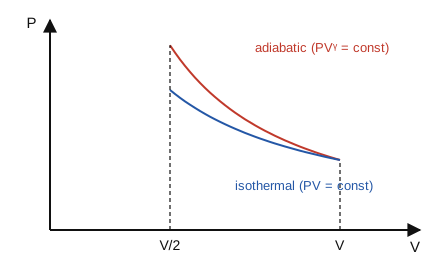
- Isothermal: = const → at V/2, P doubles.
- Adiabatic: = const → at V/2, P becomes (γ > 1 for every gas).
- Adiabatic curve lies above the isothermal throughout → larger area → more work. Since γ > 1 for all gases, the result does not depend on atomicity (D wrong).
Short trick: In adiabatic compression the gas also heats up, so pressure climbs faster → more work.
Answer: (B) Adiabatic compression needs more work
अवधारणा: गैस पर किया गया कार्य = P–V वक्र के नीचे का क्षेत्रफल। संपीडन में, समान प्रारंभिक बिंदु से रुद्धोष्म वक्र समतापी वक्र से अधिक तीव्रता से ऊपर उठता है।
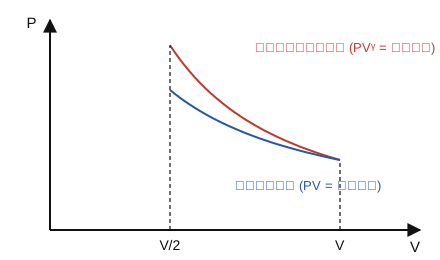
- समतापी: = नियत → V/2 पर P दुगुना।
- रुद्धोष्म: = नियत → V/2 पर P = (प्रत्येक गैस के लिए γ > 1)।
- रुद्धोष्म वक्र पूरे परास में समतापी से ऊपर है → अधिक क्षेत्रफल → अधिक कार्य। सभी गैसों के लिए γ > 1, अतः परिणाम परमाणुकता पर निर्भर नहीं (D गलत)।
शॉर्ट ट्रिक: रुद्धोष्म संपीडन में गैस गर्म भी होती है, अतः दाब तेज़ी से बढ़ता है → अधिक कार्य।
उत्तर: (B) रुद्धोष्म संपीडन में अधिक कार्य
NEET UGPhysicsThermodynamics – isothermal vs adiabatic compression workNEET UG 2016 · 1 May Shift 1
Q1911.A potentiometer wire is 100 cm long and a constant potential difference is maintained across it. Two cells are connected in series first to support one another and then in opposite direction. The balance points are obtained at 50 cm and 10 cm from the positive end of the wire in the two cases. The ratio of emf’s is :
एक विभवमापी तार 100 cm लंबा है तथा इसके सिरों पर एक नियत विभवांतर बनाए रखा गया है। दो सेलों को श्रेणी में पहले एक-दूसरे की सहायता करते हुए तथा फिर विपरीत दिशा में जोड़ा जाता है। दोनों स्थितियों में संतुलन बिंदु तार के धन सिरे से 50 cm तथा 10 cm पर प्राप्त होते हैं। विद्युत वाहक बलों का अनुपात है :
- A5 : 1
- B5 : 4
- C3 : 4
- D3 : 2
Show answer
Concept: Potentiometer: emf balanced ∝ balancing length ().
- , .
- → → .
- .
Short trick: .
Answer: (D) 3 : 2
अवधारणा: विभवमापी: संतुलित विद्युत वाहक बल ∝ संतुलन लंबाई ()।
- , ।
- → → ।
- ।
शॉर्ट ट्रिक: ।
उत्तर: (D) 3 : 2
NEET UGPhysicsCurrent electricity – potentiometer, comparison of emfsNEET UG 2016 · 1 May Shift 1
Q1912.An astronomical telescope has objective and eyepiece of focal lengths 40 cm and 4 cm respectively. To view an object 200 cm away from the objective, the lenses must be separated by a distance:
एक खगोलीय दूरदर्शक के अभिदृश्यक तथा नेत्रिका की फोकस दूरियाँ क्रमशः 40 cm तथा 4 cm हैं। अभिदृश्यक से 200 cm दूर स्थित वस्तु को देखने के लिए लेंसों के बीच की दूरी होनी चाहिए:
- A37.3 cm
- B46.0 cm
- C50.0 cm
- D54.0 cm
Show answer
Concept: Objective forms a real image; for normal adjustment that image lies at the focus of the eyepiece, so .
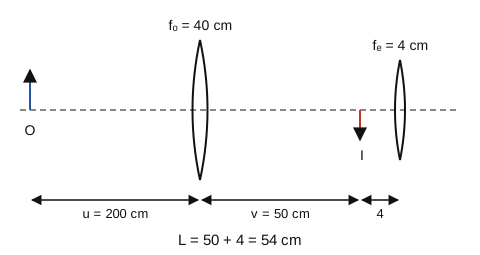
- → → cm.
- cm.
Short trick: Object not at infinity → image beyond (50 > 40); add : 54 cm.
Answer: (D) 54.0 cm
अवधारणा: अभिदृश्यक वास्तविक प्रतिबिंब बनाता है; सामान्य समायोजन में वह प्रतिबिंब नेत्रिका के फोकस पर होता है, अतः ।
- → → cm।
- cm।
शॉर्ट ट्रिक: वस्तु अनंत पर नहीं → प्रतिबिंब से आगे (50 > 40); जोड़ें: 54 cm।
उत्तर: (D) 54.0 cm
NEET UGPhysicsRay optics – astronomical telescope (object at finite distance)NEET UG 2016 · 1 May Shift 1
Q1913.Two non-mixing liquids of densities ρ and nρ are put in a container. The height of each liquid is h. A solid cylinder of length L and density d is put in this container. The cylinder floats with its axis vertical and length pL in the denser liquid. The density d is equal to:
घनत्व ρ तथा nρ के दो अमिश्रणीय द्रव एक पात्र में रखे गए हैं। प्रत्येक द्रव की ऊँचाई h है। लंबाई L तथा घनत्व d का एक ठोस बेलन इस पात्र में डाला जाता है। बेलन अपनी अक्ष ऊर्ध्वाधर रखते हुए इस प्रकार तैरता है कि इसकी pL लंबाई सघन द्रव में है। घनत्व d बराबर है:
- A
- B
- C
- D
Show answer
Concept: Floating: weight = total buoyant force (sum of the weights of liquid displaced in each layer).
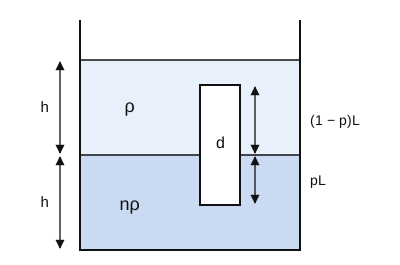
- Weight: . Buoyancy: .
- .
Short trick: Check limits: p = 0 → d = ρ; p = 1 → d = nρ. Only (D) satisfies both.
Answer: (D)
अवधारणा: तैरना: भार = कुल उत्प्लावन बल (प्रत्येक परत में विस्थापित द्रव के भारों का योग)।
- भार: । उत्प्लावन: ।
- ।
शॉर्ट ट्रिक: सीमाएँ जाँचें: p = 0 → d = ρ; p = 1 → d = nρ। केवल (D) दोनों को संतुष्ट करता है।
उत्तर: (D)
NEET UGPhysicsMechanical properties of fluids – floating in two liquidsNEET UG 2016 · 1 May Shift 1
Q1914.To get output 1 for the following circuit, the correct choice for the input is:
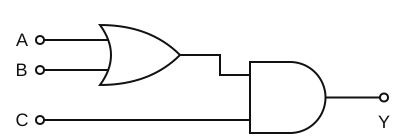
निम्नलिखित परिपथ में निर्गत 1 प्राप्त करने के लिए निवेश का सही चयन है:
- AA = 0, B = 1, C = 0
- BA = 1, B = 0, C = 0
- CA = 1, B = 1, C = 0
- DA = 1, B = 0, C = 1
Show answer
Concept: : A and B go to an OR gate; its output and C go to an AND gate.
- AND output is 1 only if C = 1 → options (A), (B), (C) (all with C = 0) give Y = 0.
- (D): , then → Y = 1.
Short trick: Final AND gate → C must be 1; only one option has C = 1.
Answer: (D) A = 1, B = 0, C = 1
अवधारणा: : A तथा B, OR द्वार में जाते हैं; इसका निर्गत तथा C, AND द्वार में जाते हैं।
- AND का निर्गत तभी 1 होगा जब C = 1 → विकल्प (A), (B), (C) (सभी में C = 0) से Y = 0।
- (D): , फिर → Y = 1।
शॉर्ट ट्रिक: अंतिम द्वार AND है → C = 1 होना चाहिए; केवल एक विकल्प में C = 1 है।
उत्तर: (D) A = 1, B = 0, C = 1
NEET UGPhysicsSemiconductors – logic gates (OR followed by AND)NEET UG 2016 · 1 May Shift 1
Q1915.A piece of ice falls from a height h so that it melts completely. Only one-quarter of the heat produced is absorbed by the ice and all energy of ice gets converted into heat during its fall. The value of h is: [Latent heat of ice is J/kg and g = 10 N/kg]
बर्फ का एक टुकड़ा ऊँचाई h से इस प्रकार गिरता है कि वह पूर्णतः पिघल जाता है। उत्पन्न ऊष्मा का केवल एक-चौथाई भाग बर्फ द्वारा अवशोषित होता है तथा गिरने के दौरान बर्फ की समस्त ऊर्जा ऊष्मा में परिवर्तित हो जाती है। h का मान है: [बर्फ की गुप्त ऊष्मा J/kg तथा g = 10 N/kg]
- A34 km
- B544 km
- C136 km
- D68 km
Show answer
Concept: Heat absorbed by ice = × (potential energy lost) must equal .
- → .
- m = 136 km.
Short trick: Mass cancels; h = 4L/g = 4 × 34 000 m = 136 km.
Answer: (C) 136 km
अवधारणा: बर्फ द्वारा अवशोषित ऊष्मा = × (स्थितिज ऊर्जा में हानि), जो के बराबर होनी चाहिए।
- → ।
- m = 136 km।
शॉर्ट ट्रिक: द्रव्यमान कट जाता है; h = 4L/g = 4 × 34 000 m = 136 km।
उत्तर: (C) 136 km
NEET UGPhysicsThermal properties – energy conservation, melting of iceNEET UG 2016 · 1 May Shift 1
Q1916.The ratio of escape velocity at earth to the escape velocity at a planet whose radius and mean density are twice as that of earth is:
पृथ्वी पर पलायन वेग तथा उस ग्रह पर पलायन वेग का अनुपात, जिसकी त्रिज्या तथा माध्य घनत्व पृथ्वी के दोगुने हैं, है:
- A1 : 2
- B1 :
- C1 : 4
- D1 :
Show answer
Concept: → .
- .
Short trick: : doubling R ×2, doubling ρ ×√2 → planet is times.
Answer: (B) 1 :
अवधारणा: → ।
- ।
शॉर्ट ट्रिक: : R दोगुना → ×2, ρ दोगुना → ×√2 → ग्रह पर गुना।
उत्तर: (B) 1 :
NEET UGPhysicsGravitation – escape velocityNEET UG 2016 · 1 May Shift 1
Q1917.If the magnitude of sum of two vectors is equal to the magnitude of difference of the two vectors, the angle between these vectors is:
यदि दो सदिशों के योग का परिमाण उन दोनों सदिशों के अंतर के परिमाण के बराबर है, तो इन सदिशों के बीच का कोण है:
- A
- B
- C
- D
Show answer
Concept: .
- Equal magnitudes → .
- → → .
Short trick: Sum and difference are the two diagonals of the parallelogram; equal diagonals → rectangle → 90°.
Answer: (B)
अवधारणा: ।
- परिमाण बराबर → ।
- → → ।
शॉर्ट ट्रिक: योग तथा अंतर समांतर चतुर्भुज के दो विकर्ण हैं; बराबर विकर्ण → आयत → 90°।
उत्तर: (B)
NEET UGPhysicsVectors – sum and differenceNEET UG 2016 · 1 May Shift 1
Q1918.Given the value of Rydberg constant is , the wave number of the last line of the Balmer series in hydrogen spectrum will be:
रिडबर्ग नियतांक का मान दिया गया है, तो हाइड्रोजन स्पेक्ट्रम में बामर श्रेणी की अंतिम रेखा की तरंग संख्या होगी:
- A
- B
- C
- D
Show answer
Concept: ; Balmer: ; last line (series limit): .
- .
- .
Short trick: Series limit wave number = → R/4 for Balmer.
Answer: (C)
अवधारणा: ; बामर: ; अंतिम रेखा (श्रेणी सीमा): ।
- ।
- ।
शॉर्ट ट्रिक: श्रेणी सीमा की तरंग संख्या = → बामर के लिए R/4।
उत्तर: (C)
NEET UGPhysicsAtoms – Balmer series limitNEET UG 2016 · 1 May Shift 1
Q1919.A body of mass 1 kg begins to move under the action of a time dependent force N, where and are unit vectors along x and y axis. What power will be developed by the force at the time t?
1 kg द्रव्यमान की एक वस्तु एक समय-निर्भर बल N के प्रभाव में गति करना प्रारंभ करती है, जहाँ तथा क्रमशः x तथा y अक्षों के अनुदिश एकांक सदिश हैं। समय t पर बल द्वारा विकसित शक्ति कितनी होगी?
- A W
- B W
- C W
- D W
Show answer
Concept: ; starting from rest, with .
- (m = 1 kg).
- .
- W.
Short trick: Each term: → → : n = 1 → , n = 2 → .
Answer: (D) W
अवधारणा: ; विरामावस्था से प्रारंभ, , जहाँ ।
- (m = 1 kg)।
- ।
- W।
शॉर्ट ट्रिक: प्रत्येक पद: → → : n = 1 → , n = 2 → ।
उत्तर: (D) W
NEET UGPhysicsWork, energy and power – power of a time-dependent forceNEET UG 2016 · 1 May Shift 1
Q1920.An inductor 20 mH, a capacitor 50 μF and a resistor 40 Ω are connected in series across a source of emf . The power loss in A.C. circuit is :
20 mH का एक प्रेरक, 50 μF का एक संधारित्र तथा 40 Ω का एक प्रतिरोधक, emf के स्रोत से श्रेणी में जुड़े हैं। A.C. परिपथ में शक्ति हानि है :
- A0.51 W
- B0.67 W
- C0.76 W
- D0.89 W
Show answer
Concept: Average power , with .
- ; .
- → .
- → W.
- The value closest to this among the choices is 0.51 W; the others (0.67, 0.76, 0.89 W) are much farther away.
Short trick: W – pick the nearest option.
Answer: (A) 0.51 W
अवधारणा: औसत शक्ति , जहाँ ।
- ; ।
- → ।
- → W।
- दिए गए विकल्पों में इसके सबसे निकट 0.51 W है; अन्य (0.67, 0.76, 0.89 W) बहुत दूर हैं।
शॉर्ट ट्रिक: W – निकटतम विकल्प चुनें।
उत्तर: (A) 0.51 W
NEET UGPhysicsAlternating current – power in series LCR circuitNEET UG 2016 · 1 May Shift 1

