Q1881.From a disc of radius R and mass M, a circular hole of diameter R, whose rim passes through the centre is cut. What is the moment of inertia of the remaining part of the disc about a perpendicular axis, passing through the centre?
त्रिज्या R तथा द्रव्यमान M की एक चकती में से R व्यास का एक वृत्ताकार छिद्र काटा जाता है, जिसकी परिधि (रिम) चकती के केंद्र से होकर गुजरती है। केंद्र से गुजरने वाले लंबवत अक्ष के परितः चकती के शेष भाग का जड़त्व आघूर्ण क्या है?
- A
- B
- C
- D
Show answer
Concept: Remaining I = I(full disc) − I(removed disc) about the same axis; use the parallel-axis theorem for the removed part.
- Mass per area ; removed disc radius → mass .
- Its centre is from O: .
- .
Short trick: Hole of radius R/2 touching the centre always removes → .
Answer: (B)
अवधारणा: शेष I = पूरी चकती का I − हटाई गई चकती का I (उसी अक्ष के परितः); हटाए गए भाग के लिए समांतर अक्ष प्रमेय लगाएँ।
- प्रति क्षेत्रफल द्रव्यमान ; हटाई गई चकती की त्रिज्या → द्रव्यमान ।
- इसका केंद्र O से दूर है: ।
- ।
शॉर्ट ट्रिक: केंद्र को छूने वाला R/2 त्रिज्या का छिद्र सदैव घटाता है → ।
उत्तर: (B)
NEET UGPhysicsRotational motion – moment of inertia (cut disc)NEET UG 2016 · 1 May Shift 1
Q1882.A square loop ABCD carrying a current i, is placed near and coplanar with a long straight conductor XY carrying a current I, the net force on the loop will be:
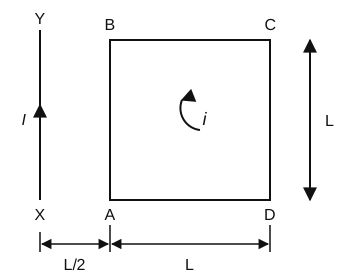
धारा i वाहित एक वर्गाकार लूप ABCD को धारा I वाहित एक लंबे सीधे चालक XY के निकट तथा उसी तल में रखा गया है। लूप पर नेट बल होगा:
- A
- B
- C
- D
Show answer
Concept: Force on a length L of wire parallel to a long wire: (like currents attract). Forces on BC and DA are equal and opposite.
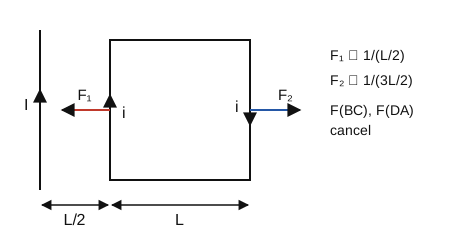
- AB at , current along I → attraction: (towards XY).
- CD at , current opposite → repulsion: (away).
- , towards the wire.
Short trick: L cancels (force ∝ L/r), so options (C), (D) with extra L are dimensionally wrong; then → (A).
Answer: (A)
अवधारणा: लंबे तार के समांतर L लंबाई के तार पर बल: (समान दिशा की धाराएँ आकर्षित करती हैं)। BC तथा DA पर बल बराबर व विपरीत होते हैं।
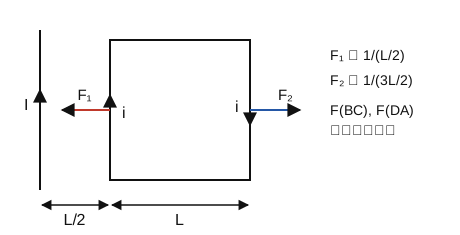
- AB दूरी पर, धारा I की दिशा में → आकर्षण: (XY की ओर)।
- CD दूरी पर, विपरीत धारा → प्रतिकर्षण: (दूर की ओर)।
- , तार की ओर।
शॉर्ट ट्रिक: L कट जाता है (बल ∝ L/r), इसलिए अतिरिक्त L वाले विकल्प (C), (D) विमीय रूप से गलत हैं; फिर → (A)।
उत्तर: (A)
NEET UGPhysicsMoving charges – force between current-carrying conductorsNEET UG 2016 · 1 May Shift 1
Q1883.The magnetic susceptibility is negative for:
चुंबकीय प्रवृत्ति (susceptibility) ऋणात्मक होती है:
- Adiamagnetic material onlyकेवल प्रतिचुंबकीय पदार्थ के लिए
- Bparamagnetic material onlyकेवल अनुचुंबकीय पदार्थ के लिए
- Cferromagnetic material onlyकेवल लौहचुंबकीय पदार्थ के लिए
- Dparamagnetic and ferromagnetic materialsअनुचुंबकीय तथा लौहचुंबकीय पदार्थों के लिए
Show answer
Concept: . Diamagnets get magnetised opposite to the field, so is small and negative.
- Diamagnetic: (e.g. Bi, Cu, water) → negative.
- Paramagnetic: small positive → (B) wrong.
- Ferromagnetic: large positive → (C), (D) wrong.
Short trick: Dia = "against" → only diamagnets have negative susceptibility (and μr < 1).
Answer: (A) diamagnetic material only
अवधारणा: । प्रतिचुंबकीय पदार्थ क्षेत्र के विपरीत चुंबकित होते हैं, अतः छोटा व ऋणात्मक होता है।
- प्रतिचुंबकीय: (जैसे Bi, Cu, जल) → ऋणात्मक।
- अनुचुंबकीय: छोटा धनात्मक → (B) गलत।
- लौहचुंबकीय: बड़ा धनात्मक → (C), (D) गलत।
शॉर्ट ट्रिक: Dia = "विरुद्ध" → केवल प्रतिचुंबकीय पदार्थों की प्रवृत्ति ऋणात्मक होती है (और μr < 1)।
उत्तर: (A) केवल प्रतिचुंबकीय पदार्थ के लिए
NEET UGPhysicsMagnetism and matter – magnetic susceptibilityNEET UG 2016 · 1 May Shift 1
Q1884.A siren emitting a sound of frequency 800 Hz moves away from an observer towards a cliff at a speed of 15 . Then, the frequency of sound that the observer hears in the echo reflected from the cliff is : (Take velocity of sound in air = 330 )
800 Hz आवृत्ति की ध्वनि उत्सर्जित करने वाला एक सायरन एक प्रेक्षक से दूर, एक चट्टान की ओर 15 की चाल से गतिमान है। चट्टान से परावर्तित प्रतिध्वनि में प्रेक्षक द्वारा सुनी गई ध्वनि की आवृत्ति है : (वायु में ध्वनि का वेग = 330 लीजिए)
- A765 Hz
- B800 Hz
- C838 Hz
- D885 Hz
Show answer
Concept: The cliff receives sound from a source approaching it: . The cliff (at rest) reflects this same frequency to the stationary observer.
- Source moves towards the cliff with m/s.
- Hz (observer and cliff are at rest, so the echo keeps this frequency).
Short trick: Echo comes from the side the source approaches → frequency must be above 800 Hz; ratio 330/315 ≈ 1.048 → 838 Hz.
Answer: (C) 838 Hz
अवधारणा: चट्टान को निकट आते स्रोत से ध्वनि मिलती है: । स्थिर चट्टान यही आवृत्ति स्थिर प्रेक्षक की ओर परावर्तित करती है।
- स्रोत चट्टान की ओर m/s से गतिमान है।
- Hz (प्रेक्षक व चट्टान स्थिर हैं, अतः प्रतिध्वनि की आवृत्ति यही रहती है)।
शॉर्ट ट्रिक: प्रतिध्वनि उस ओर से आती है जिधर स्रोत बढ़ रहा है → आवृत्ति 800 Hz से अधिक; अनुपात 330/315 ≈ 1.048 → 838 Hz।
उत्तर: (C) 838 Hz
NEET UGPhysicsWaves – Doppler effect (echo from cliff)NEET UG 2016 · 1 May Shift 1
Q1885.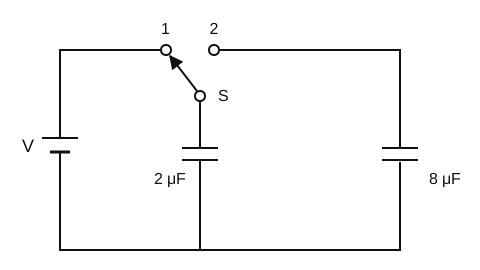
A capacitor of 2 μF is charged as shown in the diagram. When the switch S is turned to position 2, the percentage of its stored energy dissipated is:
आरेख में दर्शाए अनुसार 2 μF के एक संधारित्र को आवेशित किया गया है। जब स्विच S को स्थिति 2 पर घुमाया जाता है, तो इसकी संचित ऊर्जा का कितना प्रतिशत क्षयित होता है?
- A0%
- B20%
- C75%
- D80%
Show answer
Concept: When a charged capacitor is joined to an uncharged one, charge is shared (common potential) and energy lost .
- Initially (position 1): μC, .
- Position 2: 2 μF and 8 μF in parallel, common potential .
- .
- Dissipated → .
Short trick: Fraction lost .
Answer: (D) 80%
अवधारणा: जब आवेशित संधारित्र को अनावेशित संधारित्र से जोड़ते हैं, तो आवेश बँटता है (उभयनिष्ठ विभव) तथा ऊर्जा हानि ।
- प्रारंभ में (स्थिति 1): μC, ।
- स्थिति 2: 2 μF तथा 8 μF समांतर में, उभयनिष्ठ विभव ।
- ।
- क्षयित ऊर्जा → ।
शॉर्ट ट्रिक: हानि का अंश ।
उत्तर: (D) 80%
NEET UGPhysicsCapacitance – energy loss in charge sharingNEET UG 2016 · 1 May Shift 1
Q1886.In a diffraction pattern due to a single slit of width ‘a’, the first minimum is observed at an angle when light of wavelength 5000 Å is incident on the slit. The first secondary maximum is observed at an angle of:
चौड़ाई ‘a’ की एकल झिरी के कारण बने विवर्तन पैटर्न में, जब झिरी पर 5000 Å तरंगदैर्ध्य का प्रकाश आपतित होता है, तो प्रथम निम्निष्ठ कोण पर प्राप्त होता है। प्रथम द्वितीयक उच्चिष्ठ किस कोण पर प्राप्त होगा?
- A
- B
- C
- D
Show answer
Concept: Single slit: minima at ; secondary maxima approximately at .
- First minimum: → .
- First secondary maximum: .
- → .
Short trick: .
Answer: (D)
अवधारणा: एकल झिरी: निम्निष्ठ पर; द्वितीयक उच्चिष्ठ लगभग पर।
- प्रथम निम्निष्ठ: → ।
- प्रथम द्वितीयक उच्चिष्ठ: ।
- → ।
शॉर्ट ट्रिक: ।
उत्तर: (D)
NEET UGPhysicsWave optics – single slit diffractionNEET UG 2016 · 1 May Shift 1
Q1887.At what height from the surface of earth the gravitation potential and the value of g are and respectively? Take the radius of earth as 6400 km:
पृथ्वी की सतह से किस ऊँचाई पर गुरुत्वीय विभव तथा g के मान क्रमशः तथा हैं? पृथ्वी की त्रिज्या 6400 km लीजिए:
- A2600 km
- B1600 km
- C1400 km
- D2000 km
Show answer
Concept: At distance from the centre: and , so .
- m = 9000 km.
- km.
Short trick: Divide |V| by g directly → distance from centre; subtract R.
Answer: (A) 2600 km
अवधारणा: केंद्र से दूरी पर: तथा , अतः ।
- m = 9000 km।
- km।
शॉर्ट ट्रिक: |V| को g से सीधे भाग दें → केंद्र से दूरी; उसमें से R घटाएँ।
उत्तर: (A) 2600 km
NEET UGPhysicsGravitation – potential and g at heightNEET UG 2016 · 1 May Shift 1
Q1888.Out of the following options which one can be used to produce a propagating electromagnetic wave?
निम्नलिखित विकल्पों में से किसका उपयोग संचरित होने वाली विद्युत-चुंबकीय तरंग उत्पन्न करने के लिए किया जा सकता है?
- AA charge moving at constant velocityनियत वेग से गतिमान आवेश
- BA stationary chargeएक स्थिर आवेश
- CA chargeless particleएक आवेशरहित कण
- DAn accelerating chargeएक त्वरित आवेश
Show answer
Concept: A changing (time-varying) electric and magnetic field that radiates away needs an accelerated charge.
- Stationary charge → only static electric field (B wrong).
- Uniform velocity → steady current-like fields, no radiation (A wrong).
- Chargeless particle → no field at all (C wrong).
- Accelerating / oscillating charge → radiates EM waves.
Short trick: NCERT line: "An accelerated charge produces electromagnetic waves" (e.g. oscillating charges in an antenna).
Answer: (D) An accelerating charge
अवधारणा: दूर तक विकिरित होने वाले परिवर्ती विद्युत तथा चुंबकीय क्षेत्र के लिए त्वरित आवेश आवश्यक है।
- स्थिर आवेश → केवल स्थिर विद्युत क्षेत्र (B गलत)।
- नियत वेग → स्थायी क्षेत्र, विकिरण नहीं (A गलत)।
- आवेशरहित कण → कोई क्षेत्र नहीं (C गलत)।
- त्वरित / दोलनशील आवेश → EM तरंगें विकिरित करता है।
शॉर्ट ट्रिक: NCERT पंक्ति: "त्वरित आवेश विद्युत-चुंबकीय तरंगें उत्पन्न करता है" (जैसे ऐंटेना में दोलन करते आवेश)।
उत्तर: (D) एक त्वरित आवेश
NEET UGPhysicsElectromagnetic waves – source of EM wavesNEET UG 2016 · 1 May Shift 1
Q1889.Two identical charged spheres suspended from a common point by two massless strings of lengths , are initially at a distance apart because of their mutual repulsion. The charges begin to leak from both the spheres at a constant rate. As a result, the spheres approach each other with a velocity υ. Then υ varies as a function of the distance between the spheres, as
दो सर्वसम आवेशित गोले एक उभयनिष्ठ बिंदु से लंबाई की दो द्रव्यमानरहित डोरियों द्वारा लटके हैं तथा परस्पर प्रतिकर्षण के कारण प्रारंभ में दूरी पर हैं। दोनों गोलों से आवेश एक नियत दर से क्षरित होने लगता है। परिणामस्वरूप गोले वेग υ से एक-दूसरे की ओर आते हैं। तब गोलों के बीच की दूरी के फलन के रूप में υ किस प्रकार परिवर्तित होता है?
- A
- B
- C
- D
Show answer
Concept: Equilibrium of each sphere: , and for small angle . Leak rate = constant.
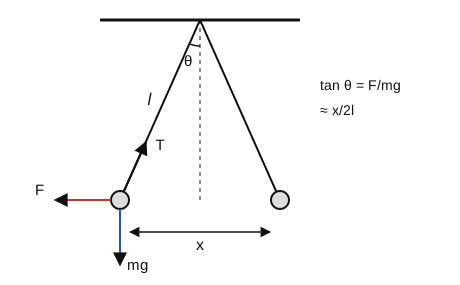
- → → .
- Differentiate: .
- constant → = constant → .
Short trick: ; constant means .
Answer: (C)
अवधारणा: प्रत्येक गोले का संतुलन: , तथा छोटे कोण के लिए । क्षरण दर = नियत।
- → → ।
- अवकलन करने पर: ।
- नियत → = नियत → ।
शॉर्ट ट्रिक: ; नियत का अर्थ ।
उत्तर: (C)
NEET UGPhysicsElectrostatics – leaking charges on suspended spheresNEET UG 2016 · 1 May Shift 1
Q1890.A uniform rope of length L and mass , hangs vertically from a rigid support. A block of mass is attached to the free end of the rope. A transverse pulse of wavelength is produced at the lower end of the rope. The wavelength of the pulse when it reaches the top of the rope is . The ratio is:
लंबाई L तथा द्रव्यमान की एक एकसमान रस्सी एक दृढ़ आधार से ऊर्ध्वाधर लटकी है। रस्सी के मुक्त सिरे से द्रव्यमान का एक गुटका बँधा है। रस्सी के निचले सिरे पर तरंगदैर्ध्य का एक अनुप्रस्थ स्पंद उत्पन्न किया जाता है। रस्सी के ऊपरी सिरे पर पहुँचने पर स्पंद की तरंगदैर्ध्य है। अनुपात है:
- A
- B
- C
- D
Show answer
Concept: ; frequency stays the same along the rope, so .
- Bottom: tension .
- Top: tension .
- .
Short trick: Top supports everything → ratio must be > 1 with in the denominator → (B).
Answer: (B)
अवधारणा: ; रस्सी में आवृत्ति समान रहती है, अतः ।
- नीचे: तनाव ।
- ऊपर: तनाव ।
- ।
शॉर्ट ट्रिक: ऊपरी सिरा सब कुछ सँभालता है → अनुपात > 1 तथा हर में → (B)।
उत्तर: (B)
NEET UGPhysicsWaves – speed of transverse wave in hanging ropeNEET UG 2016 · 1 May Shift 1
Q1891.A refrigerator works between C and C. It is required to remove 600 calories of heat every second in order to keep the temperature of the refrigerated space constant. The power required is: (Take 1 cal = 4.2 Joules)
एक प्रशीतित्र C तथा C के बीच कार्य करता है। प्रशीतित स्थान का ताप नियत बनाए रखने के लिए प्रति सेकंड 600 कैलोरी ऊष्मा निकालना आवश्यक है। आवश्यक शक्ति है: (1 cal = 4.2 जूल लीजिए)
- A2.365 W
- B23.65 W
- C236.5 W
- D2365 W
Show answer
Concept: Ideal (Carnot) refrigerator: .
- K, K → .
- per second J/s.
- W.
Short trick: W.
Answer: (C) 236.5 W
अवधारणा: आदर्श (कार्नो) प्रशीतित्र: ।
- K, K → ।
- प्रति सेकंड J/s।
- W।
शॉर्ट ट्रिक: W।
उत्तर: (C) 236.5 W
NEET UGPhysicsThermodynamics – refrigerator (coefficient of performance)NEET UG 2016 · 1 May Shift 1
Q1892.An air column, closed at one end and open at the other, resonates with a tuning fork when the smallest length of the column is 50 cm. The next larger length of the column resonating with the same tuning fork is:
एक सिरे पर बंद तथा दूसरे सिरे पर खुला एक वायु स्तंभ, स्तंभ की न्यूनतम लंबाई 50 cm होने पर एक स्वरित्र के साथ अनुनाद करता है। उसी स्वरित्र के साथ अनुनाद करने वाली स्तंभ की अगली बड़ी लंबाई है:
- A66.7 cm
- B100 cm
- C150 cm
- D200 cm
Show answer
Concept: Closed pipe resonance lengths: (odd multiples).
- cm → cm.
- Next: cm.
Short trick: Closed pipe → lengths in ratio 1 : 3 : 5 → 50 × 3 = 150 cm.
Answer: (C) 150 cm
अवधारणा: बंद नली की अनुनाद लंबाइयाँ: (विषम गुणज)।
- cm → cm।
- अगली: cm।
शॉर्ट ट्रिक: बंद नली → लंबाइयाँ 1 : 3 : 5 के अनुपात में → 50 × 3 = 150 cm।
उत्तर: (C) 150 cm
NEET UGPhysicsWaves – resonance in closed pipeNEET UG 2016 · 1 May Shift 1
Q1893.Consider the junction diode as ideal. The value of current flowing through AB is:
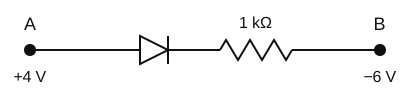
संधि डायोड को आदर्श मानिए। AB से प्रवाहित धारा का मान है:
- A0 A
- B A
- C A
- D A
Show answer
Concept: An ideal diode has zero resistance when forward biased (p-side at higher potential).
- Diode arrow points from A (+4 V) towards B (−6 V) → p-side at higher potential → forward biased, acts as a plain wire.
- V across 1 kΩ.
- A.
Short trick: Arrow of the diode points "downhill" in potential → conducts; I = ΔV/R = 10 V / 1 kΩ = 10 mA.
Answer: (B) A
अवधारणा: अग्र अभिनत (p-सिरा उच्च विभव पर) होने पर आदर्श डायोड का प्रतिरोध शून्य होता है।
- डायोड का तीर A (+4 V) से B (−6 V) की ओर है → p-सिरा उच्च विभव पर → अग्र अभिनत, साधारण तार की तरह कार्य करता है।
- 1 kΩ के सिरों पर V।
- A।
शॉर्ट ट्रिक: डायोड का तीर विभव के "ढलान" की ओर → चालन; I = ΔV/R = 10 V / 1 kΩ = 10 mA।
उत्तर: (B) A
NEET UGPhysicsSemiconductors – ideal diode in a circuitNEET UG 2016 · 1 May Shift 1
Q1894.The charge flowing through a resistance R varies with time t as where a and b are positive constants. The total heat produced in R is :
एक प्रतिरोध R से प्रवाहित आवेश समय t के साथ के अनुसार परिवर्तित होता है, जहाँ a तथा b धनात्मक नियतांक हैं। R में उत्पन्न कुल ऊष्मा है :
- A
- B
- C
- D
Show answer
Concept: and heat . Charge flows only while Q keeps increasing, i.e. until .
- ; current becomes zero at (Q is then maximum and the flow stops).
- .
Short trick: i falls linearly from a to 0 in time : of a straight line = → .
Answer: (A)
अवधारणा: तथा ऊष्मा । आवेश तभी तक प्रवाहित होता है जब तक Q बढ़ता रहता है, अर्थात् होने तक।
- ; पर धारा शून्य हो जाती है (तब Q अधिकतम होता है और प्रवाह रुक जाता है)।
- ।
शॉर्ट ट्रिक: i, समय में a से 0 तक रैखिक घटती है: सरल रेखा का → ।
उत्तर: (A)
NEET UGPhysicsCurrent electricity – Joule heating with time-varying chargeNEET UG 2016 · 1 May Shift 1
Q1895.A black body is at a temperature of 5760 K. The energy of radiation emitted by the body at wavelength 250 nm is , at wavelength 500 nm is and that at 1000 nm is . Wien’s constant, nmK. Which of the following is correct?
एक कृष्णिका 5760 K ताप पर है। कृष्णिका द्वारा 250 nm तरंगदैर्ध्य पर उत्सर्जित विकिरण की ऊर्जा , 500 nm पर तथा 1000 nm पर है। वीन नियतांक nmK है। निम्नलिखित में से कौन-सा सही है?
- A
- B
- C
- D
Show answer
Concept: Wien's law: ; emitted energy is maximum at and smaller on both sides (never zero).
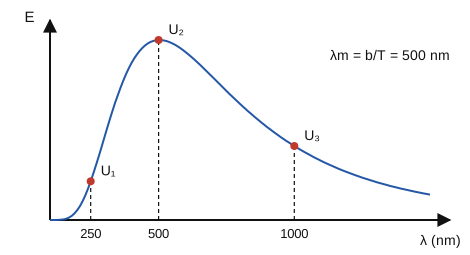
- nm → is the peak.
- 250 nm and 1000 nm lie on either side of the peak → and → (D) correct, (C) wrong.
- A black body emits at all wavelengths, so , → (A), (B) wrong.
Short trick: Compute first: it equals one of the given wavelengths (500 nm) → that U is the largest.
Answer: (D)
अवधारणा: वीन नियम: ; उत्सर्जित ऊर्जा पर अधिकतम तथा दोनों ओर कम होती है (कभी शून्य नहीं)।
- nm → शिखर है।
- 250 nm तथा 1000 nm शिखर के दोनों ओर हैं → तथा → (D) सही, (C) गलत।
- कृष्णिका सभी तरंगदैर्ध्यों पर उत्सर्जन करती है, अतः , → (A), (B) गलत।
शॉर्ट ट्रिक: पहले निकालें: यह दी गई तरंगदैर्ध्यों में से एक (500 nm) है → वही U सबसे बड़ा।
उत्तर: (D)
NEET UGPhysicsThermal radiation – Wien's displacement lawNEET UG 2016 · 1 May Shift 1
Q1896.Coefficient of linear expansion of brass and steel rods are and . Lengths of brass and steel rods are and respectively. If is maintained same at all temperatures, which one of the following relations holds good?
पीतल तथा इस्पात की छड़ों के रैखिक प्रसार गुणांक तथा हैं। पीतल तथा इस्पात की छड़ों की लंबाइयाँ क्रमशः तथा हैं। यदि सभी तापों पर समान बना रहता है, तो निम्नलिखित में से कौन-सा संबंध सही है?
- A
- B
- C
- D
Show answer
Concept: . A constant difference means both rods expand by the same amount.
- → .
- → .
Short trick: Equal expansion ⇒ product same for both rods (each α with its own l).
Answer: (D)
अवधारणा: । नियत अंतर का अर्थ है कि दोनों छड़ें समान मात्रा में फैलती हैं।
- → ।
- → ।
शॉर्ट ट्रिक: समान प्रसार ⇒ दोनों छड़ों के लिए गुणनफल समान (प्रत्येक α अपनी l के साथ)।
उत्तर: (D)
NEET UGPhysicsThermal expansion – constant length differenceNEET UG 2016 · 1 May Shift 1
Q1897.A npn transistor is connected in common emitter configuration in a given amplifier. A load resistance of 800 Ω is connected in the collector circuit and the voltage drop across it is 0.8 V. If the current amplification factor is 0.96 and the input resistance of the circuit is 192 Ω, the voltage gain and the power gain of the amplifier will respectively be:
एक प्रवर्धक में एक npn ट्रांजिस्टर उभयनिष्ठ उत्सर्जक विन्यास में जुड़ा है। संग्राहक परिपथ में 800 Ω का एक लोड प्रतिरोध जुड़ा है तथा इसके सिरों पर वोल्टता पात 0.8 V है। यदि धारा प्रवर्धन गुणांक 0.96 है तथा परिपथ का निवेश प्रतिरोध 192 Ω है, तो प्रवर्धक की वोल्टता लब्धि तथा शक्ति लब्धि क्रमशः होंगी:
- A4, 3.84
- B3.69, 3.84
- C4, 4
- D4, 3.69
Show answer
Concept: Voltage gain ; power gain (using the given current gain 0.96).
- .
- Power gain .
Short trick: 800/192 = 25/6; × 0.96 = 4 exactly; power gain = current gain × voltage gain.
Answer: (A) 4, 3.84
अवधारणा: वोल्टता लब्धि ; शक्ति लब्धि (दी गई धारा लब्धि 0.96 लेकर)।
- ।
- शक्ति लब्धि ।
शॉर्ट ट्रिक: 800/192 = 25/6; × 0.96 = ठीक 4; शक्ति लब्धि = धारा लब्धि × वोल्टता लब्धि।
उत्तर: (A) 4, 3.84
NEET UGPhysicsSemiconductors – CE transistor amplifier gainsNEET UG 2016 · 1 May Shift 1
Q1898.The intensity at the maximum in a Young’s double slit experiment is . Distance between two slits is , where λ is the wavelength of light used in the experiment. What will be the intensity in front of one of the slits on the screen placed at a distance ?
यंग के द्वि-झिरी प्रयोग में उच्चिष्ठ पर तीव्रता है। दोनों झिरियों के बीच की दूरी है, जहाँ λ प्रयोग में प्रयुक्त प्रकाश की तरंगदैर्ध्य है। दूरी पर रखे पर्दे पर किसी एक झिरी के ठीक सामने तीव्रता क्या होगी?
- A
- B
- C
- D
Show answer
Concept: Path difference at height y: ; intensity with .
- In front of a slit: → .
- .
- .
Short trick: Path difference λ/4 ↔ phase π/2 ↔ intensity exactly half of maximum.
Answer: (D)
अवधारणा: ऊँचाई y पर पथांतर: ; तीव्रता , जहाँ ।
- झिरी के सामने: → ।
- ।
- ।
शॉर्ट ट्रिक: पथांतर λ/4 ↔ कलांतर π/2 ↔ तीव्रता ठीक अधिकतम की आधी।
उत्तर: (D)
NEET UGPhysicsWave optics – Young's double slit intensityNEET UG 2016 · 1 May Shift 1
Q1899.A uniform circular disc of radius 50 cm at rest is free to turn about an axis which is perpendicular to its plane and passes through its centre. It is subjected to a torque which produces a constant angular acceleration of 2.0 . Its net acceleration in at the end of 2.0 s is approximately:
50 cm त्रिज्या की एक विरामावस्था में स्थित एकसमान वृत्ताकार चकती, अपने तल के लंबवत तथा केंद्र से गुजरने वाले अक्ष के परितः घूमने के लिए स्वतंत्र है। इस पर एक बल-आघूर्ण लगाया जाता है जो 2.0 का नियत कोणीय त्वरण उत्पन्न करता है। 2.0 s के अंत में इसका कुल त्वरण में लगभग है:
- A8.0
- B7.0
- C6.0
- D3.0
Show answer
Concept: A rim point has tangential and centripetal ; net .
- rad/s.
- ; .
- .
Short trick: Centripetal part dominates (8 vs 1), so net ≈ 8.
Answer: (A) 8.0
अवधारणा: परिधि के बिंदु का स्पर्शरेखीय त्वरण तथा अभिकेंद्र त्वरण ; कुल ।
- rad/s।
- ; ।
- ।
शॉर्ट ट्रिक: अभिकेंद्र भाग प्रभावी है (8 बनाम 1), अतः कुल ≈ 8।
उत्तर: (A) 8.0
NEET UGPhysicsRotational motion – net acceleration of a point on a discNEET UG 2016 · 1 May Shift 1
Q1900.An electron of mass m and a photon have same energy E. The ratio of de-Broglie wavelengths associated with them is: (c being velocity of light)
द्रव्यमान m के एक इलेक्ट्रॉन तथा एक फोटॉन की ऊर्जा समान E है। इनसे संबद्ध दे-ब्रॉग्ली तरंगदैर्ध्यों का अनुपात है: (c प्रकाश का वेग है)
- A
- B
- C
- D
Show answer
Concept: . Electron: . Photon: .
- ; .
- .
Short trick: Ratio must be dimensionless: is a speed, so divide by c → only (A) works.
Answer: (A)
अवधारणा: । इलेक्ट्रॉन: । फोटॉन: ।
- ; ।
- ।
शॉर्ट ट्रिक: अनुपात विमाहीन होना चाहिए: एक चाल है, अतः c से भाग → केवल (A) सही बैठता है।
उत्तर: (A)
NEET UGPhysicsDual nature – de Broglie wavelength of electron and photonNEET UG 2016 · 1 May Shift 1

