Q641.Each of P, Q, R, S, T, U and V has an exam on a different day of a week starting from Monday and ending on Sunday of the same week. R has an exam on Friday. Only 2 people have an exam between R and Q. S has an exam immediately before U and P has an exam immediately after V. Only 2 people have an exam between T and U.
Who has an exam on Monday?
P, Q, R, S, T, U और V में से प्रत्येक की परीक्षा एक ही सप्ताह के सोमवार से शुरू होकर रविवार को समाप्त होने वाले सप्ताह के अलग-अलग दिन है। R की परीक्षा शुक्रवार को है। R और Q के बीच केवल 2 व्यक्तियों की परीक्षा है। S की परीक्षा U से ठीक पहले है और P की परीक्षा V के ठीक बाद है। T और U के बीच केवल 2 व्यक्तियों की परीक्षा है।
सोमवार को किसकी परीक्षा है?
- AS
- BP
- CT
- DU
Show answer
Concept: Place R, then Q, then the consecutive pairs.
- R = Friday; two people between R and Q → Q = Tuesday (Monday-start week has no day after Sunday).
- Free: Mon, Wed, Thu, Sat, Sun. Pairs S–U and V–P need consecutive days → (Wed, Thu) and (Sat, Sun).
- T and U have two between: if U = Thu, T = Mon ✔. So S = Wed, U = Thu, V = Sat, P = Sun, T = Mon.
| Mon | Tue | Wed | Thu | Fri | Sat | Sun |
| T | Q | S | U | R | V | P |
Short trick: Two consecutive pairs fill the only two free blocks of two days, leaving Monday for T.
Answer: (C) T
अवधारणा: पहले R, फिर Q, फिर क्रमागत जोड़े रखें।
- R = शुक्रवार; R और Q के बीच दो → Q = मंगलवार।
- खाली: सोम, बुध, गुरु, शनि, रवि। S–U और V–P जोड़े → (बुध, गुरु) और (शनि, रवि)।
- T और U के बीच दो: U = गुरु, T = सोम ✔।
| सोम | मंगल | बुध | गुरु | शुक्र | शनि | रवि |
| T | Q | S | U | R | V | P |
शॉर्ट ट्रिक: दो क्रमागत जोड़े दो खाली दो-दिनी खंड भरते हैं, सोमवार T के लिए बचता है।
उत्तर: (C) T
RRB ALP CBT 1General Intelligence and ReasoningScheduling puzzle – daysRRB ALP CBT 1 2025 · 16 Feb Shift 2
Q642.BE 11 is related to AI 33 in a certain way. In the same way, HK 16 is related to GO 48. To which of the given options is SV 18 related, following the same logic?
BE 11 किसी निश्चित प्रकार से AI 33 से संबंधित है। उसी प्रकार, HK 16, GO 48 से संबंधित है। समान तर्क का अनुसरण करते हुए, SV 18 दिए गए विकल्पों में से किससे संबंधित है?
- ATY 55
- BRZ 54
- CTZ 65
- DRY 55
Show answer
Concept: Find separate rules for each part.
- 1st letter −1: B→A, H→G, S→R.
- 2nd letter +4: E→I, K→O, V→Z.
- Number ×3: 11→33, 16→48, 18→54.
Short trick: Number ×3 → 54 kills A, C, D at once → RZ 54.
Answer: (B) RZ 54
अवधारणा: हर भाग के लिए अलग नियम।
- पहला अक्षर −1: B→A, H→G, S→R।
- दूसरा अक्षर +4: E→I, K→O, V→Z।
- संख्या ×3: 18→54।
शॉर्ट ट्रिक: संख्या ×3 = 54 से ही A, C, D हट जाते हैं → RZ 54।
उत्तर: (B) RZ 54
RRB ALP CBT 1General Intelligence and ReasoningAnalogy – letters and numbersRRB ALP CBT 1 2025 · 16 Feb Shift 2
Q643.Refer to the following letter series and answer the question that follows. Counting to be done from left to right only.
(Left) O K A E K J E E K R Y U V J M W O F E O Y A (Right)
How many such vowel are there, each of which is immediately preceded by a consonant and also immediately followed by a vowel?
निम्नलिखित अक्षर श्रृंखला को देखें और नीचे दिए गए प्रश्न का उत्तर दें। गिनती केवल बाएँ से दाएँ की जानी है।
(बाएँ) O K A E K J E E K R Y U V J M W O F E O Y A (दाएँ)
ऐसे कितने स्वर हैं, जिनमें से प्रत्येक के ठीक पहले एक व्यंजन है और ठीक बाद एक स्वर है?
- A3
- B5
- C4
- D2
Show answer
Concept: Pattern needed: consonant – vowel – vowel.
- O K A E K J E E K R Y U V J M W O F E O Y A
- K A E ✔, J E E ✔, F E O ✔
- (Y U V, W O F, Y A end ✘) → 3.
Short trick: Look only at vowel pairs (AE, EE, EO): count those whose left neighbour is a consonant → 3.
Answer: (A) 3
अवधारणा: पैटर्न: व्यंजन – स्वर – स्वर।
- O K A E K J E E K R Y U V J M W O F E O Y A
- K A E ✔, J E E ✔, F E O ✔
- कुल = 3।
शॉर्ट ट्रिक: केवल स्वर-युग्म (AE, EE, EO) देखें जिनके पहले व्यंजन है → 3।
उत्तर: (A) 3
RRB ALP CBT 1General Intelligence and ReasoningLetter series – consonant–vowel–vowelRRB ALP CBT 1 2025 · 16 Feb Shift 2
Q644.Refer to the following series and answer the question (All numbers are single digit numbers only. Counting to be done from left to right.)
(Left) 9 1 7 5 1 1 4 7 2 1 9 5 4 8 5 6 6 8 7 6 8 1 5 7 6 2 8 (Right)
How many such odd numbers are there each of which is immediately preceded by an even number and also immediately followed by an even number?
निम्नलिखित श्रृंखला को देखें और प्रश्न का उत्तर दें (सभी संख्याएँ केवल एक अंक वाली हैं। गिनती बाएँ से दाएँ की जानी है।)
(बाएँ) 9 1 7 5 1 1 4 7 2 1 9 5 4 8 5 6 6 8 7 6 8 1 5 7 6 2 8 (दाएँ)
ऐसी कितनी विषम संख्याएँ हैं जिनमें से प्रत्येक के ठीक पहले एक सम संख्या है और ठीक बाद भी एक सम संख्या है?
- A5
- B3
- C4
- D2
Show answer
Concept: Pattern: even – odd – even.
- 9 1 7 5 1 1 4 7 2 1 9 5 4 8 5 6 6 8 7 6 8 1 5 7 6 2 8
- 4 7 2 ✔, 8 5 6 ✔, 8 7 6 ✔
- Total = 3.
Short trick: Scan only for isolated odd digits (an odd digit with no odd neighbour).
Answer: (B) 3
अवधारणा: पैटर्न: सम – विषम – सम।
- 9 1 7 5 1 1 4 7 2 1 9 5 4 8 5 6 6 8 7 6 8 1 5 7 6 2 8
- 4 7 2 ✔, 8 5 6 ✔, 8 7 6 ✔
- कुल = 3।
शॉर्ट ट्रिक: केवल अकेले विषम अंक खोजें (जिनके दोनों पड़ोसी विषम न हों)।
उत्तर: (B) 3
RRB ALP CBT 1General Intelligence and ReasoningNumber series – odd between evensRRB ALP CBT 1 2025 · 16 Feb Shift 2
Q645.In a certain code language,
'A + B' means 'A is the son of B',
'A – B' means 'A is the brother of B',
'A × B' means 'A is the wife of B' and
'A ÷ B' means 'A is the father of B'.
Based on the above, how is T related to M if 'T × R – Y + G ÷ M'?
एक निश्चित कूट भाषा में,
'A + B' का अर्थ है 'A, B का पुत्र है',
'A – B' का अर्थ है 'A, B का भाई है',
'A × B' का अर्थ है 'A, B की पत्नी है' और
'A ÷ B' का अर्थ है 'A, B का पिता है'।
उपरोक्त के आधार पर, यदि 'T × R – Y + G ÷ M' है, तो T, M से किस प्रकार संबंधित है?
- ABrother's wifeभाई की पत्नी
- BMotherमाता
- CSisterबहन
- DBrother's daughterभाई की पुत्री
Show answer
Concept: Decode left to right and draw the tree.
- T × R: T is wife of R.
- R − Y: R is brother of Y; Y + G: Y is son of G.
- G ÷ M: G is father of M → R, Y, M are siblings.
- T is the wife of M’s brother.
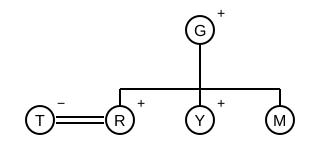
Short trick: Read the chain as a path T → R → (G) → M: wife of → brother of → sibling ⇒ T = brother’s wife.
Answer: (A) Brother's wife
अवधारणा: बाएँ से दाएँ कूट खोलें और वंश-वृक्ष बनाएँ।
- T × R: T, R की पत्नी है।
- R − Y: R, Y का भाई; Y + G: Y, G का पुत्र।
- G ÷ M: G, M का पिता → R, Y, M भाई-बहन।
- T, M के भाई की पत्नी है।
शॉर्ट ट्रिक: शृंखला T → R → M पढ़ें: पत्नी → भाई ⇒ T = भाई की पत्नी।
उत्तर: (A) भाई की पत्नी
RRB ALP CBT 1General Intelligence and ReasoningCoded blood relationRRB ALP CBT 1 2025 · 16 Feb Shift 2
Q646.Based on the English alphabetical order, three of the following four letter-cluster pairs are alike in a certain way and thus form a group. Which letter-cluster pair DOES NOT belong to that group? (Note: The odd one out is not based on the number of consonants/vowels or their position in the letter-cluster.)
अंग्रेजी वर्णमाला क्रम के आधार पर, निम्नलिखित चार अक्षर-समूह युग्मों में से तीन किसी प्रकार से एकसमान हैं और इस प्रकार एक समूह बनाते हैं। कौन-सा अक्षर-समूह युग्म उस समूह से संबंधित नहीं है? (ध्यान दें: असंगत का निर्धारण व्यंजनों/स्वरों की संख्या या अक्षर-समूह में उनके स्थान के आधार पर नहीं है।)
- AXY−ZA
- BLM−MQ
- CNO−PQ
- DQR−ST
Show answer
Concept: In each pair the four letters run consecutively.
- XY−ZA: X, Y, Z, A (wrap-around) ✔
- NO−PQ ✔, QR−ST ✔
- LM−MQ: after M should come N, O → breaks.
Short trick: Check whether the 3rd letter = 2nd letter + 1: Y→Z, O→P, R→S, but M→M ✘.
Answer: (B) LM−MQ
अवधारणा: प्रत्येक युग्म में चारों अक्षर क्रमागत हैं।
- XY−ZA ✔ (Z के बाद A)
- NO−PQ ✔, QR−ST ✔
- LM−MQ: M के बाद N, O आना चाहिए ✘।
शॉर्ट ट्रिक: तीसरा अक्षर = दूसरा + 1? Y→Z, O→P, R→S, पर M→M ✘।
उत्तर: (B) LM−MQ
RRB ALP CBT 1General Intelligence and ReasoningOdd one out – letter pairsRRB ALP CBT 1 2025 · 16 Feb Shift 2
Q647.Based on the English alphabetical order, three of the following four letter-cluster pairs are alike in a certain way and thus form a group. Which letter-cluster pair DOES NOT belong to that group?
(Note: The odd one out is not based on the number of consonants/vowels or their position in the letter-cluster.)
अंग्रेजी वर्णमाला क्रम के आधार पर, निम्नलिखित चार अक्षर-समूह युग्मों में से तीन किसी प्रकार से एकसमान हैं और इस प्रकार एक समूह बनाते हैं। कौन-सा अक्षर-समूह युग्म उस समूह से संबंधित नहीं है? (ध्यान दें: असंगत का निर्धारण व्यंजनों/स्वरों की संख्या या अक्षर-समूह में उनके स्थान के आधार पर नहीं है।)
- AMJ - NK
- BTQ - JI
- COL - PM
- DVS - WT
Show answer
Concept: First pair: letter, letter −3; second pair = first pair each +1.
- MJ − NK: M−3 = J; M+1 = N, J+1 = K ✔
- OL − PM ✔, VS − WT ✔
- TQ − JI: J, I is not T+1, Q+1 ✘
Short trick: Second cluster should simply be the next letters of the first (MJ→NK); TQ→UR, not JI.
Answer: (B) TQ - JI
अवधारणा: पहला युग्म: अक्षर, अक्षर −3; दूसरा युग्म = पहले के प्रत्येक अक्षर +1।
- MJ − NK ✔
- OL − PM ✔, VS − WT ✔
- TQ − JI ✘ (होना चाहिए UR)
शॉर्ट ट्रिक: दूसरा समूह पहले का अगला अक्षर होना चाहिए: TQ→UR, JI नहीं।
उत्तर: (B) TQ - JI
RRB ALP CBT 1General Intelligence and ReasoningOdd one out – letter pairsRRB ALP CBT 1 2025 · 16 Feb Shift 2
Q648.WURT is related to RPMZ in a certain way based on the English alphabetical order. In the same way, QNLG is related to LIGM. To which of the following is SPMH related, following the same logic?
अंग्रेजी वर्णमाला क्रम के आधार पर WURT किसी निश्चित प्रकार से RPMZ से संबंधित है। उसी प्रकार, QNLG, LIGM से संबंधित है। समान तर्क का अनुसरण करते हुए, SPMH निम्नलिखित में से किससे संबंधित है?
- ANKHN
- BNLIM
- CMLHM
- DMKIN
Show answer
Concept: Find the shift for each position.
- W→R, U→P, R→M: −5 each; T→Z: +6.
- Check: Q→L, N→I, L→G (−5), G→M (+6) ✔.
- SPMH → N K H N.
Short trick: First letter S − 5 = N removes C, D; second P − 5 = K → NKHN.
Answer: (A) NKHN
अवधारणा: हर स्थान का अंतर निकालें।
- W→R, U→P, R→M: −5; T→Z: +6।
- जाँच: QNLG → LIGM ✔।
- SPMH → N K H N।
शॉर्ट ट्रिक: S − 5 = N (C, D हटे); P − 5 = K → NKHN।
उत्तर: (A) NKHN
RRB ALP CBT 1General Intelligence and ReasoningLetter analogy – shiftsRRB ALP CBT 1 2025 · 16 Feb Shift 2
Q649.Kamal starts from point X and walks for 3 m towards west. Then he takes a left turn and walks for 8 m. Then he takes a left turn again and walks for 10 m. Then, again, he takes a left turn and walks for 2 m. Once more he takes a left turn and walks for 7 m and stops at a point Y. Towards which direction should he walk in order to reach point A again? (All turns are 90-degree turns only unless specified.)
कमल बिंदु X से शुरू करता है और पश्चिम की ओर 3 m चलता है। फिर वह बाएँ मुड़ता है और 8 m चलता है। फिर वह पुनः बाएँ मुड़ता है और 10 m चलता है। फिर, एक बार और, वह बाएँ मुड़ता है और 2 m चलता है। एक बार फिर वह बाएँ मुड़ता है और 7 m चलकर बिंदु Y पर रुक जाता है। फिर से बिंदु A पर पहुँचने के लिए उसे किस दिशा में चलना चाहिए? (जब तक निर्दिष्ट न हो, सभी मोड़ केवल 90 डिग्री के मोड़ हैं।)
- AWestपश्चिम
- BEastपूर्व
- CNorthउत्तर
- DSouthदक्षिण
Show answer
Concept: Trace the path on axes (start X at origin).
- 3 W → (−3, 0); left (face S) 8 → (−3, −8); left (face E) 10 → (7, −8).
- left (face N) 2 → (7, −6); left (face W) 7 → Y (0, −6).
- Y is directly 6 m south of the start, so he must walk North to return.
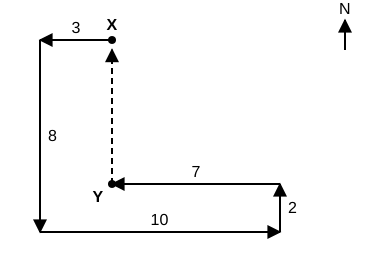
Short trick: Net east–west: −3 + 10 − 7 = 0; net north–south: −8 + 2 = −6 → he is due south of start → go North.
Answer: (C) North
अवधारणा: पथ को अक्षों पर बनाएँ (प्रारंभ X मूल बिंदु पर)।
- 3 पश्चिम → (−3, 0); बाएँ (दक्षिण) 8 → (−3, −8); बाएँ (पूर्व) 10 → (7, −8)।
- बाएँ (उत्तर) 2 → (7, −6); बाएँ (पश्चिम) 7 → Y (0, −6)।
- Y प्रारंभ बिंदु से ठीक 6 m दक्षिण में है → उत्तर की ओर चलना होगा।
शॉर्ट ट्रिक: पूर्व–पश्चिम: −3 + 10 − 7 = 0; उत्तर–दक्षिण: −8 + 2 = −6 → प्रारंभ के दक्षिण में → उत्तर जाएँ।
उत्तर: (C) उत्तर
RRB ALP CBT 1General Intelligence and ReasoningDirection senseRRB ALP CBT 1 2025 · 16 Feb Shift 2
Q650.D, E, F, G, K, L and M are sitting around a circular table, facing the centre of the table. F sits third to the left of K. Only one person sits between K and D when counted from the left of D. Only two people sit between L and E when counted from the right of E. G is an immediate neighbour of L.
Who sits third to the right of M?
D, E, F, G, K, L और M एक वृत्ताकार मेज़ के चारों ओर मेज़ के केंद्र की ओर मुख करके बैठे हैं। F, K के बाएँ से तीसरे स्थान पर बैठा है। D के बाएँ से गिनने पर K और D के बीच केवल एक व्यक्ति बैठा है। E के दाएँ से गिनने पर L और E के बीच केवल दो व्यक्ति बैठे हैं। G, L का निकटतम पड़ोसी है।
M के दाएँ से तीसरे स्थान पर कौन बैठा है?
- AG
- BD
- CL
- DF
Show answer
Concept: Facing the centre: left = clockwise, right = anticlockwise.
- Only one person between K and D counting from D’s left → K is 2nd to the left of D.
- F is 3rd to the left of K.
- Two people between E and L from E’s right → L is 3rd to the right of E; G next to L → remaining seat for M.
- Clockwise from D: D, M, K, L, G, F, E.
- 3rd to the right of M: M → D → E → F.
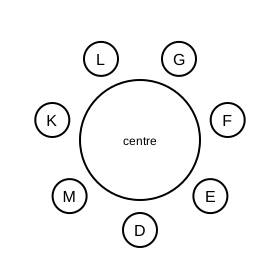
Short trick: With 7 seats, 3rd to the right = 4th to the left: from M go clockwise 4 → K, L, G, F.
Answer: (D) F
अवधारणा: केंद्र की ओर मुख: बायाँ = दक्षिणावर्त, दायाँ = वामावर्त।
- D के बाएँ से गिनने पर K और D के बीच एक → K, D के बाएँ दूसरा।
- F, K के बाएँ तीसरा।
- E के दाएँ से L और E के बीच दो → L, E के दाएँ तीसरा; G, L के पास → M शेष स्थान पर।
- दक्षिणावर्त D से: D, M, K, L, G, F, E।
- M के दाएँ तीसरा: M → D → E → F।
शॉर्ट ट्रिक: 7 सीटों में दाएँ तीसरा = बाएँ चौथा: M से दक्षिणावर्त 4 → F।
उत्तर: (D) F
RRB ALP CBT 1General Intelligence and ReasoningCircular seating – facing centreRRB ALP CBT 1 2025 · 16 Feb Shift 2
Q651.A, G, H, P, S, and Y live on six different floors of the same building. The lowermost floor in the building is numbered 1, the floor above it is numbered 2, and so on, until the topmost floor is numbered 6. H lives immediately above Y. Only two people live between P and Y. P lives on an odd-numbered floor. S lives immediately below G. Who lives on the topmost floor?
A, G, H, P, S और Y एक ही इमारत की छह अलग-अलग मंज़िलों पर रहते हैं। इमारत की सबसे निचली मंज़िल की संख्या 1 है, उसके ऊपर की मंज़िल की संख्या 2 है, और इसी प्रकार सबसे ऊपरी मंज़िल की संख्या 6 है। H, Y के ठीक ऊपर रहता है। P और Y के बीच केवल दो व्यक्ति रहते हैं। P एक विषम संख्या वाली मंज़िल पर रहता है। S, G के ठीक नीचे रहता है। सबसे ऊपरी मंज़िल पर कौन रहता है?
- AH
- BP
- CA
- DS
Show answer
Concept: Use the pair conditions and P’s odd floor.
- H directly above Y; P and Y have two floors between.
- P odd: P = 1 → Y = 4, H = 5 (P = 3 → Y = 6, no room for H; P = 5 → Y = 2, H = 3, but then S–G pair cannot fit with A left alone).
- S directly below G → S = 2, G = 3; A = 6.
Short trick: Only P = 1 leaves two consecutive free floors (2, 3) for S–G.
Answer: (C) A
अवधारणा: जोड़ी वाली शर्तें और P की विषम मंज़िल का प्रयोग करें।
- H, Y के ठीक ऊपर; P और Y के बीच दो मंज़िलें।
- P = 1 → Y = 4, H = 5 (अन्य स्थितियों में S–G का जोड़ा नहीं बैठता)।
- S, G के ठीक नीचे → S = 2, G = 3; A = 6।
| मंज़िल | 6 | 5 | 4 | 3 | 2 | 1 |
| व्यक्ति | A | H | Y | G | S | P |
शॉर्ट ट्रिक: केवल P = 1 पर S–G के लिए दो क्रमागत खाली मंज़िलें (2, 3) बचती हैं।
उत्तर: (C) A
RRB ALP CBT 1General Intelligence and ReasoningFloor puzzleRRB ALP CBT 1 2025 · 16 Feb Shift 2
Q652.Based on the English alphabetical order, three of the following four letter-cluster pairs are alike in a certain way and thus form a group. Which letter-cluster pair DOES NOT belong to that group? (Note: The odd one out is not based on the number of consonants/vowels or their position in the letter-cluster.)
अंग्रेजी वर्णमाला क्रम के आधार पर, निम्नलिखित चार अक्षर-समूह युग्मों में से तीन किसी प्रकार से एकसमान हैं और इस प्रकार एक समूह बनाते हैं। कौन-सा अक्षर-समूह युग्म उस समूह से संबंधित नहीं है? (ध्यान दें: असंगत का निर्धारण व्यंजनों/स्वरों की संख्या या अक्षर-समूह में उनके स्थान के आधार पर नहीं है।)
- AFG-HI
- BOP-IJ
- CST-UV
- DWX-YZ
Show answer
Concept: In the group, the four letters are consecutive in forward order.
- FG-HI, ST-UV, WX-YZ: F G H I, S T U V, W X Y Z ✔
- OP-IJ: I J comes before O P ✘
Short trick: Check 3rd letter = 2nd + 1: G→H, T→U, X→Y, but P→I ✘.
Answer: (B) OP-IJ
अवधारणा: समूह में चारों अक्षर आगे के क्रम में क्रमागत हैं।
- FG-HI, ST-UV, WX-YZ ✔
- OP-IJ: IJ, OP से पहले आता है ✘
शॉर्ट ट्रिक: तीसरा अक्षर = दूसरा + 1? P→I ✘।
उत्तर: (B) OP-IJ
RRB ALP CBT 1General Intelligence and ReasoningOdd one out – letter pairsRRB ALP CBT 1 2025 · 16 Feb Shift 2
Q653.Each of G, J, M, O, R, S and T has an exam on a different day of a week, starting from Monday and ending on Sunday of the same week.
Only three people have exams between O and S. Only three people have exams between G and J. T has an exam on some day before R and on some day after M. Only J has an exam after S.
Who has an exam on Thursday?
G, J, M, O, R, S और T में से प्रत्येक की परीक्षा एक ही सप्ताह के सोमवार से शुरू होकर रविवार को समाप्त होने वाले सप्ताह के अलग-अलग दिन है।
O और S के बीच केवल तीन व्यक्तियों की परीक्षा है। G और J के बीच केवल तीन व्यक्तियों की परीक्षा है। T की परीक्षा R से पहले किसी दिन और M के बाद किसी दिन है। S के बाद केवल J की परीक्षा है।
गुरुवार को किसकी परीक्षा है?
- AM
- BO
- CG
- DT
Show answer
Concept: Start with the fixed end: only J after S.
- J = Sunday, S = Saturday.
- Three between O and S → O = Tuesday; three between G and J → G = Wednesday.
- Left: Mon, Thu, Fri for M, T, R with M before T before R → M = Mon, T = Thu, R = Fri.
| Mon | Tue | Wed | Thu | Fri | Sat | Sun |
| M | O | G | T | R | S | J |
Short trick: “Only J after S” pins the last two days; the rest falls in place with the ±4 gaps.
Answer: (D) T
अवधारणा: निश्चित छोर से शुरू करें: S के बाद केवल J।
- J = रविवार, S = शनिवार।
- O और S के बीच तीन → O = मंगलवार; G और J के बीच तीन → G = बुधवार।
- शेष सोम, गुरु, शुक्र: M, T, R क्रम में → T = गुरुवार।
| सोम | मंगल | बुध | गुरु | शुक्र | शनि | रवि |
| M | O | G | T | R | S | J |
शॉर्ट ट्रिक: “S के बाद केवल J” से अंतिम दो दिन तय, बाकी ±4 के अंतर से।
उत्तर: (D) T
RRB ALP CBT 1General Intelligence and ReasoningScheduling puzzle – daysRRB ALP CBT 1 2025 · 16 Feb Shift 2
Q654.A, B, C, D, E and F are sitting around a circular table, facing the centre. D sits to the immediate right of E. B sits to the immediate right of F. C sits second to the left of E. What is the position of A with respect to C?
A, B, C, D, E और F एक वृत्ताकार मेज़ के चारों ओर केंद्र की ओर मुख करके बैठे हैं। D, E के ठीक दाएँ बैठा है। B, F के ठीक दाएँ बैठा है। C, E के बाएँ से दूसरे स्थान पर बैठा है। C के सापेक्ष A का स्थान क्या है?
- AImmediate rightठीक दाएँ
- BSecond to the leftबाएँ से दूसरा
- CThird to the leftबाएँ से तीसरा
- DThird to the rightदाएँ से तीसरा
Show answer
Concept: Facing the centre: left = clockwise, right = anticlockwise.
- D immediate right of E; C second to the left of E.
- B immediate right of F → F, B fill two remaining adjacent seats, A the last.
- Clockwise: A, C, B, F, D, E → A is to the immediate right of C.
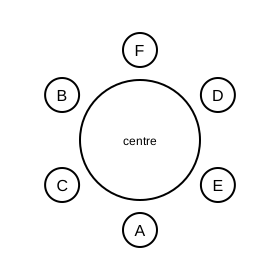
Short trick: C is 2nd left of E and D is right of E → the seat between C and the E–D block goes to B/F pair, leaving A next to C on its right.
Answer: (A) Immediate right
अवधारणा: केंद्र की ओर मुख: बायाँ = दक्षिणावर्त, दायाँ = वामावर्त।
- D, E के ठीक दाएँ; C, E के बाएँ दूसरा।
- B, F के ठीक दाएँ → F, B बचे दो सटे स्थानों पर, A अंतिम पर।
- दक्षिणावर्त: A, C, B, F, D, E → A, C के ठीक दाएँ है।
शॉर्ट ट्रिक: आरेख से सीधे: C के दाएँ पड़ोसी A।
उत्तर: (A) ठीक दाएँ
RRB ALP CBT 1General Intelligence and ReasoningCircular seating – six personsRRB ALP CBT 1 2025 · 16 Feb Shift 2
Q655.What will come in the place of ‘?’ in the following equation, if ‘+’ and ‘-‘ are interchanged and ‘×’ and ‘÷’ are interchanged?
33 + 31 × 31 ÷ 2 - 49 = ?
यदि ‘+’ और ‘-’ को आपस में बदल दिया जाए तथा ‘×’ और ‘÷’ को आपस में बदल दिया जाए, तो निम्नलिखित समीकरण में ‘?’ के स्थान पर क्या आएगा?
33 + 31 × 31 ÷ 2 - 49 = ?
- A82
- B81
- C78
- D80
Show answer
Concept: Swap + ↔ − and × ↔ ÷, then BODMAS.
- 33 − 31 ÷ 31 × 2 + 49
- = 33 − 1 × 2 + 49 = 33 − 2 + 49 = 80
Short trick: 31 ÷ 31 = 1 instantly; 33 + 49 − 2 = 80.
Answer: (D) 80
अवधारणा: + ↔ − और × ↔ ÷ बदलें, फिर BODMAS।
- 33 − 31 ÷ 31 × 2 + 49
- = 33 − 2 + 49 = 80
शॉर्ट ट्रिक: 31 ÷ 31 = 1; 82 − 2 = 80।
उत्तर: (D) 80
RRB ALP CBT 1General Intelligence and ReasoningOperator interchangeRRB ALP CBT 1 2025 · 16 Feb Shift 2
Q656.Refer to the following letter series and answer the question that follows.
(Left) M P L T V H B U I N G F D C R E W X L M P O T Y R C D S W Z X D F (Right)
How many letters are there in the letter series between the letter which is sixth from the right end and sixth from left end of the series?
निम्नलिखित अक्षर श्रृंखला को देखें और नीचे दिए गए प्रश्न का उत्तर दें।
(बाएँ) M P L T V H B U I N G F D C R E W X L M P O T Y R C D S W Z X D F (दाएँ)
श्रृंखला के दाएँ छोर से छठे और बाएँ छोर से छठे अक्षर के बीच श्रृंखला में कितने अक्षर हैं?
- A23
- B21
- C22
- D20
Show answer
Concept: Letters between positions p and q = q − p − 1.
- Total letters = 33.
- 6th from right = 33 − 6 + 1 = 28th from left.
- Between 6th and 28th = 28 − 6 − 1 = 21.
Short trick: Between = N − (6 + 6) = 33 − 12 = 21.
Answer: (B) 21
अवधारणा: स्थान p और q के बीच अक्षर = q − p − 1।
- कुल अक्षर = 33।
- दाएँ से 6वाँ = बाएँ से 28वाँ।
- बीच में = 28 − 6 − 1 = 21।
शॉर्ट ट्रिक: बीच में = N − 12 = 33 − 12 = 21।
उत्तर: (B) 21
RRB ALP CBT 1General Intelligence and ReasoningLetter series – positionRRB ALP CBT 1 2025 · 16 Feb Shift 2
Q657.In a code language, 'ONE' is coded as 9 and 'FOUR' is coded as 16. How will 'FIFTEEN' be coded in the same language?
एक कूट भाषा में, 'ONE' को 9 और 'FOUR' को 16 लिखा जाता है। उसी भाषा में 'FIFTEEN' को किस प्रकार लिखा जाएगा?
- A49
- B18
- C24
- D36
Show answer
Concept: Code = (number of letters)².
- ONE: 3 letters → 9; FOUR: 4 → 16.
- FIFTEEN: 7 letters → 49.
Short trick: Both codes are perfect squares of word length — only 49 and 36 are squares; FIFTEEN has 7 letters → 49.
Answer: (A) 49
अवधारणा: कूट = (अक्षरों की संख्या)²।
- ONE: 3 → 9; FOUR: 4 → 16।
- FIFTEEN: 7 → 49।
शॉर्ट ट्रिक: शब्द की लंबाई का वर्ग — FIFTEEN में 7 अक्षर → 49।
उत्तर: (A) 49
RRB ALP CBT 1General Intelligence and ReasoningCoding – letter count squaredRRB ALP CBT 1 2025 · 16 Feb Shift 2
Q658.CPWG is related to HLZE in a certain way based on the English alphabetical order. In the same way, IMTE is related to NIWC. To which of the following is JOWF related, following the same logic?
अंग्रेजी वर्णमाला क्रम के आधार पर CPWG किसी निश्चित प्रकार से HLZE से संबंधित है। उसी प्रकार, IMTE, NIWC से संबंधित है। समान तर्क का अनुसरण करते हुए, JOWF निम्नलिखित में से किससे संबंधित है?
- APLZE
- BOKZD
- COLYD
- DPKYE
Show answer
Concept: Find the shift at each position.
- C→H +5, P→L −4, W→Z +3, G→E −2.
- IMTE → NIWC follows the same.
- JOWF → O K Z D.
Short trick: Shifts +5, −4, +3, −2: J + 5 = O removes A, D; O − 4 = K → OKZD.
Answer: (B) OKZD
अवधारणा: हर स्थान का अंतर निकालें।
- C→H +5, P→L −4, W→Z +3, G→E −2।
- IMTE → NIWC भी यही।
- JOWF → O K Z D।
शॉर्ट ट्रिक: +5, −4, +3, −2: J + 5 = O; O − 4 = K → OKZD।
उत्तर: (B) OKZD
RRB ALP CBT 1General Intelligence and ReasoningLetter analogy – shiftsRRB ALP CBT 1 2025 · 16 Feb Shift 2
Q659.What should come in place of ? in the given series?
23 26 31 38 47 ?
दी गई श्रृंखला में ? के स्थान पर क्या आना चाहिए?
23 26 31 38 47 ?
- A60
- B58
- C59
- D57
Show answer
Concept: Differences are consecutive odd numbers.
- 26−23 = 3, 31−26 = 5, 38−31 = 7, 47−38 = 9
- Next difference 11 → 47 + 11 = 58
Short trick: Terms are : 1+22, 4+22, 9+22, … 36+22 = 58.
Answer: (B) 58
अवधारणा: अंतर क्रमागत विषम संख्याएँ हैं।
- अंतर: 3, 5, 7, 9
- अगला अंतर 11 → 58
शॉर्ट ट्रिक: पद = : 36 + 22 = 58।
उत्तर: (B) 58
RRB ALP CBT 1General Intelligence and ReasoningNumber series – odd differencesRRB ALP CBT 1 2025 · 16 Feb Shift 2
Q660.In this question, a question is followed by two statements numbered (I) and (II). You have to decide whether the data provided in the statements are sufficient to answer the question. Read both the statements and decide the appropriate answer.
Among the five poles—R, A, M, E, and N—each having a different height, which one is the shortest?
(I) E is taller than only one pole. R is taller than A.
(II) E is taller than N.
इस प्रश्न में, एक प्रश्न के बाद दो कथन (I) और (II) दिए गए हैं। आपको यह तय करना है कि कथनों में दिए गए आँकड़े प्रश्न का उत्तर देने के लिए पर्याप्त हैं या नहीं। दोनों कथनों को पढ़ें और उपयुक्त उत्तर चुनें।
पाँच खंभों—R, A, M, E और N—में से प्रत्येक की ऊँचाई भिन्न है, कौन-सा सबसे छोटा है?
(I) E केवल एक खंभे से ऊँचा है। R, A से ऊँचा है।
(II) E, N से ऊँचा है।
- ABoth statements I and II together are NOT sufficient to answer the questionकथन I और II दोनों एक साथ भी प्रश्न का उत्तर देने के लिए पर्याप्त नहीं हैं
- BData in statement I alone is sufficient to answer the question while data in statement II is notअकेले कथन I के आँकड़े प्रश्न का उत्तर देने के लिए पर्याप्त हैं, जबकि कथन II के आँकड़े नहीं
- CBoth statements I and II together (and not statement I alone or statement II alone) are sufficient to answer the questionकथन I और II दोनों एक साथ (और न तो अकेले कथन I और न ही अकेले कथन II) प्रश्न का उत्तर देने के लिए पर्याप्त हैं
- DData in statement II alone is sufficient to answer the question while data in statement I is notअकेले कथन II के आँकड़े प्रश्न का उत्तर देने के लिए पर्याप्त हैं, जबकि कथन I के आँकड़े नहीं
Show answer
Concept: Decide whether the shortest pole is fixed.
- I alone: E is second shortest; the shortest is one of A, M, N → not sufficient.
- II alone: E > N only → not sufficient.
- I + II: the one pole shorter than E is N → N is the shortest ✔.
Short trick: “E taller than only one” + “E taller than N” ⇒ that one is N.
Answer: (C) Both statements together are sufficient
अवधारणा: देखें कि सबसे छोटा खंभा तय होता है या नहीं।
- केवल I: E दूसरा सबसे छोटा; सबसे छोटा A, M या N → पर्याप्त नहीं।
- केवल II: E > N → पर्याप्त नहीं।
- I + II: E से छोटा एकमात्र N → N सबसे छोटा ✔।
शॉर्ट ट्रिक: “E केवल एक से ऊँचा” + “E, N से ऊँचा” ⇒ वह एक N है।
उत्तर: (C) दोनों कथन मिलकर पर्याप्त
RRB ALP CBT 1General Intelligence and ReasoningData sufficiency – shortestRRB ALP CBT 1 2025 · 16 Feb Shift 2

