Q661.What should come in place of the question mark (?) in the given series?
79 88 100 115 133 154 ?
दी गई श्रृंखला में प्रश्न चिह्न (?) के स्थान पर क्या आना चाहिए?
79 88 100 115 133 154 ?
- A170
- B181
- C175
- D178
Show answer
Concept: Differences increase by 3.
- Differences: 9, 12, 15, 18, 21
- Next: 24 → 154 + 24 = 178
Short trick: Differences are 3 × (3, 4, 5, 6, 7, 8) → last is 24.
Answer: (D) 178
अवधारणा: अंतर 3-3 बढ़ते हैं।
- अंतर: 9, 12, 15, 18, 21
- अगला 24 → 178
शॉर्ट ट्रिक: अंतर = 3 × (3, 4, 5, 6, 7, 8) → अंतिम 24।
उत्तर: (D) 178
RRB ALP CBT 1General Intelligence and ReasoningNumber series – second differencesRRB ALP CBT 1 2025 · 16 Feb Shift 2
Q662.Akshita starts from Point A and drives 22 km towards North. He then takes a left turn, drives 17 km, turns left and drives 27 km. He then takes a left turn and drives 21 km. He takes a final left turn, drives 5 km and stops at Point P. How far (shortest distance) and towards which direction should he drive in order to reach Point A again? (All turns are 90-degree turns only, unless specified.)
अक्षिता बिंदु A से शुरू करती है और उत्तर की ओर 22 km गाड़ी चलाती है। फिर वह बाएँ मुड़ती है, 17 km गाड़ी चलाती है, बाएँ मुड़ती है और 27 km गाड़ी चलाती है। फिर वह बाएँ मुड़ती है और 21 km गाड़ी चलाती है। वह अंतिम बार बाएँ मुड़ती है, 5 km गाड़ी चलाती है और बिंदु P पर रुक जाती है। फिर से बिंदु A पर पहुँचने के लिए उसे कितनी दूरी (न्यूनतम दूरी) और किस दिशा में गाड़ी चलानी चाहिए? (जब तक निर्दिष्ट न हो, सभी मोड़ केवल 90 डिग्री के मोड़ हैं।)
- A5 km to the eastपूर्व की ओर 5 km
- B5 km to the westपश्चिम की ओर 5 km
- C4 km to the eastपूर्व की ओर 4 km
- D4 km to the westपश्चिम की ओर 4 km
Show answer
Concept: Track the net east–west and north–south displacement.
- N 22 → (0, 22); left (W) 17 → (−17, 22); left (S) 27 → (−17, −5).
- left (E) 21 → (4, −5); left (N) 5 → P (4, 0).
- P is 4 km east of A → drive 4 km to the west.
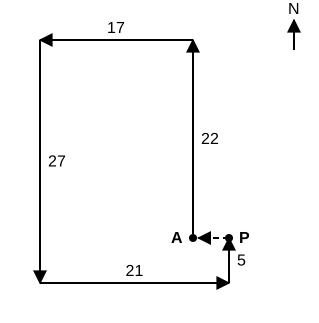
Short trick: N–S: 22 − 27 + 5 = 0; E–W: −17 + 21 = +4 east → go 4 km West.
Answer: (D) 4 km to the west
अवधारणा: शुद्ध पूर्व–पश्चिम और उत्तर–दक्षिण विस्थापन निकालें।
- उत्तर 22 → (0, 22); बाएँ (पश्चिम) 17 → (−17, 22); बाएँ (दक्षिण) 27 → (−17, −5)।
- बाएँ (पूर्व) 21 → (4, −5); बाएँ (उत्तर) 5 → P (4, 0)।
- P, A से 4 km पूर्व में → 4 km पश्चिम जाएँ।
शॉर्ट ट्रिक: उ–द: 22 − 27 + 5 = 0; पू–प: −17 + 21 = +4 → 4 km पश्चिम।
उत्तर: (D) पश्चिम की ओर 4 km
RRB ALP CBT 1General Intelligence and ReasoningDirection sense – distanceRRB ALP CBT 1 2025 · 16 Feb Shift 2
Q663.A and D are married to each other. A is the mother of L. L is the husband of P. P is the mother of U. U is the sister of O. O is the only grandson of D. How is O related to L?
A और D एक-दूसरे से विवाहित हैं। A, L की माता है। L, P का पति है। P, U की माता है। U, O की बहन है। O, D का इकलौता पोता है। O, L से किस प्रकार संबंधित है?
- AFatherपिता
- BSonपुत्र
- CFather's fatherपिता के पिता
- DDaughterपुत्री
Show answer
Concept: Draw the family tree generation-wise.
- A (mother) and D (father) → child L.
- L (husband) and P (wife) → children U (sister) and O.
- O is D’s only grandson → O is male → O is the son of L.
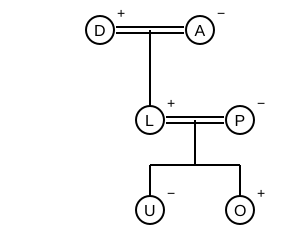
Short trick: “Grandson” fixes gender = male; O is in the generation below L → Son.
Answer: (B) Son
अवधारणा: पीढ़ीवार वंश-वृक्ष बनाएँ।
- A (माता) और D (पिता) → संतान L।
- L (पति) और P (पत्नी) → संतानें U (बहन) और O।
- O, D का इकलौता पोता → पुरुष → O, L का पुत्र है।
शॉर्ट ट्रिक: “पोता” से लिंग पुरुष तय; O, L से एक पीढ़ी नीचे → पुत्र।
उत्तर: (B) पुत्र
RRB ALP CBT 1General Intelligence and ReasoningBlood relationRRB ALP CBT 1 2025 · 16 Feb Shift 2
Q664.49 is related to 99 following a certain logic. Following the same logic, 73 is related to 147. To which of the given options is 26 related, following the same logic?
(NOTE: Operations should be performed on the whole numbers, without breaking down the numbers into their constituent digits. E.g. 13 – Operations on 13 such as adding/subtracting/multiplying to 13 can be performed. Breaking down 13 into 1 and 3 and then performing mathematical operations on 1 and 3 is not allowed.)
किसी निश्चित तर्क के अनुसार 49, 99 से संबंधित है। उसी तर्क के अनुसार, 73, 147 से संबंधित है। समान तर्क का अनुसरण करते हुए, 26 दिए गए विकल्पों में से किससे संबंधित है?
(ध्यान दें: संक्रियाएँ पूर्ण संख्याओं पर की जानी चाहिए, संख्याओं को उनके घटक अंकों में विभाजित किए बिना। उदाहरण के लिए 13 – 13 पर संक्रियाएँ जैसे 13 में जोड़ना/घटाना/गुणा करना की जा सकती हैं। 13 को 1 और 3 में विभाजित करके फिर 1 और 3 पर गणितीय संक्रियाएँ करने की अनुमति नहीं है।)
- A53
- B62
- C59
- D64
Show answer
Concept: Find a rule that works for both pairs.
- 49 × 2 + 1 = 99; 73 × 2 + 1 = 147 ✔
- 26 × 2 + 1 = 53
Short trick: Result is always odd and ≈ double → 53 is the only odd value near 52.
Answer: (A) 53
अवधारणा: दोनों युग्मों पर लागू नियम खोजें।
- 49 × 2 + 1 = 99; 73 × 2 + 1 = 147 ✔
- 26 × 2 + 1 = 53
शॉर्ट ट्रिक: परिणाम हमेशा विषम और लगभग दोगुना → 53।
उत्तर: (A) 53
RRB ALP CBT 1General Intelligence and ReasoningNumber analogyRRB ALP CBT 1 2025 · 16 Feb Shift 2
Q665.Two sets of numbers are given below. In each set of numbers, a certain mathematical operation on the first number results in the second number. Similarly, certain mathematical operation on the second number results in the third number and so on. Which of the given options follows the same set of operations as in the given sets?
(NOTE – A two/three digit number cannot be broken into individual digits for operations e.g. if 37 is followed by 10, the operation cannot be 3+7 as a two digit number cannot be broken into individual digits)
42 - 45 - 270 - 265
25 - 28 - 168 - 163
नीचे संख्याओं के दो समुच्चय दिए गए हैं। प्रत्येक समुच्चय में, पहली संख्या पर एक निश्चित गणितीय संक्रिया करने पर दूसरी संख्या प्राप्त होती है। इसी प्रकार, दूसरी संख्या पर एक निश्चित गणितीय संक्रिया करने पर तीसरी संख्या प्राप्त होती है, और इसी तरह आगे भी। दिए गए विकल्पों में से कौन-सा विकल्प दिए गए समुच्चयों की तरह संक्रियाओं के समान समुच्चय का अनुसरण करता है?
(ध्यान दें – दो/तीन अंकों वाली संख्या को संक्रियाओं के लिए अलग-अलग अंकों में विभाजित नहीं किया जा सकता, उदाहरण के लिए यदि 37 के बाद 10 आता है, तो संक्रिया 3+7 नहीं हो सकती क्योंकि दो अंकों वाली संख्या को अलग-अलग अंकों में विभाजित नहीं किया जा सकता)
42 - 45 - 270 - 265
25 - 28 - 168 - 163
- A33 - 34 - 204 - 193
- B28 - 39 - 156 - 153
- C20 - 23 - 138 - 133
- D12 - 23 - 46 - 37
Show answer
Concept: Rule: +3, ×6, −5.
- 42 + 3 = 45, × 6 = 270, − 5 = 265; 25 → 28 → 168 → 163.
- C: 20 + 3 = 23, × 6 = 138, − 5 = 133 ✔
- A: 33 + 3 ≠ 34; B: 28 + 3 ≠ 39; D: 12 + 3 ≠ 23.
Short trick: First step “+3” alone eliminates A, B, D.
Answer: (C) 20 - 23 - 138 - 133
अवधारणा: नियम: +3, ×6, −5।
- 42 → 45 → 270 → 265; 25 → 28 → 168 → 163।
- C: 20 → 23 → 138 → 133 ✔
- A, B, D में पहला चरण +3 नहीं।
शॉर्ट ट्रिक: केवल पहला चरण “+3” ही A, B, D को हटा देता है।
उत्तर: (C) 20 - 23 - 138 - 133
RRB ALP CBT 1General Intelligence and ReasoningNumber sets – operationsRRB ALP CBT 1 2025 · 16 Feb Shift 2
Q666.If the frequency of a sound wave increases and the speed remains constant, its wavelength will:
यदि किसी ध्वनि तरंग की आवृत्ति बढ़ जाती है और चाल स्थिर रहती है, तो उसकी तरंगदैर्ध्य:
- Aincreaseबढ़ जाएगी
- Bbecome zeroशून्य हो जाएगी
- Cremain the sameसमान रहेगी
- Ddecreaseघट जाएगी
Show answer
Concept: Wave speed .
- If is constant, , i.e. .
- So when frequency increases, wavelength decreases.
Short trick: Constant speed ⇒ f and λ are inverse partners: one up, the other down (like a see-saw).
Answer: (D) decrease
अवधारणा: तरंग की चाल ।
- स्थिर हो तो , अर्थात ।
- अतः आवृत्ति बढ़ने पर तरंगदैर्ध्य घटती है।
शॉर्ट ट्रिक: चाल स्थिर ⇒ f और λ व्युत्क्रमानुपाती — एक ऊपर तो दूसरा नीचे (सी-सॉ की तरह)।
उत्तर: (D) घट जाएगी
RRB ALP CBT 1General ScienceWaves – v = fλRRB ALP CBT 1 2025 · 16 Feb Shift 2
Q667.Which type of cell has very small vacuoles?
किस प्रकार की कोशिका में बहुत छोटी रिक्तिकाएँ होती हैं?
- APlant cellपादप कोशिका
- BBacterial cellजीवाणु कोशिका
- CFungal cellकवक कोशिका
- DAnimal cellजंतु कोशिका
Show answer
Concept: Vacuoles are storage sacs; their size differs in plant and animal cells.
- Plant cells have one large central vacuole (up to 50–90% of cell volume) giving turgidity.
- Animal cells have small and few (or temporary) vacuoles.
Short trick: Memory hook: “Plant = Pool (big vacuole), Animal = drops (tiny vacuoles)”.
Answer: (D) Animal cell
अवधारणा: रिक्तिकाएँ भंडारण थैलियाँ हैं; पादप और जंतु कोशिका में इनका आकार अलग होता है।
- पादप कोशिका में एक बड़ी केंद्रीय रिक्तिका होती है जो स्फीति देती है।
- जंतु कोशिका में रिक्तिकाएँ छोटी और कम होती हैं।
शॉर्ट ट्रिक: याद रखें: “पादप = तालाब (बड़ी रिक्तिका), जंतु = बूँदें (छोटी रिक्तिकाएँ)”।
उत्तर: (D) जंतु कोशिका
RRB ALP CBT 1General ScienceCell – vacuolesRRB ALP CBT 1 2025 · 16 Feb Shift 2
Q668.The colour of scattered light depends on the size of the scattering particles. Very fine particles scatter mainly which colour of light?
प्रकीर्णित प्रकाश का रंग प्रकीर्णन करने वाले कणों के आकार पर निर्भर करता है। अत्यंत सूक्ष्म कण मुख्य रूप से किस रंग के प्रकाश का प्रकीर्णन करते हैं?
- ABlue lightनीला प्रकाश
- BRed lightलाल प्रकाश
- CGreen lightहरा प्रकाश
- DYellow lightपीला प्रकाश
Show answer
Concept: Very fine particles (smaller than wavelength) scatter shorter wavelengths more (Rayleigh: intensity ∝ ).
- Blue has a shorter wavelength than red/yellow/green, so it is scattered most.
- Hence the sky looks blue; larger particles scatter all colours (white clouds).
Short trick: Hook: “Tiny particles – tiny wavelength – blue”; big particles – white.
Answer: (A) Blue light
अवधारणा: अत्यंत सूक्ष्म कण छोटी तरंगदैर्ध्य को अधिक प्रकीर्णित करते हैं (रैले: तीव्रता ∝ )।
- नीले रंग की तरंगदैर्ध्य लाल/पीले/हरे से कम है, इसलिए यह सबसे अधिक प्रकीर्णित होता है।
- इसी कारण आकाश नीला दिखता है; बड़े कण सभी रंग प्रकीर्णित करते हैं (सफ़ेद बादल)।
शॉर्ट ट्रिक: याद रखें: “छोटे कण – छोटी तरंगदैर्ध्य – नीला”; बड़े कण – सफ़ेद।
उत्तर: (A) नीला प्रकाश
RRB ALP CBT 1General ScienceLight – scatteringRRB ALP CBT 1 2025 · 16 Feb Shift 2
Q669.What is the product when ethanol reacts with sodium?
एथेनॉल की सोडियम के साथ अभिक्रिया का उत्पाद क्या है?
- ASodium ethoxide and hydrogen gas evolve during the reaction with ethanol.एथेनॉल के साथ अभिक्रिया में सोडियम एथॉक्साइड और हाइड्रोजन गैस निकलती है।
- BSodium hydroxide and oxygen gas evolve during the reaction with ethanol.एथेनॉल के साथ अभिक्रिया में सोडियम हाइड्रॉक्साइड और ऑक्सीजन गैस निकलती है।
- CSodium oxide and water evolve during the reaction with ethanol only.केवल एथेनॉल के साथ अभिक्रिया में सोडियम ऑक्साइड और जल निकलते हैं।
- DSodium carbonate and hydrogen gas evolve during the reaction with ethanol.एथेनॉल के साथ अभिक्रिया में सोडियम कार्बोनेट और हाइड्रोजन गैस निकलती है।
Show answer
Concept:
- Sodium replaces H of the –OH group, forming sodium ethoxide.
- Hydrogen gas is evolved (burns with a pop sound) – a test for alcohols.
Short trick: Like Na + water gives NaOH + H₂, Na + ethanol gives NaOEt + H₂ — “active metal + –OH → H₂”.
Answer: (A) Sodium ethoxide and hydrogen gas
अवधारणा:
- सोडियम –OH के H को प्रतिस्थापित कर सोडियम एथॉक्साइड बनाता है।
- हाइड्रोजन गैस निकलती है (पॉप ध्वनि के साथ जलती है)।
शॉर्ट ट्रिक: जैसे Na + जल → NaOH + H₂, वैसे Na + एथेनॉल → NaOEt + H₂ — “सक्रिय धातु + –OH → H₂”।
उत्तर: (A) सोडियम एथॉक्साइड और हाइड्रोजन गैस
RRB ALP CBT 1General ScienceCarbon compounds – ethanol + sodiumRRB ALP CBT 1 2025 · 16 Feb Shift 2
Q670.When an object is placed at infinity in front of a convex lens, the image formed is:
जब किसी वस्तु को उत्तल लेंस के सामने अनंत पर रखा जाता है, तो बनने वाला प्रतिबिंब होता है:
- AReal, inverted, and at the focusवास्तविक, उल्टा और फोकस पर
- BReal, erect, and at 2Fवास्तविक, सीधा और 2F पर
- CVirtual, erect, and at infinityआभासी, सीधा और अनंत पर
- DVirtual, inverted, and at the focusआभासी, उल्टा और फोकस पर
Show answer
Concept: Rays from an object at infinity arrive parallel to the principal axis.
- A convex lens converges parallel rays to its principal focus F.
- The image is real, inverted and highly diminished (point-sized), at F.
Short trick: Hook: “Infinity ⇄ Focus” — object at ∞ gives image at F, object at F gives image at ∞.
Answer: (A) Real, inverted, and at the focus
अवधारणा: अनंत पर रखी वस्तु से किरणें मुख्य अक्ष के समांतर आती हैं।
- उत्तल लेंस समांतर किरणों को मुख्य फोकस F पर अभिसरित करता है।
- प्रतिबिंब वास्तविक, उल्टा और अत्यधिक छोटा (बिंदु आकार) F पर बनता है।
शॉर्ट ट्रिक: याद रखें: “अनंत ⇄ फोकस” — वस्तु ∞ पर तो प्रतिबिंब F पर, वस्तु F पर तो प्रतिबिंब ∞ पर।
उत्तर: (A) वास्तविक, उल्टा और फोकस पर
RRB ALP CBT 1General ScienceLenses – convex lens imageRRB ALP CBT 1 2025 · 16 Feb Shift 2
Q671.Which of the following option is INCORRECT about plasma membrane?
प्लाज्मा झिल्ली के बारे में निम्नलिखित में से कौन-सा विकल्प गलत है?
- AIt is outermost covering of the cellयह कोशिका का सबसे बाहरी आवरण है
- BPlasma membrane is made up of lipid and proteinप्लाज्मा झिल्ली लिपिड और प्रोटीन से बनी होती है
- CIt is selectively permeableयह वरणात्मक पारगम्य है
- DIt is rigid in natureयह प्रकृति में दृढ़ (कठोर) होती है
Show answer
Concept: Plasma membrane is a thin, flexible lipid–protein layer that controls entry and exit.
- It is the outermost layer of animal cells, made of lipids and proteins, and selectively permeable – A, B, C are correct.
- It is flexible (allows endocytosis); the rigid layer is the cell wall of plants.
Short trick: Hook: “Membrane = flexible gatekeeper; Wall = rigid guard”.
Answer: (D) It is rigid in nature
अवधारणा: प्लाज्मा झिल्ली एक पतली, लचीली लिपिड–प्रोटीन परत है जो पदार्थों के आवागमन को नियंत्रित करती है।
- यह कोशिका की बाहरी परत है, लिपिड और प्रोटीन से बनी, वरणात्मक पारगम्य है — A, B, C सही।
- यह लचीली होती है (एंडोसाइटोसिस संभव); दृढ़ परत पादपों की कोशिका भित्ति है।
शॉर्ट ट्रिक: याद रखें: “झिल्ली = लचीला द्वारपाल; भित्ति = कठोर रक्षक”।
उत्तर: (D) यह प्रकृति में दृढ़ होती है
RRB ALP CBT 1General ScienceCell – plasma membraneRRB ALP CBT 1 2025 · 16 Feb Shift 2
Q672.Substances degraded easily by the biological processes are called as ________.
जैविक प्रक्रमों द्वारा आसानी से अपघटित होने वाले पदार्थ ________ कहलाते हैं।
- ASoft materialमृदु पदार्थ
- BBiodegradableजैव निम्नीकरणीय
- CHard materialकठोर पदार्थ
- DNon-biodegradableजैव अनिम्नीकरणीय
Show answer
Concept: Substances broken down by microbes (bacteria, fungi) are biodegradable.
- Examples: vegetable peels, paper, cotton, cow dung.
- Plastic, glass, DDT are non-biodegradable.
Short trick: Hook: “Bio-degradable = broken by bio (living) agents”.
Answer: (B) Biodegradable
अवधारणा: जो पदार्थ सूक्ष्मजीवों (जीवाणु, कवक) द्वारा अपघटित होते हैं, वे जैव निम्नीकरणीय हैं।
- उदाहरण: सब्ज़ियों के छिलके, कागज़, सूती कपड़ा, गोबर।
- प्लास्टिक, काँच, DDT जैव अनिम्नीकरणीय हैं।
शॉर्ट ट्रिक: याद रखें: “जैव-निम्नीकरणीय = जीवों द्वारा तोड़ा गया”।
उत्तर: (B) जैव निम्नीकरणीय
RRB ALP CBT 1General ScienceEnvironment – biodegradableRRB ALP CBT 1 2025 · 16 Feb Shift 2
Q673.When a drop of ink is placed in water, it spreads evenly without stirring. What does this demonstrate?
जब पानी में स्याही की एक बूँद डाली जाती है, तो वह बिना हिलाए समान रूप से फैल जाती है। यह क्या प्रदर्शित करता है?
- AParticles are at restकण विराम अवस्था में हैं
- BParticles are heavy and settle downकण भारी हैं और नीचे बैठ जाते हैं
- CParticles of matter are constantly movingद्रव्य के कण निरंतर गतिशील रहते हैं
- DWater reacts with inkपानी स्याही के साथ अभिक्रिया करता है
Show answer
Concept: Spreading of ink in water without stirring is diffusion.
- Diffusion happens because particles of matter are continuously moving and intermix.
- It is faster in hot water (particles have more kinetic energy).
Short trick: Hook: “Diffusion = particles dancing on their own”.
Answer: (C) Particles of matter are constantly moving
अवधारणा: बिना हिलाए स्याही का पानी में फैलना विसरण है।
- विसरण इसलिए होता है क्योंकि द्रव्य के कण निरंतर गति करते और आपस में मिलते रहते हैं।
- गर्म पानी में यह तेज़ होता है (कणों की गतिज ऊर्जा अधिक)।
शॉर्ट ट्रिक: याद रखें: “विसरण = कणों का अपने-आप नाचना”।
उत्तर: (C) द्रव्य के कण निरंतर गतिशील रहते हैं
RRB ALP CBT 1General ScienceMatter – particles in motion (diffusion)RRB ALP CBT 1 2025 · 16 Feb Shift 2
Q674.The Directive Principles of State Policy in the Indian Constitution ____________.
भारतीय संविधान में राज्य के नीति निदेशक तत्व ____________।
- ACannot be questioned in courtsन्यायालयों में प्रश्नगत नहीं किए जा सकते
- BOverride Fundamental Rights in courtsन्यायालयों में मौलिक अधिकारों पर अधिभावी होते हैं
- CAre enforceable by courtsन्यायालयों द्वारा प्रवर्तनीय हैं
- DAre not enforceable by any courtकिसी भी न्यायालय द्वारा प्रवर्तनीय नहीं हैं
Show answer
Concept: Article 37 (Part IV): DPSP are not enforceable by any court, yet fundamental in governance.
- DPSP are non-justiciable; Fundamental Rights (Part III) are justiciable.
- They do not override Fundamental Rights; courts only use them to interpret laws.
Short trick: Hook: “Part IV = Policy guidance, not Police enforcement” — Art. 37 says so in plain words.
Answer: (D) Are not enforceable by any court
अवधारणा: अनुच्छेद 37 (भाग IV): नीति निदेशक तत्व किसी भी न्यायालय द्वारा प्रवर्तनीय नहीं हैं, फिर भी शासन में मूलभूत हैं।
- DPSP गैर-न्यायोचित हैं; मौलिक अधिकार (भाग III) न्यायोचित हैं।
- ये मौलिक अधिकारों पर अधिभावी नहीं होते।
शॉर्ट ट्रिक: याद रखें: “भाग IV = मार्गदर्शन, बाध्यता नहीं” — अनु. 37।
उत्तर: (D) किसी भी न्यायालय द्वारा प्रवर्तनीय नहीं हैं
RRB ALP CBT 1General AwarenessPolity – DPSPRRB ALP CBT 1 2025 · 16 Feb Shift 2
Q675.Which organisation hosted the National Agro-RE Summit 2025?
राष्ट्रीय एग्रो-आरई शिखर सम्मेलन 2025 (National Agro-RE Summit 2025) की मेज़बानी किस संगठन ने की?
- AIndian Renewable Energy Development Agencyभारतीय अक्षय ऊर्जा विकास संस्था (IREDA)
- BNational Solar Energy Federation of Indiaनेशनल सोलर एनर्जी फेडरेशन ऑफ इंडिया (NSEFI)
- CNITI Aayogनीति आयोग
- DMinistry of Powerविद्युत मंत्रालय
Show answer
Concept: The National Agro-RE Summit 2025 in New Delhi was organised by the National Solar Energy Federation of India (NSEFI).
- Theme: using renewable energy (solar pumps, agri-PV) in agriculture, linked with PM-KUSUM.
- Union Agriculture Minister Shivraj Singh Chouhan addressed the summit.
Short trick: Hook: “Agro + RE (solar) → Solar federation (NSEFI)”.
Answer: (B) National Solar Energy Federation of India
अवधारणा: नई दिल्ली में राष्ट्रीय एग्रो-आरई शिखर सम्मेलन 2025 का आयोजन नेशनल सोलर एनर्जी फेडरेशन ऑफ इंडिया (NSEFI) ने किया।
- विषय: कृषि में अक्षय ऊर्जा (सोलर पंप, एग्री-PV), PM-KUSUM से जुड़ा।
- केंद्रीय कृषि मंत्री शिवराज सिंह चौहान ने संबोधित किया।
शॉर्ट ट्रिक: याद रखें: “एग्रो + RE (सौर) → सौर फेडरेशन (NSEFI)”।
उत्तर: (B) नेशनल सोलर एनर्जी फेडरेशन ऑफ इंडिया
RRB ALP CBT 1General AwarenessCurrent affairs – summits 2025RRB ALP CBT 1 2025 · 16 Feb Shift 2
Q676.The sum of the present ages of Bunty and Bubbly is 24 years. After 2 years from now, Bunty's age will be three times that of Bubbly's age. Bunty's present age (in years) is:
बंटी और बबली की वर्तमान आयु का योग 24 वर्ष है। अब से 2 वर्ष बाद, बंटी की आयु बबली की आयु की तीन गुनी होगी। बंटी की वर्तमान आयु (वर्षों में) कितनी है?
- A28
- B17
- C22
- D19
Show answer
Concept: Form an equation using the condition 2 years later.
- Let Bubbly = , Bunty = .
- After 2 years: ⇒ ⇒ .
- Bunty = 24 − 5 = 19 years.
Short trick: After 2 years the total is 28 and the ratio is 3 : 1 → Bunty = then; now 21 − 2 = 19.
Answer: (D) 19
अवधारणा: 2 वर्ष बाद की शर्त से समीकरण बनाएँ।
- माना बबली = , बंटी = ।
- 2 वर्ष बाद: ⇒ ⇒ ।
- बंटी = 24 − 5 = 19 वर्ष।
शॉर्ट ट्रिक: 2 वर्ष बाद योग 28 और अनुपात 3 : 1 → तब बंटी = ; अभी 21 − 2 = 19।
उत्तर: (D) 19
RRB ALP CBT 1MathematicsProblems on agesRRB ALP CBT 1 2025 · 16 Feb Shift 1
Q677.A student's marks were incorrectly entered as 84 instead of 94. Due to this, the average marks of the class got decreased by . What is the number of students in the class?
एक छात्र के अंक 94 के बजाय गलती से 84 दर्ज किए गए। इसके कारण कक्षा के औसत अंक कम हो गए। कक्षा में छात्रों की संख्या कितनी है?
- A4
- B8
- C15
- D17
Show answer
Concept: Change in total = (change in average) × (number of students).
- Total marks fell by 94 − 84 = 10.
- Fall in average = .
- Number of students = .
Short trick: n = (error in total) ÷ (change in average) = .
Answer: (B) 8
अवधारणा: कुल में परिवर्तन = (औसत में परिवर्तन) × (छात्रों की संख्या)।
- कुल अंक 94 − 84 = 10 कम हुए।
- औसत में कमी = ।
- छात्रों की संख्या = ।
शॉर्ट ट्रिक: n = (कुल में त्रुटि) ÷ (औसत में परिवर्तन) = ।
उत्तर: (B) 8
RRB ALP CBT 1MathematicsAverage – wrong entryRRB ALP CBT 1 2025 · 16 Feb Shift 1
Q678.A boat running downstream covers a distance of 18 km in 3 hours while it covers the same distance upstream in 9 hours. The speed of the boat in still water is:
एक नाव धारा के अनुकूल 18 km की दूरी 3 घंटे में तय करती है, जबकि वही दूरी धारा के प्रतिकूल 9 घंटे में तय करती है। शांत जल में नाव की चाल कितनी है?
- A6 km/hr6 km/घंटा
- B4 km/hr4 km/घंटा
- C2 km/hr2 km/घंटा
- D8 km/hr8 km/घंटा
Show answer
Concept: Speed in still water = .
- Downstream speed = 18 ÷ 3 = 6 km/hr.
- Upstream speed = 18 ÷ 9 = 2 km/hr.
- Boat speed = (6 + 2) ÷ 2 = 4 km/hr (stream = 2 km/hr).
Short trick: Boat = average of the two speeds; stream = half their difference.
Answer: (B) 4 km/hr
अवधारणा: शांत जल में चाल = ।
- धारा के अनुकूल चाल = 18 ÷ 3 = 6 km/घंटा।
- धारा के प्रतिकूल चाल = 18 ÷ 9 = 2 km/घंटा।
- नाव की चाल = (6 + 2) ÷ 2 = 4 km/घंटा (धारा = 2 km/घंटा)।
शॉर्ट ट्रिक: नाव = दोनों चालों का औसत; धारा = उनके अंतर का आधा।
उत्तर: (B) 4 km/घंटा
RRB ALP CBT 1MathematicsBoats and streamsRRB ALP CBT 1 2025 · 16 Feb Shift 1
Q679.A, B and C together can complete a task in 20 days. A and B together can do it in 30 days, and B and C together can do it in 24 days. How long would B alone take to complete the entire work?
A, B और C मिलकर एक कार्य को 20 दिनों में पूरा कर सकते हैं। A और B मिलकर इसे 30 दिनों में, तथा B और C मिलकर इसे 24 दिनों में कर सकते हैं। B अकेले पूरा कार्य कितने दिनों में पूरा करेगा?
- A48 days48 दिन
- B40 days40 दिन
- C45 days45 दिन
- D54 days54 दिन
Show answer
Concept: Use LCM of 20, 30, 24 = 120 units as total work.
- A+B+C = 120/20 = 6 units/day; A+B = 120/30 = 4; B+C = 120/24 = 5.
- C = 6 − 4 = 2, A = 6 − 5 = 1, so B = 4 − 1 = 3 units/day.
- B alone = 120 ÷ 3 = 40 days.
Short trick: B = (A+B) + (B+C) − (A+B+C) = 4 + 5 − 6 = 3 units/day → 120/3 = 40.
Answer: (B) 40 days
अवधारणा: कुल कार्य = 20, 30, 24 का LCM = 120 इकाई लें।
- A+B+C = 120/20 = 6 इकाई/दिन; A+B = 120/30 = 4; B+C = 120/24 = 5।
- C = 6 − 4 = 2, A = 6 − 5 = 1, अतः B = 4 − 1 = 3 इकाई/दिन।
- B अकेले = 120 ÷ 3 = 40 दिन।
शॉर्ट ट्रिक: B = (A+B) + (B+C) − (A+B+C) = 4 + 5 − 6 = 3 इकाई/दिन → 120/3 = 40।
उत्तर: (B) 40 दिन
RRB ALP CBT 1MathematicsTime and work – combined ratesRRB ALP CBT 1 2025 · 16 Feb Shift 1
Q680.Anand purchased an item and spent ₹84 on its repair. He then sold it to Bharath at a profit of 25%. Later, Bharath sold the item for ₹4368, incurring a loss of 9%. What was Anand’s cost (in ₹) of the item just before selling it to Bharath?
आनंद ने एक वस्तु खरीदी और उसकी मरम्मत पर ₹84 खर्च किए। फिर उसने उसे भरत को 25% लाभ पर बेच दिया। बाद में, भरत ने वह वस्तु 9% की हानि पर ₹4368 में बेची। भरत को बेचने से ठीक पहले आनंद की वस्तु की लागत (₹ में) कितनी थी?
- A3838
- B3842
- C3839
- D3840
Show answer
Concept: Work backwards from the final selling price.
- Bharath's cost: .
- This is Anand's selling price at 25% profit on his total cost: .
- Anand's cost just before selling (price + ₹84 repair) = ₹3840.
Short trick: (note 4368 = 91 × 48).
Answer: (D) 3840
अवधारणा: अंतिम विक्रय मूल्य से पीछे की ओर गणना करें।
- भरत का क्रय मूल्य: ।
- यह आनंद का विक्रय मूल्य है जो उसकी कुल लागत पर 25% लाभ है: ।
- बेचने से ठीक पहले आनंद की लागत (मूल्य + ₹84 मरम्मत) = ₹3840।
शॉर्ट ट्रिक: (ध्यान दें 4368 = 91 × 48)।
उत्तर: (D) 3840
RRB ALP CBT 1MathematicsProfit and loss – chain sellingRRB ALP CBT 1 2025 · 16 Feb Shift 1

