Q161.In 1878, dissatisfied followers of Keshab Chandra Sen established the Sadharan Brahmo Samaj. Who among the following were its founders?
1878 में, केशव चंद्र सेन के असंतुष्ट अनुयायियों ने साधारण ब्रह्म समाज की स्थापना की। निम्नलिखित में से इसके संस्थापक कौन थे?
- ASib Chandra Deb, Rabindranath Tagore and Surendranath Banerjeeशिवचंद्र देब, रवींद्रनाथ टैगोर और सुरेंद्रनाथ बनर्जी
- BIshwar Chandra Vidyasagar, Ananda Mohan Bose and Bankim Chandra Chatterjeeईश्वरचंद्र विद्यासागर, आनंद मोहन बोस और बंकिम चंद्र चटर्जी
- CRaja Ram Mohan Roy, Debendranath Tagore and Keshab Chandra Senराजा राम मोहन राय, देवेंद्रनाथ टैगोर और केशव चंद्र सेन
- DAnanda Mohan Bose, Sib Chandra Deb and Umesh Chandra Duttaआनंद मोहन बोस, शिवचंद्र देब और उमेश चंद्र दत्त
Show answer
Concept: In 1878, after Keshab Chandra Sen married his minor daughter to the Maharaja of Cooch Behar, his followers broke away and formed the Sadharan Brahmo Samaj.
- Founders: Ananda Mohan Bose, Sib Chandra Deb, Umesh Chandra Dutta (with Shivnath Shastri).
- Raja Ram Mohan Roy founded the Brahmo Sabha (1828); Debendranath Tagore led the Adi Brahmo Samaj.
- Keshab Chandra Sen formed the Brahmo Samaj of India (1866) – the group that split.
Yaad rakhein: Brahmo splits: 1866 (Adi vs of India) → 1878 (Sadharan).
Answer: (D) Ananda Mohan Bose, Sib Chandra Deb and Umesh Chandra Dutta
अवधारणा: 1878 में केशव चंद्र सेन द्वारा अपनी नाबालिग पुत्री का विवाह कूचबिहार के महाराजा से करने पर उनके अनुयायियों ने अलग होकर साधारण ब्रह्म समाज बनाया।
- संस्थापक: आनंद मोहन बोस, शिवचंद्र देब, उमेशचंद्र दत्त (शिवनाथ शास्त्री के साथ)।
- राजा राममोहन राय ने ब्रह्म सभा (1828) स्थापित की; देवेंद्रनाथ टैगोर ने आदि ब्रह्म समाज का नेतृत्व किया।
- केशव चंद्र सेन ने भारतीय ब्रह्म समाज (1866) बनाया – जिससे यह विभाजन हुआ।
याद रखें: ब्रह्म समाज विभाजन: 1866 (आदि बनाम भारतीय) → 1878 (साधारण)।
उत्तर: (D) आनंद मोहन बोस, शिवचंद्र देब और उमेशचंद्र दत्त
RRB NTPC Graduate CBT 2General AwarenessSocio-Religious Reform MovementsRRB NTPC Graduate CBT 2 2024 · 13 Oct Shift 1
Q162.Life expectancy is an indicator of which of the following?
जीवन प्रत्याशा निम्नलिखित में से किसका एक संकेतक है?
- AHuman Development Reportमानव विकास रिपोर्ट
- BTechnology and Innovation Reportप्रौद्योगिकी और नवाचार रिपोर्ट
- CCommodities and Development Reportपण्य और विकास रिपोर्ट
- DWorld Employment Reportविश्व रोज़गार रिपोर्ट
Show answer
Concept: The UNDP's Human Development Report publishes the HDI, built on three dimensions.
- Long and healthy life – life expectancy at birth.
- Knowledge – mean and expected years of schooling.
- Decent standard of living – GNI per capita (PPP).
Yaad rakhein: HDI = Health + Education + Income (first HDR in 1990, Mahbub ul Haq and Amartya Sen).
Answer: (A) Human Development Report
अवधारणा: UNDP की मानव विकास रिपोर्ट (Human Development Report) HDI प्रकाशित करती है, जो तीन आयामों पर आधारित है।
- लंबा और स्वस्थ जीवन – जन्म के समय जीवन प्रत्याशा (life expectancy)।
- ज्ञान – स्कूली शिक्षा के औसत और अपेक्षित वर्ष।
- अच्छा जीवन स्तर – प्रति व्यक्ति GNI (PPP)।
याद रखें: HDI = स्वास्थ्य + शिक्षा + आय (पहली HDR 1990, महबूब उल हक और अमर्त्य सेन)।
उत्तर: (A) Human Development Report (मानव विकास रिपोर्ट)
RRB NTPC Graduate CBT 2General AwarenessHuman Development Index (Economy)RRB NTPC Graduate CBT 2 2024 · 13 Oct Shift 1
Q163.Which of the following traditional dance forms in India incorporates the use of a pair of decorated sticks and is traditionally performed during Navratri?
भारत के निम्नलिखित में से किस पारंपरिक नृत्य रूप में सजी हुई डंडियों के जोड़े का उपयोग होता है और इसे पारंपरिक रूप से नवरात्रि के दौरान किया जाता है?
- ABhangraभांगड़ा
- BBihuबिहू
- CKoliकोली
- DDandiyaडांडिया
Show answer
Concept: Dandiya Raas of Gujarat is danced with a pair of decorated sticks (dandiyas) during Navratri.
- It depicts a mock fight between Goddess Durga and Mahishasura; the sticks represent swords.
- Garba is the other Navratri dance of Gujarat, done with clapping in circles.
- Bhangra – Punjab (harvest), Bihu – Assam, Koli – fishermen of Maharashtra.
Yaad rakhein: Navratri + sticks = Dandiya; Navratri + clapping in circles = Garba.
Answer: (D) Dandiya
अवधारणा: गुजरात का डांडिया रास नवरात्रि में सजी हुई डंडियों (dandiyas) की जोड़ी के साथ किया जाता है।
- यह देवी दुर्गा और महिषासुर के युद्ध का प्रतीक है; डंडियाँ तलवारों का प्रतीक हैं।
- गरबा गुजरात का दूसरा नवरात्रि नृत्य है, जो ताली बजाते हुए घेरे में होता है।
- भांगड़ा – पंजाब (फसल), बिहू – असम, कोली – महाराष्ट्र के मछुआरे।
याद रखें: नवरात्रि + डंडी = डांडिया; नवरात्रि + ताली, घेरा = गरबा।
उत्तर: (D) डांडिया
RRB NTPC Graduate CBT 2General AwarenessFolk Dances of India (Culture)RRB NTPC Graduate CBT 2 2024 · 13 Oct Shift 1
Q164.Why does evaporation cause cooling?
वाष्पीकरण से शीतलन क्यों होता है?
- ABecause evaporation increases particle sizeक्योंकि वाष्पीकरण से कणों का आकार बढ़ता है
- BBecause evaporation reduces air pressureक्योंकि वाष्पीकरण से वायु दाब कम होता है
- CBecause particles lose heat to the surroundings during evaporationक्योंकि वाष्पीकरण के दौरान कण परिवेश को ऊष्मा खो देते हैं
- DBecause particles absorb latent heat from the surroundings during evaporationक्योंकि वाष्पीकरण के दौरान कण परिवेश से गुप्त ऊष्मा (latent heat) अवशोषित करते हैं
Show answer
Concept: During evaporation, surface particles need energy (latent heat of vaporisation) to escape; they take it from the liquid and surroundings, which therefore cool.
- Only high-energy particles escape, so the average kinetic energy of the remaining liquid falls.
- The lost heat is replaced by absorbing heat from the surroundings → cooling.
- Examples: sweating, water in an earthen pot (matka), acetone on palm.
Yaad rakhein: Evaporation = absorbs heat → cooling effect.
Answer: (D) Because particles absorb latent heat from the surroundings during evaporation
अवधारणा: वाष्पन में सतह के कणों को बाहर निकलने हेतु ऊर्जा (वाष्पन की गुप्त ऊष्मा – latent heat) चाहिए; वे इसे द्रव और परिवेश से लेते हैं, इसलिए परिवेश ठंडा होता है।
- केवल अधिक ऊर्जा वाले कण निकलते हैं, अतः बचे द्रव की औसत गतिज ऊर्जा घटती है।
- इस ऊष्मा की पूर्ति परिवेश से ऊष्मा अवशोषित करके होती है → ठंडक।
- उदाहरण: पसीना, मटके का पानी, हथेली पर एसीटोन।
याद रखें: वाष्पन = ऊष्मा अवशोषण → शीतलन प्रभाव।
उत्तर: (D) क्योंकि वाष्पन के दौरान कण परिवेश से गुप्त ऊष्मा अवशोषित करते हैं
RRB NTPC Graduate CBT 2General AwarenessEvaporation (Chemistry)RRB NTPC Graduate CBT 2 2024 · 13 Oct Shift 1
Q165.What happens to the speed of sound in a medium when its temperature increases?
किसी माध्यम का तापमान बढ़ने पर उसमें ध्वनि की चाल का क्या होता है?
- AIt decreases.यह घटती है।
- BIt increases.यह बढ़ती है।
- CIt remains the same.यह समान रहती है।
- DIt is not affected by the temperature.यह तापमान से प्रभावित नहीं होती।
Show answer
Concept: Speed of sound in a medium increases with temperature, because particles vibrate faster and pass on the disturbance quicker.
- In air, ( in ).
- At about 331 m/s; at about 346 m/s.
- Sound is also faster in solids than liquids, and in liquids than gases.
Yaad rakhein: Roughly for every rise.
Answer: (B) It increases.
अवधारणा: किसी माध्यम में ताप बढ़ने पर ध्वनि की चाल बढ़ती है, क्योंकि कण तेज़ी से कंपन कर विक्षोभ जल्दी आगे बढ़ाते हैं।
- वायु में (, में)।
- पर लगभग 331 m/s; पर लगभग 346 m/s।
- ध्वनि ठोस में द्रव से और द्रव में गैस से तेज़ चलती है।
याद रखें: हर वृद्धि पर लगभग ।
उत्तर: (B) यह बढ़ती है।
RRB NTPC Graduate CBT 2General AwarenessSpeed of Sound (Physics)RRB NTPC Graduate CBT 2 2024 · 13 Oct Shift 1
Q166.The reservation of seats for women in Panchayati Raj institutions is provided by which of the following Constitutional amendments?
पंचायती राज संस्थाओं में महिलाओं के लिए सीटों का आरक्षण निम्नलिखित में से किस संविधान संशोधन द्वारा प्रदान किया गया है?
- A75th Amendment75वाँ संशोधन
- B74th Amendment74वाँ संशोधन
- C73rd Amendment73वाँ संशोधन
- D70th Amendment70वाँ संशोधन
Show answer
Concept: The 73rd Constitutional Amendment Act, 1992 (in force 24 April 1993) gave constitutional status to Panchayati Raj institutions.
- Article 243D reserves not less than one-third of seats (and chairperson posts) for women.
- The 74th Amendment did the same for urban local bodies (Municipalities).
- 24 April is celebrated as National Panchayati Raj Day.
Yaad rakhein: 73 = Village (Panchayat), 74 = City (Municipality).
Answer: (C) 73rd Amendment
अवधारणा: 73वें संविधान संशोधन अधिनियम, 1992 (24 अप्रैल 1993 से लागू) ने पंचायती राज संस्थाओं को संवैधानिक दर्जा दिया।
- अनुच्छेद 243D महिलाओं के लिए कम से कम एक-तिहाई सीटें (और अध्यक्ष पद) आरक्षित करता है।
- 74वें संशोधन ने यही शहरी स्थानीय निकायों (नगरपालिकाओं) के लिए किया।
- 24 अप्रैल राष्ट्रीय पंचायती राज दिवस के रूप में मनाया जाता है।
याद रखें: 73 = गाँव (पंचायत), 74 = शहर (नगरपालिका)।
उत्तर: (C) 73वाँ संशोधन
RRB NTPC Graduate CBT 2General AwarenessPanchayati Raj (Polity)RRB NTPC Graduate CBT 2 2024 · 13 Oct Shift 1
Q167.Which statement about lyophilic sols is correct?
द्रवरागी सॉल (lyophilic sols) के बारे में कौन-सा कथन सही है?
- AThey do not show the Tyndall effect.वे टिंडल प्रभाव नहीं दर्शाते।
- BThey have strong affinity for the dispersion medium.परिक्षेपण माध्यम के प्रति उनकी प्रबल बंधुता होती है।
- CThey are unstable compared to lyophobic sols.वे द्रवविरागी सॉल की तुलना में अस्थायी होते हैं।
- DThey are easily coagulated by electrolytes.वे विद्युत अपघट्यों द्वारा आसानी से स्कंदित हो जाते हैं।
Show answer
Concept: Lyophilic ("solvent-loving") sols have strong affinity for the dispersion medium, e.g. starch, gum, gelatin in water.
- Because they are well solvated, they are stable and reversible.
- They are not easily coagulated by electrolytes – that is a property of lyophobic sols.
- Like all colloids, they do show the Tyndall effect (though weakly).
Yaad rakhein: Lyo-philic = love of solvent = stable; lyo-phobic = fear of solvent = unstable.
Answer: (B) They have strong affinity for the dispersion medium.
अवधारणा: द्रवरागी (lyophilic, "विलायक-प्रेमी") सॉल का परिक्षेपण माध्यम से प्रबल आकर्षण होता है, जैसे पानी में स्टार्च, गोंद, जिलेटिन।
- अच्छी तरह विलायकित होने से ये स्थायी और उत्क्रमणीय (reversible) होते हैं।
- विद्युत-अपघट्यों से आसानी से स्कंदित (coagulate) नहीं होते – यह द्रवविरागी (lyophobic) सॉल का गुण है।
- सभी कोलॉइड की तरह ये भी टिंडल प्रभाव दिखाते हैं (हल्का)।
याद रखें: Lyophilic = विलायक प्रेमी = स्थायी; Lyophobic = विलायक विरागी = अस्थायी।
उत्तर: (B) इनका परिक्षेपण माध्यम से प्रबल आकर्षण होता है।
RRB NTPC Graduate CBT 2General AwarenessColloids (Chemistry)RRB NTPC Graduate CBT 2 2024 · 13 Oct Shift 1
Q168.The Brundtland Report, 'Our Common Future' (1987), formally introduced which key concept, defined as meeting present needs without compromising the ability of future generations to meet their own?
ब्रंटलैंड रिपोर्ट, ‘हमारा साझा भविष्य (Our Common Future)’ (1987) ने औपचारिक रूप से किस प्रमुख अवधारणा को प्रस्तुत किया, जिसे भावी पीढ़ियों की अपनी आवश्यकताओं को पूरा करने की क्षमता से समझौता किए बिना वर्तमान आवश्यकताओं को पूरा करने के रूप में परिभाषित किया गया है?
- AGreen Economyहरित अर्थव्यवस्था
- BInclusive Growthसमावेशी विकास
- CSustainable Developmentसतत विकास
- DEcological Modernisationपारिस्थितिक आधुनिकीकरण
Show answer
Concept: The Brundtland Commission (World Commission on Environment and Development) gave the classic definition of Sustainable Development in "Our Common Future" (1987).
- Definition: development that meets the needs of the present without compromising the ability of future generations to meet their own needs.
- The commission was chaired by Gro Harlem Brundtland, former PM of Norway.
- The idea led to the Rio Earth Summit (1992) and later the SDGs (2015).
Yaad rakhein: Brundtland 1987 = Sustainable Development; Rio 1992 = Agenda 21.
Answer: (C) Sustainable Development
अवधारणा: ब्रंटलैंड आयोग (पर्यावरण और विकास पर विश्व आयोग) ने "Our Common Future" (1987) में सतत विकास (Sustainable Development) की प्रसिद्ध परिभाषा दी।
- परिभाषा: ऐसा विकास जो भावी पीढ़ियों की आवश्यकताएँ पूरी करने की क्षमता से समझौता किए बिना वर्तमान की आवश्यकताएँ पूरी करे।
- आयोग की अध्यक्ष नॉर्वे की पूर्व प्रधानमंत्री ग्रो हार्लेम ब्रंटलैंड थीं।
- इसी से रियो पृथ्वी सम्मेलन (1992) और बाद में SDGs (2015) आए।
याद रखें: ब्रंटलैंड 1987 = सतत विकास; रियो 1992 = एजेंडा 21।
उत्तर: (C) Sustainable Development (सतत विकास)
RRB NTPC Graduate CBT 2General AwarenessEnvironment and DevelopmentRRB NTPC Graduate CBT 2 2024 · 13 Oct Shift 1
Q169.The Champaran Satyagraha of 1917, Gandhi’s first major involvement in India’s freedom struggle, was launched in support of which group?
1917 का चंपारण सत्याग्रह, जो भारत के स्वतंत्रता संग्राम में गांधी की पहली प्रमुख भागीदारी थी, किस समूह के समर्थन में शुरू किया गया था?
- AIndigo farmers in Biharबिहार के नील किसान
- BCotton mill workers in Bombayबंबई के सूती मिल श्रमिक
- CTea plantation workers in Assamअसम के चाय बागान श्रमिक
- DPeasant tenants in Awadhअवध के काश्तकार किसान
Show answer
Concept: Champaran Satyagraha (1917, Bihar) was Gandhi's first civil disobedience in India, for indigo farmers.
- Under the tinkathia system, peasants had to grow indigo on of their land for European planters.
- Raj Kumar Shukla invited Gandhi; Rajendra Prasad and others joined him.
- Kheda (1918) helped peasants of Gujarat; Ahmedabad mill strike (1918) helped cotton mill workers.
Yaad rakhein: Order: Champaran 1917 (indigo) → Ahmedabad 1918 (mill workers) → Kheda 1918 (revenue).
Answer: (A) Indigo farmers in Bihar
अवधारणा: चंपारण सत्याग्रह (1917, बिहार) भारत में गांधीजी का पहला सविनय अवज्ञा आंदोलन था, नील (indigo) किसानों के लिए।
- तिनकठिया प्रणाली में किसानों को यूरोपीय बागान मालिकों हेतु अपनी भूमि के भाग पर नील उगाना पड़ता था।
- राजकुमार शुक्ल ने गांधीजी को बुलाया; राजेंद्र प्रसाद आदि उनके साथ जुड़े।
- खेड़ा (1918) – गुजरात के किसान; अहमदाबाद मिल हड़ताल (1918) – सूती मिल मज़दूर।
याद रखें: क्रम: चंपारण 1917 (नील) → अहमदाबाद 1918 (मिल मज़दूर) → खेड़ा 1918 (लगान)।
उत्तर: (A) बिहार के नील किसान
RRB NTPC Graduate CBT 2General AwarenessGandhian Movements (History)RRB NTPC Graduate CBT 2 2024 · 13 Oct Shift 1
Q170.Who was appointed as the president and chief executive officer of BMW Group India as of September 2025?
सितंबर 2025 तक BMW ग्रुप इंडिया के अध्यक्ष और मुख्य कार्यकारी अधिकारी के रूप में किसे नियुक्त किया गया?
- AAnurag Mehrotraअनुराग मेहरोत्रा
- BSantosh Iyerसंतोष अय्यर
- CHardeep Singh Brarहरदीप सिंह बरार
- DBalbir Singh Dhillonबलबीर सिंह ढिल्लों
Show answer
Concept: Hardeep Singh Brar became President and CEO of BMW Group India from 1 September 2025.
- He succeeded Vikram Pawah, who moved to head BMW Group Australia.
- Brar earlier led sales and marketing at Kia India.
- Santosh Iyer heads Mercedes-Benz India – a common distractor.
Yaad rakhein: BMW India 2025 – Hardeep Singh Brar; Mercedes-Benz India – Santosh Iyer.
Answer: (C) Hardeep Singh Brar
अवधारणा: हरदीप सिंह बराड़ 1 सितंबर 2025 से BMW ग्रुप इंडिया के अध्यक्ष और CEO बने।
- उन्होंने विक्रम पावाह का स्थान लिया, जो BMW ग्रुप ऑस्ट्रेलिया के प्रमुख बने।
- बराड़ पहले Kia India में सेल्स और मार्केटिंग प्रमुख थे।
- संतोष अय्यर मर्सिडीज़-बेंज़ इंडिया के प्रमुख हैं – भ्रामक विकल्प।
याद रखें: BMW India 2025 – हरदीप सिंह बराड़; Mercedes-Benz India – संतोष अय्यर।
उत्तर: (C) हरदीप सिंह बराड़
RRB NTPC Graduate CBT 2General AwarenessCurrent Affairs – Business AppointmentsRRB NTPC Graduate CBT 2 2024 · 13 Oct Shift 1
Q171.The marked price of a shirt is ₹1,200. A shopkeeper offers two successive discounts of 5% and 15% on the marked price. By how many rupees is the selling price less than the marked price?
एक कमीज़ का अंकित मूल्य ₹1,200 है। एक दुकानदार अंकित मूल्य पर 5% और 15% की दो क्रमिक छूट देता है। विक्रय मूल्य, अंकित मूल्य से कितने रुपये कम है?
- A₹231
- B₹141
- C₹131
- D₹241
Show answer
Concept: For successive discounts, multiply the marked price by .
- ,
- Difference
Trick: Equivalent discount ; of .
Answer: (A) ₹231
अवधारणा: क्रमिक छूट में अंकित मूल्य को से गुणा करते हैं।
- ,
- अंतर
ट्रिक: समतुल्य छूट ; का ।
उत्तर: (A) ₹231
RRB NTPC Graduate CBT 2MathematicsSuccessive discountsRRB NTPC Graduate CBT 2 2024 · 13 Oct Shift 1
Q172.A trader gives 10% discount on the marked price of an article and gives 4 articles free for buying 15 articles and gains 35% in the entire transaction. Assuming a customer pays for 15 articles, the marked price of an article is what percentage more than its cost price?
एक व्यापारी किसी वस्तु के अंकित मूल्य पर 10% छूट देता है तथा 15 वस्तुएँ खरीदने पर 4 वस्तुएँ मुफ़्त देता है और पूरे लेन-देन में 35% लाभ प्राप्त करता है। यह मानते हुए कि एक ग्राहक 15 वस्तुओं का भुगतान करता है, एक वस्तु का अंकित मूल्य उसके क्रय मूल्य से कितने प्रतिशत अधिक है?
- A90%
- B89%
- C95%
- D94%
Show answer
Concept: Customer pays for 15 articles (at 10% off) but receives articles; trader's gain is on the cost of all 19.
- Let per article; cost of 19 articles .
- Required SP
- MP is more than CP.
Trick: → more.
Answer: (A)
अवधारणा: ग्राहक 15 वस्तुओं (10% छूट पर) का भुगतान करता है पर वस्तुएँ पाता है; लाभ 19 की लागत पर।
- माना प्रति वस्तु; 19 वस्तुओं की लागत ।
- आवश्यक SP
- MP, CP से अधिक।
ट्रिक: → अधिक।
उत्तर: (A)
RRB NTPC Graduate CBT 2MathematicsDiscount with free articlesRRB NTPC Graduate CBT 2 2024 · 13 Oct Shift 1
Q173.The number 977340 is divisible by:
संख्या 977340 किससे विभाज्य है?
- A35
- B24
- C37
- D34
Show answer
Concept: A number is divisible by 35 if it is divisible by both 5 and 7 (co-prime factors).
- Last digit 0 → divisible by 5.
- exactly → divisible by 7. Hence divisible by 35.
- 24 fails: last three digits 340 not divisible by 8; 34 fails: is not a multiple of 17; 37 also leaves a remainder.
Trick: Test 7 quickly: (alternate 3-digit groups) → divisible by 7.
Answer: (A) 35
अवधारणा: कोई संख्या 35 से विभाज्य है यदि वह 5 और 7 दोनों से विभाज्य हो (सह-अभाज्य गुणनखंड)।
- अंतिम अंक 0 → 5 से विभाज्य।
- पूर्णतः → 7 से विभाज्य, अतः 35 से विभाज्य।
- 24 नहीं: अंतिम तीन अंक 340, 8 से विभाज्य नहीं; 34 नहीं: , 17 का गुणज नहीं; 37 से भी शेष बचता है।
ट्रिक: 7 की जाँच: (3-अंकीय समूहों का अंतर) → 7 से विभाज्य।
उत्तर: (A) 35
RRB NTPC Graduate CBT 2MathematicsDivisibilityRRB NTPC Graduate CBT 2 2024 · 13 Oct Shift 1
Q174.The ratio of the cost prices of articles X and Y is 3 : 7. A man earns a profit of 14% by selling X and loses 11% by selling Y. What is his gain/loss percentage in the entire transaction?
वस्तुओं X और Y के क्रय मूल्यों का अनुपात 3 : 7 है। एक व्यक्ति X को बेचकर 14% लाभ अर्जित करता है और Y को बेचकर 11% हानि उठाता है। पूरे लेन-देन में उसका लाभ/हानि प्रतिशत क्या है?
- AGain, 3.5%लाभ, 3.5%
- BLoss, 3%हानि, 3%
- CLoss, 3.5%हानि, 3.5%
- DGain, 5%लाभ, 5%
Show answer
Concept: Overall gain/loss % = net profit ÷ total CP × 100.
- Let CP of X , Y (ratio ), total .
- Profit on X of ; loss on Y of .
- Net → loss
Trick: Weighted: .
Answer: (C) Loss,
अवधारणा: कुल लाभ/हानि % = शुद्ध लाभ ÷ कुल CP × 100।
- माना X का CP , Y का (अनुपात ), कुल ।
- X पर लाभ का ; Y पर हानि का ।
- शुद्ध → हानि
ट्रिक: भारित: ।
उत्तर: (C) हानि,
RRB NTPC Graduate CBT 2MathematicsProfit and loss – combinedRRB NTPC Graduate CBT 2 2024 · 13 Oct Shift 1
Q175.Evaluate the following.
निम्नलिखित का मान ज्ञात कीजिए।
- A
- B
- C
- D
Show answer
Concept: Simplify the inner bracket first, then combine the like fractions.
- , so
- Total
Trick: Pair and first – they give 1 instantly.
Answer: (D)
अवधारणा: पहले भीतरी कोष्ठक सरल करें, फिर समान भिन्नों को जोड़ें।
- , अतः
- कुल
ट्रिक: और को पहले जोड़ें – सीधा 1 मिलता है।
उत्तर: (D)
RRB NTPC Graduate CBT 2MathematicsSimplification – fractionsRRB NTPC Graduate CBT 2 2024 · 13 Oct Shift 1
Q176.Simplify:
सरल कीजिए:
- A0.73
- B0.55
- C0.53
- D0.75
Show answer
Concept: Apply BODMAS: ÷ and × from left to right before +.
- , then
- , then
Trick: Dividing by = multiplying by ; so second part .
Answer: (B) 0.55
अवधारणा: BODMAS: + से पहले ÷ और × को बाएँ से दाएँ हल करें।
- , फिर
- , फिर
ट्रिक: से भाग = से गुणा; दूसरा भाग ।
उत्तर: (B) 0.55
RRB NTPC Graduate CBT 2MathematicsSimplification – decimalsRRB NTPC Graduate CBT 2 2024 · 13 Oct Shift 1
Q177.Evaluate the following.
निम्नलिखित का मान ज्ञात कीजिए।
- A
- B
- C
- D
Show answer
Concept: Cancel equal terms first, then simplify the complex fraction.
- , so
- Value
Trick: → .
Answer: (A)
अवधारणा: पहले समान पद काटें, फिर जटिल भिन्न सरल करें।
- , अतः
- मान
ट्रिक: → ।
उत्तर: (A)
RRB NTPC Graduate CBT 2MathematicsSimplification – fractionsRRB NTPC Graduate CBT 2 2024 · 13 Oct Shift 1
Q178.The sides of a triangle are 70 cm, 56 cm and 42 cm. What is its area? (in cm2)
एक त्रिभुज की भुजाएँ 70 cm, 56 cm और 42 cm हैं। इसका क्षेत्रफल क्या है? (cm2 में)
- A1176
- B1171
- C1186
- D1211
Show answer
Concept: Check for a Pythagorean triple first; a right triangle's area is .
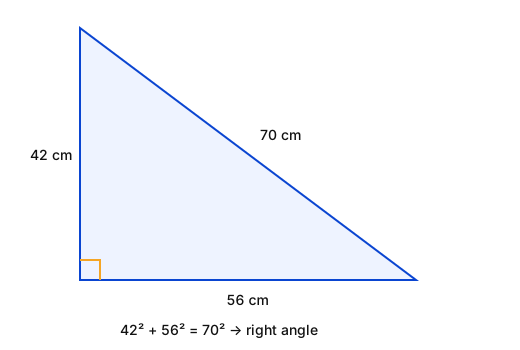
- (×14) → right-angled triangle.
- Check:
- Area
Trick: Spot 3-4-5 multiples to skip Heron's formula.
Answer: (A) 1176
अवधारणा: पहले पाइथागोरस त्रिक जाँचें; समकोण त्रिभुज का क्षेत्रफल ।
- (×14) → समकोण त्रिभुज।
- जाँच:
- क्षेत्रफल
ट्रिक: 3-4-5 के गुणज पहचानें, हीरोन सूत्र की ज़रूरत नहीं।
उत्तर: (A) 1176
RRB NTPC Graduate CBT 2MathematicsMensuration – triangle areaRRB NTPC Graduate CBT 2 2024 · 13 Oct Shift 1
Q179.The simplified value of is:
का सरलीकृत मान है:
- A6
- B8
- C3
- D4
Show answer
Concept: Solve brackets from innermost outward: ( ), then { }, then [ ].
- ,
Trick: Innermost first – never open outer brackets before inner ones.
Answer: (D) 4
अवधारणा: सबसे भीतरी कोष्ठक से बाहर की ओर हल करें: ( ), फिर { }, फिर [ ]।
- ,
ट्रिक: हमेशा भीतरी कोष्ठक पहले।
उत्तर: (D) 4
RRB NTPC Graduate CBT 2MathematicsSimplification – bracketsRRB NTPC Graduate CBT 2 2024 · 13 Oct Shift 1
Q180.During a sale 50% of the goods are sold at 45% profit, 30% of the remaining goods are sold at 27% profit and the still remaining goods are sold at a loss of 43%. If there is an overall profit of x%, then what is the value of x?
एक सेल के दौरान 50% माल 45% लाभ पर बेचा जाता है, शेष माल का 30% 27% लाभ पर बेचा जाता है और अभी भी बचा हुआ माल 43% हानि पर बेचा जाता है। यदि कुल लाभ x% है, तो x का मान क्या है?
- A11.5
- B10
- C12
- D13
Show answer
Concept: Overall profit % = sum of (share of goods × profit % of that share), taking total goods as 100.
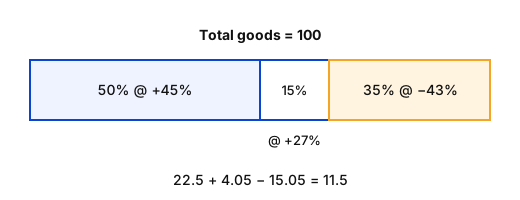
- sold at →
- Remaining ; of it units at →
- Rest units at →
Trick: '30% of the remaining' is 30% of 50, i.e. 15% of the total – not 30% of the total.
Answer: (A) 11.5
अवधारणा: कुल लाभ % = Σ (माल का भाग × उस भाग का लाभ %), कुल माल = 100 मानकर।
- माल पर →
- शेष ; उसका इकाई पर →
- बाकी इकाई पर →
ट्रिक: 'शेष का 30%' = 50 का 30% = कुल का 15%, कुल का 30% नहीं।
उत्तर: (A) 11.5
RRB NTPC Graduate CBT 2MathematicsProfit and loss – mixed saleRRB NTPC Graduate CBT 2 2024 · 13 Oct Shift 1

