Q41.The Balimela Power Plant is located in which of the following states of India?
बालीमेला विद्युत संयंत्र भारत के निम्नलिखित में से किस राज्य में स्थित है?
- AAndhra Pradeshआंध्र प्रदेश
- BJharkhandझारखंड
- CChhattisgarhछत्तीसगढ़
- DOdishaओडिशा
Show answer
Concept: Balimela is a hydroelectric project in Malkangiri district, Odisha.
- It is built on the Sileru river (a tributary of the Godavari system) on the Odisha–Andhra Pradesh border region.
- It is operated by Odisha Hydro Power Corporation (OHPC).
- Andhra Pradesh is tempting because the Sileru river is shared, but the Balimela plant is in Odisha.
Yaad rakhein: Odisha hydel projects: Hirakud, Balimela, Rengali, Upper Kolab, Upper Indravati.
Answer: (D) Odisha
अवधारणा: बालिमेला, ओडिशा के मलकानगिरी ज़िले में स्थित जलविद्युत परियोजना है।
- यह सिलेरु नदी (गोदावरी तंत्र की सहायक) पर ओडिशा–आंध्र प्रदेश सीमा क्षेत्र में बनी है।
- इसका संचालन ओडिशा हाइड्रो पावर कॉरपोरेशन (OHPC) करता है।
- सिलेरु नदी साझा होने से आंध्र प्रदेश भ्रामक विकल्प है, पर संयंत्र ओडिशा में है।
याद रखें: ओडिशा की जलविद्युत परियोजनाएँ: हीराकुड, बालिमेला, रेंगाली, अपर कोलाब, अपर इंद्रावती।
उत्तर: (D) ओडिशा
RRB NTPC Undergraduate CBT 2General AwarenessIndian Geography – Power PlantsRRB NTPC Undergraduate CBT 2 2024 · 20 Dec Shift 3
Q42.Mohammad Qasim Nanotavi and Rashid Ahmed Gangohi founded which of the following movements?
मोहम्मद कासिम नानौतवी और रशीद अहमद गंगोही ने निम्नलिखित में से किस आंदोलन की स्थापना की थी?
- AShariya Movementशरिया आंदोलन
- BWahabi Movementवहाबी आंदोलन
- CPagal Panti Movementपागल पंथी आंदोलन
- DDeoband Movementदेवबंद आंदोलन
Show answer
Concept: The Deoband Movement began with the Darul Uloom seminary at Deoband (Saharanpur, UP) in 1866–67.
- Founders: Mohammad Qasim Nanautavi and Rashid Ahmad Gangohi.
- It was a revivalist, anti-British movement that welcomed the Indian National Congress.
- Wahabi (Syed Ahmad of Rae Bareli), Faraizi/Shariatullah (Haji Shariatullah) and Pagal Panthi (Karam Shah) had other founders.
Yaad rakhein: Deoband = anti-British, pro-Congress; Aligarh (Sir Syed) = pro-British, modern education.
Answer: (D) Deoband Movement
अवधारणा: देवबंद आंदोलन 1866–67 में देवबंद (सहारनपुर, उ.प्र.) के दारुल उलूम मदरसे से शुरू हुआ।
- संस्थापक: मोहम्मद क़ासिम नानौतवी और रशीद अहमद गंगोही।
- यह पुनरुत्थानवादी, अंग्रेज़-विरोधी आंदोलन था, जिसने भारतीय राष्ट्रीय कांग्रेस का स्वागत किया।
- वहाबी (रायबरेली के सैयद अहमद), फ़राज़ी (हाजी शरीयतुल्लाह) और पागलपंथी (करम शाह) के संस्थापक अलग थे।
याद रखें: देवबंद = अंग्रेज़-विरोधी, कांग्रेस-समर्थक; अलीगढ़ (सर सैयद) = अंग्रेज़-समर्थक, आधुनिक शिक्षा।
उत्तर: (D) देवबंद आंदोलन
RRB NTPC Undergraduate CBT 2General AwarenessModern History – Socio-religious MovementsRRB NTPC Undergraduate CBT 2 2024 · 20 Dec Shift 3
Q43.As per the Ministry of Culture, which of the following represents an impact of a language being declared classical?
संस्कृति मंत्रालय के अनुसार, निम्नलिखित में से कौन-सा किसी भाषा को शास्त्रीय भाषा घोषित किए जाने के प्रभाव को दर्शाता है?
- ANational integrationराष्ट्रीय एकीकरण
- BGlobal collaborationsवैश्विक सहयोग
- CEmployment opportunitiesरोज़गार के अवसर
- DIncreased literacy rateसाक्षरता दर में वृद्धि
Show answer
Concept: When the Union Cabinet granted classical status to five more languages (3 October 2024), the Ministry of Culture listed its impacts.
- It said the status will create significant employment opportunities, especially in academic and research fields (also in archiving, translation, publishing and digital media).
- The new languages were Marathi, Pali, Prakrit, Assamese and Bengali – taking the total to 11.
Yaad rakhein: First classical language: Tamil (2004); latest five added in 2024 → 11 in all.
Answer: (C) Employment opportunities
अवधारणा: केंद्रीय मंत्रिमंडल द्वारा 3 अक्टूबर 2024 को पाँच और भाषाओं को शास्त्रीय दर्जा देने पर संस्कृति मंत्रालय ने इसके प्रभाव बताए।
- मंत्रालय के अनुसार इससे विशेष रूप से शैक्षणिक और अनुसंधान क्षेत्रों में (साथ ही संग्रहण, अनुवाद, प्रकाशन और डिजिटल मीडिया में) रोज़गार के बड़े अवसर बनेंगे।
- नई भाषाएँ: मराठी, पाली, प्राकृत, असमिया और बांग्ला – कुल संख्या 11।
याद रखें: पहली शास्त्रीय भाषा: तमिल (2004); 2024 में पाँच और → कुल 11।
उत्तर: (C) रोज़गार के अवसर
RRB NTPC Undergraduate CBT 2General AwarenessArt & Culture – Classical LanguagesRRB NTPC Undergraduate CBT 2 2024 · 20 Dec Shift 3
Q44.The substances that are used for making food products unsafe for human consumption are known as:
वे पदार्थ जिनका उपयोग खाद्य उत्पादों को मानव उपभोग के लिए असुरक्षित बनाने हेतु किया जाता है, कहलाते हैं:
- Achemical hazardsरासायनिक संकट
- Badulterantsअपमिश्रक (adulterants)
- Cfood additivesखाद्य योजक (food additives)
- Dflavouring agentsसुगंधकारक (flavouring agents)
Show answer
Concept: Adulterants are substances added to food that lower its quality and make it unsafe.
- Examples: chalk powder in flour, metanil yellow in turmeric, brick powder in chilli, starch in milk.
- Food additives (preservatives, colours, flavours) are permitted substances used within safe limits to improve food – not to make it unsafe.
Yaad rakhein: Additive = allowed and useful; Adulterant = harmful or cheap mixing.
Answer: (B) adulterants
अवधारणा: अपमिश्रक (Adulterants) वे पदार्थ हैं जो भोजन में मिलाकर उसकी गुणवत्ता घटाते हैं और उसे असुरक्षित बनाते हैं।
- उदाहरण: आटे में चॉक पाउडर, हल्दी में मेटानिल येलो, मिर्च में ईंट का चूरा, दूध में स्टार्च।
- खाद्य योज्य (additives – परिरक्षक, रंग, स्वाद) अनुमत पदार्थ हैं जो सुरक्षित सीमा में भोजन सुधारने हेतु डाले जाते हैं।
याद रखें: योज्य = अनुमत और उपयोगी; अपमिश्रक = हानिकारक या सस्ती मिलावट।
उत्तर: (B) अपमिश्रक (adulterants)
RRB NTPC Undergraduate CBT 2General AwarenessGeneral Science – Food AdulterationRRB NTPC Undergraduate CBT 2 2024 · 20 Dec Shift 3
Q45.Under the Citizenship (Amendment) Act, 2019, the Overseas Citizen of India (OCI) registration may be cancelled if _______.
नागरिकता (संशोधन) अधिनियम, 2019 के अंतर्गत, भारत के प्रवासी नागरिक (OCI) का पंजीकरण रद्द किया जा सकता है यदि _______।
- AThe Overseas Citizen of India formally seeks dual citizenship statusभारत का प्रवासी नागरिक औपचारिक रूप से दोहरी नागरिकता का दर्जा माँगता है
- BThe Overseas Citizen of India permanently relocates to another countryभारत का प्रवासी नागरिक स्थायी रूप से किसी अन्य देश में बस जाता है
- CThe Overseas Citizen of India violates the Citizenship Act or any notified lawभारत का प्रवासी नागरिक नागरिकता अधिनियम या किसी अधिसूचित कानून का उल्लंघन करता है
- DThe Overseas Citizen of India refuses to comply with tax obligationsभारत का प्रवासी नागरिक कर दायित्वों का पालन करने से इनकार करता है
Show answer
Concept: CAA 2019 added a new ground to Section 7D of the Citizenship Act, 1955 for cancelling OCI registration.
- OCI registration can be cancelled if the cardholder violates any provision of the Citizenship Act or any other law notified by the Central Government.
- The OCI holder must be given a reasonable opportunity of being heard before cancellation.
- India does not allow dual citizenship; relocation or tax issues are not grounds under this amendment.
Yaad rakhein: CAA 2019 → Section 7D(da): violation of Citizenship Act or notified law = OCI cancellation.
Answer: (C) The Overseas Citizen of India violates the Citizenship Act or any notified law
अवधारणा: CAA 2019 ने नागरिकता अधिनियम, 1955 की धारा 7D में OCI पंजीकरण रद्द करने का नया आधार जोड़ा।
- यदि कार्डधारक नागरिकता अधिनियम या केंद्र सरकार द्वारा अधिसूचित किसी अन्य कानून का उल्लंघन करे, तो OCI पंजीकरण रद्द हो सकता है।
- रद्द करने से पहले OCI धारक को सुनवाई का उचित अवसर देना होगा।
- भारत दोहरी नागरिकता नहीं देता; स्थानांतरण या कर संबंधी मुद्दे इस संशोधन के आधार नहीं हैं।
याद रखें: CAA 2019 → धारा 7D(da): नागरिकता अधिनियम या अधिसूचित कानून का उल्लंघन = OCI रद्द।
उत्तर: (C) OCI धारक नागरिकता अधिनियम या किसी अधिसूचित कानून का उल्लंघन करे
RRB NTPC Undergraduate CBT 2General AwarenessPolity – CitizenshipRRB NTPC Undergraduate CBT 2 2024 · 20 Dec Shift 3
Q46.Which of the following laws states that 'Every object will remain at rest or in uniform motion unless acted upon by an external force'?
निम्नलिखित में से कौन-सा नियम यह बताता है कि 'प्रत्येक वस्तु तब तक विराम अवस्था में या एकसमान गति की अवस्था में बनी रहेगी जब तक उस पर कोई बाह्य बल कार्य न करे'?
- AKepler’s Laws of Planetary Motionकेप्लर के ग्रहीय गति के नियम
- BNewton’s First Law of Motionन्यूटन का गति का प्रथम नियम
- CLaw of Conservation of Momentumसंवेग संरक्षण का नियम
- DNewton’s Third Law of Motionन्यूटन का गति का तृतीय नियम
Show answer
Concept: Newton's First Law (Law of Inertia): a body stays at rest or in uniform straight-line motion unless an external unbalanced force acts on it.
- It defines inertia – e.g., passengers jerk forward when a bus stops suddenly.
- Third law is about action–reaction pairs; conservation of momentum applies when no external force acts; Kepler's laws describe planetary orbits.
Yaad rakhein: 1st law – inertia; 2nd – ; 3rd – action = reaction.
Answer: (B) Newton’s First Law of Motion
अवधारणा: न्यूटन का प्रथम नियम (जड़त्व का नियम): कोई वस्तु विरामावस्था या एकसमान सरल रेखीय गति में तब तक रहती है जब तक उस पर बाहरी असंतुलित बल न लगे।
- यह जड़त्व (inertia) को परिभाषित करता है – जैसे बस अचानक रुकने पर यात्री आगे झुकते हैं।
- तीसरा नियम क्रिया–प्रतिक्रिया का है; संवेग संरक्षण बाहरी बल न होने पर लागू; केप्लर के नियम ग्रहों की कक्षाएँ बताते हैं।
याद रखें: पहला नियम – जड़त्व; दूसरा – ; तीसरा – क्रिया = प्रतिक्रिया।
उत्तर: (B) न्यूटन का गति का प्रथम नियम
RRB NTPC Undergraduate CBT 2General AwarenessPhysics – Laws of MotionRRB NTPC Undergraduate CBT 2 2024 · 20 Dec Shift 3
Q47.Lok Adalats aim to settle disputes amicably by promoting which type of resolution?
लोक अदालतों का उद्देश्य किस प्रकार के समाधान को बढ़ावा देकर विवादों का सौहार्दपूर्ण निपटारा करना है?
- AMandatory Ordersअनिवार्य आदेश
- BCriminalआपराधिक
- CAdversarialप्रतिकूल (Adversarial)
- DAmicable/compromiseसौहार्दपूर्ण/समझौता
Show answer
Concept: Lok Adalats ("people's courts") settle disputes by mutual compromise.
- They have statutory status under the Legal Services Authorities Act, 1987.
- Their award is final and binding, with no appeal; no court fee is charged.
- They are non-adversarial – the opposite of a regular court's adversarial trial; non-compoundable criminal cases are excluded.
Yaad rakhein: Lok Adalat = compromise, no fee, no appeal (Legal Services Authorities Act 1987).
Answer: (D) Amicable/compromise
अवधारणा: लोक अदालतें ("जनता की अदालत") आपसी समझौते से विवाद सुलझाती हैं।
- इन्हें विधिक सेवा प्राधिकरण अधिनियम, 1987 के तहत वैधानिक दर्जा प्राप्त है।
- इनका निर्णय (award) अंतिम और बाध्यकारी होता है, कोई अपील नहीं; कोई कोर्ट फीस नहीं।
- यह विरोधात्मक (adversarial) नहीं है; असमझौता योग्य आपराधिक मामले इसमें नहीं आते।
याद रखें: लोक अदालत = समझौता, कोई फीस नहीं, कोई अपील नहीं (अधिनियम 1987)।
उत्तर: (D) सौहार्दपूर्ण/समझौता
RRB NTPC Undergraduate CBT 2General AwarenessPolity – JudiciaryRRB NTPC Undergraduate CBT 2 2024 · 20 Dec Shift 3
Q48.Speakers of which of the following languages in India are mostly confined to the Himalayan belt contiguous with the international boundaries?
भारत में निम्नलिखित में से किस भाषा के बोलने वाले अधिकांशतः अंतर्राष्ट्रीय सीमाओं से सटी हिमालयी पट्टी तक सीमित हैं?
- ADravidianद्रविड़
- BIndo-Aryanभारतीय-आर्य
- CTibeto-Burmanतिब्बती-बर्मी
- DAustricऑस्ट्रिक
Show answer
Concept: Tibeto-Burman (Sino-Tibetan) languages are spoken mainly along the Himalayas and the North-East, next to the borders with China, Nepal, Bhutan and Myanmar.
- Examples: Bodo, Manipuri (Meitei), Lepcha, Bhutia, Ladakhi, Naga languages.
- Indo-Aryan covers the northern plains; Dravidian the south; Austric (Munda) central-eastern tribal belts.
Yaad rakhein: Himalaya + North-East border belt = Tibeto-Burman.
Answer: (C) Tibeto-Burman
अवधारणा: तिब्बती-बर्मी (चीनी-तिब्बती) भाषाएँ मुख्यतः हिमालय और पूर्वोत्तर में, चीन, नेपाल, भूटान और म्यांमार की सीमाओं के पास बोली जाती हैं।
- उदाहरण: बोडो, मणिपुरी (मैतेई), लेप्चा, भूटिया, लद्दाखी, नागा भाषाएँ।
- भारोपीय (Indo-Aryan) उत्तरी मैदानों में; द्रविड़ दक्षिण में; आस्ट्रिक (मुंडा) मध्य-पूर्वी जनजातीय क्षेत्रों में।
याद रखें: हिमालय + पूर्वोत्तर सीमा पट्टी = तिब्बती-बर्मी।
उत्तर: (C) तिब्बती-बर्मी (Tibeto-Burman)
RRB NTPC Undergraduate CBT 2General AwarenessIndian Geography – Language FamiliesRRB NTPC Undergraduate CBT 2 2024 · 20 Dec Shift 3
Q49.Who among the following was the leader of 1857 Revolt at Delhi?
निम्नलिखित में से कौन दिल्ली में 1857 के विद्रोह का नेता था?
- ANana Sahibनाना साहब
- BMangal Pandeyमंगल पांडे
- CBegum Hazrat Mahalबेगम हज़रत महल
- DBahadur Shah IIबहादुर शाह द्वितीय
Show answer
Concept: At Delhi, the rebels proclaimed the Mughal emperor Bahadur Shah II (Zafar) as their leader.
- He was the nominal leader; the real military command at Delhi was with General Bakht Khan.
- Nana Sahib led at Kanpur, Begum Hazrat Mahal at Lucknow; Mangal Pandey revolted at Barrackpore (March 1857).
- After Delhi fell, Bahadur Shah was exiled to Rangoon, where he died in 1862.
Yaad rakhein: Delhi – Bahadur Shah II / Bakht Khan; Kanpur – Nana Sahib; Lucknow – Begum Hazrat Mahal; Jhansi – Rani Lakshmibai.
Answer: (D) Bahadur Shah II
अवधारणा: दिल्ली में विद्रोहियों ने मुग़ल बादशाह बहादुर शाह द्वितीय (ज़फ़र) को अपना नेता घोषित किया।
- वे नाममात्र के नेता थे; दिल्ली में वास्तविक सैन्य कमान जनरल बख़्त ख़ान के पास थी।
- कानपुर – नाना साहब, लखनऊ – बेगम हज़रत महल; मंगल पांडे ने बैरकपुर में (मार्च 1857) विद्रोह किया।
- दिल्ली के पतन के बाद बहादुर शाह को रंगून निर्वासित किया गया, जहाँ 1862 में उनकी मृत्यु हुई।
याद रखें: दिल्ली – बहादुर शाह द्वितीय / बख़्त ख़ान; कानपुर – नाना साहब; लखनऊ – बेगम हज़रत महल; झाँसी – रानी लक्ष्मीबाई।
उत्तर: (D) बहादुर शाह द्वितीय
RRB NTPC Undergraduate CBT 2General AwarenessModern History – Revolt of 1857RRB NTPC Undergraduate CBT 2 2024 · 20 Dec Shift 3
Q50.Which of the following male athletes was crowned the 'World Athlete of the Year' in 2025?
निम्नलिखित में से किस पुरुष एथलीट को 2025 में 'वर्ल्ड एथलीट ऑफ द ईयर' (World Athlete of the Year) का खिताब दिया गया?
- AMondo Duplantis
- BNeeraj Chopraनीरज चोपड़ा
- CJakob Ingebrigtsen
- DNoah Lyles
Show answer
Concept: Sweden's pole vaulter Armand "Mondo" Duplantis was named the men's World Athlete of the Year 2025 by World Athletics.
- In 2025 he raised the pole vault world record several times, to 6.30 m at the World Championships in Tokyo, where he also won gold.
- Neeraj Chopra (javelin), Jakob Ingebrigtsen (middle distance) and Noah Lyles (sprints) did not win the 2025 award.
Yaad rakhein: Duplantis – pole vault, Sweden, world record 6.30 m (Tokyo 2025).
Answer: (A) Mondo Duplantis
अवधारणा: स्वीडन के पोल वॉल्टर आर्मंड "मोंडो" डुप्लांटिस को World Athletics ने 2025 का पुरुष विश्व एथलीट ऑफ़ द ईयर चुना।
- 2025 में उन्होंने पोल वॉल्ट का विश्व रिकॉर्ड कई बार तोड़ा और टोक्यो विश्व चैंपियनशिप में 6.30 m के साथ स्वर्ण जीता।
- नीरज चोपड़ा (भाला फेंक), जैकब इंगेब्रिग्त्सन (मध्यम दूरी) और नोआ लाइल्स (स्प्रिंट) को 2025 का यह पुरस्कार नहीं मिला।
याद रखें: डुप्लांटिस – पोल वॉल्ट, स्वीडन, विश्व रिकॉर्ड 6.30 m (टोक्यो 2025)।
उत्तर: (A) मोंडो डुप्लांटिस
RRB NTPC Undergraduate CBT 2General AwarenessSports – AthleticsRRB NTPC Undergraduate CBT 2 2024 · 20 Dec Shift 3
Q51.Evaluate:
मान ज्ञात कीजिए:
- A5
- B9
- C4
- D6
Show answer
Concept: Simplify a nested root from the innermost bracket outward.
- , so and .
- , .
- , .
- , .
Trick: Each step gives a perfect square – if a step does not, recheck the arithmetic.
Answer: (D)
अवधारणा: नेस्टेड वर्गमूल को सबसे अंदर वाले कोष्ठक से बाहर की ओर हल करें।
- , अतः और ।
- , ।
- , ।
- , ।
ट्रिक: हर चरण में पूर्ण वर्ग बनता है – न बने तो गणना दोबारा जाँचें।
उत्तर: (D)
RRB NTPC Undergraduate CBT 2MathematicsNested square rootsRRB NTPC Undergraduate CBT 2 2024 · 20 Dec Shift 3
Q52.Two pipes can fill a cistern, individually, in 99 min and 90 min, respectively. There is a pipe located at the bottom of the cistern to empty it. If all the three pipes are opened simultaneously, then the empty cistern gets filled in 50 min. How long will the pipe at the bottom of the tank take to empty the completely filled cistern if no other pipe is then open?
दो पाइप अलग-अलग किसी टंकी को क्रमशः 99 मिनट और 90 मिनट में भर सकते हैं। टंकी को खाली करने के लिए उसके तल पर एक पाइप लगा है। यदि तीनों पाइप एक साथ खोले जाते हैं, तो खाली टंकी 50 मिनट में भर जाती है। यदि कोई अन्य पाइप खुला न हो, तो टंकी के तल पर लगा पाइप पूरी भरी टंकी को खाली करने में कितना समय लेगा?
- A841 min841 मिनट
- B825 min825 मिनट
- C822 min822 मिनट
- D815 min815 मिनट
Show answer
Concept: Filling rates are added and the emptying rate is subtracted: .
- .
- .
- So the outlet empties the full cistern in min.
Trick: Use LCM units: total units; rates ; together /min, so outlet /min; .
Answer: (B) min
अवधारणा: भरने वाले पाइपों की दरें जोड़ें, खाली करने वाले की घटाएँ: ।
- ।
- ।
- अतः निकास पाइप भरी टंकी को मिनट में खाली करेगा।
ट्रिक: LCM इकाई: कुल ; दरें ; साथ में /मिनट, अतः निकास /मिनट; ।
उत्तर: (B) मिनट
RRB NTPC Undergraduate CBT 2MathematicsPipes and cisternRRB NTPC Undergraduate CBT 2 2024 · 20 Dec Shift 3
Q53.The downstream speed is 115 km/hr and the upstream speed is 23 km/hr. It takes a total of 25 hours to go to a place and come back. What is the total distance travelled by boat?
धारा के अनुकूल चाल 115 km/hr और धारा के प्रतिकूल चाल 23 km/hr है। किसी स्थान तक जाने और वापस आने में कुल 25 घंटे लगते हैं। नाव द्वारा तय की गई कुल दूरी कितनी है?
- A km
- B km
- C km
- D km
Show answer
Concept: For a round trip of distance each way: .
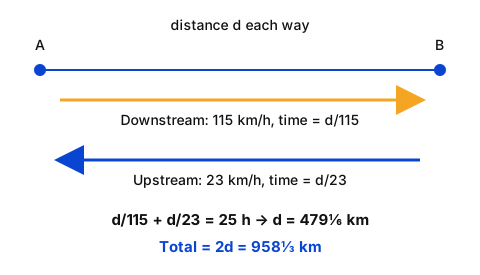
- .
- .
- Total distance .
Trick: Downstream speed is upstream, so time splits : upstream time h; .
Answer: (B)
अवधारणा: आने-जाने की यात्रा में (प्रत्येक ओर दूरी ): ।
- ।
- ।
- कुल दूरी ।
ट्रिक: धारा के साथ चाल विपरीत चाल की गुना है, इसलिए समय में बँटता है।
उत्तर: (B)
RRB NTPC Undergraduate CBT 2MathematicsBoats and streamsRRB NTPC Undergraduate CBT 2 2024 · 20 Dec Shift 3
Q54.Evaluate: 30 + [{-9 × (26 - 14 + 6)}]
मान ज्ञात कीजिए: 30 + [{-9 × (26 - 14 + 6)}]
- A-133
- B-135
- C-132
- D-134
Show answer
Concept: Solve the innermost bracket first, then multiply, then add.
- .
- .
- .
Trick: A positive number plus a bigger negative number: subtract and keep the minus sign.
Answer: (C)
अवधारणा: सबसे अंदर का कोष्ठक पहले, फिर गुणा, फिर जोड़।
- ।
- ।
- ।
ट्रिक: धनात्मक + बड़ी ऋणात्मक संख्या: घटाएँ और ऋण चिह्न रखें।
उत्तर: (C)
RRB NTPC Undergraduate CBT 2MathematicsSimplification (BODMAS)RRB NTPC Undergraduate CBT 2 2024 · 20 Dec Shift 3
Q55.A and B complete a work in 14 days. If A alone can do it in 42 days, then B alone can do one-third of the same work in _________ (days).
A और B मिलकर एक कार्य 14 दिनों में पूरा करते हैं। यदि A अकेले उसे 42 दिनों में कर सकता है, तो B अकेले उसी कार्य का एक-तिहाई भाग _________ (दिनों) में कर सकता है।
- A21
- B14
- C28
- D7
Show answer
Concept: Take total work as the LCM of the given days; then work rate time.
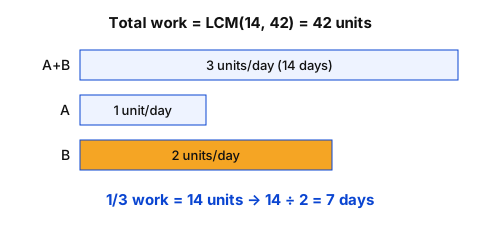
- Total work units.
- A+B units/day; A unit/day B units/day.
- One-third work units time days.
Trick: B alone takes days for full work, so of it takes days.
Answer: (D)
अवधारणा: कुल कार्य = दिए गए दिनों का LCM; फिर कार्य दर समय।
- कुल कार्य इकाई।
- A+B इकाई/दिन; A इकाई/दिन B इकाई/दिन।
- एक-तिहाई कार्य इकाई समय दिन।
ट्रिक: B अकेला पूरा कार्य दिन में करता है, अतः कार्य दिन में।
उत्तर: (D)
RRB NTPC Undergraduate CBT 2MathematicsTime and workRRB NTPC Undergraduate CBT 2 2024 · 20 Dec Shift 3
Q56.Three years ago from now, Aman was four times Chaman’s age. Three years from now, he will be twice as old as Chaman. What is Aman's current age (in years)?
अब से तीन वर्ष पहले, अमन की आयु चमन की आयु की चार गुनी थी। अब से तीन वर्ष बाद, उसकी आयु चमन की आयु की दोगुनी होगी। अमन की वर्तमान आयु (वर्षों में) कितनी है?
- A20
- B18
- C10
- D15
Show answer
Concept: Let present ages be (Aman) and (Chaman); form two equations.
- .
- .
- , so .
Trick: Check options: gives and ✓.
Answer: (D)
अवधारणा: मान लें वर्तमान आयु अमन , चमन ; दो समीकरण बनाएँ।
- ।
- ।
- , अतः ।
ट्रिक: विकल्प जाँचें: पर और ✓।
उत्तर: (D)
RRB NTPC Undergraduate CBT 2MathematicsProblems on agesRRB NTPC Undergraduate CBT 2 2024 · 20 Dec Shift 3
Q57.Simplify:
सरल कीजिए:
- A
- B
- C
- D
Show answer
Concept: Expand each bracket and combine like terms.
- .
- .
- Sum: .
Trick: The constant term decides quickly: , and coefficient is positive.
Answer: (A)
अवधारणा: हर कोष्ठक खोलें और समान पदों को जोड़ें।
- ।
- ।
- योग: ।
ट्रिक: अचर पद से ही पता चलता है: , और का गुणांक धनात्मक।
उत्तर: (A)
RRB NTPC Undergraduate CBT 2MathematicsAlgebraic simplificationRRB NTPC Undergraduate CBT 2 2024 · 20 Dec Shift 3
Q58.Simplify .
को सरल कीजिए।
- A
- B
- C
- D
Show answer
Concept: and .
- and .
- Product .
- .
- .
Trick: Know squares up to : , , .
Answer: (C)
अवधारणा: और ।
- तथा ।
- गुणनफल ।
- ।
- ।
ट्रिक: तक के वर्ग याद रखें: , , ।
उत्तर: (C)
RRB NTPC Undergraduate CBT 2MathematicsSurds and indicesRRB NTPC Undergraduate CBT 2 2024 · 20 Dec Shift 3
Q59.Atul earns ₹16,000 per month. He spends ₹5,500 on rent, ₹2,500 on bills, and saves the remaining amount each month. If he uses his entire monthly savings for his birthday celebration in one month, find his total savings for the year (in ₹).
अतुल प्रति माह ₹16,000 कमाता है। वह ₹5,500 किराए पर, ₹2,500 बिलों पर खर्च करता है और प्रत्येक माह शेष राशि की बचत करता है। यदि वह किसी एक माह की अपनी पूरी मासिक बचत अपने जन्मदिन समारोह पर खर्च कर देता है, तो वर्ष भर की उसकी कुल बचत (₹ में) ज्ञात कीजिए।
- A88,000
- B96,000
- C80,000
- D72,000
Show answer
Concept: Monthly saving income expenses; one month's saving is spent, so only months' savings remain.
- Expenses .
- Monthly saving .
- Yearly saving .
Trick: Subtract the birthday month: months.
Answer: (A) ₹88,000
अवधारणा: मासिक बचत आय व्यय; एक महीने की बचत खर्च हो गई, अतः केवल महीने की बचत बचती है।
- व्यय ।
- मासिक बचत ।
- वार्षिक बचत ।
ट्रिक: जन्मदिन वाला महीना घटाएँ: महीने।
उत्तर: (A) ₹88,000
RRB NTPC Undergraduate CBT 2MathematicsIncome, expenditure and savingsRRB NTPC Undergraduate CBT 2 2024 · 20 Dec Shift 3
Q60.At a health club, 55% of the members are women and 45% of the members are men. If the average age of the men is 95 years and the average age of the women is 85 years, what is the average age (in years) of all the members?
एक हेल्थ क्लब में, 55% सदस्य महिलाएँ हैं और 45% सदस्य पुरुष हैं। यदि पुरुषों की औसत आयु 95 वर्ष है और महिलाओं की औसत आयु 85 वर्ष है, तो सभी सदस्यों की औसत आयु (वर्षों में) कितनी है?
- A79.3
- B89.5
- C83.9
- D87.8
Show answer
Concept: Weighted average when weights are in form.
- Women: .
- Men: .
- Average years.
Trick: Start at and add of the gap : .
Answer: (B)
अवधारणा: भारित औसत , जब भार में हों।
- महिलाएँ: ।
- पुरुष: ।
- औसत वर्ष।
ट्रिक: से शुरू करें और अंतर का जोड़ें: ।
उत्तर: (B)
RRB NTPC Undergraduate CBT 2MathematicsWeighted averageRRB NTPC Undergraduate CBT 2 2024 · 20 Dec Shift 3

