Q81.A shopkeeper offers a trade discount of 15% on the marked price of an item. If the marked price of this product is ₹6500, what is its selling price (in ₹)?
एक दुकानदार किसी वस्तु के अंकित मूल्य पर 15% की व्यापारिक छूट देता है। यदि इस उत्पाद का अंकित मूल्य ₹6500 है, तो इसका विक्रय मूल्य (₹ में) कितना है?
- A5200
- B5255
- C5525
- D5552
Show answer
Concept:
Trick: 15% of 6500 = 975; .
Answer: (C) ₹5525
अवधारणा:
ट्रिक: 6500 का 15% = 975; ।
उत्तर: (C) ₹5525
RRB NTPC Undergraduate CBT 2MathematicsDiscountRRB NTPC Undergraduate CBT 2 2024 · 20 Dec Shift 3
Q82.The marked price of an iPad is ₹960. It is sold with two successive discounts of 25% each, followed by an additional 15% discount for cash payment. What is the final selling price (in ₹) after the cash discount?
एक iPad का अंकित मूल्य ₹960 है। इसे 25% की दो क्रमिक छूटों के साथ बेचा जाता है, जिसके बाद नकद भुगतान पर 15% की अतिरिक्त छूट दी जाती है। नकद छूट के बाद अंतिम विक्रय मूल्य (₹ में) कितना है?
- A459
- B456
- C460
- D461
Show answer
Concept: Successive discounts multiply: .
Trick: ; 15% of 540 = 81 → .
Answer: (A) 459
अवधारणा: क्रमिक छूटें गुणा होती हैं: ।
ट्रिक: ; 540 का 15% = 81 → ।
उत्तर: (A) 459
RRB NTPC Undergraduate CBT 2MathematicsSuccessive DiscountsRRB NTPC Undergraduate CBT 2 2024 · 20 Dec Shift 3
Q83.In a test with a maximum of 100 marks, B scored 54 and A scored 75. Approximately what percentage of B’s score is A’s score?
अधिकतम 100 अंकों वाली एक परीक्षा में, B ने 54 और A ने 75 अंक प्राप्त किए। A के अंक, B के अंकों का लगभग कितना प्रतिशत है?
- A75%
- B101.07%
- C72%
- D138.89%
Show answer
Concept: "A is what % of B" .
Trick: A (75) > B (54), so the answer must exceed 100% – only 101.07% and 138.89%; .
Answer: (D)
अवधारणा: "A, B का कितना % है" ।
ट्रिक: A (75) > B (54), अतः उत्तर 100% से अधिक – केवल 101.07% और 138.89%; ।
उत्तर: (D)
RRB NTPC Undergraduate CBT 2MathematicsPercentageRRB NTPC Undergraduate CBT 2 2024 · 20 Dec Shift 3
Q84.Water flows through a cylindrical pipe of internal diameter 21 cm at the rate of 8 m/s. What time, in minutes, would the pipe take to fill an empty rectangular tank of dimensions 12 m 9 m 4.41 m?
(Rounded up to one decimal place) (Use )
21 cm आंतरिक व्यास वाले एक बेलनाकार पाइप से 8 m/s की दर से पानी बहता है। 12 m 9 m 4.41 m विमाओं वाली एक खाली आयताकार टंकी को भरने में पाइप कितना समय (मिनट में) लेगा?
(एक दशमलव स्थान तक पूर्णांकित) ( का प्रयोग कीजिए)
- A28.6 minutes28.6 मिनट
- B30 minutes30 मिनट
- C36.8 minutes36.8 मिनट
- D27.5 minutes27.5 मिनट
Show answer
Concept: Water per second = (cross-section area of pipe) × speed. Time = tank volume ÷ water per second.
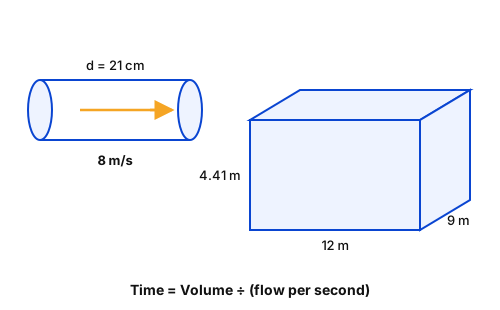
- ; area .
- Flow .
- Tank volume .
- Time .
Trick: Convert cm to m first; per-minute flow , and .
Answer: (A) 28.6 minutes
अवधारणा: प्रति सेकंड पानी = (पाइप का अनुप्रस्थ क्षेत्रफल) × चाल। समय = टंकी का आयतन ÷ प्रति सेकंड पानी।
- ; क्षेत्रफल ।
- प्रवाह ।
- टंकी का आयतन ।
- समय ।
ट्रिक: पहले cm को m में बदलें; प्रति मिनट प्रवाह , और ।
उत्तर: (A) 28.6 मिनट
RRB NTPC Undergraduate CBT 2MathematicsMensuration – Flow Through PipeRRB NTPC Undergraduate CBT 2 2024 · 20 Dec Shift 3
Q85.Mukund deposited ₹57,000 in a bank. With annual compounding, how much compound interest (in ₹) will he earn in 2 years if the interest rate is 10% per annum in the first year and increases by 3% per annum in the second year?
मुकुंद ने एक बैंक में ₹57,000 जमा किए। वार्षिक चक्रवृद्धि के साथ, यदि ब्याज दर पहले वर्ष में 10% वार्षिक है और दूसरे वर्ष में 3% वार्षिक बढ़ जाती है, तो उसे 2 वर्षों में कितना चक्रवृद्धि ब्याज (₹ में) प्राप्त होगा?
- A14,101
- B13,651
- C13,501
- D13,851
Show answer
Concept: With different yearly rates, . Here , .
- After year 1: .
- After year 2: .
- .
Trick: Effective rate ; of 57000 = 13851.
Answer: (D) ₹13,851
अवधारणा: अलग-अलग वार्षिक दरों पर । यहाँ , ।
- पहले वर्ष बाद: ।
- दूसरे वर्ष बाद: ।
- ।
ट्रिक: प्रभावी दर ; 57000 का = 13851।
उत्तर: (D) ₹13,851
RRB NTPC Undergraduate CBT 2MathematicsCompound Interest – Varying RatesRRB NTPC Undergraduate CBT 2 2024 · 20 Dec Shift 3
Q86.What should come in place of the question mark (?) in the given series based on the English alphabetical order?
EDG, CBE, AZC, YXA, WVY, ?
अंग्रेज़ी वर्णमाला क्रम के आधार पर दी गई श्रृंखला में प्रश्न चिह्न (?) के स्थान पर क्या आना चाहिए?
EDG, CBE, AZC, YXA, WVY, ?
- AVTU
- BVSW
- CUTW
- DUSW
Show answer
Concept: Treat each letter position as a separate series.
- 1st letters: E, C, A, Y, W → each → U.
- 2nd letters: D, B, Z, X, V → each → T.
- 3rd letters: G, E, C, A, Y → each → W.
Trick: All three positions move back by 2 (wrapping A → Y).
Answer: (C) UTW
अवधारणा: प्रत्येक स्थान के अक्षरों को अलग श्रृंखला मानें।
- पहले अक्षर: E, C, A, Y, W → हर बार → U।
- दूसरे अक्षर: D, B, Z, X, V → हर बार → T।
- तीसरे अक्षर: G, E, C, A, Y → हर बार → W।
ट्रिक: तीनों स्थान 2 पीछे जाते हैं (A के बाद Y)।
उत्तर: (C) UTW
RRB NTPC Undergraduate CBT 2General Intelligence and ReasoningLetter seriesRRB NTPC Undergraduate CBT 2 2024 · 20 Dec Shift 3
Q87.What should come in place of the question mark (?) in the given series?
16, 26, 39, 55, 74, ?
दी गई श्रृंखला में प्रश्न चिह्न (?) के स्थान पर क्या आना चाहिए?
16, 26, 39, 55, 74, ?
- A103
- B96
- C90
- D100
Show answer
Concept: Check the differences between consecutive terms.
- Differences: – increasing by .
- Next difference .
- .
Trick: Second difference constant () → quadratic-type series.
Answer: (B)
अवधारणा: क्रमागत पदों का अंतर देखें।
- अंतर: – हर बार बढ़ रहा है।
- अगला अंतर ।
- ।
ट्रिक: दूसरा अंतर स्थिर () है।
उत्तर: (B)
RRB NTPC Undergraduate CBT 2General Intelligence and ReasoningNumber seriesRRB NTPC Undergraduate CBT 2 2024 · 20 Dec Shift 3
Q88.EFHE is related to IJLI in a certain way based on the English alphabetical order. In the same way, IJLI is related to MNPM. To which of the given options is PQSP related, following the same logic?
अंग्रेज़ी वर्णमाला क्रम के आधार पर EFHE एक निश्चित प्रकार से IJLI से संबंधित है। उसी प्रकार, IJLI, MNPM से संबंधित है। समान तर्क का अनुसरण करते हुए, PQSP दिए गए विकल्पों में से किससे संबंधित है?
- ATVVY
- BTTVT
- CTUWT
- DTUVT
Show answer
Concept: Compare each letter with the corresponding letter of the next term.
- EFHE → IJLI: E+4=I, F+4=J, H+4=L, E+4=I.
- IJLI → MNPM: again to each letter.
- PQSP: P+4=T, Q+4=U, S+4=W, P+4=T → TUWT.
Trick: Pattern of the cluster (1st = 4th, gaps ) is kept, so check option shape first: only TUWT fits.
Answer: (C) TUWT
अवधारणा: हर अक्षर की तुलना अगले पद के संगत अक्षर से करें।
- EFHE → IJLI: E+4=I, F+4=J, H+4=L, E+4=I।
- IJLI → MNPM: फिर हर अक्षर में ।
- PQSP: P+4=T, Q+4=U, S+4=W, P+4=T → TUWT।
ट्रिक: समूह की बनावट (पहला = चौथा, अंतर ) बनी रहती है – केवल TUWT में।
उत्तर: (C) TUWT
RRB NTPC Undergraduate CBT 2General Intelligence and ReasoningLetter analogyRRB NTPC Undergraduate CBT 2 2024 · 20 Dec Shift 3
Q89.In a certain code language, 'pull bush map' is coded as 'hn ha lv' and 'kite input pull' is coded as 'ha of bq'. How is 'pull' coded in the given language?
एक निश्चित कूट भाषा में, 'pull bush map' को 'hn ha lv' लिखा जाता है और 'kite input pull' को 'ha of bq' लिखा जाता है। दी गई भाषा में 'pull' को किस प्रकार लिखा जाता है?
- Ahn
- Blv
- Cof
- Dha
Show answer
Concept: A word common to two sentences gets the code common to both.
- 'pull bush map' → 'hn ha lv'.
- 'kite input pull' → 'ha of bq'.
- Common word: pull; common code: ha.
Trick: Common word ↔ common code.
Answer: (D) ha
अवधारणा: दो वाक्यों में उभयनिष्ठ शब्द का कोड भी उभयनिष्ठ होगा।
- 'pull bush map' → 'hn ha lv'।
- 'kite input pull' → 'ha of bq'।
- उभयनिष्ठ शब्द: pull; उभयनिष्ठ कोड: ha।
ट्रिक: उभयनिष्ठ शब्द ↔ उभयनिष्ठ कोड।
उत्तर: (D) ha
RRB NTPC Undergraduate CBT 2General Intelligence and ReasoningCoding–decodingRRB NTPC Undergraduate CBT 2 2024 · 20 Dec Shift 3
Q90.Based on the English alphabetical order, three of the following four letter-clusters are alike in a certain way and thus form a group. Which letter-cluster DOES NOT belong to that group? (Note: The odd one out is not based on the number of consonants/vowels or their position in the letter-cluster.)
अंग्रेज़ी वर्णमाला क्रम के आधार पर, निम्नलिखित चार अक्षर-समूहों में से तीन किसी निश्चित प्रकार से एकसमान हैं और इस प्रकार एक समूह बनाते हैं। कौन-सा अक्षर-समूह उस समूह से संबंधित नहीं है? (ध्यान दें: असंगत का निर्धारण व्यंजनों/स्वरों की संख्या या अक्षर-समूह में उनकी स्थिति के आधार पर नहीं है।)
- AGED
- BZXW
- CSQO
- DKIH
Show answer
Concept: Find the gap between consecutive letters in each cluster.
- GED: G=E, E=D.
- ZXW: , . KIH: , .
- SQO: S=Q, Q=O → pattern – different.
Trick: Write the gaps under each option; the one with a different pair is odd.
Answer: (C) SQO
अवधारणा: हर समूह में क्रमागत अक्षरों का अंतर देखें।
- GED: G=E, E=D।
- ZXW: , । KIH: , ।
- SQO: S=Q, Q=O → – भिन्न।
ट्रिक: हर विकल्प के नीचे अंतर लिखें; जिसका जोड़ा भिन्न हो वही विषम।
उत्तर: (C) SQO
RRB NTPC Undergraduate CBT 2General Intelligence and ReasoningOdd one out – lettersRRB NTPC Undergraduate CBT 2 2024 · 20 Dec Shift 3
Q91.If ‘I’ stands for ‘+’, ‘J’ stands for ‘×’, ‘K’ stands for ‘÷’ and ‘L’ stands for ‘−’, then what will come in place of the question mark (?) in the following equation?
174 K 6 J 12 I 63 L 15 K 5 I 29 J 4 K 2 L 11 = ?
यदि 'I' का अर्थ '+', 'J' का अर्थ '×', 'K' का अर्थ '÷' और 'L' का अर्थ '−' है, तो निम्नलिखित समीकरण में प्रश्न चिह्न (?) के स्थान पर क्या आएगा?
174 K 6 J 12 I 63 L 15 K 5 I 29 J 4 K 2 L 11 = ?
- A491
- B455
- C513
- D574
Show answer
Concept: Replace letters by signs and apply BODMAS.
- Expression: .
- ; ; .
- .
Trick: Do ÷ and × left to right before any + or −.
Answer: (B)
अवधारणा: अक्षरों को चिह्नों से बदलें और BODMAS लगाएँ।
- व्यंजक: ।
- ; ; ।
- ।
ट्रिक: + या − से पहले ÷ और × बाएँ से दाएँ करें।
उत्तर: (B)
RRB NTPC Undergraduate CBT 2General Intelligence and ReasoningMathematical operationsRRB NTPC Undergraduate CBT 2 2024 · 20 Dec Shift 3
Q92.Read the given statements and conclusions carefully. Assuming that the information given in the statements is true, even if it appears to be at variance with commonly known facts, decide which of the given conclusion(s) logically follow(s) from the statements.
Statements:
Some kings are drills.
All clamps are drills.
Conclusions:
(I) Some kings are clamps.
(II) All drills are clamps.
कथन और निष्कर्षों को ध्यानपूर्वक पढ़िए। यह मानते हुए कि कथनों में दी गई जानकारी सत्य है, भले ही वह सामान्यतः ज्ञात तथ्यों से भिन्न प्रतीत होती हो, निर्णय कीजिए कि दिए गए निष्कर्षों में से कौन-सा/कौन-से निष्कर्ष तार्किक रूप से कथनों का अनुसरण करता है/करते हैं।
कथन:
कुछ राजा, ड्रिल हैं।
सभी क्लैंप, ड्रिल हैं।
निष्कर्ष:
(I) कुछ राजा, क्लैंप हैं।
(II) सभी ड्रिल, क्लैंप हैं।
- AOnly conclusion (II) follows.केवल निष्कर्ष (II) अनुसरण करता है।
- BBoth conclusions (I) and (II) follow.निष्कर्ष (I) और (II) दोनों अनुसरण करते हैं।
- COnly conclusion (I) follows.केवल निष्कर्ष (I) अनुसरण करता है।
- DNeither conclusion (I) nor (II) follows.न तो निष्कर्ष (I) और न ही (II) अनुसरण करता है।
Show answer
Concept: Draw the least-overlap Venn diagram; a conclusion follows only if it is true in every possible diagram.
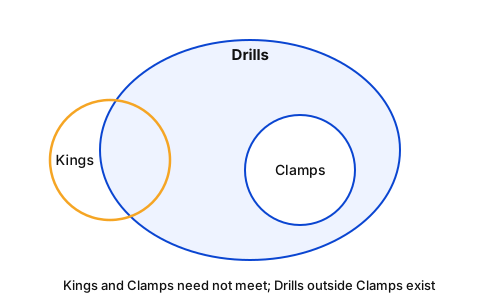
- All clamps are drills → Clamps circle inside Drills.
- Some kings are drills → Kings touches Drills, but can stay away from Clamps. So (I) 'Some kings are clamps' is not certain.
- 'All clamps are drills' cannot be reversed to 'All drills are clamps' → (II) does not follow.
Trick: 'All A are B' never gives 'All B are A'.
Answer: (D) Neither conclusion (I) nor (II) follows.
अवधारणा: न्यूनतम ओवरलैप वाला वेन आरेख बनाएँ; निष्कर्ष तभी सही है जब वह हर संभव आरेख में सत्य हो।
- सभी क्लैंप ड्रिल हैं → Clamps वृत्त Drills के अंदर।
- कुछ किंग ड्रिल हैं → Kings, Drills को छूता है पर Clamps से दूर रह सकता है। अतः (I) निश्चित नहीं।
- 'सभी क्लैंप ड्रिल हैं' को उलटकर 'सभी ड्रिल क्लैंप हैं' नहीं कह सकते → (II) अनुसरण नहीं करता।
ट्रिक: 'सभी A, B हैं' से कभी 'सभी B, A हैं' नहीं निकलता।
उत्तर: (D) न तो निष्कर्ष (I) और न ही (II) अनुसरण करता है।
RRB NTPC Undergraduate CBT 2General Intelligence and ReasoningSyllogismRRB NTPC Undergraduate CBT 2 2024 · 20 Dec Shift 3
Q93.What will come in the place of the question mark (?) in the following equation, if ‘+’ and ‘−’ are interchanged and ‘×’ and ‘÷’ are interchanged?
692 − 438 ÷ 1488 × 372 + 257 ÷ 621 × 69 = ?
यदि '+' और '−' को आपस में बदल दिया जाए तथा '×' और '÷' को आपस में बदल दिया जाए, तो निम्नलिखित समीकरण में प्रश्न चिह्न (?) के स्थान पर क्या आएगा?
692 − 438 ÷ 1488 × 372 + 257 ÷ 621 × 69 = ?
- A113
- B131
- C313
- D311
Show answer
Concept: Swap + ↔ − and × ↔ ÷, then apply BODMAS.
- New expression: .
- .
- .
- .
Trick: Look for exact divisions (, ) – they confirm the swap is right.
Answer: (B)
अवधारणा: + ↔ − और × ↔ ÷ बदलें, फिर BODMAS लगाएँ।
- नया व्यंजक: ।
- ।
- ।
- ।
ट्रिक: पूर्ण भाग (, ) बताता है कि बदलाव सही है।
उत्तर: (B)
RRB NTPC Undergraduate CBT 2General Intelligence and ReasoningInterchange of signsRRB NTPC Undergraduate CBT 2 2024 · 20 Dec Shift 3
Q94.Each vowel in the word COURAGE is changed to the letter immediately following it in the English alphabetical order, and each consonant is changed to the letter immediately preceding it in the English alphabetical order. Which of the following letters will be fifth from the right in the new group of letters thus formed?
शब्द COURAGE के प्रत्येक स्वर को अंग्रेज़ी वर्णमाला क्रम में उसके ठीक बाद वाले अक्षर से बदल दिया जाता है, और प्रत्येक व्यंजन को अंग्रेज़ी वर्णमाला क्रम में उसके ठीक पहले वाले अक्षर से बदल दिया जाता है। इस प्रकार बने अक्षरों के नए समूह में दाएँ से पाँचवाँ अक्षर निम्नलिखित में से कौन-सा होगा?
- AT
- BU
- CV
- DA
Show answer
Concept: Vowels move , consonants move ; then count from the right.
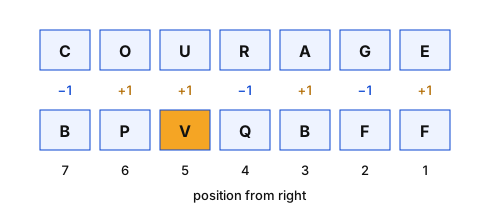
- C→B, O→P, U→V, R→Q, A→B, G→F, E→F.
- New group: B P V Q B F F.
- 5th from right 3rd from left V.
Trick: Position from right from left.
Answer: (C) V
अवधारणा: स्वर , व्यंजन ; फिर दाएँ से गिनें।
- C→B, O→P, U→V, R→Q, A→B, G→F, E→F।
- नया समूह: B P V Q B F F।
- दाएँ से 5वाँ बाएँ से रा V।
ट्रिक: दाएँ से वाँ बाएँ से वाँ।
उत्तर: (C) V
RRB NTPC Undergraduate CBT 2General Intelligence and ReasoningLetter coding – positionRRB NTPC Undergraduate CBT 2 2024 · 20 Dec Shift 3
Q95.Seven boxes H, I, J, K, Q, R and S are kept one over the other but not necessarily in the same order. H is kept second from the bottom. Only three boxes are kept between H and S. J is kept at one of the positions below H. Only Q is kept between S and R. K is kept at one of the positions above S.
How many boxes are kept between I and J?
सात बक्से H, I, J, K, Q, R और S एक के ऊपर एक रखे गए हैं, लेकिन यह आवश्यक नहीं है कि इसी क्रम में हों। H को नीचे से दूसरे स्थान पर रखा गया है। H और S के बीच केवल तीन बक्से रखे गए हैं। J को H से नीचे के स्थानों में से किसी एक पर रखा गया है। S और R के बीच केवल Q रखा गया है। K को S से ऊपर के स्थानों में से किसी एक पर रखा गया है।
I और J के बीच कितने बक्से रखे गए हैं?
- AThreeतीन
- BOneएक
- CFourचार
- DTwoदो
Show answer
Concept: Number positions 1 (bottom) to 7 (top) and place the fixed clues first.
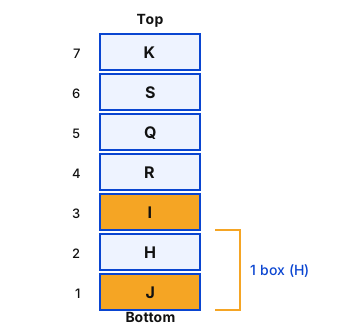
- H = 2. Three boxes between H and S → S = 6. J below H → J = 1.
- Only Q between S and R → R = 4 (8 is impossible), Q = 5.
- K above S → K = 7; remaining I = 3.
- Between I (3) and J (1): only H → one box.
Trick: Fix definite positions first (H, then S, J); 'only one between' clues then close at once.
Answer: (B) One
अवधारणा: स्थान 1 (नीचे) से 7 (ऊपर) तक मानें और निश्चित सूचनाएँ पहले रखें।
- H = 2। H और S के बीच तीन डिब्बे → S = 6। J, H से नीचे → J = 1।
- S और R के बीच केवल Q → R = 4 (8 संभव नहीं), Q = 5।
- K, S से ऊपर → K = 7; बचा I = 3।
- I (3) और J (1) के बीच केवल H → एक डिब्बा।
ट्रिक: पहले निश्चित स्थान (H, फिर S, J) भरें; बाकी अपने आप बैठ जाते हैं।
उत्तर: (B) एक
RRB NTPC Undergraduate CBT 2General Intelligence and ReasoningBox arrangementRRB NTPC Undergraduate CBT 2 2024 · 20 Dec Shift 3
Q96.Refer to the following number series and answer the question that follows (all numbers are single digit numbers only).
(Left) 8 8 4 7 5 5 3 2 9 8 6 4 5 3 8 4 5 8 9 1 5 7 4 9 7 5 1 (Right)
How many such even numbers are there, each of which is immediately preceded by an odd number and also immediately followed by an odd number?
निम्नलिखित संख्या श्रृंखला को देखिए और उसके बाद दिए गए प्रश्न का उत्तर दीजिए (सभी संख्याएँ केवल एक अंक वाली संख्याएँ हैं)।
(बाएँ) 8 8 4 7 5 5 3 2 9 8 6 4 5 3 8 4 5 8 9 1 5 7 4 9 7 5 1 (दाएँ)
ऐसी कितनी सम संख्याएँ हैं, जिनमें से प्रत्येक के ठीक पहले एक विषम संख्या है और ठीक बाद भी एक विषम संख्या है?
- A0
- B4
- C2
- D3
Show answer
Concept: Pick every even number and check its two neighbours: both must be odd.
- 3 2 9 ✓ (positions 7–9).
- 5 8 9 ✓ (positions 17–19).
- 7 4 9 ✓ (positions 22–24).
- Others fail, e.g., 3 8 4 and 8 4 5 have an even neighbour.
Trick: Pattern to scan: odd–even–odd.
Answer: (D)
अवधारणा: हर सम संख्या लें और उसके दोनों पड़ोसी देखें: दोनों विषम होने चाहिए।
- 3 2 9 ✓ (स्थान 7–9)।
- 5 8 9 ✓ (स्थान 17–19)।
- 7 4 9 ✓ (स्थान 22–24)।
- बाकी असफल, जैसे 3 8 4 और 8 4 5 में एक पड़ोसी सम है।
ट्रिक: खोजें: विषम–सम–विषम।
उत्तर: (D)
RRB NTPC Undergraduate CBT 2General Intelligence and ReasoningNumber series – conditionsRRB NTPC Undergraduate CBT 2 2024 · 20 Dec Shift 3
Q97.Refer to the following number series and answer the question that follows (all numbers are single digit numbers only). Counting to be done from left to right only.
(Left) 9 8 7 4 5 3 2 4 5 6 8 1 2 3 5 6 7 6 5 3 9 (Right)
How many such even digits are there, each of the which is immediately preceded by a perfect square and immediately followed by an odd digit? (NOTE: 1 is also a perfect square)
निम्नलिखित संख्या श्रृंखला को देखिए और उसके बाद दिए गए प्रश्न का उत्तर दीजिए (सभी संख्याएँ केवल एक अंक वाली संख्याएँ हैं)। गिनती केवल बाएँ से दाएँ की जानी है।
(बाएँ) 9 8 7 4 5 3 2 4 5 6 8 1 2 3 5 6 7 6 5 3 9 (दाएँ)
ऐसे कितने सम अंक हैं, जिनमें से प्रत्येक के ठीक पहले एक पूर्ण वर्ग है और ठीक बाद एक विषम अंक है? (ध्यान दें: 1 भी एक पूर्ण वर्ग है)
- ANoneएक भी नहीं
- BThreeतीन
- CTwoदो
- DOneएक
Show answer
Concept: Perfect-square digits are 1, 4, 9 (and 0). Find even digits with a perfect square just before and an odd digit just after.
- 9 8 7 ✓ (9 is a square, 7 is odd).
- 1 2 3 ✓ (1 is a square, 3 is odd).
- Other even digits fail: e.g., 7 4 5 (7 not a square), 2 4 5 (2 not a square), 5 6 8 (8 not odd).
Trick: Scan only around 1, 4, 9 – the digit after them must be even, then the next odd.
Answer: (C) Two
अवधारणा: पूर्ण वर्ग अंक 1, 4, 9 (और 0) हैं। ऐसे सम अंक खोजें जिनके ठीक पहले पूर्ण वर्ग और ठीक बाद विषम अंक हो।
- 9 8 7 ✓ (9 पूर्ण वर्ग, 7 विषम)।
- 1 2 3 ✓ (1 पूर्ण वर्ग, 3 विषम)।
- बाकी असफल: जैसे 7 4 5 (7 वर्ग नहीं), 2 4 5 (2 वर्ग नहीं), 5 6 8 (8 विषम नहीं)।
ट्रिक: केवल 1, 4, 9 के बाद देखें – अगला अंक सम और उसके बाद विषम।
उत्तर: (C) दो
RRB NTPC Undergraduate CBT 2General Intelligence and ReasoningNumber series – conditionsRRB NTPC Undergraduate CBT 2 2024 · 20 Dec Shift 3
Q98.TWSP is related to MPLI in a certain way based on the English alphabetical order. In the same way, LOKH is related to EHDA. To which of the given options is PSOL related, following the same logic?
अंग्रेज़ी वर्णमाला क्रम के आधार पर TWSP एक निश्चित प्रकार से MPLI से संबंधित है। उसी प्रकार, LOKH, EHDA से संबंधित है। समान तर्क का अनुसरण करते हुए, PSOL दिए गए विकल्पों में से किससे संबंधित है?
- AILHE
- BIKGE
- CIMGM
- DILGE
Show answer
Concept: Find the shift from each letter of the first term to the second.
- TWSP → MPLI: T=M, W=P, S=L, P=I.
- LOKH → EHDA: each as well.
- PSOL: P=I, S=L, O=H, L=E → ILHE.
Trick: Moving back 7 = moving forward 19.
Answer: (A) ILHE
अवधारणा: पहले पद के हर अक्षर से दूसरे पद तक का खिसकाव देखें।
- TWSP → MPLI: T=M, W=P, S=L, P=I।
- LOKH → EHDA: हर अक्षर ।
- PSOL: P=I, S=L, O=H, L=E → ILHE।
ट्रिक: 7 पीछे = 19 आगे।
उत्तर: (A) ILHE
RRB NTPC Undergraduate CBT 2General Intelligence and ReasoningLetter analogyRRB NTPC Undergraduate CBT 2 2024 · 20 Dec Shift 3
Q99.Refer to the following letter series and answer the question that follows. (Counting to be done from left to right only.)
(Left) K O P Q W S E D G U J I O P K M N V Y I P O (Right)
How many such consonants are there, each of which is immediately preceded by a vowel and also immediately followed by a vowel?
निम्नलिखित अक्षर श्रृंखला को देखिए और उसके बाद दिए गए प्रश्न का उत्तर दीजिए। (गिनती केवल बाएँ से दाएँ की जानी है।)
(बाएँ) K O P Q W S E D G U J I O P K M N V Y I P O (दाएँ)
ऐसे कितने व्यंजन हैं, जिनमें से प्रत्येक के ठीक पहले एक स्वर है और ठीक बाद भी एक स्वर है?
- AMore than twoदो से अधिक
- BNoneएक भी नहीं
- COneएक
- DTwoदो
Show answer
Concept: Mark the vowels (A, E, I, O, U); look for vowel–consonant–vowel.
- U J I ✓ (positions 10–12).
- I P O ✓ (positions 20–22).
- Others fail: O P Q, E D G, O P K have a consonant on one side.
Trick: First circle the vowels, then check only letters sitting between two circles.
Answer: (D) Two
अवधारणा: स्वर (A, E, I, O, U) चिह्नित करें; स्वर–व्यंजन–स्वर खोजें।
- U J I ✓ (स्थान 10–12)।
- I P O ✓ (स्थान 20–22)।
- बाकी असफल: O P Q, E D G, O P K में एक ओर व्यंजन है।
ट्रिक: पहले स्वरों पर घेरा लगाएँ, फिर दो घेरों के बीच वाले अक्षर देखें।
उत्तर: (D) दो
RRB NTPC Undergraduate CBT 2General Intelligence and ReasoningLetter series – conditionsRRB NTPC Undergraduate CBT 2 2024 · 20 Dec Shift 3
Q100.What should come in place of the question mark (?) in the given series?
30 40 50 60 70 ?
दी गई श्रृंखला में प्रश्न चिह्न (?) के स्थान पर क्या आना चाहिए?
30 40 50 60 70 ?
- A78
- B80
- C79
- D77
Show answer
Concept: Each term increases by a constant .
- : difference .
- Next term .
Trick: Constant difference → arithmetic progression.
Answer: (B)
अवधारणा: हर पद में जुड़ रहा है।
- : अंतर ।
- अगला पद ।
ट्रिक: स्थिर अंतर → समांतर श्रेणी।
उत्तर: (B)
RRB NTPC Undergraduate CBT 2General Intelligence and ReasoningNumber seriesRRB NTPC Undergraduate CBT 2 2024 · 20 Dec Shift 3

