Question bank

Q&A: practice questions with answers

Search questions on any topic. Filter by exam category, exam, subject and topic, try the question, then open the answer and explanation.

Courses – airGurukul

53,050 questions in the question bank.

Q2121.
Let the circle C touch the line x−y+1=0, have the centre on the positive x-axis, and cut off a chord of length 413 along the line −3x+2y=1. Let H be the hyperbola x2α2−y2β2=1, whose one of the foci is the centre of C and the length of the transverse axis is the diameter of C. Then 2α2+3β2 is equal to ______
माना वृत्त C, रेखा x−y+1=0 को स्पर्श करता है, इसका केन्द्र धनात्मक x-अक्ष पर है, तथा यह रेखा −3x+2y=1 के अनुदिश 413 लम्बाई की जीवा काटता है। माना H एक अतिपरवलय x2α2−y2β2=1 है, जिसकी एक नाभि वृत्त C का केन्द्र है तथा जिसके अनुप्रस्थ अक्ष की लम्बाई, C के व्यास के बराबर है। तब 2α2+3β2 बराबर है ______
Show answer

Concept: Tangency gives radius = distance to the tangent line; a chord of length 2ℓ satisfies r2=d2+ℓ2; for the hyperbola, c2=α2+β2.

  1. Centre (h,0), h>0: r=|h+1|2; distance to 3x−2y+1=0 is d=|3h+1|13; half-chord =213.
  2. (h+1)22=(3h+1)213+413⇒13(h+1)2=2(3h+1)2+8⇒5h2−14h−3=0⇒h=3 (taking h>0).
  3. So centre (3,0) and r=42=22.
  4. Transverse axis: 2α=2r=42⇒α2=8; focus (3,0): α2+β2=9⇒β2=1.
  5. 2α2+3β2=16+3=19.

Answer: 19

अवधारणा: स्पर्श से त्रिज्या = स्पर्श रेखा तक की दूरी; 2ℓ लम्बाई की जीवा के लिए r2=d2+ℓ2; अतिपरवलय के लिए c2=α2+β2।

  1. केन्द्र (h,0), h>0: r=|h+1|2; रेखा 3x−2y+1=0 तक दूरी d=|3h+1|13; अर्ध-जीवा =213।
  2. (h+1)22=(3h+1)213+413⇒13(h+1)2=2(3h+1)2+8⇒5h2−14h−3=0⇒h=3 (h>0 लेने पर)।
  3. अतः केन्द्र (3,0) तथा r=42=22।
  4. अनुप्रस्थ अक्ष: 2α=2r=42⇒α2=8; नाभि (3,0): α2+β2=9⇒β2=1।
  5. 2α2+3β2=16+3=19।

उत्तर: 19

JEE Main 2025 (January) – Paper 1 (B.E./B.Tech)MathematicsCircle & HyperbolaJEE Main 2025 (January) – Paper 1 (B.E./B.Tech) 2025 · 23 Jan Shift 1 →
Q2122.
If the equation a(b−c)x2+b(c−a)x+c(a−b)=0 has equal roots, where a+c=15 and b=365, then a2+c2 is equal to
यदि समीकरण a(b−c)x2+b(c−a)x+c(a−b)=0 के मूल समान हैं, जहाँ a+c=15 तथा b=365 है, तो a2+c2 बराबर है
Show answer

Concept: The coefficients add to zero, so x=1 is a root; with equal roots both roots are 1, so the product of roots equals 1 (equivalently b is the harmonic mean of a and c).

  1. a(b−c)+b(c−a)+c(a−b)=0⇒x=1 is always a root; equal roots → both roots are 1.
  2. Product of roots: c(a−b)a(b−c)=1⇒ca−cb=ab−ac⇒b=2aca+c.
  3. 365=2ac15⇒ac=54.
  4. a2+c2=(a+c)2−2ac=225−108=117.

Answer: 117

अवधारणा: गुणांकों का योग शून्य है, अतः x=1 एक मूल है; समान मूलों की स्थिति में दोनों मूल 1 होंगे, अतः मूलों का गुणनफल 1 होगा (अर्थात् b, a तथा c का हरात्मक माध्य है)।

  1. a(b−c)+b(c−a)+c(a−b)=0⇒x=1 सदैव एक मूल है; समान मूल → दोनों मूल 1।
  2. मूलों का गुणनफल: c(a−b)a(b−c)=1⇒ca−cb=ab−ac⇒b=2aca+c।
  3. 365=2ac15⇒ac=54।
  4. a2+c2=(a+c)2−2ac=225−108=117।

उत्तर: 117

JEE Main 2025 (January) – Paper 1 (B.E./B.Tech)MathematicsQuadratic Equations – equal rootsJEE Main 2025 (January) – Paper 1 (B.E./B.Tech) 2025 · 23 Jan Shift 1 →
Q2123.
If the set of all values of a, for which the equation 5x3−15x−a=0 has three distinct real roots, is the interval (α,β), then β−2α is equal to ______
यदि a के उन सभी मानों का समुच्चय, जिनके लिए समीकरण 5x3−15x−a=0 के तीन भिन्न वास्तविक मूल हैं, अन्तराल (α,β) है, तो β−2α बराबर है ______
Show answer

Concept: f(x)=5x3−15x has three distinct solutions of f(x)=a exactly when a lies strictly between the local minimum and local maximum values of f.

  1. f′(x)=15x2−15=0⇒x=±1.
  2. Local maximum: f(−1)=−5+15=10; local minimum: f(1)=5−15=−10.
  3. Three distinct real roots ⟺ −10<a<10, so (α,β)=(−10,10).
  4. β−2α=10−2(−10)=30.

Answer: 30

अवधारणा: f(x)=5x3−15x के लिए f(x)=a के तीन भिन्न हल ठीक तभी होते हैं जब a, f के स्थानीय निम्निष्ठ तथा स्थानीय उच्चिष्ठ मानों के बीच हो।

  1. f′(x)=15x2−15=0⇒x=±1।
  2. स्थानीय उच्चिष्ठ: f(−1)=−5+15=10; स्थानीय निम्निष्ठ: f(1)=5−15=−10।
  3. तीन भिन्न वास्तविक मूल ⟺ −10<a<10, अतः (α,β)=(−10,10)।
  4. β−2α=10−2(−10)=30।

उत्तर: 30

JEE Main 2025 (January) – Paper 1 (B.E./B.Tech)MathematicsApplications of Derivatives – roots of a cubicJEE Main 2025 (January) – Paper 1 (B.E./B.Tech) 2025 · 23 Jan Shift 1 →
Q2124.
The sum of all rational terms in the expansion of (1+21/3+31/2)6 is equal to
(1+21/3+31/2)6 के प्रसार में सभी परिमेय पदों का योग बराबर है
Show answer

Concept: By the multinomial theorem the general term is 6!i!j!k!2j/33k/2 with i+j+k=6; it is rational exactly when j is a multiple of 3 and k is even.

  1. List all (j,k) with 3∣j, k even, j+k≤6, and add 6!i!j!k!2j/33k/2:
  2. (0,0):1; (0,2):15⋅3=45; (0,4):15⋅9=135; (0,6):27; (3,0):20⋅2=40; (3,2):60⋅2⋅3=360; (6,0):4.
  3. Sum =1+45+135+27+40+360+4=612.

Short trick: 2j/3 is rational only for j=0,3,6 and 3k/2 only for even k — just 7 triples survive, so the sum is quick to tally.

Answer: 612

अवधारणा: बहुपद प्रमेय से व्यापक पद 6!i!j!k!2j/33k/2 है, जहाँ i+j+k=6; यह ठीक तभी परिमेय है जब j, 3 का गुणज हो तथा k सम हो।

  1. 3∣j, k सम तथा j+k≤6 वाले सभी (j,k) लेकर 6!i!j!k!2j/33k/2 जोड़िए:
  2. (0,0):1; (0,2):15⋅3=45; (0,4):15⋅9=135; (0,6):27; (3,0):20⋅2=40; (3,2):60⋅2⋅3=360; (6,0):4।
  3. योग =1+45+135+27+40+360+4=612।

शॉर्ट ट्रिक: 2j/3 केवल j=0,3,6 के लिए तथा 3k/2 केवल सम k के लिए परिमेय है — कुल 7 ही पद बचते हैं, अतः योग शीघ्र निकल जाता है।

उत्तर: 612

JEE Main 2025 (January) – Paper 1 (B.E./B.Tech)MathematicsBinomial Theorem – rational termsJEE Main 2025 (January) – Paper 1 (B.E./B.Tech) 2025 · 23 Jan Shift 1 →
Q2125.
If the area of the larger portion bounded between the curves x2+y2=25 and y=|x−1| is 14(bπ+c), b,c∈N, then b+c is equal to
यदि वक्रों x2+y2=25 तथा y=|x−1| के बीच घिरे बड़े भाग का क्षेत्रफल 14(bπ+c), b,c∈N है, तो b+c बराबर है
Show answer

Concept: The V-shaped graph y=|x−1| (vertex (1,0) inside the circle) splits the disc into two parts; the region above the V equals (triangle) + (circular segment on the chord joining the intersection points).

  1. Intersections: for x≥1, x2+(x−1)2=25⇒x=4 → (4,3); for x<1, symmetry gives (−3,4).
  2. For P1(−3,4), P2(4,3): OP1→⋅OP2→=−12+12=0, so the chord P1P2 subtends 90∘ at the centre.
  3. Triangle P1(−3,4), V(1,0), P2(4,3): area =12|9−1+16|=12; segment on P1P2: 12r2(θ−sin⁡θ)=252(π2−1).
  4. Smaller portion =12+25π4−252=25π4−12; larger portion =25π−(25π4−12)=75π4+12=14(75π+2).
  5. b=75, c=2, so b+c=77.

Answer: 77

अवधारणा: V-आकृति वाला ग्राफ y=|x−1| (शीर्ष (1,0), वृत्त के भीतर) वृत्तीय क्षेत्र को दो भागों में बाँटता है; V के ऊपर का क्षेत्र = (त्रिभुज) + (प्रतिच्छेद बिन्दुओं को मिलाने वाली जीवा पर वृत्तखण्ड)।

  1. प्रतिच्छेद बिन्दु: x≥1 के लिए x2+(x−1)2=25⇒x=4 → (4,3); x<1 के लिए सममिति से (−3,4)।
  2. P1(−3,4), P2(4,3) के लिए: OP1→⋅OP2→=−12+12=0, अतः जीवा P1P2 केन्द्र पर 90∘ अन्तरित करती है।
  3. त्रिभुज P1(−3,4), V(1,0), P2(4,3): क्षेत्रफल =12|9−1+16|=12; जीवा P1P2 पर वृत्तखण्ड: 12r2(θ−sin⁡θ)=252(π2−1)।
  4. छोटा भाग =12+25π4−252=25π4−12; बड़ा भाग =25π−(25π4−12)=75π4+12=14(75π+2)।
  5. b=75, c=2, अतः b+c=77।

उत्तर: 77

JEE Main 2025 (January) – Paper 1 (B.E./B.Tech)MathematicsArea Under CurvesJEE Main 2025 (January) – Paper 1 (B.E./B.Tech) 2025 · 23 Jan Shift 1 →
Q2126.
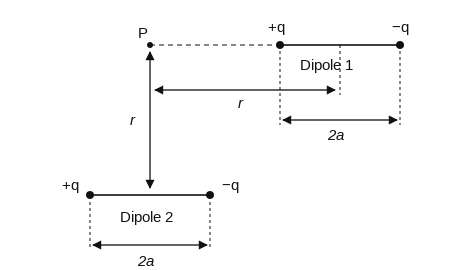
A point particle of charge Q is located at P along the axis of an electric dipole 1 at a distance r as shown in the figure. The point P is also on the equatorial plane of a second electric dipole 2 at a distance r. The dipoles are made of opposite charge q separated by a distance 2a. For the charge particle at P not to experience any net force, which of the following correctly describes the situation?
चित्र में दर्शाए अनुसार एक बिंदु कण, जिस पर आवेश Q है, विद्युत द्विध्रुव 1 के अक्ष (axis) पर दूरी r पर बिंदु P पर स्थित है। बिंदु P एक दूसरे विद्युत द्विध्रुव 2 के निरक्षीय तल (equatorial plane) पर भी दूरी r पर है। द्विध्रुव, दूरी 2a से पृथक विपरीत आवेशों q से बने हैं। P पर स्थित आवेशित कण पर कोई नेट बल न लगे, इसके लिए निम्नलिखित में से कौन-सा कथन स्थिति का सही वर्णन करता है?
  1. Aar∼10
  2. Bar∼20
  3. Car∼0.5
  4. Dar∼3
Show answer

Concept: Exact (not small-a) dipole fields. Axial field: Eax=14πε02pr(r2−a2)2; equatorial field: Eeq=14πε0p(r2+a2)3/2, with p=q(2a). The two fields at P are oppositely directed, so the net force on Q vanishes when their magnitudes are equal.

  1. Equate the magnitudes: 2pr(r2−a2)2=p(r2+a2)3/2.
  2. So 2r(r2+a2)3/2=(r2−a2)2. Put x=ar and divide by r4: 2(1+x2)3/2=(1−x2)2.
  3. Test the options. For x=3: LHS =2(10)3/2≈63.2, RHS =(1−9)2=64 — nearly equal. For x=0.5, 10, 20 the two sides differ by orders of magnitude.
  4. Hence the force balances when ar∼3.

Short trick: For a≪r the axial field (2kp/r3) is always double the equatorial field (kp/r3) — they can never cancel. So the answer must be a large a/r; checking x=3 works at once.

Answer: (D) ar∼3

अवधारणा: द्विध्रुव के यथार्थ (बिना a≪r सन्निकटन) क्षेत्र। अक्षीय क्षेत्र: Eax=14πε02pr(r2−a2)2; निरक्षीय क्षेत्र: Eeq=14πε0p(r2+a2)3/2, जहाँ p=q(2a)। P पर दोनों क्षेत्र विपरीत दिशा में हैं, अतः परिमाण बराबर होने पर Q पर नेट बल शून्य होगा।

  1. परिमाण बराबर रखें: 2pr(r2−a2)2=p(r2+a2)3/2।
  2. अतः 2r(r2+a2)3/2=(r2−a2)2। x=ar रखकर r4 से भाग दें: 2(1+x2)3/2=(1−x2)2।
  3. विकल्प जाँचें। x=3 के लिए: बायाँ पक्ष =2(10)3/2≈63.2, दायाँ पक्ष =(1−9)2=64 — लगभग बराबर। x=0.5, 10, 20 के लिए दोनों पक्ष बहुत भिन्न हैं।
  4. अतः बल संतुलन ar∼3 पर होता है।

शॉर्ट ट्रिक: a≪r के लिए अक्षीय क्षेत्र (2kp/r3) सदैव निरक्षीय क्षेत्र (kp/r3) का दुगुना होता है — वे कभी निरस्त नहीं हो सकते। अतः उत्तर बड़ा a/r ही होगा; x=3 रखते ही संतुलन मिल जाता है।

उत्तर: (D) ar∼3

JEE Main 2025 (January) – Paper 1 (B.E./B.Tech)PhysicsElectrostatics – electric dipoleJEE Main 2025 (January) – Paper 1 (B.E./B.Tech) 2025 · 23 Jan Shift 1 →
Q2127.
A spherical surface of radius of curvature R, separates air from glass (refractive index =1.5). The centre of curvature is in the glass medium. A point object 'O' placed in air on the optic axis of the surface, so that its real image is formed at 'I' inside glass. The line OI intersects the spherical surface at P and PO=PI. The distance PO equals to
वक्रता त्रिज्या R का एक गोलीय पृष्ठ, वायु को काँच (अपवर्तनांक =1.5) से पृथक करता है। वक्रता केंद्र काँच माध्यम में है। एक बिंदु वस्तु 'O' वायु में पृष्ठ के मुख्य अक्ष पर इस प्रकार रखी है कि उसका वास्तविक प्रतिबिंब काँच के भीतर 'I' पर बनता है। रेखा OI गोलीय पृष्ठ को P पर काटती है तथा PO=PI है। दूरी PO बराबर है
  1. A5 R
  2. B3 R
  3. C1.5 R
  4. D2 R
Show answer

Concept: Refraction at a single spherical surface: n2v−n1u=n2−n1R (sign convention: distances from P, light travels from air into glass, R positive as centre of curvature lies in glass).

  1. Let PO=PI=d. Then u=−d (object in air) and v=+d (real image in glass).
  2. 1.5d−1−d=1.5−1R
  3. 1.5d+1d=0.5R ⇒ 2.5d=0.5R
  4. d=5R.

Short trick: With |u|=|v|=d, the equation collapses to n1+n2d=n2−n1R, so d=(n1+n2)Rn2−n1=2.5R0.5=5R.

Answer: (A) 5R

अवधारणा: एकल गोलीय पृष्ठ पर अपवर्तन: n2v−n1u=n2−n1R (चिह्न परिपाटी: दूरियाँ P से, प्रकाश वायु से काँच में जाता है, वक्रता केंद्र काँच में होने से R धनात्मक)।

  1. मान लें PO=PI=d। तब u=−d (वस्तु वायु में) तथा v=+d (वास्तविक प्रतिबिंब काँच में)।
  2. 1.5d−1−d=1.5−1R
  3. 1.5d+1d=0.5R ⇒ 2.5d=0.5R
  4. d=5R।

शॉर्ट ट्रिक: |u|=|v|=d होने पर समीकरण n1+n2d=n2−n1R बन जाता है, अतः d=(n1+n2)Rn2−n1=2.5R0.5=5R।

उत्तर: (A) 5R

JEE Main 2025 (January) – Paper 1 (B.E./B.Tech)PhysicsRay optics – refraction at spherical surfaceJEE Main 2025 (January) – Paper 1 (B.E./B.Tech) 2025 · 23 Jan Shift 1 →
Q2128.
The position of a particle moving on x-axis is given by x(t)=Asin⁡t+Bcos2⁡t+Ct2+D, where t is time. The dimension of ABCD is
x-अक्ष पर गतिमान एक कण की स्थिति x(t)=Asin⁡t+Bcos2⁡t+Ct2+D द्वारा दी जाती है, जहाँ t समय है। ABCD की विमा है
  1. AL2T−2
  2. BL2
  3. CL
  4. DL3T−2
Show answer

Concept: Every term added to give position x must itself have the dimension of length; arguments of sin and cos are dimensionless.

  1. [Asin⁡t]=L⇒[A]=L; similarly [B]=L and [D]=L.
  2. [Ct2]=L⇒[C]=LT−2.
  3. [ABCD]=L⋅L⋅LT−2L=L2T−2.

Short trick: In ABCD, one L (from A, B or D) cancels, leaving L2 times the T−2 carried by C.

Answer: (A) L2T−2

अवधारणा: स्थिति x देने वाले प्रत्येक जोड़े गए पद की विमा लंबाई की होनी चाहिए; sin व cos के कोणांक विमाहीन होते हैं।

  1. [Asin⁡t]=L⇒[A]=L; इसी प्रकार [B]=L तथा [D]=L।
  2. [Ct2]=L⇒[C]=LT−2।
  3. [ABCD]=L⋅L⋅LT−2L=L2T−2।

शॉर्ट ट्रिक: ABCD में एक L (A, B या D से) कट जाता है, शेष रहता है L2 और C वाला T−2।

उत्तर: (A) L2T−2

JEE Main 2025 (January) – Paper 1 (B.E./B.Tech)PhysicsUnits and dimensionsJEE Main 2025 (January) – Paper 1 (B.E./B.Tech) 2025 · 23 Jan Shift 1 →
Q2129.
Given a thin convex lens (refractive index μ2), kept in a liquid (refractive index μ1, μ1<μ2) having radii of curvatures |R1| and |R2|. Its second surface is silver polished. Where should an object be placed on the optic axis so that a real and inverted image is formed at the same place?
एक पतला उत्तल लेंस (अपवर्तनांक μ2) एक द्रव (अपवर्तनांक μ1, μ1<μ2) में रखा है, जिसकी वक्रता त्रिज्याएँ |R1| तथा |R2| हैं। इसके दूसरे पृष्ठ पर चाँदी की पॉलिश (silver polish) की गई है। मुख्य अक्ष पर वस्तु कहाँ रखी जाए कि वास्तविक एवं उल्टा प्रतिबिंब उसी स्थान पर बने?
  1. Aμ1|R1|⋅|R2|μ2(|R1|+|R2|)−μ1|R2|
  2. Bμ1|R1|⋅|R2|μ2(|R1|+|R2|)−μ1|R1|
  3. C(μ2+μ1)|R1|(μ2−μ1)
  4. Dμ1|R1|⋅|R2|μ2(2|R1|+|R2|)−μ1|R1|⋅|R2|
Show answer

Concept: A lens silvered on its back face acts as an equivalent mirror with power Peq=2PL+PM. An object kept at the centre of curvature of this equivalent mirror (u=Req=2feq) forms a real, inverted image at the same place.

  1. Lens in liquid: PL=(μ2μ1−1)(1|R1|+1|R2|)=(μ2−μ1)(|R1|+|R2|)μ1|R1||R2| (convex: R1=+|R1|, R2=−|R2|).
  2. Silvered second surface is a concave mirror: PM=2|R2|.
  3. Peq=2PL+PM=2(μ2−μ1)(|R1|+|R2|)+2μ1|R1|μ1|R1||R2|.
  4. Required object distance =2feq=2Peq=μ1|R1||R2|(μ2−μ1)(|R1|+|R2|)+μ1|R1|=μ1|R1||R2|μ2(|R1|+|R2|)−μ1|R2|.

Short trick: "Real, inverted image at the object itself" always means the object sits at 2f (centre of curvature) of the equivalent mirror — just compute 2/Peq.

Answer: (A) μ1|R1|⋅|R2|μ2(|R1|+|R2|)−μ1|R2|

अवधारणा: पिछले पृष्ठ पर पॉलिश किया लेंस एक तुल्य दर्पण की तरह कार्य करता है जिसकी क्षमता Peq=2PL+PM होती है। इस तुल्य दर्पण के वक्रता केंद्र (u=Req=2feq) पर रखी वस्तु का वास्तविक, उल्टा प्रतिबिंब उसी स्थान पर बनता है।

  1. द्रव में लेंस: PL=(μ2μ1−1)(1|R1|+1|R2|)=(μ2−μ1)(|R1|+|R2|)μ1|R1||R2| (उत्तल: R1=+|R1|, R2=−|R2|)।
  2. पॉलिश किया दूसरा पृष्ठ अवतल दर्पण है: PM=2|R2|।
  3. Peq=2PL+PM=2(μ2−μ1)(|R1|+|R2|)+2μ1|R1|μ1|R1||R2|।
  4. अभीष्ट वस्तु दूरी =2feq=2Peq=μ1|R1||R2|(μ2−μ1)(|R1|+|R2|)+μ1|R1|=μ1|R1||R2|μ2(|R1|+|R2|)−μ1|R2|।

शॉर्ट ट्रिक: "वस्तु के स्थान पर ही वास्तविक, उल्टा प्रतिबिंब" का अर्थ सदैव है कि वस्तु तुल्य दर्पण के 2f (वक्रता केंद्र) पर है — बस 2/Peq निकालें।

उत्तर: (A) μ1|R1|⋅|R2|μ2(|R1|+|R2|)−μ1|R2|

JEE Main 2025 (January) – Paper 1 (B.E./B.Tech)PhysicsRay optics – silvered lensJEE Main 2025 (January) – Paper 1 (B.E./B.Tech) 2025 · 23 Jan Shift 1 →
Q2130.
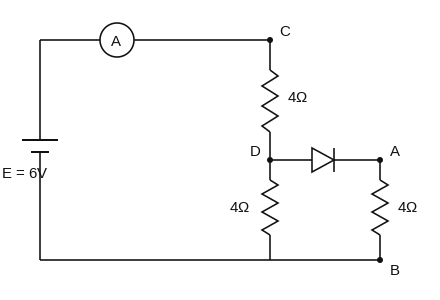
Refer to the circuit diagram given in the figure. which of the following observations are correct?

A. Total resistance of circuit is 6Ω
B. Current in Ammeter is 1 A
C. Potential across AB is 4 Volts.
D. Potential across CD is 4 Volts
E. Total resistance of the circuit is 8Ω.
Choose the correct answer from the options given below:
चित्र में दिए गए परिपथ आरेख के आधार पर, निम्नलिखित में से कौन-से प्रेक्षण सही हैं?

A. परिपथ का कुल प्रतिरोध 6Ω है
B. अमीटर में धारा 1 A है
C. AB के सिरों पर विभव 4 वोल्ट है।
D. CD के सिरों पर विभव 4 वोल्ट है
E. परिपथ का कुल प्रतिरोध 8Ω है।
नीचे दिए गए विकल्पों में से सही उत्तर चुनिए:
  1. AA, B and D Onlyकेवल A, B तथा D
  2. BA, B and C Onlyकेवल A, B तथा C
  3. CA, C and D Onlyकेवल A, C तथा D
  4. DB, C and E Onlyकेवल B, C तथा E
Show answer

Concept: The diode is forward biased (current can flow from D through it towards A), so it behaves as an ideal conductor. Then reduce the network.

  1. From D two parallel paths reach the bottom rail: the direct 4Ω, and the diode + 4Ω (AB). Parallel value =4×44+4=2Ω.
  2. Total resistance =4Ω(CD)+2Ω=6Ω — A is correct, E is wrong.
  3. Ammeter current I=ER=66=1A — B is correct.
  4. VCD=I×4=1×4=4V — D is correct.
  5. Across the parallel pair: V=1×2=2V, which splits the current equally (0.5A each). So VAB=0.5×4=2V, not 4 V — C is wrong.

Short trick: Series 4 Ω takes 4 V of the 6 V; only 2 V is left for the parallel part, so AB can never be at 4 V.

Answer: (A) A, B and D Only

अवधारणा: डायोड अग्र अभिनत (forward biased) है (धारा D से होकर A की ओर बह सकती है), अतः यह आदर्श चालक की तरह व्यवहार करता है। अब परिपथ को सरल करें।

  1. D से नीचे की पट्टी तक दो समांतर पथ हैं: सीधा 4Ω, तथा डायोड + 4Ω (AB)। समांतर मान =4×44+4=2Ω।
  2. कुल प्रतिरोध =4Ω(CD)+2Ω=6Ω — A सही, E गलत।
  3. अमीटर की धारा I=ER=66=1A — B सही।
  4. VCD=I×4=1×4=4V — D सही।
  5. समांतर युग्म पर: V=1×2=2V, धारा बराबर बँटती है (0.5A प्रत्येक)। अतः VAB=0.5×4=2V, 4 V नहीं — C गलत।

शॉर्ट ट्रिक: श्रेणी वाला 4 Ω, 6 V में से 4 V ले लेता है; समांतर भाग के लिए केवल 2 V बचता है, अतः AB पर 4 V कभी नहीं हो सकता।

उत्तर: (A) केवल A, B तथा D

JEE Main 2025 (January) – Paper 1 (B.E./B.Tech)PhysicsCurrent electricity – circuit with diodeJEE Main 2025 (January) – Paper 1 (B.E./B.Tech) 2025 · 23 Jan Shift 1 →
Q2131.
Given below are two statements:
Statement I: The hot water flows faster than cold water
Statement II: Soap water has higher surface tension as compared to fresh water.
In the light above statements, choose the correct answer from the options given below
नीचे दो कथन दिए गए हैं:
कथन I: गर्म पानी, ठंडे पानी की अपेक्षा तेज़ी से बहता है
कथन II: साबुन के पानी का पृष्ठ तनाव (surface tension), स्वच्छ पानी की अपेक्षा अधिक होता है।
उपर्युक्त कथनों के आलोक में, नीचे दिए गए विकल्पों में से सही उत्तर चुनिए
  1. AStatement I is true but Statement II is falseकथन I सत्य है परंतु कथन II असत्य है
  2. BStatement I is false but Statement II is trueकथन I असत्य है परंतु कथन II सत्य है
  3. CBoth Statement I and Statement II are falseकथन I और कथन II दोनों असत्य हैं
  4. DBoth Statement I and Statement II are trueकथन I और कथन II दोनों सत्य हैं
Show answer

Concept: Viscosity of liquids decreases on heating; dissolving soap/detergent lowers the surface tension of water.

  1. Statement I: On heating, the viscosity of water falls, so hot water meets less internal friction and flows faster than cold water — true.
  2. Statement II: Soap molecules accumulate at the surface and reduce surface tension (that is why soap water spreads and wets better) — soap water has lower surface tension than fresh water, so the statement is false.

Short trick: Soap always lowers surface tension — that is the whole point of a detergent.

Answer: (A) Statement I is true but Statement II is false

अवधारणा: गर्म करने पर द्रवों की श्यानता (viscosity) घटती है; साबुन/अपमार्जक घोलने पर पानी का पृष्ठ तनाव घटता है।

  1. कथन I: गर्म करने पर पानी की श्यानता घट जाती है, अतः गर्म पानी को आंतरिक घर्षण कम मिलता है और वह ठंडे पानी से तेज़ बहता है — सत्य।
  2. कथन II: साबुन के अणु सतह पर एकत्र होकर पृष्ठ तनाव घटा देते हैं (इसीलिए साबुन का पानी बेहतर फैलता और भिगोता है) — साबुन के पानी का पृष्ठ तनाव स्वच्छ पानी से कम होता है, अतः कथन असत्य।

शॉर्ट ट्रिक: साबुन सदैव पृष्ठ तनाव घटाता है — अपमार्जक का यही तो कार्य है।

उत्तर: (A) कथन I सत्य है परंतु कथन II असत्य है

JEE Main 2025 (January) – Paper 1 (B.E./B.Tech)PhysicsFluid mechanics – viscosity and surface tensionJEE Main 2025 (January) – Paper 1 (B.E./B.Tech) 2025 · 23 Jan Shift 1 →
Q2132.
Consider a circular disc of radius 20 cm with centre located at the origin. A circular hole of radius 5 cm is cut from this disc in such a way that the edge of the hole touches the edge of the disc. The distance of centre of mass of residual or remaining disc from the origin will be
मूल बिंदु पर केंद्र वाली 20 cm त्रिज्या की एक वृत्ताकार चकती लीजिए। इस चकती से 5 cm त्रिज्या का एक वृत्ताकार छिद्र इस प्रकार काटा जाता है कि छिद्र का किनारा चकती के किनारे को स्पर्श करता है। शेष बची चकती के द्रव्यमान केंद्र की मूल बिंदु से दूरी होगी
  1. A2.0 cm
  2. B1.5 cm
  3. C1.0 cm
  4. D0.5 cm
Show answer

Concept: Treat the hole as negative mass. For a uniform disc of radius R with a hole of radius r whose centre is at distance d from the disc centre: xcm=−r2dR2−r2.

  1. The hole touches the edge internally, so its centre is at d=20−5=15 cm from the origin.
  2. xcm=−(5)2(15)(20)2−(5)2=−375375=−1 cm.
  3. Distance of the centre of mass of the remaining disc from the origin =1.0 cm (on the side opposite to the hole).

Short trick: Masses scale as areas: mhole/mdisc=1/16; shift =mholedmdisc−mhole=1515=1 cm.

Answer: (C) 1.0 cm

अवधारणा: छिद्र को ऋणात्मक द्रव्यमान मानें। R त्रिज्या की एकसमान चकती में r त्रिज्या का छिद्र, जिसका केंद्र चकती के केंद्र से d दूरी पर है: xcm=−r2dR2−r2।

  1. छिद्र किनारे को भीतर से छूता है, अतः उसका केंद्र मूल बिंदु से d=20−5=15 cm पर है।
  2. xcm=−(5)2(15)(20)2−(5)2=−375375=−1 cm।
  3. शेष चकती के द्रव्यमान केंद्र की मूल बिंदु से दूरी =1.0 cm (छिद्र के विपरीत ओर)।

शॉर्ट ट्रिक: द्रव्यमान क्षेत्रफल के अनुपात में: mछिद्र/mचकती=1/16; विस्थापन =mछिद्रdmचकती−mछिद्र=1515=1 cm।

उत्तर: (C) 1.0 cm

JEE Main 2025 (January) – Paper 1 (B.E./B.Tech)PhysicsCentre of mass – disc with cavityJEE Main 2025 (January) – Paper 1 (B.E./B.Tech) 2025 · 23 Jan Shift 1 →
Q2133.
The electric flux is ϕ=ασ+βλ where λ and σ are linear and surface charge density, respectively. (αβ) represents
विद्युत फ्लक्स ϕ=ασ+βλ है, जहाँ λ तथा σ क्रमशः रैखिक एवं पृष्ठ आवेश घनत्व हैं। (αβ) निरूपित करता है
  1. Aelectric fieldविद्युत क्षेत्र
  2. Bareaक्षेत्रफल
  3. Cchargeआवेश
  4. Ddisplacementविस्थापन
Show answer

Concept: Both terms must have the dimension of electric flux. [σ]=[Q]L2, [λ]=[Q]L.

  1. [ασ]=[ϕ]⇒[α]=[ϕ]L2[Q].
  2. [βλ]=[ϕ]⇒[β]=[ϕ]L[Q].
  3. [αβ]=L2L=L — the dimension of length, i.e. displacement.

Short trick: αβ=λσ dimensionally =Q/LQ/L2=L.

Answer: (D) displacement

अवधारणा: दोनों पदों की विमा विद्युत फ्लक्स की होनी चाहिए। [σ]=[Q]L2, [λ]=[Q]L।

  1. [ασ]=[ϕ]⇒[α]=[ϕ]L2[Q]।
  2. [βλ]=[ϕ]⇒[β]=[ϕ]L[Q]।
  3. [αβ]=L2L=L — लंबाई की विमा, अर्थात विस्थापन।

शॉर्ट ट्रिक: विमीय रूप से αβ=λσ=Q/LQ/L2=L।

उत्तर: (D) विस्थापन

JEE Main 2025 (January) – Paper 1 (B.E./B.Tech)PhysicsUnits and dimensions – electric fluxJEE Main 2025 (January) – Paper 1 (B.E./B.Tech) 2025 · 23 Jan Shift 1 →
Q2134.
A sub-atomic particle of mass 10−30 kg is moving with a velocity 2.21×10⁶ m/s. Under the matter wave consideration, the particle will behave closely like (h=6.63×10⁻³⁴ J.s)
10−30 kg द्रव्यमान का एक उप-परमाण्विक कण 2.21×10⁶ m/s वेग से गतिमान है। द्रव्य तरंग (matter wave) की दृष्टि से यह कण लगभग किसके समान व्यवहार करेगा? (h=6.63×10⁻³⁴ J.s)
  1. AVisible radiationदृश्य विकिरण
  2. BGamma raysगामा किरणें
  3. CInfra-red radiationअवरक्त (इन्फ्रा-रेड) विकिरण
  4. DX-raysX-किरणें
Show answer

Concept: de Broglie wavelength λ=hmv; then compare with the electromagnetic spectrum.

  1. λ=6.63×10−3410−30×2.21×106=6.63×10−342.21×10−24=3×10⁻¹⁰ m.
  2. λ=3 Å =0.3 nm, which lies in the X-ray region (∼0.01–10 nm).
  3. Visible light is 400–700 nm, infra-red is longer still, and gamma rays are shorter than about 0.01 nm — none of these match.

Short trick: 6.63/2.21=3; powers: 10−34+30−6=10−10 m → a few Å → X-rays.

Answer: (D) X-rays

अवधारणा: डी-ब्रॉग्ली तरंगदैर्घ्य λ=hmv; फिर विद्युतचुंबकीय स्पेक्ट्रम से तुलना करें।

  1. λ=6.63×10−3410−30×2.21×106=6.63×10−342.21×10−24=3×10⁻¹⁰ m।
  2. λ=3 Å =0.3 nm, जो X-किरण क्षेत्र (∼0.01–10 nm) में आता है।
  3. दृश्य प्रकाश 400–700 nm, अवरक्त उससे भी लंबा, तथा गामा किरणें लगभग 0.01 nm से छोटी होती हैं — इनमें से कोई मेल नहीं खाता।

शॉर्ट ट्रिक: 6.63/2.21=3; घातें: 10−34+30−6=10−10 m → कुछ Å → X-किरणें।

उत्तर: (D) X-किरणें

JEE Main 2025 (January) – Paper 1 (B.E./B.Tech)PhysicsDual nature – matter wavesJEE Main 2025 (January) – Paper 1 (B.E./B.Tech) 2025 · 23 Jan Shift 1 →
Q2135.
Consider a moving coil galvanomenter (MCG):
A. The torsional constant in moving coil galvanometer has dimentions [ML2T−2]
B. Increasing the current sensitivity may not necessarily increase the voltage sensitivity.
C. If we increase number of turns (N) to its double (2N), then the voltage sensitivity doubles.
D. MCG can be converted into an ammeter by introducing a shunt resistance of large value in parallel with galvanometer.
E. Current sensitivity of MCG depends inversely on number of turns of coil.
Choose the correct answer from the options given below:
एक चल कुंडली धारामापी (MCG) पर विचार कीजिए:
A. चल कुंडली धारामापी में ऐंठन नियतांक (torsional constant) की विमाएँ [ML2T−2] हैं
B. धारा सुग्राहिता बढ़ाने से वोल्टता सुग्राहिता का बढ़ना आवश्यक नहीं है।
C. यदि फेरों की संख्या (N) को दुगुना (2N) कर दें, तो वोल्टता सुग्राहिता दुगुनी हो जाती है।
D. धारामापी के समांतर बड़े मान का शंट प्रतिरोध लगाकर MCG को अमीटर में बदला जा सकता है।
E. MCG की धारा सुग्राहिता कुंडली के फेरों की संख्या के व्युत्क्रमानुपाती होती है।
नीचे दिए गए विकल्पों में से सही उत्तर चुनिए:
  1. AA, D Onlyकेवल A, D
  2. BA, B, E Onlyकेवल A, B, E
  3. CB, D, E Onlyकेवल B, D, E
  4. DA, B Onlyकेवल A, B
Show answer

Concept: For an MCG, current sensitivity θI=NABk and voltage sensitivity θV=NABkRg, where k is the torsional constant and Rg the coil resistance.

  1. A: k = torque per unit twist; torque has dimensions [ML2T−2] and angle is dimensionless, so [k]=[ML2T−2] — correct.
  2. B: Doubling N doubles current sensitivity, but Rg also roughly doubles (more wire), so voltage sensitivity need not rise — correct.
  3. C: With N→2N, Rg→2Rg as well, so θV stays nearly unchanged, it does not double — wrong.
  4. D: An ammeter needs a small shunt in parallel, not a large one — wrong.
  5. E: Current sensitivity is directly proportional to N, not inverse — wrong.

Short trick: Remember the pair: current sensitivity ∝N; voltage sensitivity ∝N/Rg — and Rg grows with N.

Answer: (D) A, B Only

अवधारणा: MCG के लिए धारा सुग्राहिता θI=NABk तथा वोल्टता सुग्राहिता θV=NABkRg, जहाँ k ऐंठन नियतांक और Rg कुंडली का प्रतिरोध है।

  1. A: k = प्रति एकांक ऐंठन बल-आघूर्ण; बल-आघूर्ण की विमाएँ [ML2T−2] हैं और कोण विमाहीन है, अतः [k]=[ML2T−2] — सही।
  2. B: N दुगुना करने पर धारा सुग्राहिता दुगुनी होती है, परंतु Rg भी लगभग दुगुना हो जाता है (तार अधिक), अतः वोल्टता सुग्राहिता का बढ़ना आवश्यक नहीं — सही।
  3. C: N→2N के साथ Rg→2Rg भी, अतः θV लगभग अपरिवर्तित रहती है, दुगुनी नहीं होती — गलत।
  4. D: अमीटर के लिए समांतर में छोटा शंट चाहिए, बड़ा नहीं — गलत।
  5. E: धारा सुग्राहिता N के अनुक्रमानुपाती है, व्युत्क्रमानुपाती नहीं — गलत।

शॉर्ट ट्रिक: यह जोड़ी याद रखें: धारा सुग्राहिता ∝N; वोल्टता सुग्राहिता ∝N/Rg — और Rg, N के साथ बढ़ता है।

उत्तर: (D) केवल A, B

JEE Main 2025 (January) – Paper 1 (B.E./B.Tech)PhysicsMoving coil galvanometerJEE Main 2025 (January) – Paper 1 (B.E./B.Tech) 2025 · 23 Jan Shift 1 →
Q2136.
LIST-ILIST-II
A.Pressure varies inversely with volume of an ideal gas.I.Adiabatic process
B.Heat absorbed goes partly to increase internal energy and partly to do work.II.Isochoric process
C.Heat is neither absorbed nor released by a system.III.Isothermal process
D.No work is done on or by a gas.IV.Isobaric process
सूची-Iसूची-II
A.आदर्श गैस का दाब, आयतन के व्युत्क्रमानुपाती बदलता है।I.रुद्धोष्म प्रक्रम
B.अवशोषित ऊष्मा का कुछ भाग आंतरिक ऊर्जा बढ़ाने में तथा कुछ भाग कार्य करने में जाता है।II.समआयतनिक प्रक्रम
C.निकाय द्वारा ऊष्मा न अवशोषित होती है, न उत्सर्जित।III.समतापी प्रक्रम
D.गैस पर या गैस द्वारा कोई कार्य नहीं होता।IV.समदाबी प्रक्रम
  1. AA-III, B-IV, C-I, D-II
  2. BA-I, B-IV, C-II, D-III
  3. CA-III, B-I, C-IV, D-II
  4. DA-I, B-III, C-II, D-IV
Show answer

Concept: Identify each thermodynamic process from its defining property and the first law ΔQ=ΔU+ΔW.

  1. A: P∝1V means PV= constant, i.e. Boyle's law at constant temperature → Isothermal (III).
  2. B: ΔQ=ΔU+ΔW with all three non-zero happens at constant pressure → Isobaric (IV).
  3. C: No heat exchange (ΔQ=0) → Adiabatic (I).
  4. D: ΔW=PΔV=0 means constant volume → Isochoric (II).
  5. So A-III, B-IV, C-I, D-II. Options (B), (C), (D) each mismatch at least one pair (e.g. (C) pairs "no heat" with isochoric, (B) and (D) pair P∝1/V with adiabatic, which actually has PVγ= const).

Short trick: PV= const → isothermal; Q=0 → adiabatic; W=0 → isochoric; the "partly-partly" statement is the isobaric one.

Answer: (A) A-III, B-IV, C-I, D-II

अवधारणा: प्रत्येक ऊष्मागतिक प्रक्रम को उसके परिभाषक गुण तथा प्रथम नियम ΔQ=ΔU+ΔW से पहचानें।

  1. A: P∝1V का अर्थ PV= नियत, अर्थात नियत ताप पर बॉयल का नियम → समतापी (III)।
  2. B: ΔQ=ΔU+ΔW में तीनों अशून्य — यह नियत दाब पर होता है → समदाबी (IV)।
  3. C: ऊष्मा का आदान-प्रदान नहीं (ΔQ=0) → रुद्धोष्म (I)।
  4. D: ΔW=PΔV=0 अर्थात आयतन नियत → समआयतनिक (II)।
  5. अतः A-III, B-IV, C-I, D-II। विकल्प (B), (C), (D) में कम-से-कम एक युग्म गलत है (जैसे (C) में "ऊष्मा नहीं" को समआयतनिक से, (B) व (D) में P∝1/V को रुद्धोष्म से जोड़ा गया है, जबकि रुद्धोष्म में PVγ= नियत होता है)।

शॉर्ट ट्रिक: PV= नियत → समतापी; Q=0 → रुद्धोष्म; W=0 → समआयतनिक; "कुछ भाग–कुछ भाग" वाला कथन समदाबी का है।

उत्तर: (A) A-III, B-IV, C-I, D-II

JEE Main 2025 (January) – Paper 1 (B.E./B.Tech)PhysicsThermodynamics – processes (match the list)JEE Main 2025 (January) – Paper 1 (B.E./B.Tech) 2025 · 23 Jan Shift 1 →
Q2137.
The electric field of an electromagnetic wave in free space is E→=57cos⁡[7.5×10⁶t−5×10⁻³(3x+4y)](4i^−3j^)N/C. The associated magnetic field in Tesla is
मुक्त आकाश में एक विद्युतचुंबकीय तरंग का विद्युत क्षेत्र E→=57cos⁡[7.5×10⁶t−5×10⁻³(3x+4y)](4i^−3j^)N/C है। संबद्ध चुंबकीय क्षेत्र (टेस्ला में) है
  1. AB→=573×108cos⁡[7.5×10⁶t−5×10⁻³(3x+4y)](k^)
  2. BB→=−573×108cos⁡[7.5×10⁶t−5×10⁻³(3x+4y)](k^)
  3. CB→=−573×108cos⁡[7.5×10⁶t−5×10⁻³(3x+4y)](5k^)
  4. DB→=573×108cos⁡[7.5×10⁶t−5×10⁻³(3x+4y)](5k^)
Show answer

Concept: For an EM wave, B→=1c(k^×E→), where k^ is the propagation direction read from the phase.

  1. Phase ∝(3x+4y), so the wave vector is along (3i^+4j^), i.e. k^=3i^+4j^5. (Check: ωk=7.5×1065×10−3×5=3×10⁸ m/s =c.)
  2. Electric field direction E^=4i^−3j^5, amplitude E0=57×5=285 N/C.
  3. k^×E^=125(3i^+4j^)×(4i^−3j^)=125(−9−16)k^=−k^ (unit vector k^ here means z^).
  4. So B→=−2853×108cos⁡[7.5×10⁶t−5×10⁻³(3x+4y)]k^=−573×108cos⁡[7.5×10⁶t−5×10⁻³(3x+4y)](5k^) T.

Short trick: |B0|=E0/c with E0=57×5; only options (B) and (C) have the minus sign from k^×E^=−z^, and only (C) keeps the factor 5.

Answer: (C) B→=−573×108cos⁡[7.5×10⁶t−5×10⁻³(3x+4y)](5k^)

अवधारणा: विद्युतचुंबकीय तरंग के लिए B→=1c(k^×E→), जहाँ k^ कला (phase) से प्राप्त संचरण दिशा है।

  1. कला ∝(3x+4y), अतः तरंग सदिश (3i^+4j^) के अनुदिश है, अर्थात k^=3i^+4j^5। (जाँच: ωk=7.5×1065×10−3×5=3×10⁸ m/s =c।)
  2. विद्युत क्षेत्र की दिशा E^=4i^−3j^5, आयाम E0=57×5=285 N/C।
  3. k^×E^=125(3i^+4j^)×(4i^−3j^)=125(−9−16)k^=−k^ (यहाँ k^ से आशय z^)।
  4. अतः B→=−2853×108cos⁡[7.5×10⁶t−5×10⁻³(3x+4y)]k^=−573×108cos⁡[7.5×10⁶t−5×10⁻³(3x+4y)](5k^) T।

शॉर्ट ट्रिक: |B0|=E0/c जिसमें E0=57×5; ऋण चिह्न k^×E^=−z^ से केवल विकल्प (B) व (C) में है, और 5 का गुणांक केवल (C) में सुरक्षित है।

उत्तर: (C) B→=−573×108cos⁡[7.5×10⁶t−5×10⁻³(3x+4y)](5k^)

JEE Main 2025 (January) – Paper 1 (B.E./B.Tech)PhysicsElectromagnetic wavesJEE Main 2025 (January) – Paper 1 (B.E./B.Tech) 2025 · 23 Jan Shift 1 →
Q2138.
A gun fires a lead bullet of temperature 300 K into a wooden block. The bullet having melting temperature of 600 K penetrates into the block and melts down. If the total heat required for the process is 625 J, then the mass of the bullet is ______ grams. (Latent heat of fusion of lead =2.5×10⁴JKg−1 and specific heat capacity of lead =125JKg−1K−1)
एक बंदूक 300 K ताप की सीसे (lead) की गोली लकड़ी के गुटके में दागती है। 600 K गलनांक वाली यह गोली गुटके में धँसकर पिघल जाती है। यदि इस प्रक्रिया के लिए कुल आवश्यक ऊष्मा 625 J है, तो गोली का द्रव्यमान ______ ग्राम है। (सीसे की गलन की गुप्त ऊष्मा =2.5×10⁴JKg−1 तथा सीसे की विशिष्ट ऊष्मा धारिता =125JKg−1K−1)
  1. A10
  2. B20
  3. C5
  4. D15
Show answer

Concept: Total heat = heat to raise temperature to the melting point + latent heat of melting: Q=mcΔT+mL.

  1. ΔT=600−300=300 K.
  2. Q=m(cΔT+L)=m(125×300+2.5×10⁴)=m(37500+25000)=62500m.
  3. 62500m=625⇒m=0.01 kg =10 g.

Short trick: cΔT+L=62.5 kJ/kg; 625 J ÷ 62.5 kJ/kg =10 g directly.

Answer: (A) 10

अवधारणा: कुल ऊष्मा = गलनांक तक ताप बढ़ाने की ऊष्मा + गलन की गुप्त ऊष्मा: Q=mcΔT+mL।

  1. ΔT=600−300=300 K।
  2. Q=m(cΔT+L)=m(125×300+2.5×10⁴)=m(37500+25000)=62500m।
  3. 62500m=625⇒m=0.01 kg =10 g।

शॉर्ट ट्रिक: cΔT+L=62.5 kJ/kg; 625 J ÷ 62.5 kJ/kg =10 g सीधे।

उत्तर: (A) 10

JEE Main 2025 (January) – Paper 1 (B.E./B.Tech)PhysicsCalorimetry – heat and change of stateJEE Main 2025 (January) – Paper 1 (B.E./B.Tech) 2025 · 23 Jan Shift 1 →
Q2139.
What is the lateral shift of a ray refracted through a parallel-sided glass slab of thickness 'h' in terms of the angle of incidence 'i' and angle of refraction 'r', if the glass slab is placed in air medium?
वायु माध्यम में रखी 'h' मोटाई की समांतर फलकों वाली काँच की पट्टिका (glass slab) से अपवर्तित किरण का पार्श्व विस्थापन (lateral shift), आपतन कोण 'i' तथा अपवर्तन कोण 'r' के पदों में क्या है?
  1. Ahtan⁡(i−r)tan⁡r
  2. Bhsin⁡(i−r)cos⁡r
  3. Ch
  4. Dhcos⁡(i−r)sin⁡r
Show answer

Concept: In a parallel-sided slab the emergent ray is parallel to the incident ray but laterally displaced. Geometry of the refracted ray inside the slab gives the shift.

  1. The ray travels a path length PQ=hcos⁡r inside the slab (h = thickness).
  2. The lateral shift is the perpendicular distance between incident and emergent rays: d=PQsin⁡(i−r).
  3. Hence d=hsin⁡(i−r)cos⁡r.

Short trick: At normal incidence (i=r=0) the shift must vanish — options (C) and (D) fail at once; (A) gives the wrong limit h(1−r/tan⁡r)≠ standard form, while (B) is the memorised slab formula.

Answer: (B) hsin⁡(i−r)cos⁡r

अवधारणा: समांतर फलकों वाली पट्टिका से निर्गत किरण, आपतित किरण के समांतर परंतु पार्श्वतः विस्थापित होती है। पट्टिका के भीतर अपवर्तित किरण की ज्यामिति से विस्थापन मिलता है।

  1. पट्टिका के भीतर किरण की पथ लंबाई PQ=hcos⁡r (h = मोटाई)।
  2. पार्श्व विस्थापन, आपतित व निर्गत किरणों के बीच की लंब दूरी है: d=PQsin⁡(i−r)।
  3. अतः d=hsin⁡(i−r)cos⁡r।

शॉर्ट ट्रिक: अभिलंब आपतन (i=r=0) पर विस्थापन शून्य होना चाहिए — विकल्प (C) व (D) तुरंत असफल; (A) सही सीमा नहीं देता, जबकि (B) पट्टिका का मानक सूत्र है।

उत्तर: (B) hsin⁡(i−r)cos⁡r

JEE Main 2025 (January) – Paper 1 (B.E./B.Tech)PhysicsRay optics – lateral shift in glass slabJEE Main 2025 (January) – Paper 1 (B.E./B.Tech) 2025 · 23 Jan Shift 1 →
Q2140.
A radioactive nucleus n2 has 3 times the decay constant as compared to the decay constant of another radioactive nucleus n1. If initial number of both nuclei are the same, what is the ratio of number of nuclei of n2 to the number of nuclei of n1, after one half-life of n1?
एक रेडियोऐक्टिव नाभिक n2 का क्षय नियतांक, दूसरे रेडियोऐक्टिव नाभिक n1 के क्षय नियतांक का 3 गुना है। यदि दोनों नाभिकों की प्रारंभिक संख्या समान है, तो n1 की एक अर्ध-आयु के पश्चात n2 के नाभिकों की संख्या का n1 के नाभिकों की संख्या से अनुपात क्या है?
  1. A1/8
  2. B8
  3. C4
  4. D1/4
Show answer

Concept: Radioactive decay law N=N0e−λt; one half-life of n1 means t=ln⁡2λ1.

  1. After t: N1=N0e−λ1t=N02.
  2. N2=N0e−3λ1t=N0e−3ln⁡2=N08.
  3. N2N1=1/81/2=14.

Short trick: In one half-life of n1, n2 completes 3 half-lives: n2 left =(12)3, n1 left =12; ratio =(12)2=14.

Answer: (D) 1/4

अवधारणा: रेडियोऐक्टिव क्षय नियम N=N0e−λt; n1 की एक अर्ध-आयु का अर्थ t=ln⁡2λ1।

  1. t के पश्चात: N1=N0e−λ1t=N02।
  2. N2=N0e−3λ1t=N0e−3ln⁡2=N08।
  3. N2N1=1/81/2=14।

शॉर्ट ट्रिक: n1 की एक अर्ध-आयु में n2 की 3 अर्ध-आयु पूरी होती हैं: n2 शेष =(12)3, n1 शेष =12; अनुपात =(12)2=14।

उत्तर: (D) 1/4

JEE Main 2025 (January) – Paper 1 (B.E./B.Tech)PhysicsNuclear physics – radioactive decayJEE Main 2025 (January) – Paper 1 (B.E./B.Tech) 2025 · 23 Jan Shift 1 →