Question bank

Q&A: practice questions with answers

Search questions on any topic. Filter by exam category, exam, subject and topic, try the question, then open the answer and explanation.

Courses – airGurukul

53,050 questions in the question bank.

Q3441.
Match list I with list II.
List IList II
(a) Adaptive radiation(i) Selection of resistant varieties due to excessive use of herbicides and pesticides
(b) Convergent evolution(ii) Bones of forelimbs in Man and Whale
(c) Divergent evolution(iii) Wings of butterfly and birds
(d) Evolution by anthropogenic action(iv) Darwin Finches
सूची I का सूची II से मिलान कीजिए।
सूची Iसूची II
(a) अनुकूली विकिरण(i) शाकनाशियों तथा पीड़कनाशियों के अत्यधिक उपयोग के कारण प्रतिरोधी किस्मों का वरण
(b) अभिसारी विकास(ii) मनुष्य तथा व्हेल की अग्रपाद अस्थियाँ
(c) अपसारी विकास(iii) तितली तथा पक्षियों के पंख
(d) मानवोद्भवी क्रिया द्वारा विकास(iv) डार्विन की फ़िंच
  1. A(a)-(ii); (b)-(i); (c)-(iv); (d)-(iii)
  2. B(a)-(i); (b)-(iv); (c)-(iii); (d)-(ii)
  3. C(a)-(iv); (b)-(iii); (c)-(ii); (d)-(i)
  4. D(a)-(iii); (b)-(ii); (c)-(i); (d)-(iv)
Show answer

Concept: NCERT, Evolution: homologous organs → divergent evolution; analogous organs → convergent evolution.

  1. Adaptive radiation → Darwin's finches of Galapagos (iv).
  2. Convergent evolution → analogous wings of butterfly and bird (iii).
  3. Divergent evolution → homologous forelimb bones of man and whale (ii).
  4. Anthropogenic action → herbicide/pesticide-resistant varieties (i).

Short trick: Same structure, different function = Divergent (homologous); different structure, same function = Convergent (analogous).

Answer: (C) (a)-(iv); (b)-(iii); (c)-(ii); (d)-(i)

अवधारणा: NCERT, विकास: समजात अंग → अपसारी विकास; समरूप अंग → अभिसारी विकास।

  1. अनुकूली विकिरण → गैलापैगोस की डार्विन फ़िंच (iv)।
  2. अभिसारी विकास → तितली व पक्षी के समरूप पंख (iii)।
  3. अपसारी विकास → मनुष्य व व्हेल की समजात अग्रपाद अस्थियाँ (ii)।
  4. मानवोद्भवी क्रिया → शाकनाशी/पीड़कनाशी-प्रतिरोधी किस्में (i)।

शॉर्ट ट्रिक: समान संरचना, भिन्न कार्य = अपसारी (समजात); भिन्न संरचना, समान कार्य = अभिसारी (समरूप)।

उत्तर: (C) (a)-(iv); (b)-(iii); (c)-(ii); (d)-(i)
NEET UGZoologyEvolution – types of evolutionNEET UG 2021 · 12 Sep Shift 1 →
Q3442.
Following are the statements about prostomium of earthworm.
(a) It serves as a covering for mouth
(b) It helps to open cracks in the soil into which it can crawl
(c) It is one of the sensory structures
(d) It is the first body segment
Choose the correct answer from the options given below
केंचुए के पुरोमुख (prostomium) के बारे में निम्नलिखित कथन हैं।
(a) यह मुख के आवरण का कार्य करता है
(b) यह मिट्टी में दरारें खोलने में सहायता करता है जिनमें यह रेंग सकता है
(c) यह संवेदी संरचनाओं में से एक है
(d) यह शरीर का पहला खंड है
नीचे दिए गए विकल्पों में से सही उत्तर चुनिए
  1. A(a), (b), (c) and (d) are correct(a), (b), (c) तथा (d) सही हैं
  2. B(b), (c) are correct(b), (c) सही हैं
  3. C(a), (b) and (c) are correct(a), (b) तथा (c) सही हैं
  4. D(a), (b) and (d) are correct(a), (b) तथा (d) सही हैं
Show answer

Concept: NCERT: the mouth is in the first segment (peristomium); the prostomium is a lobe that serves as a covering for the mouth and as a wedge to force open cracks in the soil; it is sensory in function.

  1. (a) True – covers the mouth.
  2. (b) True – acts as a wedge to open soil cracks.
  3. (c) True – it is sensory.
  4. (d) False – the first body segment is the peristomium (buccal segment); the prostomium is only a lobe above the mouth.
  5. Correct = (a), (b), (c).

Short trick: "Pro" = before – the prostomium lies BEFORE the first segment, not as it.

Answer: (C) (a), (b) and (c) are correct

अवधारणा: NCERT: मुख पहले खंड (परिमुख – peristomium) में होता है; पुरोमुख एक पालि है जो मुख का आवरण बनती है तथा मिट्टी की दरारें खोलने हेतु फन्नी (wedge) का कार्य करती है; यह संवेदी कार्य भी करती है।

  1. (a) सत्य – मुख को ढकता है।
  2. (b) सत्य – मिट्टी की दरारें खोलने हेतु फन्नी का कार्य करता है।
  3. (c) सत्य – यह संवेदी है।
  4. (d) असत्य – शरीर का पहला खंड परिमुख (मुख खंड) है; पुरोमुख केवल मुख के ऊपर की पालि है।
  5. सही = (a), (b), (c)।

शॉर्ट ट्रिक: "Pro" = पहले – पुरोमुख पहले खंड से पहले स्थित है, स्वयं पहला खंड नहीं।

उत्तर: (C) (a), (b) तथा (c) सही हैं

NEET UGZoologyStructural organisation in animals – earthwormNEET UG 2021 · 12 Sep Shift 1 →
Q3443.
The Adenosine deaminase deficiency results into:
ऐडिनोसीन डिऐमिनेज़ (ADA) की कमी का परिणाम होता है:
  1. ADigestive disorderपाचन विकार
  2. BAddison’s diseaseऐडिसन रोग
  3. CDysfunction of Immune systemप्रतिरक्षा तंत्र की दुष्क्रिया
  4. DParkinson’s diseaseपार्किंसन रोग
Show answer

Concept: NCERT: the enzyme adenosine deaminase is crucial for the immune system to function; its deficiency (deletion of the ADA gene) causes severe combined immunodeficiency (SCID). It was the first disease treated by gene therapy (1990, a 4-year-old girl).

  1. Digestive disorder – unrelated to ADA.
  2. Addison's disease – hyposecretion of adrenal cortex hormones.
  3. Parkinson's disease – loss of dopamine-producing neurons.
  4. Only (C) fits – immune dysfunction.

Short trick: ADA → SCID → first gene therapy (1990): "A-D-A = A Defective Army (immunity)".

Answer: (C) Dysfunction of Immune system

अवधारणा: NCERT: ऐडिनोसीन डिऐमिनेज़ एंजाइम प्रतिरक्षा तंत्र के कार्य के लिए अत्यंत आवश्यक है; इसकी कमी (ADA जीन के विलोपन) से गंभीर संयुक्त प्रतिरक्षा न्यूनता (SCID) होती है। यह जीन चिकित्सा से उपचारित पहला रोग था (1990, चार वर्ष की बालिका)।

  1. पाचन विकार – ADA से असंबंधित।
  2. ऐडिसन रोग – अधिवृक्क वल्कुट हॉर्मोनों का अल्पस्रावण।
  3. पार्किंसन रोग – डोपामीन बनाने वाले न्यूरॉनों की क्षति।
  4. केवल (C) सही बैठता है – प्रतिरक्षा दुष्क्रिया।

शॉर्ट ट्रिक: ADA → SCID → पहली जीन चिकित्सा (1990): "A-D-A = A Defective Army (प्रतिरक्षा सेना)"।

उत्तर: (C) प्रतिरक्षा तंत्र की दुष्क्रिया

NEET UGZoologyBiotechnology applications – gene therapy (ADA)NEET UG 2021 · 12 Sep Shift 1 →
Q3444.
Match list I with list II.
List IList II
(a) Allen’s Rule(i) Kangaroo rat
(b) Physiological adaptation(ii) Desert lizard
(c) Behavioural adaptation(iii) Marine fish at depth
(d) Biochemical adaptation(iv) Polar seal
सूची I का सूची II से मिलान कीजिए।
सूची Iसूची II
(a) एलन का नियम (Allen’s Rule)(i) कंगारू चूहा
(b) कार्यिकीय अनुकूलन(ii) मरुस्थलीय छिपकली
(c) व्यावहारिक अनुकूलन(iii) गहराई पर रहने वाली समुद्री मछली
(d) जैव-रासायनिक अनुकूलन(iv) ध्रुवीय सील
  1. A(a)-(iv); (b)-(i); (c)-(ii); (d)-(iii)
  2. B(a)-(iv); (b)-(iii); (c)-(ii); (d)-(i)
  3. C(a)-(iv); (b)-(ii); (c)-(iii); (d)-(i)
  4. D(a)-(iv); (b)-(i); (c)-(iii); (d)-(ii)
Show answer

Concept: NCERT, Organisms and Populations – adaptations.

  1. Allen’s rule (shorter ears and limbs in cold climates to reduce heat loss) → polar seal (iv).
  2. Physiological adaptation → kangaroo rat meets water needs by internal fat oxidation and concentrated urine (i).
  3. Behavioural adaptation → desert lizard basks in the sun or burrows to regulate body temperature (ii).
  4. Biochemical adaptation → deep-sea fish have special enzymes/proteins working at high pressure (iii).

Short trick: All options agree on (a)-(iv); kangaroo rat = physiology (no drinking) → (b)-(i); lizard = behaviour → (c)-(ii); only (A).

Answer: (A) (a)-(iv); (b)-(i); (c)-(ii); (d)-(iii)

अवधारणा: NCERT, जीव और समष्टियाँ – अनुकूलन।

  1. एलन का नियम (ऊष्मा-हानि घटाने हेतु ठंडी जलवायु में छोटे कान व पाद) → ध्रुवीय सील (iv)।
  2. कार्यिकीय अनुकूलन → कंगारू चूहा आंतरिक वसा ऑक्सीकरण तथा सांद्र मूत्र द्वारा जल की आवश्यकता पूरी करता है (i)।
  3. व्यावहारिक अनुकूलन → मरुस्थलीय छिपकली शरीर ताप नियंत्रण हेतु धूप सेंकती या बिल में छिपती है (ii)।
  4. जैव-रासायनिक अनुकूलन → गहरे समुद्र की मछलियों में उच्च दाब पर कार्य करने वाले विशेष एंजाइम/प्रोटीन होते हैं (iii)।

शॉर्ट ट्रिक: सभी विकल्पों में (a)-(iv) है; कंगारू चूहा = कार्यिकी (पानी नहीं पीता) → (b)-(i); छिपकली = व्यवहार → (c)-(ii); केवल (A)।

उत्तर: (A) (a)-(iv); (b)-(i); (c)-(ii); (d)-(iii)

NEET UGZoologyOrganisms and populations – adaptationsNEET UG 2021 · 12 Sep Shift 1 →
Q3445.
Which of these is not an important component of initiation of parturition in humans?
मनुष्यों में प्रसव के प्रारंभन का इनमें से कौन-सा महत्वपूर्ण घटक नहीं है?
  1. ARelease of Oxytocinऑक्सीटोसिन का मोचन
  2. BRelease of Prolactinप्रोलैक्टिन का मोचन
  3. CIncrease in estrogen and progesterone ratioएस्ट्रोजन तथा प्रोजेस्टेरॉन अनुपात में वृद्धि
  4. DSynthesis of prostaglandinsप्रोस्टाग्लैंडिनों का संश्लेषण
Show answer

Concept: NCERT: parturition is induced by a complex neuroendocrine mechanism – signals from the fully developed foetus and placenta (foetal ejection reflex) trigger release of oxytocin from the maternal pituitary, causing stronger uterine contractions; a rising estrogen : progesterone ratio and prostaglandins also promote labour.

  1. Oxytocin, the rise in estrogen/progesterone ratio and prostaglandins all initiate or strengthen uterine contractions.
  2. Prolactin acts after birth – it stimulates milk production (lactation), not parturition.

Short trick: Prolactin = PRO-LACTation → milk, after delivery.

Answer: (B) Release of Prolactin

अवधारणा: NCERT: प्रसव एक जटिल तंत्रिका-अंतःस्रावी क्रियाविधि द्वारा प्रेरित होता है – पूर्ण विकसित भ्रूण तथा अपरा के संकेत (भ्रूण-उत्क्षेपण प्रतिवर्त) माता की पीयूष ग्रंथि से ऑक्सीटोसिन मुक्त कराते हैं, जिससे गर्भाशय के संकुचन तेज़ होते हैं; एस्ट्रोजन : प्रोजेस्टेरॉन अनुपात में वृद्धि तथा प्रोस्टाग्लैंडिन भी प्रसव को बढ़ावा देते हैं।

  1. ऑक्सीटोसिन, एस्ट्रोजन/प्रोजेस्टेरॉन अनुपात में वृद्धि तथा प्रोस्टाग्लैंडिन – ये सभी गर्भाशय संकुचन प्रारंभ या प्रबल करते हैं।
  2. प्रोलैक्टिन जन्म के बाद कार्य करता है – यह दुग्ध उत्पादन (दुग्धस्रवण) को उद्दीपित करता है, प्रसव को नहीं।

शॉर्ट ट्रिक: Prolactin = PRO-LACTation → दूध, प्रसव के बाद।

उत्तर: (B) प्रोलैक्टिन का मोचन

NEET UGZoologyHuman reproduction – parturitionNEET UG 2021 · 12 Sep Shift 1 →
Q3446.
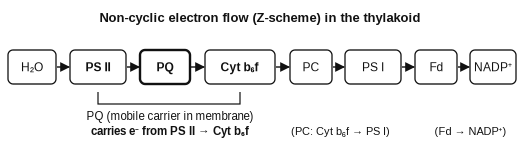
In light reaction, plastoquinone facilitates the transfer of electrons from
प्रकाश अभिक्रिया में, प्लास्टोक्विनोन (plastoquinone) इलेक्ट्रॉनों के स्थानांतरण को किससे किस तक सुगम बनाता है?
  1. APS-I to NADP+PS-I से NADP+ तक
  2. BPS-I to ATP synthasePS-I से ATP सिंथेज़ तक
  3. CPS-II to Cytb6f complexPS-II से Cytb6f सम्मिश्र तक
  4. DCytb6f complex to PS-ICytb6f सम्मिश्र से PS-I तक
Show answer

Concept: In the non-cyclic (Z-scheme) electron flow, plastoquinone (PQ) is a lipid-soluble mobile carrier that takes electrons from PS II to the cytochrome b6f complex.

  1. Excited P680 of PS II passes e− to pheophytin → plastoquinone (PQ).
  2. PQ (reduced to PQH2) diffuses in the membrane and hands e− to Cyt b6f, also pumping H+ into the lumen.
  3. Cyt b6f → PS I is done by plastocyanin (PC) – so (D) is wrong.
  4. PS I → NADP+ is via ferredoxin and NADP+ reductase – (A) is wrong; PS I never sends e− to ATP synthase – (B) is wrong.

Short trick: Order of carriers: PS II → PQ → Cyt b6f → PC → PS I → Fd → NADP+ ("Please Queue, Cyt Plays Fair").

Answer: (C) PS-II to Cytb6f complex

अवधारणा: अचक्रीय (Z-योजना) इलेक्ट्रॉन प्रवाह में प्लास्टोक्विनोन (PQ) एक वसा-विलेय गतिशील वाहक है जो इलेक्ट्रॉनों को PS II से साइटोक्रोम b6f सम्मिश्र तक ले जाता है।

  1. PS II का उत्तेजित P680 e− को फियोफाइटिन → प्लास्टोक्विनोन (PQ) को देता है।
  2. PQ (PQH2 में अपचयित) झिल्ली में विसरित होकर e− को Cyt b6f को सौंपता है और H+ को ल्यूमेन में पंप भी करता है।
  3. Cyt b6f → PS I का कार्य प्लास्टोसायनिन (PC) करता है – अतः (D) गलत है।
  4. PS I → NADP+ फेरेडॉक्सिन व NADP+ रिडक्टेज़ द्वारा होता है – (A) गलत; PS I कभी ATP सिंथेज़ को e− नहीं भेजता – (B) गलत।

शॉर्ट ट्रिक: वाहकों का क्रम: PS II → PQ → Cyt b6f → PC → PS I → Fd → NADP+।

उत्तर: (C) PS-II से Cytb6f सम्मिश्र तक

NEET UGBiologyPhotosynthesis – light reaction, electron transportNEET UG 2020 · 13 Sep Shift 1 →
Q3447.
The sequence that controls the copy number of the linked DNA in the vector is termed
संवाहक (vector) में जुड़े DNA की प्रतिलिपि संख्या (copy number) को नियंत्रित करने वाला अनुक्रम कहलाता है
  1. APalindromic sequenceपैलिंड्रोमिक अनुक्रम
  2. BRecognition siteपहचान स्थल (recognition site)
  3. CSelectable markerवरणयोग्य चिह्नक (selectable marker)
  4. DOri siteOri स्थल
Show answer

Concept: NCERT: "Origin of replication (ori) – this is a sequence from where replication starts and any piece of DNA when linked to this sequence can be made to replicate within the host cells. This sequence is also responsible for controlling the copy number of the linked DNA."

  1. Ori site starts replication and fixes how many copies are made → correct.
  2. Palindromic sequence – a base sequence that reads the same on both strands; it is the cutting site of restriction enzymes.
  3. Recognition site – the specific sequence a restriction enzyme binds to.
  4. Selectable marker – helps pick out transformants (e.g. ampicillin/tetracycline resistance genes).

Short trick: Want MORE copies of a gene? Clone it into a vector whose ori supports a high copy number – "ori = origin + number".

Answer: (D) Ori site

अवधारणा: NCERT: "प्रतिकृतियन का उद्भव (ori) – यह वह अनुक्रम है जहाँ से प्रतिकृतियन शुरू होता है, और इससे जुड़ा कोई भी DNA खंड परपोषी कोशिका में प्रतिकृत हो सकता है। यही अनुक्रम जुड़े DNA की प्रतिलिपि संख्या को भी नियंत्रित करता है।"

  1. Ori स्थल प्रतिकृतियन शुरू करता है और प्रतियों की संख्या तय करता है → सही।
  2. पैलिंड्रोमिक अनुक्रम – दोनों रज्जुकों पर समान पढ़ा जाने वाला क्षार-अनुक्रम; यह प्रतिबंधन एंजाइम का कटाव स्थल है।
  3. पहचान स्थल – वह विशिष्ट अनुक्रम जिससे प्रतिबंधन एंजाइम जुड़ता है।
  4. वरणयोग्य चिह्नक – रूपांतरित कोशिकाओं को चुनने में सहायक (जैसे ऐम्पिसिलिन/टेट्रासाइक्लिन प्रतिरोधी जीन)।

शॉर्ट ट्रिक: किसी जीन की अधिक प्रतियाँ चाहिए? उसे ऐसे संवाहक में क्लोन करें जिसका ori उच्च प्रतिलिपि संख्या देता हो – "ori = उद्भव + संख्या"।

उत्तर: (D) Ori स्थल

NEET UGBiologyBiotechnology – cloning vectorsNEET UG 2020 · 13 Sep Shift 1 →
Q3448.
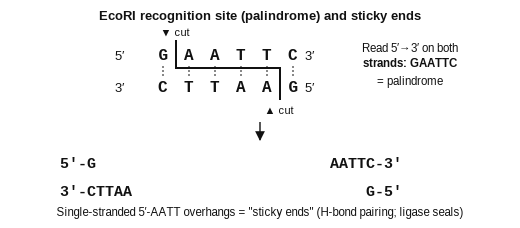
The specific palindromic sequence which is recognized by EcoRI is
EcoRI द्वारा पहचाना जाने वाला विशिष्ट पैलिंड्रोमिक अनुक्रम है
  1. A5′ - CTTAAG - 3′
    3′ - GAATTC - 5′
  2. B5′ - GGATCC - 3′
    3′ - CCTAGG - 5′
  3. C5′ - GAATTC - 3′
    3′ - CTTAAG - 5′
  4. D5′ - GGAACC - 3′
    3′ - CCTTGG - 5′
Show answer

Concept: EcoRI recognises the palindrome 5′-GAATTC-3′ / 3′-CTTAAG-5′ and cuts between G and A on both strands, leaving AATT sticky ends.

  1. Read the top strand 5′→3′ = GAATTC; read the lower strand also 5′→3′ (right to left) = GAATTC → palindrome ✔ (C).
  2. (A) reads CTTAAG 5′→3′ on top – it is the site written upside down, not the EcoRI site as read 5′→3′.
  3. (B) GGATCC is the site of BamHI.
  4. (D) GGAACC: lower strand read 5′→3′ is GGTTCC ≠ GGAACC → not even a palindrome.

Short trick: NCERT example: "5′—GAATTC—3′ / 3′—CTTAAG—5′" – EcoRI = "GAATTC"; BamHI = "GGATCC".

Answer: (C) 5′-GAATTC-3′ / 3′-CTTAAG-5′

अवधारणा: EcoRI पैलिंड्रोम 5′-GAATTC-3′ / 3′-CTTAAG-5′ को पहचानता है और दोनों रज्जुकों पर G और A के बीच काटता है, जिससे AATT चिपचिपे सिरे (sticky ends) बनते हैं।

  1. ऊपरी रज्जुक 5′→3′ पढ़ें = GAATTC; निचला रज्जुक भी 5′→3′ (दाएँ से बाएँ) पढ़ें = GAATTC → पैलिंड्रोम ✔ (C)।
  2. (A) ऊपर 5′→3′ पढ़ने पर CTTAAG – यह स्थल उलटा लिखा है, 5′→3′ में EcoRI स्थल नहीं।
  3. (B) GGATCC, BamHI का स्थल है।
  4. (D) GGAACC: निचला रज्जुक 5′→3′ पढ़ने पर GGTTCC ≠ GGAACC → यह पैलिंड्रोम भी नहीं है।

शॉर्ट ट्रिक: NCERT उदाहरण: "5′—GAATTC—3′ / 3′—CTTAAG—5′" – EcoRI = "GAATTC"; BamHI = "GGATCC"।

उत्तर: (C) 5′-GAATTC-3′ / 3′-CTTAAG-5′

NEET UGBiologyBiotechnology – restriction enzymes (EcoRI)NEET UG 2020 · 13 Sep Shift 1 →
Q3449.
Identify the wrong statement with reference to immunity.
प्रतिरक्षा के संदर्भ में गलत कथन को पहचानिए।
  1. AActive immunity is quick and gives full responseसक्रिय प्रतिरक्षा तीव्र होती है और पूर्ण अनुक्रिया देती है
  2. BFoetus receives some antibodies from mother, it is an example for passive immunityगर्भस्थ शिशु (foetus) माता से कुछ प्रतिरक्षी प्राप्त करता है, यह निष्क्रिय प्रतिरक्षा का उदाहरण है
  3. CWhen exposed to antigen (living or dead) antibodies are produced in the host’s body. It is called “Active immunity”प्रतिजन (जीवित या मृत) के संपर्क में आने पर परपोषी के शरीर में प्रतिरक्षी बनते हैं। इसे “सक्रिय प्रतिरक्षा” कहते हैं
  4. DWhen ready-made antibodies are directly given, it is called “Passive immunity”जब बने-बनाए प्रतिरक्षी सीधे दिए जाते हैं, तो इसे “निष्क्रिय प्रतिरक्षा” कहते हैं
Show answer

Concept: NCERT: "Active immunity is slow and takes time to give its full effective response." Passive immunity (ready-made antibodies) is quick.

  1. (A) says active immunity is quick – wrong → answer.
  2. (B) Antibodies (IgG) cross the placenta to the foetus – passive immunity ✔.
  3. (C) Host makes its own antibodies after antigen exposure – active immunity ✔.
  4. (D) Ready-made antibodies (e.g. anti-tetanus serum, antivenom) – passive immunity ✔.

Short trick: Active = Antibodies made by self = slow but long-lasting; Passive = Pre-made = quick but short-lived.

Answer: (A) Active immunity is quick and gives full response

अवधारणा: NCERT: "सक्रिय प्रतिरक्षा धीमी होती है और पूर्ण प्रभावी अनुक्रिया देने में समय लेती है।" निष्क्रिय प्रतिरक्षा (बने-बनाए प्रतिरक्षी) तीव्र होती है।

  1. (A) कहता है सक्रिय प्रतिरक्षा तीव्र है – गलत → उत्तर।
  2. (B) प्रतिरक्षी (IgG) अपरा पार करके गर्भस्थ शिशु तक पहुँचते हैं – निष्क्रिय प्रतिरक्षा ✔।
  3. (C) प्रतिजन संपर्क के बाद परपोषी स्वयं प्रतिरक्षी बनाता है – सक्रिय प्रतिरक्षा ✔।
  4. (D) बने-बनाए प्रतिरक्षी (जैसे टिटनेस-रोधी सीरम, प्रतिविष) – निष्क्रिय प्रतिरक्षा ✔।

शॉर्ट ट्रिक: सक्रिय = स्वयं बनाए प्रतिरक्षी = धीमी पर दीर्घकालिक; निष्क्रिय = पहले से बने = तीव्र पर अल्पकालिक।

उत्तर: (A) सक्रिय प्रतिरक्षा तीव्र होती है और पूर्ण अनुक्रिया देती है

NEET UGBiologyHuman health and disease – immunityNEET UG 2020 · 13 Sep Shift 1 →
Q3450.
Experimental verification of the chromosomal theory of inheritance was done by
वंशागति के गुणसूत्रीय सिद्धांत का प्रायोगिक सत्यापन किसके द्वारा किया गया?
  1. ABoveriबोवेरी
  2. BMorganमॉर्गन
  3. CMendelमेंडल
  4. DSuttonसटन
Show answer

Concept: NCERT: "Experimental verification of the chromosomal theory of inheritance by Thomas Hunt Morgan and his colleagues" – using Drosophila melanogaster.

  1. Morgan worked on fruit flies, discovered linkage and recombination of X-linked genes → verified the theory.
  2. Sutton and Boveri (1902) only proposed the chromosomal theory – (A), (D) wrong.
  3. Mendel (1865) gave the laws of inheritance with "factors"; chromosomes were unknown to him – (C) wrong.

Short trick: Sutton–Boveri proposed, Morgan proved (with fruit flies).

Answer: (B) Morgan

अवधारणा: NCERT: "वंशागति के गुणसूत्रीय सिद्धांत का प्रायोगिक सत्यापन थॉमस हंट मॉर्गन और उनके सहयोगियों ने किया" – Drosophila melanogaster का उपयोग करके।

  1. मॉर्गन ने फल-मक्खी पर कार्य किया, X-सहलग्न जीनों की सहलग्नता और पुनर्योजन खोजे → सिद्धांत सत्यापित किया।
  2. सटन और बोवेरी (1902) ने केवल गुणसूत्रीय सिद्धांत प्रस्तावित किया – (A), (D) गलत।
  3. मेंडल (1865) ने "कारकों" के साथ वंशागति के नियम दिए; उन्हें गुणसूत्रों का ज्ञान नहीं था – (C) गलत।

शॉर्ट ट्रिक: सटन–बोवेरी ने प्रस्तावित किया, मॉर्गन ने सिद्ध किया (फल-मक्खी से)।

उत्तर: (B) मॉर्गन

NEET UGBiologyPrinciples of inheritance – chromosomal theoryNEET UG 2020 · 13 Sep Shift 1 →
Q3451.
Match the following concerning essential elements and their functions in plants
(a) Iron(i) Photolysis of water
(b) Zinc(ii) Pollen germination
(c) Boron(iii) Required for chlorophyll biosynthesis
(d) Manganese(iv) IAA biosynthesis
पादपों में आवश्यक तत्वों और उनके कार्यों का मिलान कीजिए
(a) आयरन (Iron)(i) जल का प्रकाश-अपघटन
(b) जिंक (Zinc)(ii) परागकण अंकुरण
(c) बोरॉन (Boron)(iii) पर्णहरित (क्लोरोफिल) जैवसंश्लेषण के लिए आवश्यक
(d) मैंगनीज़ (Manganese)(iv) IAA जैवसंश्लेषण
  1. A(a) - (iii); (b) - (iv); (c) - (ii); (d) - (i)
  2. B(a) - (iv); (b) - (i); (c) - (ii); (d) - (iii)
  3. C(a) - (ii); (b) - (i); (c) - (iv); (d) - (iii)
  4. D(a) - (iv); (b) - (iii); (c) - (ii); (d) - (i)
Show answer

Concept: NCERT mineral nutrition: Fe – needed for chlorophyll formation; Zn – needed for synthesis of auxin (IAA); B – pollen germination; Mn – splitting of water during photosynthesis.

  1. Iron → chlorophyll biosynthesis = (iii).
  2. Zinc → IAA biosynthesis (tryptophan synthesis) = (iv).
  3. Boron → pollen germination, Ca uptake, cell differentiation = (ii).
  4. Manganese → photolysis of water (with Cl−) = (i).
  5. Only (A) = a-iii, b-iv, c-ii, d-i. (B), (C), (D) give Fe the wrong role (iv/ii) or Mn the wrong role (iii) → wrong.

Short trick: "Mn splits water, Zn makes auxin, B helps pollen, Fe greens the leaf". Even a-iii alone picks (A).

Answer: (A) (a) - (iii); (b) - (iv); (c) - (ii); (d) - (i)

अवधारणा: NCERT खनिज पोषण: Fe – पर्णहरित निर्माण के लिए आवश्यक; Zn – ऑक्सिन (IAA) संश्लेषण के लिए आवश्यक; B – परागकण अंकुरण; Mn – प्रकाश-संश्लेषण में जल का विघटन।

  1. आयरन → पर्णहरित जैवसंश्लेषण = (iii)।
  2. जिंक → IAA जैवसंश्लेषण (ट्रिप्टोफैन संश्लेषण) = (iv)।
  3. बोरॉन → परागकण अंकुरण, Ca अवशोषण, कोशिका विभेदन = (ii)।
  4. मैंगनीज़ → जल का प्रकाश-अपघटन (Cl− के साथ) = (i)।
  5. केवल (A) = a-iii, b-iv, c-ii, d-i। (B), (C), (D) में Fe की भूमिका (iv/ii) या Mn की भूमिका (iii) गलत है → गलत।

शॉर्ट ट्रिक: "Mn जल तोड़े, Zn ऑक्सिन बनाए, B पराग उगाए, Fe पत्ती हरी करे"। केवल a-iii से ही (A) मिल जाता है।

उत्तर: (A) (a) - (iii); (b) - (iv); (c) - (ii); (d) - (i)

NEET UGBiologyMineral nutrition – functions of micronutrientsNEET UG 2020 · 13 Sep Shift 1 →
Q3452.
In gel electrophoresis, separated DNA fragments can be visualized with the help of
जेल वैद्युतकणसंचलन (gel electrophoresis) में पृथक DNA खंडों को किसकी सहायता से देखा जा सकता है?
  1. AAcetocarmine in UV radiationUV विकिरण में ऐसीटोकार्मिन
  2. BEthidium bromide in infrared radiationअवरक्त विकिरण में एथिडियम ब्रोमाइड
  3. CAcetocarmine in bright blue lightतेज़ नीले प्रकाश में ऐसीटोकार्मिन
  4. DEthidium bromide in UV radiationUV विकिरण में एथिडियम ब्रोमाइड
Show answer

Concept: NCERT: "The separated DNA fragments can be visualised only after staining the DNA with a compound known as ethidium bromide followed by exposure to UV radiation" – they appear as bright orange bands.

  1. Ethidium bromide intercalates between DNA bases and fluoresces orange under UV → (D) ✔.
  2. Infrared does not excite EtBr fluorescence – (B) wrong.
  3. Acetocarmine is a stain for chromosomes in squash preparations, not for DNA bands in gel – (A), (C) wrong.

Short trick: EtBr + UV = Orange bands ("E.T. phones home in UV").

Answer: (D) Ethidium bromide in UV radiation

अवधारणा: NCERT: "पृथक DNA खंडों को एथिडियम ब्रोमाइड नामक यौगिक से अभिरंजित करके UV विकिरण में रखने पर ही देखा जा सकता है" – वे चमकीली नारंगी पट्टियों के रूप में दिखते हैं।

  1. एथिडियम ब्रोमाइड DNA क्षारों के बीच घुसकर UV में नारंगी प्रतिदीप्ति देता है → (D) ✔।
  2. अवरक्त विकिरण EtBr की प्रतिदीप्ति को उत्तेजित नहीं करता – (B) गलत।
  3. ऐसीटोकार्मिन स्क्वैश तैयारी में गुणसूत्रों का अभिरंजक है, जेल में DNA पट्टियों का नहीं – (A), (C) गलत।

शॉर्ट ट्रिक: EtBr + UV = नारंगी पट्टियाँ।

उत्तर: (D) UV विकिरण में एथिडियम ब्रोमाइड

NEET UGBiologyBiotechnology – gel electrophoresisNEET UG 2020 · 13 Sep Shift 1 →
Q3453.
Name the enzyme that facilitates opening of DNA helix during transcription.
अनुलेखन (transcription) के दौरान DNA कुंडलिनी को खोलने में सहायक एंजाइम का नाम बताइए।
  1. ADNA polymeraseDNA पॉलिमरेज़
  2. BRNA polymeraseRNA पॉलिमरेज़
  3. CDNA ligaseDNA लाइगेज़
  4. DDNA helicaseDNA हेलिकेज़
Show answer

Concept: NCERT: "RNA polymerase binds to the promoter and initiates transcription… It also facilitates opening of the helix and continues elongation."

  1. In transcription, RNA polymerase itself unwinds the short stretch of DNA (transcription bubble) → (B) ✔.
  2. DNA helicase opens the helix during replication, not transcription – (D) wrong.
  3. DNA polymerase synthesises DNA in replication – (A) wrong.
  4. DNA ligase joins Okazaki fragments – (C) wrong.

Short trick: Replication needs a separate helicase; transcription's RNA polymerase is its own "zip-opener".

Answer: (B) RNA polymerase

अवधारणा: NCERT: "RNA पॉलिमरेज़ प्रवर्तक (promoter) से जुड़कर अनुलेखन आरंभ करता है… यह कुंडलिनी को खोलने में भी सहायता करता है और दीर्घीकरण जारी रखता है।"

  1. अनुलेखन में RNA पॉलिमरेज़ स्वयं DNA के छोटे भाग को खोलता है (अनुलेखन बुलबुला) → (B) ✔।
  2. DNA हेलिकेज़ प्रतिकृतियन में कुंडलिनी खोलता है, अनुलेखन में नहीं – (D) गलत।
  3. DNA पॉलिमरेज़ प्रतिकृतियन में DNA बनाता है – (A) गलत।
  4. DNA लाइगेज़ ओकाज़ाकी खंडों को जोड़ता है – (C) गलत।

शॉर्ट ट्रिक: प्रतिकृतियन को अलग हेलिकेज़ चाहिए; अनुलेखन का RNA पॉलिमरेज़ स्वयं ही "ज़िप खोलने वाला" है।

उत्तर: (B) RNA पॉलिमरेज़

NEET UGBiologyMolecular basis of inheritance – transcriptionNEET UG 2020 · 13 Sep Shift 1 →
Q3454.
In which of the following techniques, the embryos are transferred to assist those females who cannot conceive?
निम्नलिखित में से किन तकनीकों में, गर्भधारण न कर सकने वाली स्त्रियों की सहायता के लिए भ्रूण स्थानांतरित किए जाते हैं?
  1. AICSI and ZIFTICSI और ZIFT
  2. BGIFT and ICSIGIFT और ICSI
  3. CZIFT and IUTZIFT और IUT
  4. DGIFT and ZIFTGIFT और ZIFT
Show answer

Concept: NCERT: In IVF–ET, the zygote or early embryo (up to 8 blastomeres) is transferred into the Fallopian tube (ZIFT), and embryos with more than 8 blastomeres into the uterus (IUT).

  1. ZIFT – zygote/early embryo (≤ 8 cells) → Fallopian tube ✔.
  2. IUT – embryo (> 8 cells) → uterus ✔ → (C).
  3. GIFT – transfer of gametes (ovum) into the Fallopian tube, not an embryo – (B), (D) wrong.
  4. ICSI – sperm injected directly into the ovum in the lab to form an embryo; it is not a transfer technique – (A), (B) wrong.

Short trick: ZIFT = Zygote, IUT = In uterus embryo, GIFT = Gamete only.

Answer: (C) ZIFT and IUT

अवधारणा: NCERT: IVF–ET में युग्मनज या प्रारंभिक भ्रूण (8 कोरकखंड तक) को फैलोपियन नलिका में (ZIFT), और 8 से अधिक कोरकखंड वाले भ्रूण को गर्भाशय में (IUT) स्थानांतरित किया जाता है।

  1. ZIFT – युग्मनज/प्रारंभिक भ्रूण (≤ 8 कोशिकाएँ) → फैलोपियन नलिका ✔।
  2. IUT – भ्रूण (> 8 कोशिकाएँ) → गर्भाशय ✔ → (C)।
  3. GIFT – फैलोपियन नलिका में युग्मकों (अंडाणु) का स्थानांतरण, भ्रूण का नहीं – (B), (D) गलत।
  4. ICSI – प्रयोगशाला में शुक्राणु को सीधे अंडाणु में अंतःक्षेपित कर भ्रूण बनाना; यह स्थानांतरण तकनीक नहीं – (A), (B) गलत।

शॉर्ट ट्रिक: ZIFT = Zygote (युग्मनज), IUT = गर्भाशय में भ्रूण, GIFT = केवल Gamete (युग्मक)।

उत्तर: (C) ZIFT और IUT

NEET UGBiologyReproductive health – assisted reproductive technologiesNEET UG 2020 · 13 Sep Shift 1 →
Q3455.
Identify the basic amino acid from the following
निम्नलिखित में से क्षारीय ऐमीनो अम्ल को पहचानिए
  1. ALysineलाइसिन
  2. BValineवैलीन
  3. CTyrosineटायरोसिन
  4. DGlutamic Acidग्लूटैमिक अम्ल
Show answer

Concept: NCERT: "Based on number of amino and carboxyl groups, there are acidic (e.g. glutamic acid), basic (lysine) and neutral (valine) amino acids."

  1. Lysine has an extra –NH2 group in its side chain → basic ✔.
  2. Valine – neutral (one –NH2, one –COOH).
  3. Tyrosine – neutral, aromatic (–OH on benzene ring).
  4. Glutamic acid – acidic (extra –COOH).

Short trick: Basic trio: "His Lys Arg" (Histidine, Lysine, Arginine); acidic pair: Aspartic and Glutamic acid.

Answer: (A) Lysine

अवधारणा: NCERT: "ऐमीनो और कार्बोक्सिल समूहों की संख्या के आधार पर अम्लीय (जैसे ग्लूटैमिक अम्ल), क्षारीय (लाइसिन) और उदासीन (वैलीन) ऐमीनो अम्ल होते हैं।"

  1. लाइसिन की पार्श्व शृंखला में एक अतिरिक्त –NH2 समूह है → क्षारीय ✔।
  2. वैलीन – उदासीन (एक –NH2, एक –COOH)।
  3. टायरोसिन – उदासीन, ऐरोमैटिक (बेंज़ीन वलय पर –OH)।
  4. ग्लूटैमिक अम्ल – अम्लीय (अतिरिक्त –COOH)।

शॉर्ट ट्रिक: क्षारीय तिकड़ी: "His Lys Arg" (हिस्टिडीन, लाइसिन, आर्जिनीन); अम्लीय जोड़ी: ऐस्पार्टिक व ग्लूटैमिक अम्ल।

उत्तर: (A) लाइसिन

NEET UGBiologyBiomolecules – amino acidsNEET UG 2020 · 13 Sep Shift 1 →
Q3456.
Identify the wrong statement with reference to transport of oxygen.
ऑक्सीजन के परिवहन के संदर्भ में गलत कथन को पहचानिए।
  1. AHigher H+ conc. In alveoli favours the formation of oxyhaemoglobinकूपिकाओं में उच्च H+ सांद्रता ऑक्सीहीमोग्लोबिन के निर्माण के अनुकूल है
  2. BLow pCO2 in alveoli favours the formation of oxyhaemoglobinकूपिकाओं में निम्न pCO2 ऑक्सीहीमोग्लोबिन के निर्माण के अनुकूल है
  3. CBinding of oxygen with haemoglobin is mainly related to partial pressure of O2ऑक्सीजन का हीमोग्लोबिन से बंधन मुख्यतः O2 के आंशिक दाब से संबंधित है
  4. DPartial pressure of CO2 can interfere with O2 binding with haemoglobinCO2 का आंशिक दाब O2 के हीमोग्लोबिन से बंधन में बाधा डाल सकता है
Show answer

Concept: NCERT: "In the alveoli, where there is high pO2, low pCO2, lesser H+ concentration and lower temperature, the factors are all favourable for the formation of oxyhaemoglobin."

  1. (A) says higher H+ favours oxyHb – wrong; high H+ (low pH) favours dissociation (Bohr effect) → answer.
  2. (B) Low pCO2 in alveoli favours oxyHb ✔.
  3. (C) O2 binding is primarily related to pO2 ✔.
  4. (D) pCO2, H+ and temperature interfere with O2 binding ✔.

Short trick: Lungs: "High O2, Low everything else" (low CO2, low H+, low temp) → loading. Tissues: the reverse → unloading.

Answer: (A) Higher H+ conc. in alveoli favours the formation of oxyhaemoglobin

अवधारणा: NCERT: "कूपिकाओं में उच्च pO2, निम्न pCO2, कम H+ सांद्रता और कम तापमान – ये सभी कारक ऑक्सीहीमोग्लोबिन निर्माण के अनुकूल हैं।"

  1. (A) कहता है उच्च H+ ऑक्सीHb के अनुकूल है – गलत; उच्च H+ (निम्न pH) वियोजन के अनुकूल है (बोर प्रभाव) → उत्तर।
  2. (B) कूपिकाओं में निम्न pCO2 ऑक्सीHb के अनुकूल ✔।
  3. (C) O2 बंधन मुख्यतः pO2 से संबंधित ✔।
  4. (D) pCO2, H+ और तापमान O2 बंधन को प्रभावित करते हैं ✔।

शॉर्ट ट्रिक: फेफड़े: "O2 अधिक, बाकी सब कम" (कम CO2, कम H+, कम ताप) → भारण। ऊतक: उल्टा → मोचन।

उत्तर: (A) कूपिकाओं में उच्च H+ सांद्रता ऑक्सीहीमोग्लोबिन के निर्माण के अनुकूल है

NEET UGBiologyBreathing and exchange of gases – transport of O2NEET UG 2020 · 13 Sep Shift 1 →
Q3457.
Floridean starch has structure similar to
फ्लोरिडियन मंड (Floridean starch) की संरचना किसके समान होती है?
  1. AMannitol and alginमैनिटॉल और ऐल्जिन
  2. BLaminarin and celluloseलैमिनेरिन और सेलुलोस
  3. CStarch and celluloseमंड और सेलुलोस
  4. DAmylopectin and glycogenएमाइलोपेक्टिन और ग्लाइकोजन
Show answer

Concept: NCERT (Rhodophyceae): "The food is stored as floridean starch which is very similar to amylopectin and glycogen in structure."

  1. Red algae store floridean starch – a highly branched glucan like amylopectin/glycogen → (D) ✔.
  2. Mannitol, laminarin – stored food of brown algae (Phaeophyceae); algin – their cell-wall colloid – (A), (B) wrong.
  3. Starch – stored food of green algae; cellulose is a structural wall polysaccharide – (C) wrong.

Short trick: Green = starch, Brown = laminarin/mannitol, Red = floridean starch (≈ amylopectin + glycogen).

Answer: (D) Amylopectin and glycogen

अवधारणा: NCERT (रोडोफाइसी): "भोजन फ्लोरिडियन मंड के रूप में संचित होता है, जो संरचना में एमाइलोपेक्टिन और ग्लाइकोजन के बहुत समान है।"

  1. लाल शैवाल फ्लोरिडियन मंड संचित करते हैं – एमाइलोपेक्टिन/ग्लाइकोजन जैसा अत्यधिक शाखित ग्लूकन → (D) ✔।
  2. मैनिटॉल, लैमिनेरिन – भूरे शैवाल (फियोफाइसी) का संचित भोजन; ऐल्जिन – उनकी भित्ति का कोलॉइड – (A), (B) गलत।
  3. मंड – हरे शैवाल का संचित भोजन; सेलुलोस संरचनात्मक भित्ति पॉलीसैकेराइड है – (C) गलत।

शॉर्ट ट्रिक: हरा = मंड, भूरा = लैमिनेरिन/मैनिटॉल, लाल = फ्लोरिडियन मंड (≈ एमाइलोपेक्टिन + ग्लाइकोजन)।

उत्तर: (D) एमाइलोपेक्टिन और ग्लाइकोजन

NEET UGBiologyPlant kingdom – algae (Rhodophyceae)NEET UG 2020 · 13 Sep Shift 1 →
Q3458.
By which method was a new breed ‘Hisardale’ of sheep formed by using Bikaneri ewes and Marino rams?
बीकानेरी भेड़ों (ewes) और मेरिनो मेढ़ों (rams) का उपयोग करके भेड़ की नई नस्ल ‘हिसारडेल’ किस विधि द्वारा बनाई गई?
  1. ACross breedingसंकरण (cross breeding)
  2. BInbreedingअंतःप्रजनन (inbreeding)
  3. COut crossingबहिःसंकरण (out crossing)
  4. DMutational breedingउत्परिवर्तन प्रजनन
Show answer

Concept: NCERT: "Cross-breeding – superior males of one breed are mated with superior females of another breed… Hisardale is a new breed of sheep developed in Punjab by crossing Bikaneri ewes and Marino rams."

  1. Two different breeds (Bikaneri × Marino) are mated → cross-breeding ✔.
  2. Inbreeding – mating within the same breed for 4–6 generations – (B) wrong.
  3. Out-crossing – mating within the same breed but with no common ancestor for 4–6 generations – (C) wrong.
  4. Mutation breeding is used in plants, not for Hisardale – (D) wrong.

Short trick: Hisar + Dale: two breeds → CROSS-breeding.

Answer: (A) Cross breeding

अवधारणा: NCERT: "संकरण – एक नस्ल के श्रेष्ठ नर का दूसरी नस्ल की श्रेष्ठ मादा से संगम… हिसारडेल, पंजाब में बीकानेरी भेड़ों और मेरिनो मेढ़ों के संकरण से विकसित भेड़ की नई नस्ल है।"

  1. दो अलग नस्लें (बीकानेरी × मेरिनो) संगमित → संकरण ✔।
  2. अंतःप्रजनन – एक ही नस्ल में 4–6 पीढ़ियों तक संगम – (B) गलत।
  3. बहिःसंकरण – एक ही नस्ल में, पर 4–6 पीढ़ियों तक बिना उभयनिष्ठ पूर्वज वाले जंतुओं में संगम – (C) गलत।
  4. उत्परिवर्तन प्रजनन पादपों में प्रयुक्त होता है, हिसारडेल में नहीं – (D) गलत।

शॉर्ट ट्रिक: दो नस्लें → संकरण (CROSS-breeding)।

उत्तर: (A) संकरण (cross breeding)

NEET UGBiologyFood production – animal breedingNEET UG 2020 · 13 Sep Shift 1 →
Q3459.
Match the following columns and select the correct option.
Column-IColumn-II
(a) Pituitary gland(i) Grave’s disease
(b) Thyroid gland(ii) Diabetes mellitus
(c) Adrenal gland(iii) Diabetes insipidus
(d) Pancreas(iv) Addison’s disease
निम्नलिखित स्तंभों का मिलान कीजिए और सही विकल्प चुनिए।
स्तंभ-Iस्तंभ-II
(a) पीयूष ग्रंथि(i) ग्रेव्स रोग
(b) थायरॉइड ग्रंथि(ii) डायबिटीज़ मेलिटस
(c) अधिवृक्क ग्रंथि(iii) डायबिटीज़ इन्सिपिडस
(d) अग्न्याशय(iv) ऐडिसन रोग
  1. A(a) - (iii); (b) - (i); (c) - (iv); (d) - (ii)
  2. B(a) - (ii); (b) - (i); (c) - (iv); (d) - (iii)
  3. C(a) - (iv); (b) - (iii); (c) - (i); (d) - (ii)
  4. D(a) - (iii); (b) - (ii); (c) - (i); (d) - (iv)
Show answer

Concept: Each disorder is due to the hormone of one gland.

  1. Pituitary – low ADH (vasopressin) → diabetes insipidus = (iii).
  2. Thyroid – hyperthyroidism (exophthalmic goitre) → Graves’ disease = (i).
  3. Adrenal – deficiency of adrenal cortex hormones → Addison’s disease = (iv).
  4. Pancreas – insulin deficiency → diabetes mellitus = (ii).
  5. a-iii, b-i, c-iv, d-ii = (A). (B) gives pituitary diabetes mellitus, (C) gives thyroid diabetes insipidus, (D) gives adrenal Graves’ – all wrong.

Short trick: Diabetes Insipidus = ADH from pItuitary; Addison = Adrenal; Graves = thyroid Goitre.

Answer: (A) (a) - (iii); (b) - (i); (c) - (iv); (d) - (ii)

अवधारणा: प्रत्येक विकार किसी एक ग्रंथि के हॉर्मोन से संबंधित है।

  1. पीयूष ग्रंथि – ADH (वैसोप्रेसिन) की कमी → डायबिटीज़ इन्सिपिडस = (iii)।
  2. थायरॉइड – अतिथायरॉइडता (नेत्रोत्सेधी गलगंड) → ग्रेव्स रोग = (i)।
  3. अधिवृक्क – अधिवृक्क वल्कुट हॉर्मोनों की कमी → ऐडिसन रोग = (iv)।
  4. अग्न्याशय – इंसुलिन की कमी → डायबिटीज़ मेलिटस = (ii)।
  5. a-iii, b-i, c-iv, d-ii = (A)। (B) पीयूष को डायबिटीज़ मेलिटस, (C) थायरॉइड को डायबिटीज़ इन्सिपिडस, (D) अधिवृक्क को ग्रेव्स देता है – सभी गलत।

शॉर्ट ट्रिक: डायबिटीज़ Insipidus = pItuitary का ADH; Addison = Adrenal; Graves = थायरॉइड Goitre।

उत्तर: (A) (a) - (iii); (b) - (i); (c) - (iv); (d) - (ii)

NEET UGBiologyChemical coordination – endocrine disordersNEET UG 2020 · 13 Sep Shift 1 →
Q3460.
Select the option including all sexually transmitted diseases.
वह विकल्प चुनिए जिसमें सभी यौन संचारित रोग हों।
  1. AAIDS, Malaria, Filariaएड्स, मलेरिया, फाइलेरिया
  2. BCancer, AIDS, Syphilisकैंसर, एड्स, सिफ़िलिस
  3. CGonorrhoea, Syphilis, Genital herpesसुज़ाक (गोनोरिया), सिफ़िलिस, जननिक परिसर्प (genital herpes)
  4. DGonorrhoea, Malaria, Genital herpesसुज़ाक (गोनोरिया), मलेरिया, जननिक परिसर्प
Show answer

Concept: NCERT lists STDs: gonorrhoea, syphilis, genital herpes, chlamydiasis, genital warts, trichomoniasis, hepatitis-B and HIV/AIDS.

  1. Gonorrhoea, syphilis and genital herpes – all STDs → (C) ✔.
  2. Malaria (mosquito, Anopheles) and filaria (Culex) are vector-borne – (A), (D) wrong.
  3. Cancer is not an infectious disease – (B) wrong.

Short trick: Spot the intruder: any option with a mosquito disease or cancer is out.

Answer: (C) Gonorrhoea, Syphilis, Genital herpes

अवधारणा: NCERT में यौन संचारित रोग: सुज़ाक, सिफ़िलिस, जननिक परिसर्प, क्लेमिडियता, जननिक मस्से, ट्राइकोमोनसता, यकृतशोथ-B और HIV/एड्स।

  1. सुज़ाक, सिफ़िलिस और जननिक परिसर्प – सभी यौन संचारित रोग → (C) ✔।
  2. मलेरिया (Anopheles मच्छर) और फाइलेरिया (Culex) वाहक-जनित हैं – (A), (D) गलत।
  3. कैंसर संक्रामक रोग नहीं है – (B) गलत।

शॉर्ट ट्रिक: घुसपैठिया पहचानें: जिस विकल्प में मच्छर-जनित रोग या कैंसर है, वह बाहर।

उत्तर: (C) सुज़ाक (गोनोरिया), सिफ़िलिस, जननिक परिसर्प

NEET UGBiologyReproductive health – STDsNEET UG 2020 · 13 Sep Shift 1 →