Q521.According to Lewis theory, the total number of σ bond-pairs and lone pair of electrons around the central atom of XeO64− ion is _______.
लूइस सिद्धांत के अनुसार, XeO64− आयन के केन्द्रीय परमाणु के चारों ओर σ आबंध-युग्मों तथा एकाकी इलेक्ट्रॉन युग्मों की कुल संख्या _______ है।
Show answer
Concept: In perxenate XeO64−, Xe is in the +8 state: all 8 valence electrons are used in bonding.
- Oxidation state: x + 6(−2) = −4 → x = +8.
- Xe forms 6 σ bonds to O (two of them additionally π, the other four O carry the 4− charge).
- Lone pairs on Xe = (8 − 8)/2 = 0 (all 8 electrons used: 6 in σ, 2 in π).
- σ bond pairs + lone pairs = 6 + 0 = 6 (octahedral).
Short trick: Xe(+8) has no lone pair; steric number = number of O atoms = 6.
Answer: 6
अवधारणा: परज़ीनेट XeO64− में Xe +8 अवस्था में है: सभी 8 संयोजी इलेक्ट्रॉन आबंधन में प्रयुक्त होते हैं।
- ऑक्सीकरण अवस्था: x + 6(−2) = −4 → x = +8।
- Xe, O से 6 σ बंध बनाता है (इनमें से दो पर अतिरिक्त π, शेष चार O पर 4− आवेश)।
- Xe पर एकाकी युग्म = (8 − 8)/2 = 0 (सभी 8 इलेक्ट्रॉन प्रयुक्त: 6 σ में, 2 π में)।
- σ आबंध युग्म + एकाकी युग्म = 6 + 0 = 6 (अष्टफलकीय)।
शॉर्ट ट्रिक: Xe(+8) पर कोई एकाकी युग्म नहीं; स्टेरिक संख्या = O परमाणुओं की संख्या = 6।
उत्तर: 6
JEE Main 2026 (April) – Paper 1 (B.E./B.Tech)ChemistryChemical bonding – Lewis structure of XeO₆⁴⁻JEE Main 2026 (April) – Paper 1 (B.E./B.Tech) 2026 · 4 Apr Shift 1
Q522.Consider the following sequence of reactions to give the major product (X)
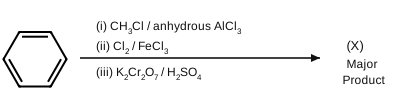
P g of the major product (X) formed is reacted with NaHCO
3 solution to liberate a gas which occupied 11.2 dm
3 at STP.
P = _______ g.
(Given molar mass in g mol
−1 H:1, C:12, O:16, Cl:35.5)
मुख्य उत्पाद (X) देने वाली अभिक्रियाओं के निम्नलिखित अनुक्रम पर विचार कीजिए
बने हुए मुख्य उत्पाद (X) के P g को NaHCO
3 विलयन से अभिक्रिया कराने पर एक गैस मुक्त होती है जो STP पर 11.2 dm
3 आयतन घेरती है।
P = _______ g।
(दिया है, मोलर द्रव्यमान g mol
−1 में H:1, C:12, O:16, Cl:35.5)
Show answer
Concept: –CH3 is o/p-directing (para major); side-chain oxidation turns –CH3 into –COOH; each –COOH releases one CO2 with NaHCO3.
- Benzene + CH3Cl/AlCl3 → toluene.
- Cl2/FeCl3 → 4-chlorotoluene (major).
- K2Cr2O7/H2SO4 → 4-chlorobenzoic acid X, C7H5ClO2, M = 84 + 5 + 35.5 + 32 = 156.5 g mol−1.
- ArCOOH + NaHCO3 → ArCOONa + H2O + CO2; n(CO2) = 11.2/22.4 = 0.5 mol = n(X).
- P = 0.5 × 156.5 = 78.25 g; the integer answer is 78.
Short trick: 11.2 L = ½ mol → P = M/2 = 156.5/2 = 78.25 → 78.
Answer: 78
अवधारणा: –CH3 o/p-निर्देशी है (पैरा मुख्य); पार्श्व-शृंखला ऑक्सीकरण –CH3 को –COOH में बदलता है; प्रत्येक –COOH, NaHCO3 के साथ एक CO2 मुक्त करता है।
- बेन्ज़ीन + CH3Cl/AlCl3 → टॉलूईन।
- Cl2/FeCl3 → 4-क्लोरोटॉलूईन (मुख्य)।
- K2Cr2O7/H2SO4 → 4-क्लोरोबेन्ज़ोइक अम्ल X, C7H5ClO2, M = 84 + 5 + 35.5 + 32 = 156.5 g mol−1।
- ArCOOH + NaHCO3 → ArCOONa + H2O + CO2; n(CO2) = 11.2/22.4 = 0.5 mol = n(X)।
- P = 0.5 × 156.5 = 78.25 g; पूर्णांक उत्तर 78 है।
शॉर्ट ट्रिक: 11.2 L = ½ mol → P = M/2 = 156.5/2 = 78.25 → 78।
उत्तर: 78
JEE Main 2026 (April) – Paper 1 (B.E./B.Tech)ChemistryAromatic compounds – synthesis and stoichiometryJEE Main 2026 (April) – Paper 1 (B.E./B.Tech) 2026 · 4 Apr Shift 1
Q523.2.0 g of a bromo hydrocarbon (X) was subjected to Carius analysis, gave 3.36 g of AgBr. The percentage of carbon in the compound (X) is 26.7%. Total number of carbon atoms in the empirical formula for compound (X) is _______.
(Given molar mass in g mol−1 H:1, C:12, Br : 80, Ag : 108)
एक ब्रोमो हाइड्रोकार्बन (X) के 2.0 g का कैरिअस विश्लेषण करने पर 3.36 g AgBr प्राप्त हुआ। यौगिक (X) में कार्बन का प्रतिशत 26.7% है। यौगिक (X) के मूलानुपाती सूत्र में कार्बन परमाणुओं की कुल संख्या _______ है।
(दिया है, मोलर द्रव्यमान g mol−1 में H:1, C:12, Br : 80, Ag : 108)
Show answer
Concept: Carius: %Br = ; H by difference; then mole ratio.
- %Br
- %H = 100 − 71.49 − 26.7 = 1.81%
- Moles per 100 g: C = 26.7/12 = 2.225; H = 1.81/1 = 1.81; Br = 71.49/80 = 0.894
- Divide by 0.894: C : H : Br = 2.49 : 2.03 : 1 → ×2 → 4.98 : 4.05 : 2 ≈ 5 : 4 : 2
- Empirical formula C5H4Br2 → 5 carbon atoms.
Short trick: C : Br ≈ 2.225 : 0.894 = 2.5 : 1 → double it → C5…Br2.
Answer: 5
अवधारणा: कैरिअस: %Br = ; H अंतर से; फिर मोल अनुपात।
- %Br
- %H = 100 − 71.49 − 26.7 = 1.81%
- प्रति 100 g मोल: C = 26.7/12 = 2.225; H = 1.81/1 = 1.81; Br = 71.49/80 = 0.894
- 0.894 से भाग देने पर: C : H : Br = 2.49 : 2.03 : 1 → ×2 → 4.98 : 4.05 : 2 ≈ 5 : 4 : 2
- मूलानुपाती सूत्र C5H4Br2 → 5 कार्बन परमाणु।
शॉर्ट ट्रिक: C : Br ≈ 2.225 : 0.894 = 2.5 : 1 → दोगुना → C5…Br2।
उत्तर: 5
JEE Main 2026 (April) – Paper 1 (B.E./B.Tech)ChemistryOrganic analysis – Carius method and empirical formulaJEE Main 2026 (April) – Paper 1 (B.E./B.Tech) 2026 · 4 Apr Shift 1
Q524.The pH of a solution obtained by mixing 5 mL of 0.1 M NH4OH solution with 250 mL of 0.1 M NH4Cl solution is _______ × 10−2. (Nearest integer)
Given: pKb (NH4OH) = 4.74
log 2 = 0.30
log 3 = 0.48
log 5 = 0.70
5 mL 0.1 M NH4OH विलयन को 250 mL 0.1 M NH4Cl विलयन के साथ मिलाने पर प्राप्त विलयन का pH _______ × 10−2 है। (निकटतम पूर्णांक)
दिया है: pKb (NH4OH) = 4.74
log 2 = 0.30
log 3 = 0.48
log 5 = 0.70
Show answer
Concept: Basic buffer: pOH = pKb + log (ratio of millimoles, same total volume).
- NH4OH = 5 × 0.1 = 0.5 mmol; NH4Cl = 250 × 0.1 = 25 mmol
- Ratio = 25/0.5 = 50; log 50 = log 5 + 1 = 1.70
- pOH = 4.74 + 1.70 = 6.44
- pH = 14 − 6.44 = 7.56 = 756 × 10−2
Short trick: Salt is 50 × base → pOH rises by 1.70 above pKb.
Answer: 756
अवधारणा: क्षारीय बफ़र: pOH = pKb + log (मिलीमोल का अनुपात, कुल आयतन समान)।
- NH4OH = 5 × 0.1 = 0.5 mmol; NH4Cl = 250 × 0.1 = 25 mmol
- अनुपात = 25/0.5 = 50; log 50 = log 5 + 1 = 1.70
- pOH = 4.74 + 1.70 = 6.44
- pH = 14 − 6.44 = 7.56 = 756 × 10−2
शॉर्ट ट्रिक: लवण = 50 × क्षार → pOH, pKb से 1.70 अधिक।
उत्तर: 756
JEE Main 2026 (April) – Paper 1 (B.E./B.Tech)ChemistryIonic equilibrium – basic bufferJEE Main 2026 (April) – Paper 1 (B.E./B.Tech) 2026 · 4 Apr Shift 1
Q525.A non-volatile, non-electrolyte solid solute when dissolved in 40 g of a solvent, the vapour pressure of the solvent decreased from 760 mm Hg to 750 mm Hg. If the same solution boils at 320 K, then the number of moles of the solvent present in the solution is _______. (Nearest integer)
[Given: boiling point of the pure solvent = 319.5 K,
Kb of the solvent = 0.3 K kg mol−1]
एक अवाष्पशील, अविद्युत-अपघट्य ठोस विलेय को 40 g विलायक में घोलने पर विलायक का वाष्प दाब 760 mm Hg से घटकर 750 mm Hg हो जाता है। यदि यही विलयन 320 K पर उबलता है, तो विलयन में उपस्थित विलायक के मोलों की संख्या _______ है। (निकटतम पूर्णांक)
[दिया है: शुद्ध विलायक का क्वथनांक = 319.5 K,
विलायक का Kb = 0.3 K kg mol−1]
Show answer
Concept: Elevation of boiling point gives moles of solute; relative lowering of vapour pressure (Raoult's law) gives the mole fraction of solute.
- ΔTb = 320 − 319.5 = 0.5 K; m = 0.5/0.3 = 1.667 mol kg−1
- nsolute = 1.667 × 0.040 = 0.0667 mol
- →
- nsolvent = 5.067 − 0.067 = 5.0 mol
Short trick: n1 = n2 × (p/Δp) = 0.0667 × 750/10 = 5.
Answer: 5
अवधारणा: क्वथनांक उन्नयन से विलेय के मोल मिलते हैं; वाष्प दाब का आपेक्षिक अवनमन (राउल्ट नियम) विलेय का मोल अंश देता है।
- ΔTb = 320 − 319.5 = 0.5 K; m = 0.5/0.3 = 1.667 mol kg−1
- nविलेय = 1.667 × 0.040 = 0.0667 mol
- →
- nविलायक = 5.067 − 0.067 = 5.0 mol
शॉर्ट ट्रिक: n1 = n2 × (p/Δp) = 0.0667 × 750/10 = 5।
उत्तर: 5
JEE Main 2026 (April) – Paper 1 (B.E./B.Tech)ChemistrySolutions – colligative propertiesJEE Main 2026 (April) – Paper 1 (B.E./B.Tech) 2026 · 4 Apr Shift 1
Q526.Let be the roots of the equation , and be the roots of the equation . If the roots of the equation are and , then m is equal to :
माना समीकरण के मूल हैं तथा समीकरण के मूल हैं। यदि समीकरण के मूल तथा हैं, तो m बराबर है :
- A
- B
- C
- D
Show answer
Concept: For , sum of roots and product of roots .
- From the first equation: and .
- From the second equation: , i.e. (the product is automatically consistent).
- Subtracting: .
- Roots of : and .
- Sum ✓ matches . Product .
Short trick: Use the sum of the new roots () only as a check; the product directly gives .
Answer: (D) 567
अवधारणा: के लिए मूलों का योग तथा गुणनफल .
- पहले समीकरण से: तथा .
- दूसरे समीकरण से: , अर्थात (गुणनफल स्वतः संगत है)।
- घटाने पर: .
- के मूल: तथा .
- योग ✓. गुणनफल .
शॉर्ट ट्रिक: नये मूलों का योग () केवल जाँच के लिए प्रयोग करें; गुणनफल सीधे दे देता है।
उत्तर: (D) 567
JEE Main 2026 (April) – Paper 1 (B.E./B.Tech)MathematicsQuadratic equations – relation between rootsJEE Main 2026 (April) – Paper 1 (B.E./B.Tech) 2026 · 2 Apr Shift 2
Q527.Let the circles and , , be such that lies within . If moves on , moves on and , then is equal to :
माना वृत्त तथा , , इस प्रकार हैं कि , के भीतर स्थित है। यदि , पर तथा , पर चलते हैं और है, तो बराबर है :
- A12
- B17
- C22
- D24
Show answer
Concept: If a circle of radius (centre distance from O) lies inside a circle of radius , then for points on the two circles the minimum distance is and the maximum is .
- : centre , radius ; : centre , radius ; distance between centres .
- .
- .
Short trick: , so max .
Answer: (C) 22
अवधारणा: यदि त्रिज्या का वृत्त (केन्द्र की O से दूरी ) त्रिज्या के वृत्त के भीतर हो, तो दोनों वृत्तों के बिंदुओं के बीच न्यूनतम दूरी तथा अधिकतम दूरी होती है।
- : केन्द्र , त्रिज्या ; : केन्द्र , त्रिज्या ; केन्द्रों के बीच दूरी .
- .
- .
शॉर्ट ट्रिक: , अतः अधिकतम .
उत्तर: (C) 22
JEE Main 2026 (April) – Paper 1 (B.E./B.Tech)MathematicsComplex numbers – circles in the Argand planeJEE Main 2026 (April) – Paper 1 (B.E./B.Tech) 2026 · 2 Apr Shift 2
Q528.If the system of equations
has infinitely many solutions, then the point (a, b) lies on the line
यदि समीकरण निकाय
के अपरिमित रूप से अनेक हल हैं, तो बिंदु (a, b) जिस रेखा पर स्थित है, वह है
- A
- B
- C
- D
Show answer
Concept: Infinitely many solutions and the system is consistent.
- .
- : .
- : , i.e. . With : , so .
- Consistency with step 2: .
- , so satisfies . (Check: ; .)
Answer: (B)
अवधारणा: अपरिमित रूप से अनेक हल तथा निकाय संगत (consistent) हो।
- .
- : .
- : , अर्थात . रखने पर , अतः .
- चरण 2 से संगति हेतु: .
- , अतः रेखा पर स्थित है। (जाँच: ; .)
उत्तर: (B)
JEE Main 2026 (April) – Paper 1 (B.E./B.Tech)MathematicsSystem of linear equations – infinitely many solutionsJEE Main 2026 (April) – Paper 1 (B.E./B.Tech) 2026 · 2 Apr Shift 2
Q529.Let be an A.P. and be an increasing G.P. If and , then is equal to :
माना एक समांतर श्रेढ़ी (A.P.) है तथा एक वर्धमान गुणोत्तर श्रेढ़ी (G.P.) है। यदि तथा हैं, तो बराबर है :
- A81
- B76
- C62
- D55
Show answer
Concept: A.P.: ; G.P.: .
- . .
- or .
- Increasing G.P. (with ) , so .
- and , so .
Answer: (D) 55
अवधारणा: A.P.: ; G.P.: .
- . .
- या .
- वर्धमान G.P. ( के साथ) , अतः .
- तथा , अतः .
उत्तर: (D) 55
JEE Main 2026 (April) – Paper 1 (B.E./B.Tech)MathematicsSequences and series – A.P. and G.P.JEE Main 2026 (April) – Paper 1 (B.E./B.Tech) 2026 · 2 Apr Shift 2
Q530.The sum up to 8 terms, is :
योग का 8 पदों तक मान है :
- A70
- B71
- C72
- D73
Show answer
Concept: and .
- -th term .
- Sum .
Short trick: ; subtract and divide by 4.
Answer: (B) 71
अवधारणा: तथा .
- -वाँ पद .
- योग .
शॉर्ट ट्रिक: ; इसमें से घटाकर 4 से भाग दें।
उत्तर: (B) 71
JEE Main 2026 (April) – Paper 1 (B.E./B.Tech)MathematicsSequences and series – sum of special seriesJEE Main 2026 (April) – Paper 1 (B.E./B.Tech) 2026 · 2 Apr Shift 2
Q531.If for , , then m equals :
यदि के लिए, है, तो m बराबर है :
- A31
- B32
- C33
- D34
Show answer
Concept: Pascal's rule ; the coefficients are (Vandermonde pattern).
- Write the sum as .
- By Vandermonde's identity this equals .
- , so .
Short trick: Coefficients mean Pascal's rule applied three times: in the upper index.
Answer: (C) 33
अवधारणा: पास्कल नियम ; गुणांक वस्तुतः हैं (वाण्डरमोंड सर्वसमिका)।
- योग को के रूप में लिखें।
- वाण्डरमोंड सर्वसमिका से यह के बराबर है।
- , अतः .
शॉर्ट ट्रिक: गुणांक का अर्थ है पास्कल नियम तीन बार लागू होना: ऊपरी सूचकांक .
उत्तर: (C) 33
JEE Main 2026 (April) – Paper 1 (B.E./B.Tech)MathematicsBinomial theorem – identities of binomial coefficientsJEE Main 2026 (April) – Paper 1 (B.E./B.Tech) 2026 · 2 Apr Shift 2
Q532.Let denote the total number of triangles formed by joining the vertices of an n-side regular polygon. If , then the sum of all distinct prime divisors of n is :
माना एक n भुजाओं वाले सम बहुभुज के शीर्षों को मिलाकर बनने वाले त्रिभुजों की कुल संख्या है। यदि है, तो n के सभी भिन्न-भिन्न अभाज्य भाजकों (prime divisors) का योग है :
- A7
- B8
- C5
- D6
Show answer
Concept: and (Pascal's rule).
- .
- .
- ; distinct prime divisors are 2 and 3, sum .
Answer: (C) 5
अवधारणा: तथा (पास्कल नियम)।
- .
- .
- ; भिन्न-भिन्न अभाज्य भाजक 2 तथा 3 हैं, योग .
उत्तर: (C) 5
JEE Main 2026 (April) – Paper 1 (B.E./B.Tech)MathematicsPermutations and combinationsJEE Main 2026 (April) – Paper 1 (B.E./B.Tech) 2026 · 2 Apr Shift 2
Q533.A man throws a fair coin repeatedly. He gets 10 points for each head he throws and 5 points for each tail he throws. If the probability that he gets exactly 30 points is , gcd (m, n) = 1, then m + n is equal to :
एक व्यक्ति एक अनभिनत (fair) सिक्के को बार-बार उछालता है। प्रत्येक चित (head) पर उसे 10 अंक तथा प्रत्येक पट (tail) पर 5 अंक मिलते हैं। यदि उसके ठीक 30 अंक प्राप्त करने की प्रायिकता है, जहाँ gcd (m, n) = 1, तो m + n बराबर है :
- A53
- B55
- C107
- D105
Show answer
Concept: In units of 5 points, each throw adds 1 (tail) or 2 (head), each with probability . Let = probability that the running total ever equals ; then .
- Scoring exactly 30 points means the running total visits (units of 5).
- , (first throw must be a tail).
- .
- .
Short trick: ; at : .
Answer: (C) 107
अवधारणा: 5 अंकों की इकाई में प्रत्येक उछाल 1 (पट) या 2 (चित) जोड़ती है, प्रत्येक की प्रायिकता . माना = चालू योग के कभी होने की प्रायिकता; तब .
- ठीक 30 अंक प्राप्त करने का अर्थ है चालू योग (5 की इकाइयों में) से होकर गुजरे।
- , (पहली उछाल पट होनी चाहिए)।
- .
- .
शॉर्ट ट्रिक: ; पर: .
उत्तर: (C) 107
JEE Main 2026 (April) – Paper 1 (B.E./B.Tech)MathematicsProbability – recurrence on reaching a scoreJEE Main 2026 (April) – Paper 1 (B.E./B.Tech) 2026 · 2 Apr Shift 2
Q534.The mean and variance of n observations are 8 and 16, respectively. If the sum of the first observations is 48 and the sum of squares of the first observations is 496, then the value of n is :
n प्रेक्षणों के माध्य तथा प्रसरण क्रमशः 8 तथा 16 हैं। यदि प्रथम प्रेक्षणों का योग 48 तथा प्रथम प्रेक्षणों के वर्गों का योग 496 है, तो n का मान है :
- A21
- B16
- C13
- D7
Show answer
Concept: Mean , variance .
- and .
- Last observation: and .
- .
- or ; n must be a natural number, so .
- Check: , ✓.
Answer: (D) 7
अवधारणा: माध्य , प्रसरण .
- तथा .
- अंतिम प्रेक्षण: तथा .
- .
- या ; n प्राकृत संख्या है, अतः .
- जाँच: , ✓.
उत्तर: (D) 7
JEE Main 2026 (April) – Paper 1 (B.E./B.Tech)MathematicsStatistics – mean and varianceJEE Main 2026 (April) – Paper 1 (B.E./B.Tech) 2026 · 2 Apr Shift 2
Q535.Let a circle pass through the origin and its centre be the point of intersection of two mutually perpendicular lines and . If the line intersects the circle at the points A and B, then is equal to :
माना एक वृत्त मूलबिंदु से होकर जाता है तथा इसका केन्द्र दो परस्पर लंबवत रेखाओं तथा का प्रतिच्छेद बिंदु है। यदि रेखा वृत्त को बिंदुओं A तथा B पर काटती है, तो बराबर है :
- A10
- B27
- C18
- D34
Show answer
Concept: Lines , are perpendicular iff ; chord length: .
- Perpendicularity: .
- Lines become and ; solving, centre .
- Circle through origin: .
- Distance of from : .
- .
Answer: (C) 18
अवधारणा: रेखाएँ , लंबवत हैं यदि और केवल यदि ; जीवा की लंबाई: .
- लंबवतता: .
- रेखाएँ तथा बनती हैं; हल करने पर केन्द्र .
- वृत्त मूलबिंदु से गुजरता है: .
- की से दूरी: .
- .
उत्तर: (C) 18
JEE Main 2026 (April) – Paper 1 (B.E./B.Tech)MathematicsCircle – chord intercepted by a lineJEE Main 2026 (April) – Paper 1 (B.E./B.Tech) 2026 · 2 Apr Shift 2
Q536.Let O be the origin, and P and Q be two points on the rectangular hyperbola such that the mid point of the line segment PQ is . Then the area of the triangle OPQ equals :
माना O मूलबिंदु है तथा P और Q आयताकार अतिपरवलय पर दो बिंदु इस प्रकार हैं कि रेखाखंड PQ का मध्य-बिंदु है। तब त्रिभुज OPQ का क्षेत्रफल बराबर है :
- A
- B
- C
- D
Show answer
Concept: Area of triangle with vertices O, , is .
- Let , .
- Midpoint: and .
- Area .
- .
- Area .
Answer: (C)
अवधारणा: शीर्षों O, , वाले त्रिभुज का क्षेत्रफल होता है।
- माना , .
- मध्य-बिंदु से: तथा .
- क्षेत्रफल .
- .
- क्षेत्रफल .
उत्तर: (C)
JEE Main 2026 (April) – Paper 1 (B.E./B.Tech)MathematicsHyperbola – rectangular hyperbola and area of triangleJEE Main 2026 (April) – Paper 1 (B.E./B.Tech) 2026 · 2 Apr Shift 2
Q537.Let the parabola passing through the point be such that the distance between its vertex and the x-axis is minimum. Then the value of is :
माना बिंदु से गुजरने वाला परवलय इस प्रकार है कि इसके शीर्ष तथा x-अक्ष के बीच की दूरी न्यूनतम है। तब का मान है :
- A2
- B4
- C5
- D8
Show answer
Concept: Vertex of is at ; its distance from the x-axis is .
- Through : .
- Distance .
- This is minimum (equal to 1) when , giving .
- .
Answer: (B) 4
अवधारणा: का शीर्ष पर होता है; x-अक्ष से इसकी दूरी है।
- से गुजरने पर: .
- दूरी .
- यह न्यूनतम (1 के बराबर) तब है जब , जिससे .
- .
उत्तर: (B) 4
JEE Main 2026 (April) – Paper 1 (B.E./B.Tech)MathematicsParabola – vertex and minimum distanceJEE Main 2026 (April) – Paper 1 (B.E./B.Tech) 2026 · 2 Apr Shift 2
Q538.Let and . Then is :
माना तथा हैं। तब है :
- A0
- B1
- C2
- D3
Show answer
Concept: .
- .
- . So for , .
- Hence the expression takes values in .
- We need with : has no integer solution, and is excluded. So no integer a works.
- .
Short trick: The expression simplifies to ; the only perfect squares near are 1 and 4, both outside the range.
Answer: (A) 0
अवधारणा: .
- .
- . अतः के लिए .
- इसलिए व्यंजक के मान में हैं।
- हमें , चाहिए: का कोई पूर्णांक हल नहीं और परिसर से बाहर है। अतः कोई पूर्णांक a संभव नहीं।
- .
शॉर्ट ट्रिक: व्यंजक में सरल हो जाता है; के निकट पूर्ण वर्ग केवल 1 और 4 हैं, दोनों परिसर से बाहर।
उत्तर: (A) 0
JEE Main 2026 (April) – Paper 1 (B.E./B.Tech)MathematicsTrigonometry – identities and rangeJEE Main 2026 (April) – Paper 1 (B.E./B.Tech) 2026 · 2 Apr Shift 2
Q539.Let the vectors and . For some , let . If and , then is equal to :
माना सदिश तथा हैं। किन्हीं के लिए, माना है। यदि तथा हैं, तो बराबर है :
- A8
- B12
- C14
- D15
Show answer
Concept: Dot product is linear: .
- ; . So .
- ; . So .
- Adding: ; then .
- , so .
Answer: (B) 12
अवधारणा: अदिश गुणनफल रैखिक होता है: .
- ; . अतः .
- ; . अतः .
- जोड़ने पर: ; तब .
- , अतः .
उत्तर: (B) 12
JEE Main 2026 (April) – Paper 1 (B.E./B.Tech)MathematicsVector algebra – linear combination and dot productJEE Main 2026 (April) – Paper 1 (B.E./B.Tech) 2026 · 2 Apr Shift 2
Q540.Let the point A be the foot of perpendicular drawn from the point P(a, b, 0) on the line . If the midpoint of the line segment PA is , then the value of is equal to :
माना बिंदु P(a, b, 0) से रेखा पर डाले गए लंब का पाद बिंदु A है। यदि रेखाखंड PA का मध्य-बिंदु है, तो का मान बराबर है :
- A1
- B2
- C6
- D9
Show answer
Concept: A general point of the line is ; must be perpendicular to the direction .
- Midpoint of PA: , giving , , .
- .
- : .
- Then , , .
- .
Answer: (A) 1
अवधारणा: रेखा का व्यापक बिंदु है; दिक्-अनुपात के लंबवत होना चाहिए।
- PA का मध्य-बिंदु: , जिससे , , .
- .
- : .
- तब , , .
- .
उत्तर: (A) 1
JEE Main 2026 (April) – Paper 1 (B.E./B.Tech)MathematicsThree-dimensional geometry – foot of perpendicularJEE Main 2026 (April) – Paper 1 (B.E./B.Tech) 2026 · 2 Apr Shift 2

