Q541.Two adjacent sides of a parallelogram PQRS are given by and . If the side PS is rotated about the point P by an acute angle in the plane of the parallelogram so that it becomes perpendicular to the side PQ, then is equal to :
एक समांतर चतुर्भुज PQRS की दो आसन्न भुजाएँ तथा दी गई हैं। यदि भुजा PS को बिंदु P के परितः समांतर चतुर्भुज के तल में एक न्यूनकोण से इस प्रकार घुमाया जाता है कि वह भुजा PQ के लंबवत हो जाती है, तो बराबर है :
- A
- B
- C
- D
Show answer
Concept: and the identity .
- ; .
- between PQ and PS.
- Rotating PS by an acute angle to make the angle : .
- .
Short trick: With , the identity collapses instantly to .
Answer: (B)
अवधारणा: तथा सर्वसमिका .
- ; .
- PQ तथा PS के बीच कोण .
- PS को न्यूनकोण से घुमाकर कोण करने के लिए: .
- .
शॉर्ट ट्रिक: होने से सर्वसमिका तुरंत दे देती है।
उत्तर: (B)
JEE Main 2026 (April) – Paper 1 (B.E./B.Tech)MathematicsVector algebra – angle between vectorsJEE Main 2026 (April) – Paper 1 (B.E./B.Tech) 2026 · 2 Apr Shift 2
Q542.The value of is equal to :
का मान बराबर है :
- A
- B
- C
- D
Show answer
Concept: .
- .
- , so the integral .
Short trick: The average value of over full periods is ; multiply by the length .
Answer: (C)
अवधारणा: .
- .
- , अतः समाकल .
शॉर्ट ट्रिक: पूर्ण आवर्तों पर का औसत मान है; इसे लंबाई से गुणा करें।
उत्तर: (C)
JEE Main 2026 (April) – Paper 1 (B.E./B.Tech)MathematicsDefinite integration – periodic functionsJEE Main 2026 (April) – Paper 1 (B.E./B.Tech) 2026 · 2 Apr Shift 2
Q543.Let be a polynomial of degree 5, and have extrema at and . If , then is equal to :
माना घात 5 का एक बहुपद है, जिसके चरम बिंदु (extrema) तथा पर हैं। यदि है, तो बराबर है :
- A0
- B50
- C92
- D112
Show answer
Concept: For to be finite, must have as a factor and the limit equals the constant term of the remaining quadratic.
- Write ; the limit gives , so .
- . Extrema at : and .
- Solving: , , so (and indeed changes sign at ).
- ; since is odd, .
- .
Short trick: is odd here, so .
Answer: (D) 112
अवधारणा: के परिमित होने के लिए में गुणनखंड होना चाहिए और सीमा शेष द्विघात के अचर पद के बराबर होती है।
- लिखें; सीमा से , अतः .
- . पर चरम: तथा .
- हल करने पर: , , अतः (तथा वास्तव में पर चिह्न बदलता है)।
- ; चूँकि विषम फलन है, .
- .
शॉर्ट ट्रिक: यहाँ विषम है, अतः .
उत्तर: (D) 112
JEE Main 2026 (April) – Paper 1 (B.E./B.Tech)MathematicsApplication of derivatives – polynomial with given extremaJEE Main 2026 (April) – Paper 1 (B.E./B.Tech) 2026 · 2 Apr Shift 2
Q544.Let . If and , , then is equal to :
माना है। यदि तथा , हैं, तो बराबर है :
- A31
- B37
- C39
- D41
Show answer
Concept: Resolve into partial fractions: .
- (numerators: , ).
- .
- .
- .
- , .
Answer: (C) 39
अवधारणा: आंशिक भिन्नों में विभाजित करें: .
- (अंश: , )।
- .
- .
- .
- , .
उत्तर: (C) 39
JEE Main 2026 (April) – Paper 1 (B.E./B.Tech)MathematicsIndefinite integration – partial fractionsJEE Main 2026 (April) – Paper 1 (B.E./B.Tech) 2026 · 2 Apr Shift 2
Q545.Let be the solution of the differential equation , , . Then is equal to :
माना अवकल समीकरण , , का हल है। तब बराबर है :
- A
- B
- C
- D
Show answer
Concept: The equation is homogeneous in x and y; substitute .
- With : , so .
- .
- Integrating: .
- : , so , i.e. .
- .
Answer: (B)
अवधारणा: समीकरण x तथा y में समघात (homogeneous) है; प्रतिस्थापित करें।
- से: , अतः .
- .
- समाकलन करने पर: .
- : , अतः , अर्थात .
- .
उत्तर: (B)
JEE Main 2026 (April) – Paper 1 (B.E./B.Tech)MathematicsDifferential equations – homogeneous equationJEE Main 2026 (April) – Paper 1 (B.E./B.Tech) 2026 · 2 Apr Shift 2
Q546.Let . Let R be a relation on the set given by if and only if divides and . Then the number of elements in R is ________.
माना है। माना समुच्चय पर एक संबंध R, यदि और केवल यदि , को विभाजित करता है तथा , द्वारा परिभाषित है। तब R में अवयवों की संख्या ________ है।
Show answer
Concept: The two conditions are independent, so count ordered pairs with and ordered pairs with , then multiply.
- Pairs with in A: : (3); : (2); : only (1 each). Total .
- Pairs with : .
- Number of elements in R .
Short trick: For on a 5-element set: .
Answer: 120
अवधारणा: दोनों प्रतिबंध स्वतंत्र हैं, अतः वाले क्रमित युग्मों और वाले क्रमित युग्मों को अलग-अलग गिनकर गुणा करें।
- A में वाले युग्म: : (3); : (2); : केवल (प्रत्येक 1)। कुल .
- वाले युग्म: .
- R में अवयवों की संख्या .
शॉर्ट ट्रिक: 5 अवयवों के समुच्चय पर के लिए: .
उत्तर: 120
JEE Main 2026 (April) – Paper 1 (B.E./B.Tech)MathematicsRelations – counting elements of a relationJEE Main 2026 (April) – Paper 1 (B.E./B.Tech) 2026 · 2 Apr Shift 2
Q547.Consider the matrices and . If matrices P and Q are such that PA = B and AQ = B, then the absolute value of the sum of the diagonal elements of is ________.
आव्यूहों तथा पर विचार कीजिए। यदि आव्यूह P तथा Q इस प्रकार हैं कि PA = B तथा AQ = B, तो के विकर्ण अवयवों के योग का निरपेक्ष मान ________ है।
Show answer
Concept: and , with .
- , so .
- .
- .
- .
- Sum of diagonal elements ; absolute value .
Short trick: Trace is enough: – compute only diagonal entries.
Answer: 34
अवधारणा: तथा , जहाँ .
- , अतः .
- .
- .
- .
- विकर्ण अवयवों का योग ; निरपेक्ष मान .
शॉर्ट ट्रिक: केवल अनुरेख (trace) चाहिए: – केवल विकर्ण अवयव निकालें।
उत्तर: 34
JEE Main 2026 (April) – Paper 1 (B.E./B.Tech)MathematicsMatrices – matrix equations and inverseJEE Main 2026 (April) – Paper 1 (B.E./B.Tech) 2026 · 2 Apr Shift 2
Q548.Let A be the point (3, 0) and circles with variable diameter AB touch the circle internally. Let the curve C be the locus of the point B. If the eccentricity of C is e, then is equal to ________.
माना बिंदु A, (3, 0) है तथा परिवर्ती व्यास AB वाले वृत्त, वृत्त को अंतः स्पर्श करते हैं। माना बिंदु B का बिन्दुपथ वक्र C है। यदि C की उत्केन्द्रता e है, तो बराबर ________ है।
Show answer
Concept: If a circle of radius and centre M touches (radius 6, centre O) internally, then . An ellipse is the locus of points whose distances from two fixed points have a constant sum.
- The circle on diameter AB has centre M (midpoint of AB) and radius .
- Internal tangency: .
- With : and , so .
- So B moves on an ellipse with foci and and : , , .
- .
Answer: 18
अवधारणा: यदि त्रिज्या और केन्द्र M वाला वृत्त (त्रिज्या 6, केन्द्र O) को अंतः स्पर्श करे, तो . दीर्घवृत्त उन बिंदुओं का बिन्दुपथ है जिनकी दो स्थिर बिंदुओं से दूरियों का योग अचर हो।
- व्यास AB वाले वृत्त का केन्द्र M (AB का मध्य-बिंदु) तथा त्रिज्या है।
- अंतः स्पर्श से: .
- रखने पर: तथा , अतः .
- अतः B नाभियों तथा और वाले दीर्घवृत्त पर चलता है: , , .
- .
उत्तर: 18
JEE Main 2026 (April) – Paper 1 (B.E./B.Tech)MathematicsEllipse – locus and eccentricityJEE Main 2026 (April) – Paper 1 (B.E./B.Tech) 2026 · 2 Apr Shift 2
Q549.If the area of the region bounded by and is A, then is equal to ________.
यदि तथा से परिबद्ध क्षेत्र का क्षेत्रफल A है, तो बराबर ________ है।
Show answer
Concept: Integrate with respect to y between the line and the right branch of the hyperbola , using .
- Intersection: substituting in gives ; the points are and .
- In terms of y: line , hyperbola ; the line lies to the right for .
- .
- At : ; the bracket .
- .
- .
Answer: 24
अवधारणा: रेखा तथा अतिपरवलय की दाईं शाखा के बीच y के सापेक्ष समाकलन करें, जहाँ .
- प्रतिच्छेदन: को में रखने पर ; बिंदु तथा हैं।
- y के पदों में: रेखा , अतिपरवलय ; के लिए रेखा दाईं ओर है।
- .
- पर: ; कोष्ठक .
- .
- .
उत्तर: 24
JEE Main 2026 (April) – Paper 1 (B.E./B.Tech)MathematicsArea under curves – hyperbola and chordJEE Main 2026 (April) – Paper 1 (B.E./B.Tech) 2026 · 2 Apr Shift 2
Q550.The number of points in the interval , at which the function , where denotes the greatest integer function, is discontinuous, is ________.
अंतराल में उन बिंदुओं की संख्या, जिन पर फलन , जहाँ महत्तम पूर्णांक फलन है, असंतत है, ________ है।
Show answer
Concept: If is continuous and strictly increasing, then is discontinuous exactly where crosses an integer value.
- has on , so g is strictly increasing.
- and , so g increases continuously from to .
- g takes each integer value exactly once, at interior points of (neither endpoint value is an integer).
- At each such point the greatest integer function jumps, giving a discontinuity: points.
Short trick: Number of jumps = number of integers in , which is 10.
Answer: 10
अवधारणा: यदि संतत तथा निरंतर वर्धमान हो, तो ठीक उन्हीं बिंदुओं पर असंतत है जहाँ किसी पूर्णांक मान को पार करता है।
- के लिए पर , अतः g निरंतर वर्धमान है।
- तथा , अतः g संतत रूप से से तक बढ़ता है।
- g प्रत्येक पूर्णांक मान को ठीक एक बार, के आंतरिक बिंदुओं पर लेता है (किसी भी सिरे का मान पूर्णांक नहीं है)।
- ऐसे प्रत्येक बिंदु पर महत्तम पूर्णांक फलन उछाल (jump) लेता है, अर्थात असांतत्य: बिंदु।
शॉर्ट ट्रिक: उछालों की संख्या = में पूर्णांकों की संख्या = 10.
उत्तर: 10
JEE Main 2026 (April) – Paper 1 (B.E./B.Tech)MathematicsContinuity – greatest integer functionJEE Main 2026 (April) – Paper 1 (B.E./B.Tech) 2026 · 2 Apr Shift 2
Q551.Dimensions of universal gravitational constant () in terms of Planck's constant (), distance (), mass () and time () are ________.
प्लांक नियतांक (), दूरी (), द्रव्यमान () तथा समय () के पदों में सार्वत्रिक गुरुत्वाकर्षण नियतांक () की विमाएँ ________ हैं।
- A
- B
- C
- D
Show answer
Concept: Write and equate powers of using and .
- .
- Equate with : , , .
- Every option has except (D); with : , , .
- So .
Short trick: Check option (B) directly: ✓. (A) gives , (C) gives , (D) gives — all wrong.
Answer: (B)
अवधारणा: लिखकर तथा से की घातों की तुलना कीजिए।
- ।
- से तुलना: , , ।
- लेने पर: , , ।
- अतः ।
शॉर्ट ट्रिक: विकल्प (B) को सीधे जाँचिए: ✓। (A) में , (C) में , (D) में आता है — तीनों गलत।
उत्तर: (B)
JEE Main 2026 (April) – Paper 1 (B.E./B.Tech)PhysicsUnits & Dimensions – new base quantitiesJEE Main 2026 (April) – Paper 1 (B.E./B.Tech) 2026 · 2 Apr Shift 2
Q552.A 0.5 kg mass is in contact against the inner wall of a cylindrical drum of radius 4 m rotating about its vertical axis. The minimum rotational speed of the drum to enable the mass to remain stuck to the wall (without falling) is 5 rad/s. The coefficient of friction between the drum's inner wall surface and mass is ________. (Take m/s)
0.5 kg का एक द्रव्यमान, अपने ऊर्ध्वाधर अक्ष के परितः घूर्णन कर रहे 4 m त्रिज्या के बेलनाकार ड्रम की भीतरी दीवार के सम्पर्क में है। द्रव्यमान को दीवार से चिपके रहने (गिरे नहीं) के लिए ड्रम की न्यूनतम घूर्णन चाल 5 rad/s है। ड्रम की भीतरी दीवार की सतह तथा द्रव्यमान के बीच घर्षण गुणांक ________ है। ( m/s लीजिए)
- A0.1
- B0.5
- C0.7
- D0.3
Show answer
Concept: The wall's normal reaction supplies the centripetal force, ; friction balances the weight: at the minimum speed.
- .
- .
Short trick: — mass never matters in a rotor problem.
Answer: (A) 0.1
अवधारणा: दीवार की अभिलम्ब प्रतिक्रिया अभिकेन्द्री बल देती है, ; न्यूनतम चाल पर घर्षण भार को सन्तुलित करता है: ।
- ।
- ।
शॉर्ट ट्रिक: — रोटर के प्रश्न में द्रव्यमान का कोई प्रभाव नहीं होता।
उत्तर: (A) 0.1
JEE Main 2026 (April) – Paper 1 (B.E./B.Tech)PhysicsCircular Motion – rotor (death well)JEE Main 2026 (April) – Paper 1 (B.E./B.Tech) 2026 · 2 Apr Shift 2
Q553.Two blocks of masses 2 kg and 1 kg respectively, are tied to the ends of a string which passes over a light frictionless pulley as shown in the figure below. The masses are held at rest at the same horizontal level and then released. The distance traversed by the centre of mass in 2 s is ________ m. (Take
m/s
)
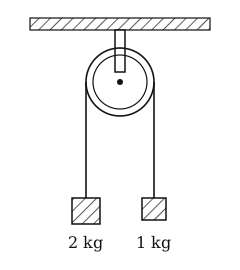
क्रमशः 2 kg तथा 1 kg द्रव्यमान के दो ब्लॉक एक डोरी के सिरों से बँधे हैं, जो नीचे चित्र में दर्शाए अनुसार एक हल्की घर्षणरहित घिरनी के ऊपर से गुजरती है। द्रव्यमानों को एक ही क्षैतिज तल में विरामावस्था में पकड़कर फिर छोड़ दिया जाता है। 2 s में द्रव्यमान केन्द्र द्वारा तय की गई दूरी ________ m है। (
m/s
लीजिए)
- A3.33
- B3.12
- C2.22
- D1.42
Show answer
Concept: In an Atwood machine ; the 2 kg block accelerates down and the 1 kg block up with the same , so (downwards).
- .
- downwards.
- Starting from rest: .
Short trick: , then .
Answer: (C) 2.22
अवधारणा: एटवुड मशीन में ; 2 kg ब्लॉक नीचे तथा 1 kg ब्लॉक ऊपर समान त्वरण से चलता है, अतः (नीचे की ओर)।
- ।
- नीचे की ओर।
- विरामावस्था से: ।
शॉर्ट ट्रिक: , फिर ।
उत्तर: (C) 2.22
JEE Main 2026 (April) – Paper 1 (B.E./B.Tech)PhysicsCentre of Mass – Atwood machineJEE Main 2026 (April) – Paper 1 (B.E./B.Tech) 2026 · 2 Apr Shift 2
Q554.A particle having charge C moving in - plane in fields of N/C and T experiences a force of N. The velocity of the particle at that instant is ________ m/s.
C आवेश का एक कण - तल में N/C तथा T क्षेत्रों में गति करते हुए N बल अनुभव करता है। उस क्षण कण का वेग ________ m/s है।
- A
- B
- C
- D
Show answer
Concept: Lorentz force with , , so .
- N.
- Magnetic part N.
- : : ; : .
- m/s.
Short trick: With along , the -component of magnetic force fixes and the -component fixes — just divide by .
Answer: (A)
अवधारणा: लोरेंज बल , जहाँ , , अतः ।
- N।
- चुम्बकीय भाग N।
- : : ; : ।
- m/s।
शॉर्ट ट्रिक: के के अनुदिश होने पर चुम्बकीय बल का -घटक तथा -घटक निर्धारित करता है — बस से भाग दीजिए।
उत्तर: (A)
JEE Main 2026 (April) – Paper 1 (B.E./B.Tech)PhysicsMoving Charges – Lorentz forceJEE Main 2026 (April) – Paper 1 (B.E./B.Tech) 2026 · 2 Apr Shift 2
Q555.If
and
are the inputs, the given circuit works as ________.
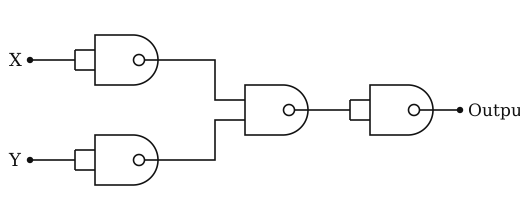
यदि
तथा
निवेशी (inputs) हैं, तो दिया गया परिपथ ________ की भाँति कार्य करता है।
- AOR gateOR गेट
- BAND gateAND गेट
- CNAND gateNAND गेट
- DNOR gateNOR गेट
Show answer
Concept: All four gates are NAND gates. A NAND gate with both inputs tied together works as a NOT gate; and by De Morgan's theorem .
- First two gates (inputs tied): outputs and .
- Middle NAND: (OR of the inputs).
- Last NAND (inputs tied) inverts it: output .
- is the NOR operation.
Short trick: NOT–NOT–NAND makes OR (bubbled-input NAND = OR); one more inverter on an OR gives NOR. Hence (A), (B), (C) are all ruled out.
Answer: (D) NOR gate
अवधारणा: चारों गेट NAND गेट हैं। दोनों निवेश जुड़े NAND गेट NOT गेट की तरह कार्य करता है; तथा डी-मॉर्गन प्रमेय से ।
- पहले दो गेट (निवेश जुड़े): निर्गत तथा ।
- बीच वाला NAND: (निवेशों का OR)।
- अन्तिम NAND (निवेश जुड़े) इसे उलट देता है: निर्गत ।
- ही NOR संक्रिया है।
शॉर्ट ट्रिक: NOT–NOT–NAND मिलकर OR बनाते हैं (बबल-निवेश NAND = OR); OR के बाद एक और इन्वर्टर NOR देता है। अतः (A), (B), (C) तीनों निरस्त।
उत्तर: (D) NOR गेट
JEE Main 2026 (April) – Paper 1 (B.E./B.Tech)PhysicsSemiconductors – logic gatesJEE Main 2026 (April) – Paper 1 (B.E./B.Tech) 2026 · 2 Apr Shift 2
Q556.If a body of mass 1 kg falls on the earth from infinity, it attains velocity () and kinetic energy () on reaching the surface of earth. The values of and respectively are ________.
(Take radius of earth to be 6400 km and m/s)
यदि 1 kg द्रव्यमान का एक पिण्ड अनन्त से पृथ्वी पर गिरता है, तो पृथ्वी की सतह पर पहुँचने पर वह वेग () तथा गतिज ऊर्जा () प्राप्त करता है। तथा के मान क्रमशः ________ हैं।
(पृथ्वी की त्रिज्या 6400 km तथा m/s लीजिए)
- A11.2 km/s; J
- B11.2 km/s; J
- C8.8 km/s; J
- D8.8 km/s; J
Show answer
Concept: By energy conservation, a body falling from rest at infinity reaches the surface with speed equal to the escape speed, .
- .
- .
Short trick: 11.2 km/s is the memorised escape speed; J for 1 kg — option (B) forgets the .
Answer: (A) 11.2 km/s; J
अवधारणा: ऊर्जा संरक्षण से, अनन्त से विरामावस्था से गिरता पिण्ड सतह पर पलायन चाल के बराबर चाल से पहुँचता है, ।
- ।
- ।
शॉर्ट ट्रिक: 11.2 km/s रटी हुई पलायन चाल है; 1 kg के लिए J — विकल्प (B) में भूल गए हैं।
उत्तर: (A) 11.2 km/s; J
JEE Main 2026 (April) – Paper 1 (B.E./B.Tech)PhysicsGravitation – escape speed & energyJEE Main 2026 (April) – Paper 1 (B.E./B.Tech) 2026 · 2 Apr Shift 2
Q557.In a screw gauge the zero of main scale reference line coincides with the fifth division of the circular scale when two studs are in contact. There are 100 divisions in circular scale and pitch of screw gauge is 0.1 mm. When diameter of a sphere is measured, the reading of main scale is 5 mm and 50th division of circular scale coincides with the reference line of main scale. The diameter of sphere is ________ mm.
एक स्क्रू गेज में दोनों स्टडों के सम्पर्क में होने पर वृत्ताकार पैमाने का पाँचवाँ भाग मुख्य पैमाने की सन्दर्भ रेखा के शून्य से सम्पाती होता है। वृत्ताकार पैमाने पर 100 भाग हैं तथा स्क्रू गेज का चूड़ी-अन्तराल (pitch) 0.1 mm है। एक गोले का व्यास मापने पर मुख्य पैमाने का पाठ्यांक 5 mm है तथा वृत्ताकार पैमाने का 50वाँ भाग मुख्य पैमाने की सन्दर्भ रेखा से सम्पाती होता है। गोले का व्यास ________ mm है।
- A5.045
- B5.055
- C5.450
- D5.550
Show answer
Concept: Least count ; corrected reading observed reading zero error (positive zero error is subtracted).
- LC mm.
- Zero error mm (5th division coincides when studs touch).
- Observed reading mm.
- Diameter mm.
Short trick: Effective circular reading divisions mm mm in one line.
Answer: (A) 5.045
अवधारणा: अल्पतमांक ; संशोधित पाठ्यांक प्रेक्षित पाठ्यांक शून्य त्रुटि (धनात्मक शून्य त्रुटि घटाई जाती है)।
- अल्पतमांक mm।
- शून्य त्रुटि mm (स्टड सम्पर्क में होने पर 5वाँ भाग सम्पाती)।
- प्रेक्षित पाठ्यांक mm।
- व्यास mm।
शॉर्ट ट्रिक: प्रभावी वृत्ताकार पाठ्यांक भाग mm एक ही पंक्ति में 5.045 mm।
उत्तर: (A) 5.045
JEE Main 2026 (April) – Paper 1 (B.E./B.Tech)PhysicsMeasurement – screw gauge with zero errorJEE Main 2026 (April) – Paper 1 (B.E./B.Tech) 2026 · 2 Apr Shift 2
Q558.The surface tension of a soap bubble is 0.03 N/m. The work done in increasing the diameter of bubble from 2 cm to 6 cm is J. The value of is ________. (Take )
एक साबुन के बुलबुले का पृष्ठ तनाव 0.03 N/m है। बुलबुले का व्यास 2 cm से 6 cm करने में किया गया कार्य J है। का मान ________ है। ( लीजिए)
- A0.86
- B0.64
- C1.92
- D7.68
Show answer
Concept: A soap bubble has two free surfaces, so .
- Radii: cm m, cm m.
- .
- .
- So .
Short trick: for a bubble; forgetting the two surfaces gives 0.96 (not offered), while (D) is the distractor.
Answer: (C) 1.92
अवधारणा: साबुन के बुलबुले की दो मुक्त सतहें होती हैं, अतः ।
- त्रिज्याएँ: cm m, cm m।
- ।
- ।
- अतः ।
शॉर्ट ट्रिक: बुलबुले के लिए ; दो सतहें भूलने पर 0.96 आता है (विकल्प में नहीं), जबकि (D) भटकाने वाला विकल्प है।
उत्तर: (C) 1.92
JEE Main 2026 (April) – Paper 1 (B.E./B.Tech)PhysicsSurface Tension – work in blowing a bubbleJEE Main 2026 (April) – Paper 1 (B.E./B.Tech) 2026 · 2 Apr Shift 2
Q559.A mixture of carbon dioxide and oxygen has volume 8310 cm, temperature 300 K, pressure 100 kPa and mass 13.2 g. The number of moles of carbon dioxide and oxygen gases in the mixture respectively are ________.
(Assume both carbon dioxide and oxygen gases behave like ideal gases) [R = 8.31 J/mol.K]
कार्बन डाइऑक्साइड तथा ऑक्सीजन के एक मिश्रण का आयतन 8310 cm, ताप 300 K, दाब 100 kPa तथा द्रव्यमान 13.2 g है। मिश्रण में कार्बन डाइऑक्साइड तथा ऑक्सीजन गैसों के मोलों की संख्या क्रमशः ________ है।
(मान लीजिए कि कार्बन डाइऑक्साइड तथा ऑक्सीजन दोनों गैसें आदर्श गैसों की भाँति व्यवहार करती हैं) [R = 8.31 J/mol.K]
- A0.15 and 0.180.15 तथा 0.18
- B0.25 and 0.080.25 तथा 0.08
- C0.21 and 0.120.21 तथा 0.12
- D0.13 and 0.200.13 तथा 0.20
Show answer
Concept: Total moles from ; then solve with (molar masses: CO2 = 44, O2 = 32 g/mol).
- mol.
- .
- mol (CO2), mol (O2).
- Check: g ✓.
Short trick: The data is rigged so mol exactly; only option (C) has its pair summing to 0.33.
Answer: (C) 0.21 and 0.12
अवधारणा: से कुल मोल; फिर के साथ हल कीजिए (मोलर द्रव्यमान: CO2 = 44, O2 = 32 g/mol)।
- mol।
- ।
- mol (CO2), mol (O2)।
- जाँच: g ✓।
शॉर्ट ट्रिक: आँकड़े ऐसे चुने गए हैं कि mol ठीक-ठीक आता है; केवल विकल्प (C) के युग्म का योग 0.33 है।
उत्तर: (C) 0.21 तथा 0.12
JEE Main 2026 (April) – Paper 1 (B.E./B.Tech)PhysicsKinetic Theory – ideal gas mixtureJEE Main 2026 (April) – Paper 1 (B.E./B.Tech) 2026 · 2 Apr Shift 2
Q560.If an air bubble of diameter 2 mm rises steadily through a liquid of density 2000 kg/m at a rate of 0.5 cm/s, then the coefficient of viscosity of liquid is ________ Poise. (Take g = 10 m/s)
यदि 2 mm व्यास का एक वायु का बुलबुला 2000 kg/m घनत्व के द्रव में 0.5 cm/s की दर से एकसमान रूप से ऊपर उठता है, तो द्रव का श्यानता गुणांक ________ प्वॉइज़ (Poise) है। (g = 10 m/s लीजिए)
- A0.88
- B8.8
- C88.8
- D0.088
Show answer
Concept: For steady (terminal) rise of a bubble, Stokes' drag balances the net upthrust: , i.e. (density of air negligible).
- m, cm/s m/s.
- .
- 1 Pa·s Poise Poise.
Short trick: Compute in SI and multiply by 10 for Poise — options (A) and (B) differ exactly by this factor.
Answer: (B) 8.8
अवधारणा: बुलबुले के एकसमान (सीमान्त) वेग से उठने पर स्टोक्स कर्षण नेट उत्प्लावन बल को सन्तुलित करता है: , अर्थात् (वायु का घनत्व नगण्य)।
- m, cm/s m/s।
- ।
- 1 Pa·s प्वॉइज़ प्वॉइज़।
शॉर्ट ट्रिक: SI में निकालकर प्वॉइज़ के लिए 10 से गुणा कीजिए — विकल्प (A) तथा (B) ठीक इसी गुणक से भिन्न हैं।
उत्तर: (B) 8.8
JEE Main 2026 (April) – Paper 1 (B.E./B.Tech)PhysicsViscosity – terminal velocity (Stokes' law)JEE Main 2026 (April) – Paper 1 (B.E./B.Tech) 2026 · 2 Apr Shift 2

