Q561.A spherical ball of mass 2 kg falls from a height of 10 m and is brought to rest after penetrating 10 cm into sand. The average force exerted by sand on the ball is ________ N.
(Take m/s)
2 kg द्रव्यमान की एक गोलाकार गेंद 10 m ऊँचाई से गिरती है तथा रेत में 10 cm धँसने के बाद विरामावस्था में आ जाती है। गेंद पर रेत द्वारा लगाया गया औसत बल ________ N है।
( m/s लीजिए)
- A1980
- B2020
- C2000
- D1000
Show answer
Concept: Work–energy theorem over the whole journey: gravity acts through while the sand's force acts through , so .
- .
- N.
Short trick: ; dropping the ball's own weight gives 2000 — the trap option (C). Net retardation force is 2000 N but the sand must also support the weight.
Answer: (B) 2020
अवधारणा: पूरी यात्रा पर कार्य–ऊर्जा प्रमेय: गुरुत्व दूरी पर तथा रेत का बल दूरी पर कार्य करता है, अतः ।
- ।
- N।
शॉर्ट ट्रिक: ; गेंद का भार छोड़ देने पर 2000 आता है — फँसाने वाला विकल्प (C)। नेट मन्दक बल 2000 N है, परन्तु रेत को भार भी सँभालना पड़ता है।
उत्तर: (B) 2020
JEE Main 2026 (April) – Paper 1 (B.E./B.Tech)PhysicsWork–Energy – retarding force in sandJEE Main 2026 (April) – Paper 1 (B.E./B.Tech) 2026 · 2 Apr Shift 2
Q562.An electromagnetic wave travels in free space along the -direction. At a particular point in space and time, T is associated with this wave. The value of corresponding electric field at this point is ________ V/m.
एक विद्युत चुम्बकीय तरंग मुक्त आकाश (free space) में -दिशा के अनुदिश चलती है। आकाश एवं समय के किसी विशेष बिन्दु पर इस तरंग से सम्बद्ध T है। इस बिन्दु पर संगत विद्युत क्षेत्र का मान ________ V/m है।
- A
- B
- C
- D
Show answer
Concept: In an EM wave , and must point along the direction of propagation ( here).
- Magnitude: V/m.
- Direction: need . Try : ✓.
- So V/m.
Short trick: in vector form: would be the got from ; quickest is to test on the options — only works with magnitude 60.
Answer: (B)
अवधारणा: विद्युत चुम्बकीय तरंग में , तथा संचरण की दिशा (यहाँ ) के अनुदिश होना चाहिए।
- परिमाण: V/m।
- दिशा: चाहिए। लेने पर: ✓।
- अतः V/m।
शॉर्ट ट्रिक: विकल्पों पर की जाँच कीजिए — परिमाण 60 के साथ केवल ही खरा उतरता है।
उत्तर: (B)
JEE Main 2026 (April) – Paper 1 (B.E./B.Tech)PhysicsEM Waves – E and B relationJEE Main 2026 (April) – Paper 1 (B.E./B.Tech) 2026 · 2 Apr Shift 2
Q563.Two resistors of 200 and 400 are connected in series with a battery of 100 V. A bulb rated at 200 V, 100 W is connected across the 400 resistance. The potential drop across the bulb is ________ V.
200 तथा 400 के दो प्रतिरोधक 100 V की बैटरी के साथ श्रेणीक्रम में जुड़े हैं। 200 V, 100 W अंकित एक बल्ब 400 प्रतिरोध के सिरों पर जुड़ा है। बल्ब के सिरों पर विभव पतन ________ V है।
- A25
- B50
- C66.6
- D100
Show answer
Concept: The bulb behaves as a resistance in parallel with the 400 resistor; then use the potential divider.
- Parallel combination: .
- Total resistance ; current A.
- Drop across the bulb (parallel pair) V.
Short trick: equals the series 200 , so the 100 V splits equally: 50 V each.
Answer: (B) 50
अवधारणा: बल्ब प्रतिरोध की भाँति 400 प्रतिरोधक के समान्तर जुड़ा है; फिर विभव विभाजक लगाइए।
- समान्तर संयोजन: ।
- कुल प्रतिरोध ; धारा A।
- बल्ब (समान्तर युग्म) पर पतन V।
शॉर्ट ट्रिक: श्रेणी वाले 200 के बराबर है, अतः 100 V बराबर बँटता है: 50 V–50 V।
उत्तर: (B) 50
JEE Main 2026 (April) – Paper 1 (B.E./B.Tech)PhysicsCurrent Electricity – series-parallel circuitJEE Main 2026 (April) – Paper 1 (B.E./B.Tech) 2026 · 2 Apr Shift 2
Q564.Two metal plates (, ) are kept horizontally with separation of cm, with plate A on the top. An atomizer jet sprays oil (density 1.5 g/cm) droplets of radius 1 mm horizontally. All oil droplets carry a charge 5 nC. The potentials and are required on plates A and B respectively in order to ensure the droplets do not descend. The values of and are ________.
(Neglect the air resistance to the droplets and take m/s)
दो धातु की प्लेटें (, ) क्षैतिज रूप से cm के अन्तराल पर रखी हैं, जिनमें प्लेट A ऊपर है। एक एटोमाइज़र जेट तेल (घनत्व 1.5 g/cm) की 1 mm त्रिज्या की बूँदों का क्षैतिज छिड़काव करता है। सभी तेल की बूँदों पर 5 nC आवेश है। बूँदें नीचे न उतरें, इसके लिए प्लेटों A तथा B पर क्रमशः विभव तथा आवश्यक हैं। तथा के मान ________ हैं।
(बूँदों पर वायु प्रतिरोध नगण्य मानिए तथा m/s लीजिए)
- A100 and 580 100 तथा 580
- B580 and 100 580 तथा 100
- C60 and 400 60 तथा 400
- D0 and 0 तथा
Show answer
Concept: For a positively charged droplet to float, the electric force must balance , so must point upward — the lower plate B must be at the higher potential, with .
- kg.
- V/m.
- V.
- Only option (A) gives V with B higher; in (B) the field would push the positive drops down, (C) gives 340 V and (D) has A higher.
Short trick: The in is planted to cancel the of the drop's mass — the required difference is a clean 480 V.
Answer: (A) 100 and 580
अवधारणा: धनावेशित बूँद को तैराए रखने के लिए विद्युत बल को सन्तुलित करना होगा, अतः ऊपर की ओर हो — निचली प्लेट B उच्च विभव पर होनी चाहिए, जहाँ ।
- kg।
- V/m।
- V।
- केवल विकल्प (A) में V है और B उच्च विभव पर है; (B) में क्षेत्र धनावेशित बूँदों को नीचे धकेलेगा, (C) में अन्तर 340 V है तथा (D) में A उच्च विभव पर है।
शॉर्ट ट्रिक: में जान-बूझकर रखा गया है ताकि बूँद के द्रव्यमान का कट जाए — आवश्यक अन्तर सीधा 480 V है।
उत्तर: (A) 100 तथा 580
JEE Main 2026 (April) – Paper 1 (B.E./B.Tech)PhysicsElectrostatics – charged drop in equilibriumJEE Main 2026 (April) – Paper 1 (B.E./B.Tech) 2026 · 2 Apr Shift 2
Q565.Two point charges 8 C and C are located at cm and cm, respectively on the -axis. The ratio of electric flux due to these charges through two spheres of radii 3 cm and 5 cm with their centers at the origin is ________.
दो बिन्दु आवेश 8 C तथा C, -अक्ष पर क्रमशः cm तथा cm पर स्थित हैं। मूलबिन्दु पर केन्द्र वाले 3 cm तथा 5 cm त्रिज्याओं के दो गोलों से इन आवेशों के कारण विद्युत फ्लक्स का अनुपात ________ है।
- A4 : 1
- B3 : 4
- C4 : 3
- D4 : 5
Show answer
Concept: By Gauss's law, flux depends only on the enclosed charge: .
- Sphere of radius 3 cm encloses only the charge at cm: C.
- Sphere of radius 5 cm encloses both: C.
- .
Short trick: Radii never enter Gauss's law — just count what each sphere swallows: 8 : 6 = 4 : 3.
Answer: (C) 4 : 3
अवधारणा: गाउस के नियम से फ्लक्स केवल परिबद्ध आवेश पर निर्भर करता है: ।
- 3 cm त्रिज्या का गोला केवल cm वाले आवेश को घेरता है: C।
- 5 cm त्रिज्या का गोला दोनों को घेरता है: C।
- ।
शॉर्ट ट्रिक: गाउस के नियम में त्रिज्या कभी नहीं आती — बस गिनिए कि प्रत्येक गोला कितना आवेश निगलता है: 8 : 6 = 4 : 3।
उत्तर: (C) 4 : 3
JEE Main 2026 (April) – Paper 1 (B.E./B.Tech)PhysicsElectrostatics – Gauss's lawJEE Main 2026 (April) – Paper 1 (B.E./B.Tech) 2026 · 2 Apr Shift 2
Q566.One side of an equilateral prism is painted by a transparent material of refractive index
. The refractive index of prism is 1.6. The minimum value of
required for total internal reflection from painted face is ________.
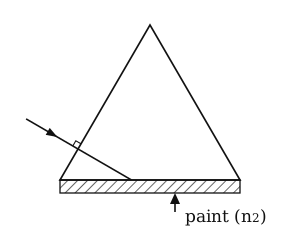
एक समबाहु प्रिज़्म का एक फलक
अपवर्तनांक के पारदर्शी पदार्थ से पेंट किया गया है। प्रिज़्म का अपवर्तनांक 1.6 है। पेंट किए गए फलक से पूर्ण आन्तरिक परावर्तन के लिए
का न्यूनतम आवश्यक मान ________ है।
- A
- B
- C
- D
Show answer
Concept: The ray enters normal to the left face (see figure), travels undeviated and strikes the painted base. For an equilateral prism this ray hits the base at an angle of incidence of . Total internal reflection at the prism–paint boundary needs .
- Angle at the base (faces of an equilateral prism meet at ).
- Limiting condition: .
- .
Short trick: TIR is possible only into a rarer medium, so must be less than 1.6 — options (A) 3.25, (B) 1.73 and (C) 1.85 all exceed 1.6; only survives.
Answer: (D)
अवधारणा: किरण बाएँ फलक पर अभिलम्बवत् प्रवेश करती है (चित्र देखिए), बिना विचलन चलकर पेंट किए आधार से टकराती है। समबाहु प्रिज़्म में यह किरण आधार पर आपतन कोण बनाती है। प्रिज़्म–पेंट सीमा पर पूर्ण आन्तरिक परावर्तन के लिए चाहिए।
- आधार पर कोण (समबाहु प्रिज़्म के फलक पर मिलते हैं)।
- सीमान्त प्रतिबन्ध: ।
- ।
शॉर्ट ट्रिक: पूर्ण आन्तरिक परावर्तन केवल विरल माध्यम की ओर सम्भव है, अतः का मान 1.6 से कम होना चाहिए — विकल्प (A) 3.25, (B) 1.73 तथा (C) 1.85 सब 1.6 से बड़े हैं; केवल बचता है।
उत्तर: (D)
JEE Main 2026 (April) – Paper 1 (B.E./B.Tech)PhysicsRay Optics – total internal reflection in prismJEE Main 2026 (April) – Paper 1 (B.E./B.Tech) 2026 · 2 Apr Shift 2
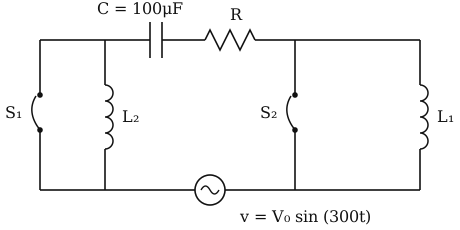
Q567.The figure given below shows an
series circuit with two switches S
and S
. When switch S
is closed keeping S
open, the phase difference (
) between the current and source voltage is
and phase difference is
when S
is closed keeping S
open. The value of
is ________ H.
नीचे दिए गए चित्र में दो स्विचों S
तथा S
वाला एक
श्रेणी परिपथ दर्शाया गया है। S
को खुला रखते हुए स्विच S
बन्द करने पर धारा तथा स्रोत वोल्टता के बीच कलान्तर (
)
है, तथा S
को खुला रखते हुए S
बन्द करने पर कलान्तर
है।
का मान ________ H है।
- A
- B
- C
- D3
Show answer
Concept: Closing S short-circuits , leaving a series –– circuit; closing S short-circuits , leaving series ––. In each case .
- .
- S closed: .
- S closed: .
- — the unknown cancels.
- H.
Short trick: The combination is chosen precisely so that cancels ; the answer is simply .
Answer: (B)
अवधारणा: S बन्द करने पर लघुपथित हो जाता है और श्रेणी –– परिपथ बचता है; S बन्द करने पर लघुपथित होकर श्रेणी –– बचता है। प्रत्येक दशा में ।
- ।
- S बन्द: ।
- S बन्द: ।
- — अज्ञात कट जाता है।
- H।
शॉर्ट ट्रिक: संयोजन इसीलिए चुना गया है कि , से कट जाए; उत्तर सीधे है।
उत्तर: (B)
JEE Main 2026 (April) – Paper 1 (B.E./B.Tech)PhysicsAlternating Current – LCR phase relationsJEE Main 2026 (April) – Paper 1 (B.E./B.Tech) 2026 · 2 Apr Shift 2
Q568.A circular current loop of radius is placed inside square loop of side length () such that they are co-planar and their centers coincide. The permeability of free space is . The mutual inductance between circular loop and square loop is ________.
त्रिज्या का एक वृत्ताकार धारा लूप, भुजा वाले वर्गाकार लूप () के भीतर इस प्रकार रखा है कि वे समतलीय हैं तथा उनके केन्द्र सम्पाती हैं। मुक्त आकाश की चुम्बकशीलता है। वृत्ताकार लूप तथा वर्गाकार लूप के बीच अन्योन्य प्रेरकत्व ________ है।
- A
- B
- C
- D
Show answer
Concept: Pass current through the square loop; since the field at its centre, , is uniform over the small circle. Then .
- Each side of the square (distance , half-angles ): .
- Four sides: .
- — the cancels.
Short trick: must vanish as the square grows (), so it must carry — kills (A) and (B) at sight; the factor from four sides at is .
Answer: (D)
अवधारणा: वर्गाकार लूप में धारा प्रवाहित कीजिए; होने से इसके केन्द्र पर क्षेत्र छोटे वृत्त पर एकसमान माना जा सकता है। तब ।
- वर्ग की प्रत्येक भुजा (दूरी , अर्ध-कोण ): ।
- चार भुजाएँ: ।
- — कट जाता है।
शॉर्ट ट्रिक: वर्ग के बड़ा होने () पर शून्य होना चाहिए, अतः इसमें होगा — (A) तथा (B) तुरन्त निरस्त; पर चार भुजाओं से गुणांक आता है।
उत्तर: (D)
JEE Main 2026 (April) – Paper 1 (B.E./B.Tech)PhysicsElectromagnetic Induction – mutual inductanceJEE Main 2026 (April) – Paper 1 (B.E./B.Tech) 2026 · 2 Apr Shift 2
Q569.The binding energy per nucleon of is ________ MeV.
[Take m u, m u, m u, 1 u MeV/c]
की प्रति न्यूक्लिऑन बन्धन ऊर्जा ________ MeV है।
[m u, m u, m u, 1 u MeV/c लीजिए]
- A7.48
- B7.84
- C8.79
- D6.94
Show answer
Concept: Mass defect , binding energy MeV, then divide by . Here , .
- u; u.
- u.
- BE MeV.
- BE per nucleon MeV.
Short trick: For heavy nuclei the curve of binding energy sits near 7.5–8 MeV/nucleon, so (C) 8.79 (the iron-peak value) and (D) 6.94 are physically off; the arithmetic settles (B).
Answer: (B) 7.84
अवधारणा: द्रव्यमान क्षति , बन्धन ऊर्जा MeV, फिर से भाग दीजिए। यहाँ , ।
- u; u।
- u।
- बन्धन ऊर्जा MeV।
- प्रति न्यूक्लिऑन बन्धन ऊर्जा MeV।
शॉर्ट ट्रिक: भारी नाभिकों के लिए बन्धन ऊर्जा वक्र 7.5–8 MeV/न्यूक्लिऑन के पास रहता है, अतः (C) 8.79 (लोहे के शिखर का मान) तथा (D) 6.94 भौतिक रूप से असंगत हैं; गणना से (B) पक्का होता है।
उत्तर: (B) 7.84
JEE Main 2026 (April) – Paper 1 (B.E./B.Tech)PhysicsNuclear Physics – binding energy per nucleonJEE Main 2026 (April) – Paper 1 (B.E./B.Tech) 2026 · 2 Apr Shift 2
Q570.The equation of motion of a particle is given by cm. The particle will come to rest at time and it will have zero acceleration at time . The and respectively are ________.
एक कण की गति का समीकरण cm है। कण समय पर विरामावस्था में आएगा तथा समय पर इसका त्वरण शून्य होगा। तथा क्रमशः ________ हैं।
- A s, s
- B s, s
- C s, s
- D s, s
Show answer
Concept: Velocity vanishes when the phase is ; acceleration vanishes when the phase is (first instants after ).
- : s.
- Acceleration : s.
Short trick: Rest happens at the extreme (phase ), zero acceleration at the mean (phase ) — the extreme comes first, so , which already eliminates (B) and (D).
Answer: (A) s, s
अवधारणा: वेग तब शून्य होता है जब कला हो; त्वरण तब शून्य होता है जब कला हो ( के बाद प्रथम क्षण)।
- : s।
- त्वरण : s।
शॉर्ट ट्रिक: विराम चरम स्थिति पर (कला ) तथा शून्य त्वरण माध्य स्थिति पर (कला ) होता है — चरम पहले आता है, अतः , जिससे (B) तथा (D) पहले ही कट जाते हैं।
उत्तर: (A) s, s
JEE Main 2026 (April) – Paper 1 (B.E./B.Tech)PhysicsSHM – velocity and acceleration zerosJEE Main 2026 (April) – Paper 1 (B.E./B.Tech) 2026 · 2 Apr Shift 2
Q571.In a Young's double slit experiment, the intensity at some point on the screen is found to be times of the maximum of the interference pattern. The path difference between the interfering waves at this point is where is wavelength of the incident light. The value of is ________.
यंग के द्विझिरी प्रयोग में पर्दे के किसी बिन्दु पर तीव्रता, व्यतिकरण प्रतिरूप के महत्तम की गुनी पाई जाती है। इस बिन्दु पर व्यतिकारी तरंगों के बीच पथान्तर है, जहाँ आपतित प्रकाश की तरंगदैर्घ्य है। का मान ________ है।
Show answer
Concept: , and path difference .
- .
- rad.
- , so .
Short trick: Memorise the trio: , , .
Answer: 6
अवधारणा: , तथा पथान्तर ।
- ।
- rad।
- , अतः ।
शॉर्ट ट्रिक: यह त्रिक याद रखिए: , , ।
उत्तर: 6
JEE Main 2026 (April) – Paper 1 (B.E./B.Tech)PhysicsWave Optics – intensity in YDSEJEE Main 2026 (April) – Paper 1 (B.E./B.Tech) 2026 · 2 Apr Shift 2
Q572.Using Bohr's model, calculate the ratio of the magnetic fields generated due to the motion of the electrons in the 2nd and 4th orbits of hydrogen atom ________.
बोर मॉडल का उपयोग करके, हाइड्रोजन परमाणु की दूसरी (2nd) तथा चौथी (4th) कक्षाओं में इलेक्ट्रॉनों की गति के कारण उत्पन्न चुम्बकीय क्षेत्रों का अनुपात परिकलित कीजिए ________।
Show answer
Concept: The orbiting electron is a current loop: at the nucleus, with . In Bohr's model and .
- .
- .
- .
Short trick: is a standard Bohr result — halving multiplies by .
Answer: 32
अवधारणा: परिक्रमण करता इलेक्ट्रॉन एक धारा लूप है: नाभिक पर , जहाँ । बोर मॉडल में तथा ।
- ।
- ।
- ।
शॉर्ट ट्रिक: बोर मॉडल का मानक परिणाम है — आधा होने पर में गुना वृद्धि होती है।
उत्तर: 32
JEE Main 2026 (April) – Paper 1 (B.E./B.Tech)PhysicsAtoms – magnetic field in Bohr orbitsJEE Main 2026 (April) – Paper 1 (B.E./B.Tech) 2026 · 2 Apr Shift 2
Q573.5 moles of unknown gas is heated at constant volume from 10 °C to 20 °C. The molar specific heat of this gas at constant pressure cal/mol.°C and J/mol.°C. The change in the internal energy of the gas is ________ calorie.
किसी अज्ञात गैस के 5 मोल को स्थिर आयतन पर 10 °C से 20 °C तक गर्म किया जाता है। इस गैस की स्थिर दाब पर मोलर विशिष्ट ऊष्मा cal/mol.°C तथा J/mol.°C है। गैस की आन्तरिक ऊर्जा में परिवर्तन ________ कैलोरी है।
Show answer
Concept: with (Mayer's relation), taking in calories.
- cal/mol.°C.
- cal/mol.°C.
- calorie.
Short trick: J is deliberately — so cal and instantly.
Answer: 300
अवधारणा: , जहाँ (मेयर सम्बन्ध), को कैलोरी में लेते हुए।
- cal/mol.°C।
- cal/mol.°C।
- कैलोरी।
शॉर्ट ट्रिक: J जान-बूझकर रखा गया है — अतः तुरन्त cal तथा ।
उत्तर: 300
JEE Main 2026 (April) – Paper 1 (B.E./B.Tech)PhysicsThermodynamics – internal energy changeJEE Main 2026 (April) – Paper 1 (B.E./B.Tech) 2026 · 2 Apr Shift 2
Q574.If sunlight is focused on a paper using convex lens, it starts burning the paper in shortest time when the lens is kept at 30 cm above the paper. If the radius of curvature of the lens is 60 cm then the refractive index of the lens material is . The value of is ________.
यदि उत्तल लेंस से सूर्य के प्रकाश को एक कागज़ पर फोकस किया जाए, तो लेंस को कागज़ से 30 cm ऊपर रखने पर कागज़ सबसे कम समय में जलना प्रारम्भ करता है। यदि लेंस की वक्रता त्रिज्या 60 cm है, तो लेंस के पदार्थ का अपवर्तनांक है। का मान ________ है।
Show answer
Concept: Burning is fastest when the paper lies at the focus, so cm. For an equiconvex lens with cm, the lens maker's formula gives .
- .
- .
- .
Short trick: For an equiconvex lens, in one step.
Answer: 20
अवधारणा: कागज़ फोकस पर होने पर सबसे जल्दी जलता है, अतः cm। cm वाले समद्विउत्तल लेंस के लिए लेंस मेकर सूत्र से ।
- ।
- ।
- ।
शॉर्ट ट्रिक: समद्विउत्तल लेंस के लिए एक ही चरण में ।
उत्तर: 20
JEE Main 2026 (April) – Paper 1 (B.E./B.Tech)PhysicsRay Optics – lens maker's formulaJEE Main 2026 (April) – Paper 1 (B.E./B.Tech) 2026 · 2 Apr Shift 2
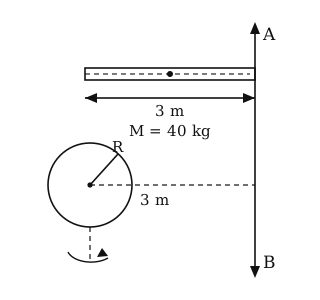
Q575.Moment of inertia about an axis
for a rod of mass 40 kg and length 3 m is same as that of a solid sphere of mass of 10 kg and radius
about an axis parallel to
axis with separation of 3 m as shown in figure below. The value of
is given as
. The value of
is ________.
नीचे चित्र में दर्शाए अनुसार, 40 kg द्रव्यमान तथा 3 m लम्बाई की एक छड़ का अक्ष
के परितः जड़त्व आघूर्ण, 10 kg द्रव्यमान तथा
त्रिज्या के एक ठोस गोले के,
अक्ष के समान्तर 3 m अन्तराल वाले अक्ष के परितः, जड़त्व आघूर्ण के बराबर है।
का मान
दिया गया है।
का मान ________ है।
Show answer
Concept: The rod's end lies on , so . The sphere's centre is 3 m from ; by the parallel-axis theorem its moment of inertia about the axis at separation 3 m is .
- .
- .
- , so m (less than 3 m, consistent with the figure).
- Comparing with : .
Short trick: .
Answer: 15
अवधारणा: छड़ का सिरा पर है, अतः । गोले का केन्द्र से 3 m दूर है; समान्तर अक्ष प्रमेय से 3 m अन्तराल वाले अक्ष के परितः इसका जड़त्व आघूर्ण है।
- ।
- ।
- , अतः m (3 m से कम, चित्र के अनुरूप)।
- से तुलना करने पर: ।
शॉर्ट ट्रिक: ।
उत्तर: 15
JEE Main 2026 (April) – Paper 1 (B.E./B.Tech)PhysicsRotational Motion – moment of inertiaJEE Main 2026 (April) – Paper 1 (B.E./B.Tech) 2026 · 2 Apr Shift 2
Q576.The ratio of mass percentage (w/w) of C : H in a hydrocarbon is 12 : 1. It has two carbon atoms. The weight (in g) of CO2(g) formed when 3.38 g of this hydrocarbon is completely burnt in oxygen is :
(Given : Molar mass in g mol−1 C : 12, H : 1, O : 16)
किसी हाइड्रोकार्बन में C : H के द्रव्यमान प्रतिशत (w/w) का अनुपात 12 : 1 है। इसमें दो कार्बन परमाणु हैं। इस हाइड्रोकार्बन के 3.38 g को ऑक्सीजन में पूर्णतः जलाने पर बनी CO2(g) का भार (g में) है :
(दिया है : मोलर द्रव्यमान g mol−1 में C : 12, H : 1, O : 16)
- A5.68
- B11.44
- C22.74
- D17.05
Show answer
Concept: Mass ratio → mole ratio gives the empirical formula; the given number of C atoms fixes the molecular formula, then use combustion stoichiometry.
- Mole ratio C : H , so the empirical formula is CH.
- With two carbon atoms the hydrocarbon is C2H2 (ethyne), g mol−1.
- Moles burnt mol; each mole gives 2 mol CO2 → mol CO2.
- Mass of CO2 g.
Short trick: Each mole of C2H2 gives 88 g CO2: g.
Answer: (B) 11.44
अवधारणा: द्रव्यमान अनुपात → मोल अनुपात से मूलानुपाती सूत्र मिलता है; दिए गए C परमाणुओं की संख्या से अणुसूत्र निश्चित होता है, फिर दहन रससमीकरणमिति लगाइए।
- मोल अनुपात C : H , अतः मूलानुपाती सूत्र CH है।
- दो कार्बन परमाणुओं के साथ हाइड्रोकार्बन C2H2 (एथाइन) है, g mol−1।
- जले मोल mol; प्रत्येक मोल से 2 mol CO2 → mol CO2।
- CO2 का द्रव्यमान g।
शॉर्ट ट्रिक: C2H2 के प्रत्येक मोल से 88 g CO2 बनती है: g।
उत्तर: (B) 11.44
JEE Main 2026 (April) – Paper 1 (B.E./B.Tech)ChemistryMole concept – combustion stoichiometryJEE Main 2026 (April) – Paper 1 (B.E./B.Tech) 2026 · 2 Apr Shift 2
Q577.The first and second ionization constants of a weak dibasic acid H2A are and respectively. 0.1 mol of H2A was dissolved in 1 L of 0.1 M HCl solution. The concentration of HA− in the resultant solution is :
एक दुर्बल द्विक्षारकीय अम्ल H2A के प्रथम तथा द्वितीय आयनन स्थिरांक क्रमशः तथा हैं। 0.1 mol H2A को 1 L, 0.1 M HCl विलयन में घोला गया। परिणामी विलयन में HA− की सांद्रता है :
- A0.1 M
- B M
- C M
- D M
Show answer
Concept: In presence of the strong acid HCl the ionisation of the weak acid is suppressed (common ion effect), so [H+] comes almost entirely from HCl.
- [H+] ≈ 0.1 M (from HCl); dissociation of H2A is negligible, so [H2A] ≈ 0.1 M.
- → M.
- The second ionisation () is far too small to change this.
Short trick: When acid concentration = [H+] from the strong acid, they cancel and numerically.
Answer: (C) M
अवधारणा: प्रबल अम्ल HCl की उपस्थिति में दुर्बल अम्ल का आयनन दब जाता है (उभयनिष्ठ आयन प्रभाव), अतः [H+] लगभग पूर्णतः HCl से आता है।
- [H+] ≈ 0.1 M (HCl से); H2A का वियोजन नगण्य है, अतः [H2A] ≈ 0.1 M।
- → M।
- द्वितीय आयनन () इतना छोटा है कि इसे बदल नहीं सकता।
शॉर्ट ट्रिक: जब अम्ल की सांद्रता = प्रबल अम्ल से [H+] हो, तो वे कट जाते हैं और संख्यात्मक रूप से ।
उत्तर: (C) M
JEE Main 2026 (April) – Paper 1 (B.E./B.Tech)ChemistryIonic equilibrium – common ion effectJEE Main 2026 (April) – Paper 1 (B.E./B.Tech) 2026 · 2 Apr Shift 2
Q578.SF4 is isostructural with :
A. BrF4⊖
B. CH4
C. IF4⊕
D. XeF4
E. XeO2F2
Choose the correct answer from the options given below :
SF4 किसके साथ समसंरचनात्मक (isostructural) है :
A. BrF4⊖
B. CH4
C. IF4⊕
D. XeF4
E. XeO2F2
नीचे दिए गए विकल्पों में से सही उत्तर चुनिए :
- AC Onlyकेवल C
- BC and E Onlyकेवल C और E
- CA and D Onlyकेवल A और D
- DB and E Onlyकेवल B और E
Show answer
Concept: Isostructural species have the same shape; count bond pairs (bp) and lone pairs (lp) on the central atom. SF4 has 4 bp + 1 lp → see-saw (based on trigonal bipyramid).
- A. BrF4⊖: lp, 4 bp → square planar. Not see-saw.
- B. CH4: 4 bp, 0 lp → tetrahedral. Not see-saw.
- C. IF4⊕: lp, 4 bp → see-saw. Isostructural ✔
- D. XeF4: 4 bp + 2 lp → square planar. Not see-saw.
- E. XeO2F2: 8 − 2×2 (to O) − 2 (to F) = 2 electrons → 1 lp with 4 bp → see-saw. Isostructural ✔
Short trick: Look for AX4E type (4 bp + 1 lp): only IF4+ and XeO2F2 qualify.
Answer: (B) C and E Only
अवधारणा: समसंरचनात्मक स्पीशीज़ की आकृति समान होती है; केंद्रीय परमाणु पर आबंध युग्म (bp) और एकाकी युग्म (lp) गिनिए। SF4 में 4 bp + 1 lp → सी-सॉ (त्रिकोणीय द्विपिरैमिडी पर आधारित)।
- A. BrF4⊖: lp, 4 bp → वर्ग समतलीय। सी-सॉ नहीं।
- B. CH4: 4 bp, 0 lp → चतुष्फलकीय। सी-सॉ नहीं।
- C. IF4⊕: lp, 4 bp → सी-सॉ। समसंरचनात्मक ✔
- D. XeF4: 4 bp + 2 lp → वर्ग समतलीय। सी-सॉ नहीं।
- E. XeO2F2: 8 − 2×2 (O को) − 2 (F को) = 2 इलेक्ट्रॉन → 1 lp तथा 4 bp → सी-सॉ। समसंरचनात्मक ✔
शॉर्ट ट्रिक: AX4E प्रकार (4 bp + 1 lp) खोजिए: केवल IF4+ और XeO2F2 ही ऐसे हैं।
उत्तर: (B) केवल C और E
JEE Main 2026 (April) – Paper 1 (B.E./B.Tech)ChemistryChemical bonding – VSEPR, isostructural speciesJEE Main 2026 (April) – Paper 1 (B.E./B.Tech) 2026 · 2 Apr Shift 2
Q579.Gas 'A' undergoes change from state 'X' to state 'Y'. In this process, the heat absorbed and work done by the gas is 10 J and 18 J respectively. Now gas is brought back to state 'X' by another process during which 6 J of heat is evolved. In the reverse process of 'Y' to 'X',
गैस 'A' अवस्था 'X' से अवस्था 'Y' में परिवर्तित होती है। इस प्रक्रम में गैस द्वारा अवशोषित ऊष्मा तथा किया गया कार्य क्रमशः 10 J और 18 J है। अब गैस को एक अन्य प्रक्रम द्वारा वापस अवस्था 'X' में लाया जाता है जिसके दौरान 6 J ऊष्मा उत्सर्जित होती है। 'Y' से 'X' के विपरीत प्रक्रम में,
- A18 J of the work is done by the gas 'A'.गैस 'A' द्वारा 18 J कार्य किया जाता है।
- B2 J of the work is done by the gas 'A'.गैस 'A' द्वारा 2 J कार्य किया जाता है।
- C12 J of the work is done on the gas 'A' by the surrounding.परिवेश द्वारा गैस 'A' पर 12 J कार्य किया जाता है।
- D14 J of the work is done on the gas 'A' by the surrounding.परिवेश द्वारा गैस 'A' पर 14 J कार्य किया जाता है।
Show answer
Concept: ΔU is a state function: . First law: , where is work done on the gas.
- X → Y: J; work done by gas = 18 J → J → J.
- Y → X: J; heat evolved 6 J → J.
- → J, i.e. 14 J of work is done on the gas by the surroundings.
- Options (A) and (B) wrongly make the gas do work, and (C) has the wrong magnitude.
Short trick: Over the complete cycle , so J; with J, J.
Answer: (D) 14 J of the work is done on the gas 'A' by the surrounding.
अवधारणा: ΔU अवस्था फलन है: । प्रथम नियम: , जहाँ गैस पर किया गया कार्य है।
- X → Y: J; गैस द्वारा किया कार्य = 18 J → J → J।
- Y → X: J; 6 J ऊष्मा उत्सर्जित → J।
- → J, अर्थात परिवेश द्वारा गैस पर 14 J कार्य किया जाता है।
- विकल्प (A) और (B) में गलत रूप से गैस कार्य करती दिखाई गई है, और (C) में परिमाण गलत है।
शॉर्ट ट्रिक: पूर्ण चक्र में , अतः J; चूँकि J, इसलिए J।
उत्तर: (D) परिवेश द्वारा गैस 'A' पर 14 J कार्य किया जाता है।
JEE Main 2026 (April) – Paper 1 (B.E./B.Tech)ChemistryThermodynamics – first lawJEE Main 2026 (April) – Paper 1 (B.E./B.Tech) 2026 · 2 Apr Shift 2
Q580.Solution A is prepared by dissolving 1 g of a protein (molar mass = 50000 g mol−1) in 0.5 L of water at 300 K. Its osmotic pressure is bar. Solution B is made by dissolving 2 g of same protein in 1 L of water at 300 K. Osmotic pressure of solution B is bar. Entire solution of A is mixed with entire solution of B at same temperature. The osmotic pressure of resultant solution is bar. , and respectively are :
(R = 0.083 L bar mol−1 K−1)
300 K पर 0.5 L जल में 1 g प्रोटीन (मोलर द्रव्यमान = 50000 g mol−1) घोलकर विलयन A बनाया जाता है। इसका परासरण दाब bar है। 300 K पर 1 L जल में उसी प्रोटीन के 2 g घोलकर विलयन B बनाया जाता है। विलयन B का परासरण दाब bar है। समान ताप पर A का सम्पूर्ण विलयन B के सम्पूर्ण विलयन में मिलाया जाता है। परिणामी विलयन का परासरण दाब bar है। , तथा क्रमशः हैं :
(R = 0.083 L bar mol−1 K−1)
- A; ;
- B; ;
- C; ;
- D; ;
Show answer
Concept: Osmotic pressure . Both solutions have the same concentration, so mixing changes nothing.
- A: mol in 0.5 L → M → bar.
- B: mol in 1 L → M → bar.
- Mixture: mol in 1.5 L → M → bar.
Short trick: Both solutions are 2 g protein per litre – equal concentrations mixed give the same concentration, so .
Answer: (A) ; ;
अवधारणा: परासरण दाब । दोनों विलयनों की सांद्रता समान है, अतः मिलाने पर कुछ नहीं बदलता।
- A: mol, 0.5 L में → M → bar।
- B: mol, 1 L में → M → bar।
- मिश्रण: mol, 1.5 L में → M → bar।
शॉर्ट ट्रिक: दोनों विलयन 2 g प्रोटीन प्रति लीटर हैं – समान सांद्रता मिलाने पर सांद्रता वही रहती है, अतः ।
उत्तर: (A) ; ;
JEE Main 2026 (April) – Paper 1 (B.E./B.Tech)ChemistrySolutions – osmotic pressureJEE Main 2026 (April) – Paper 1 (B.E./B.Tech) 2026 · 2 Apr Shift 2

