NEET UG · 2,240 questions

NEET UG 2015, 2016, 2017, 2018, 2019, 2020, 2021, 2022, 2023, 2024, 2025, 2026 PYQs

Real previous year questions, subject-wise. Try the question, then open the answer and the explanation in Hindi & English – free, no login.

Courses – airGurukul

2,240 questions.

Q2001.
Which one of the following is a characteristic feature of cropland ecosystem?
निम्नलिखित में से कौन-सा फसल-भूमि (cropland) पारितंत्र का अभिलाक्षणिक गुण है?
  1. AAbsence of soil organismsमृदा जीवों की अनुपस्थिति
  2. BLeast genetic diversityन्यूनतम आनुवंशिक विविधता
  3. CAbsence of weedsखरपतवारों की अनुपस्थिति
  4. DEcological successionपारिस्थितिक अनुक्रमण
Show answer

Concept: A cropland is a man-made monoculture – one crop variety, often genetically uniform, is grown over the whole field.

  1. Monoculture → least genetic diversity → (B).
  2. (A) Soil organisms (bacteria, fungi, earthworms) are abundant in cropland soil.
  3. (C) Weeds are always present; that is why weeding is needed.
  4. (D) Succession is prevented by repeated ploughing, sowing and harvesting – the system is kept at an early stage.

Short trick: Cropland = monoculture → minimum diversity; succession “reset” every season.

Answer: (B) Least genetic diversity

अवधारणा: फसल-भूमि मानव-निर्मित एकल-फसली (monoculture) तंत्र है – पूरे खेत में एक ही, प्रायः आनुवंशिक रूप से समान, फसल किस्म उगाई जाती है।

  1. एकल-फसल → न्यूनतम आनुवंशिक विविधता → (B)।
  2. (A) फसल-भूमि की मृदा में मृदा जीव (जीवाणु, कवक, केंचुए) प्रचुर होते हैं।
  3. (C) खरपतवार सदैव उपस्थित रहते हैं; इसीलिए निराई करनी पड़ती है।
  4. (D) बार-बार जुताई, बुवाई और कटाई से अनुक्रमण रुक जाता है – तंत्र प्रारंभिक अवस्था में ही रहता है।

शॉर्ट ट्रिक: फसल-भूमि = एकल-फसल → न्यूनतम विविधता; अनुक्रमण हर मौसम में “रीसेट”।

उत्तर: (B) न्यूनतम आनुवंशिक विविधता
NEET UGBiologyEcosystem – agro-ecosystemNEET UG 2016 · 1 May Shift 1
Q2002.
Changes in GnRH pulse frequency in females is controlled by circulating levels of:
स्त्रियों में GnRH स्पंद आवृत्ति (pulse frequency) में परिवर्तन किसके परिसंचारी स्तरों द्वारा नियंत्रित होता है?
  1. AEstrogen and progesteroneएस्ट्रोजन और प्रोजेस्टेरॉन
  2. BEstrogen and inhibinएस्ट्रोजन और इनहिबिन
  3. CProgesterone onlyकेवल प्रोजेस्टेरॉन
  4. DProgesterone and inhibinप्रोजेस्टेरॉन और इनहिबिन
Show answer

Concept: The hypothalamic GnRH pulse generator is regulated by ovarian steroid feedback: oestrogen and progesterone act on the hypothalamus to change GnRH pulse frequency.

  1. High progesterone (luteal phase) slows GnRH pulses; oestrogen (with low progesterone) speeds them, favouring LH – so both steroids control frequency → (A).
  2. (B)/(D) Inhibin acts directly on the anterior pituitary to suppress FSH; it does not alter hypothalamic GnRH pulse frequency.
  3. (C) Progesterone alone is incomplete – oestrogen is equally involved.

Short trick: Hypothalamus ← steroids (oestrogen, progesterone); pituitary FSH ← inhibin (a protein).

Answer: (A) Estrogen and progesterone

अवधारणा: हाइपोथैलेमस का GnRH स्पंद-जनित्र अंडाशयी स्टेरॉयडों के पुनर्भरण से नियंत्रित होता है: एस्ट्रोजन और प्रोजेस्टेरॉन हाइपोथैलेमस पर कार्य कर GnRH स्पंद आवृत्ति बदलते हैं।

  1. उच्च प्रोजेस्टेरॉन (पीतपिंड प्रावस्था) GnRH स्पंदों को धीमा करता है; एस्ट्रोजन (कम प्रोजेस्टेरॉन के साथ) उन्हें तेज करता है, जिससे LH बढ़ता है – अतः दोनों स्टेरॉयड आवृत्ति नियंत्रित करते हैं → (A)।
  2. (B)/(D) इनहिबिन सीधे अग्र पीयूष पर कार्य कर FSH को दबाता है; यह हाइपोथैलेमस की GnRH स्पंद आवृत्ति नहीं बदलता।
  3. (C) केवल प्रोजेस्टेरॉन अधूरा है – एस्ट्रोजन भी समान रूप से शामिल है।

शॉर्ट ट्रिक: हाइपोथैलेमस ← स्टेरॉयड (एस्ट्रोजन, प्रोजेस्टेरॉन); पीयूष FSH ← इनहिबिन (एक प्रोटीन)।

उत्तर: (A) एस्ट्रोजन और प्रोजेस्टेरॉन

NEET UGBiologyHuman reproduction – hormonal feedbackNEET UG 2016 · 1 May Shift 1
Q2003.
Which of the following is not a feature of the plasmids?
निम्नलिखित में से कौन-सा प्लाज़्मिडों का लक्षण नहीं है?
  1. AIndependent replicationस्वतंत्र प्रतिकृतियन
  2. BCircular structureवृत्ताकार संरचना
  3. CTransferableस्थानांतरणीय
  4. DSingle – strandedएकल-रज्जुकी
Show answer

Concept: NCERT: plasmids are autonomously replicating, circular, extra-chromosomal double-stranded DNA molecules of bacteria.

  1. (A) Feature – they replicate independently of the chromosomal DNA.
  2. (B) Feature – circular.
  3. (C) Feature – can be transferred between bacteria (conjugation/transformation).
  4. (D) Not a feature – plasmids are double-stranded → answer.

Short trick: Plasmid = small, circular, ds, extra-chromosomal, self-replicating DNA – the vector of choice (pBR322).

Answer: (D) Single – stranded

अवधारणा: NCERT: प्लाज़्मिड जीवाणुओं के स्वायत्त प्रतिकृतियन करने वाले, वृत्ताकार, गुणसूत्र-बाह्य द्वि-रज्जुकी DNA अणु हैं।

  1. (A) लक्षण है – गुणसूत्रीय DNA से स्वतंत्र प्रतिकृतियन।
  2. (B) लक्षण है – वृत्ताकार।
  3. (C) लक्षण है – जीवाणुओं के बीच स्थानांतरित हो सकते हैं (संयुग्मन/रूपांतरण)।
  4. (D) लक्षण नहीं – प्लाज़्मिड द्वि-रज्जुकी होते हैं → उत्तर।

शॉर्ट ट्रिक: प्लाज़्मिड = छोटा, वृत्ताकार, द्वि-रज्जुकी, गुणसूत्र-बाह्य, स्व-प्रतिकृतिक DNA – पसंदीदा वाहक (pBR322)।

उत्तर: (D) एकल-रज्जुकी

NEET UGBiologyBiotechnology – plasmidsNEET UG 2016 · 1 May Shift 1
Q2004.
Which of the following features is not present in Periplaneta americana?
निम्नलिखित में से कौन-सा लक्षण Periplaneta americana में नहीं पाया जाता?
  1. ASchizocoelom as body cavityदेहगुहा के रूप में दीर्णगुहा (schizocoelom)
  2. BIndeterminate and radial cleavage during embryonic developmentभ्रूणीय परिवर्धन में अनिर्धारी तथा अरीय विदलन
  3. CExoskeleton composed of N – acetylglucosamineN – ऐसीटिलग्लूकोसैमीन से बना बाह्यकंकाल
  4. DMetamerically segmented bodyविखंडीय (मेटामेरिक) रूप से खंडित शरीर
Show answer

Concept: Cockroach is an arthropod – a protostome schizocoelomate. Protostomes show spiral, determinate cleavage; radial, indeterminate cleavage is the deuterostome (echinoderm, chordate) pattern.

  1. (A) Present – the coelom arises by splitting of mesoderm (schizocoelom); in adults it is filled with haemolymph (haemocoel).
  2. (B) Not present – radial, indeterminate cleavage belongs to deuterostomes → answer.
  3. (C) Present – exoskeleton of chitin, a polymer of N-acetylglucosamine.
  4. (D) Present – body divided into similar segments (metameric segmentation).

Short trick: Protostome = Spiral + Determinate + Schizocoel; Deuterostome = Radial + Indeterminate + Enterocoel.

Answer: (B) Indeterminate and radial cleavage during embryonic development

अवधारणा: कॉकरोच एक संधिपाद है – प्रोटोस्टोम दीर्णगुहिक (schizocoelomate)। प्रोटोस्टोम में सर्पिल, निर्धारी विदलन होता है; अरीय, अनिर्धारी विदलन ड्यूटेरोस्टोम (एकाइनोडर्म, कॉर्डेट) का प्रतिरूप है।

  1. (A) उपस्थित – देहगुहा मध्यजनस्तर के विदलन से बनती है (दीर्णगुहा); वयस्क में यह हीमोलिम्फ से भरी होती है (हीमोसील)।
  2. (B) अनुपस्थित – अरीय, अनिर्धारी विदलन ड्यूटेरोस्टोम का लक्षण है → उत्तर।
  3. (C) उपस्थित – काइटिन का बाह्यकंकाल, जो N-ऐसीटिलग्लूकोसैमीन का बहुलक है।
  4. (D) उपस्थित – शरीर समान खंडों में विभाजित (विखंडीय खंडीभवन)।

शॉर्ट ट्रिक: प्रोटोस्टोम = सर्पिल + निर्धारी + दीर्णगुहा; ड्यूटेरोस्टोम = अरीय + अनिर्धारी + आंत्रगुहा।

उत्तर: (B) भ्रूणीय परिवर्धन में अनिर्धारी तथा अरीय विदलन

NEET UGBiologyAnimal kingdom – cockroach / protostome featuresNEET UG 2016 · 1 May Shift 1
Q2005.
In higher vertebrates, the immune system can distinguish self – cells and non – self. If this property is lost due to genetic abnormality and it attacks self – cells, then it leads to:
उच्च कशेरुकियों में प्रतिरक्षा तंत्र स्व-कोशिकाओं (self) और पर (non-self) में भेद कर सकता है। यदि आनुवंशिक असामान्यता के कारण यह गुण समाप्त हो जाए और यह स्व-कोशिकाओं पर आक्रमण करे, तो इसका परिणाम होगा:
  1. AAllergic responseएलर्जी अनुक्रिया
  2. BGraft rejectionनिरोप (ग्राफ्ट) अस्वीकृति
  3. CAuto – immune diseaseस्व-प्रतिरक्षा रोग
  4. DActive immunityसक्रिय प्रतिरक्षा
Show answer

Concept: NCERT (Human Health and Disease): memory-based acquired immunity distinguishes foreign organisms from self cells; sometimes, due to genetic and other unknown reasons, the body attacks self cells – this is autoimmunity (e.g. rheumatoid arthritis).

  1. Loss of self/non-self discrimination → attack on self cells → autoimmune disease → (C).
  2. (A) Allergy = exaggerated response to harmless foreign allergens (pollen, dust).
  3. (B) Graft rejection = normal response against a foreign (non-self) tissue.
  4. (D) Active immunity = antibodies produced by the host against an antigen – normal, protective.

Short trick: Auto = self → body vs. body. Examples: rheumatoid arthritis, type-1 diabetes, myasthenia gravis.

Answer: (C) Auto – immune disease

अवधारणा: NCERT (मानव स्वास्थ्य तथा रोग): स्मृति-आधारित उपार्जित प्रतिरक्षा बाहरी जीवों और स्व-कोशिकाओं में भेद करती है; कभी-कभी आनुवंशिक एवं अन्य अज्ञात कारणों से शरीर अपनी ही कोशिकाओं पर आक्रमण करता है – यह स्व-प्रतिरक्षा है (जैसे रूमेटॉइड आर्थराइटिस)।

  1. स्व/पर भेद की क्षमता समाप्त → स्व-कोशिकाओं पर आक्रमण → स्व-प्रतिरक्षा रोग → (C)।
  2. (A) एलर्जी = हानिरहित बाहरी एलर्जनों (परागकण, धूल) के प्रति अतिरंजित अनुक्रिया।
  3. (B) निरोप अस्वीकृति = बाहरी (पर) ऊतक के विरुद्ध सामान्य अनुक्रिया।
  4. (D) सक्रिय प्रतिरक्षा = प्रतिजन के विरुद्ध परपोषी द्वारा बनी प्रतिरक्षियाँ – सामान्य, रक्षात्मक।

शॉर्ट ट्रिक: Auto = स्वयं → शरीर बनाम शरीर। उदाहरण: रूमेटॉइड आर्थराइटिस, टाइप-1 मधुमेह, मायस्थीनिया ग्रेविस।

उत्तर: (C) स्व-प्रतिरक्षा रोग

NEET UGBiologyHuman health – immunityNEET UG 2016 · 1 May Shift 1
Q2006.
Column – IColumn – II
(a) Dominance(i) Many genes govern a single character
(b) Codominance(ii) In a heterozygous organism only one allele expresses itself
(c) Pleiotropy(iii) In a heterozygous organism both alleles express themselves fully
(d) Polygenic inheritance(iv) A single gene influences many characters
स्तंभ – Iस्तंभ – II
(a) प्रभाविता (Dominance)(i) अनेक जीन एक ही लक्षण को नियंत्रित करते हैं
(b) सहप्रभाविता (Codominance)(ii) विषमयुग्मजी जीव में केवल एक युग्मविकल्पी (allele) स्वयं को अभिव्यक्त करता है
(c) बहुप्रभाविता (Pleiotropy)(iii) विषमयुग्मजी जीव में दोनों युग्मविकल्पी स्वयं को पूर्णतः अभिव्यक्त करते हैं
(d) बहुजीनी वंशागति (Polygenic inheritance)(iv) एक ही जीन अनेक लक्षणों को प्रभावित करता है
  1. A(a)-(ii), (b)-(i), (c)-(iv), (d)-(iii)
  2. B(a)-(ii), (b)-(iii), (c)-(iv), (d)-(i)
  3. C(a)-(iv), (b)-(i), (c)-(ii), (d)-(iii)
  4. D(a)-(iv), (b)-(iii), (c)-(i), (d)-(ii)
Show answer

Concept: Definitions (NCERT, Principles of Inheritance and Variation).

  1. (a) Dominance – in a heterozygote only one allele (the dominant one) expresses itself → (ii).
  2. (b) Codominance – both alleles express fully in the heterozygote (ABO: IAIB = AB) → (iii).
  3. (c) Pleiotropy – a single gene influences many characters (phenylketonuria) → (iv).
  4. (d) Polygenic inheritance – many genes govern a single character (human skin colour, height) → (i).
  5. So a-ii, b-iii, c-iv, d-i → (B). (A) and (C) wrongly give codominance as (i); (C) and (D) wrongly give dominance as (iv).

Short trick: Pleio = “more” effects from one gene; Poly-genic = many genes, one trait. Fixing a-ii alone leaves only (A)/(B); b-iii picks (B).

Answer: (B) (a)-(ii), (b)-(iii), (c)-(iv), (d)-(i)

अवधारणा: परिभाषाएँ (NCERT, वंशागति तथा विविधता के सिद्धांत)।

  1. (a) प्रभाविता – विषमयुग्मजी में केवल एक युग्मविकल्पी (प्रभावी) अभिव्यक्त होता है → (ii)।
  2. (b) सहप्रभाविता – विषमयुग्मजी में दोनों युग्मविकल्पी पूर्णतः अभिव्यक्त होते हैं (ABO: IAIB = AB) → (iii)।
  3. (c) बहुप्रभाविता – एक जीन अनेक लक्षणों को प्रभावित करता है (फिनाइलकीटोनूरिया) → (iv)।
  4. (d) बहुजीनी वंशागति – अनेक जीन एक लक्षण को नियंत्रित करते हैं (मानव त्वचा का रंग, लंबाई) → (i)।
  5. अतः a-ii, b-iii, c-iv, d-i → (B)। (A) और (C) सहप्रभाविता को गलत ढंग से (i) देते हैं; (C) और (D) प्रभाविता को गलत ढंग से (iv) देते हैं।

शॉर्ट ट्रिक: Pleio = एक जीन से “अधिक” प्रभाव; Poly-genic = अनेक जीन, एक लक्षण। केवल a-ii तय करने से (A)/(B) बचते हैं; b-iii से (B)।

उत्तर: (B) (a)-(ii), (b)-(iii), (c)-(iv), (d)-(i)

NEET UGBiologyPrinciples of inheritance – patternsNEET UG 2016 · 1 May Shift 1
Q2007.
Joint Forest Management Concept was introduced in India during:
संयुक्त वन प्रबंधन (Joint Forest Management) की अवधारणा भारत में किस दशक में प्रारंभ की गई?
  1. A1960s1960 का दशक
  2. B1970s1970 का दशक
  3. C1980s1980 का दशक
  4. D1990s1990 का दशक
Show answer

Concept: NCERT (Environmental Issues): the Government of India introduced the concept of Joint Forest Management (JFM) in the 1980s to work closely with local communities for protecting and managing forests (National Forest Policy 1988).

  1. JFM – 1980s (1988 policy; guidelines 1990) → (C).
  2. In return, communities get benefits of various forest products (fruits, gum, rubber, medicine) and the forest is managed sustainably.
  3. (A), (B), (D) – wrong decades; the Chipko movement was 1974 (1970s) and the Amrita Devi award links to the 1731 Bishnoi episode.

Short trick: JFM ↔ 1980s; Chipko ↔ 1974; Bishnoi (Amrita Devi) ↔ 1731.

Answer: (C) 1980s

अवधारणा: NCERT (पर्यावरण के मुद्दे): भारत सरकार ने वनों की रक्षा और प्रबंधन में स्थानीय समुदायों के साथ मिलकर कार्य करने हेतु 1980 के दशक में संयुक्त वन प्रबंधन (JFM) की अवधारणा प्रारंभ की (राष्ट्रीय वन नीति 1988)।

  1. JFM – 1980 का दशक (1988 नीति; दिशानिर्देश 1990) → (C)।
  2. इसके बदले समुदायों को विभिन्न वन उत्पादों (फल, गोंद, रबर, औषधि) का लाभ मिलता है और वन का सतत प्रबंधन होता है।
  3. (A), (B), (D) – गलत दशक; चिपको आंदोलन 1974 (1970 का दशक) में हुआ और अमृता देवी पुरस्कार 1731 की बिश्नोई घटना से जुड़ा है।

शॉर्ट ट्रिक: JFM ↔ 1980 का दशक; चिपको ↔ 1974; बिश्नोई (अमृता देवी) ↔ 1731।

उत्तर: (C) 1980 का दशक

NEET UGBiologyBiodiversity – conservation (people’s participation)NEET UG 2016 · 1 May Shift 1
Q2008.
Pick out the correct statements:
(i) Hemophilia is a sex – linked recessive disease
(ii) Down’s syndrome is due to aneuploidy
(iii) Phenylketonuria is an autosomal recessive gene disorder
(iv) Sickle cell anaemia is an X – linked recessive gene disorder
सही कथनों को चुनिए:
(i) हीमोफीलिया एक लिंग-सहलग्न अप्रभावी रोग है
(ii) डाउन सिंड्रोम असुगुणिता (aneuploidy) के कारण होता है
(iii) फिनाइलकीटोनूरिया एक अलिंगसूत्री (autosomal) अप्रभावी जीन विकार है
(iv) दात्र कोशिका अरक्तता (Sickle cell anaemia) एक X – सहलग्न अप्रभावी जीन विकार है
  1. A(i) and (iv) are correct(i) और (iv) सही हैं
  2. B(ii) and (iv) are correct(ii) और (iv) सही हैं
  3. C(i), (iii) and (iv) are correct(i), (iii) और (iv) सही हैं
  4. D(i), (ii) and (iii) are correct(i), (ii) और (iii) सही हैं
Show answer

Concept: NCERT Mendelian and chromosomal disorders.

  1. (i) Correct – haemophilia is X-linked (sex-linked) recessive.
  2. (ii) Correct – Down’s syndrome = trisomy 21, an aneuploidy (gain of one chromosome).
  3. (iii) Correct – phenylketonuria is an autosomal recessive inborn error of metabolism (no phenylalanine hydroxylase).
  4. (iv) Incorrect – sickle-cell anaemia is autosomal recessive (HbS gene on chromosome 11; Glu → Val at 6th position of β-globin), not X-linked.
  5. Correct set = (i), (ii), (iii) → (D). Every other option contains (iv).

Short trick: Only haemophilia and colour blindness are X-linked in NCERT; thalassaemia, sickle-cell and PKU are all autosomal recessive.

Answer: (D) (i), (ii) and (iii) are correct

अवधारणा: NCERT मेंडेलीय तथा गुणसूत्रीय विकार।

  1. (i) सही – हीमोफीलिया X-सहलग्न (लिंग-सहलग्न) अप्रभावी है।
  2. (ii) सही – डाउन सिंड्रोम = ट्राइसोमी 21, एक असुगुणिता (एक गुणसूत्र की वृद्धि)।
  3. (iii) सही – फिनाइलकीटोनूरिया अलिंगसूत्री अप्रभावी जन्मजात उपापचयी त्रुटि है (फिनाइलऐलानीन हाइड्रॉक्सिलेज़ का अभाव)।
  4. (iv) गलत – दात्र कोशिका अरक्तता अलिंगसूत्री अप्रभावी है (HbS जीन गुणसूत्र 11 पर; β-ग्लोबिन के 6वें स्थान पर Glu → Val), X-सहलग्न नहीं।
  5. सही समूह = (i), (ii), (iii) → (D)। अन्य सभी विकल्पों में (iv) है।

शॉर्ट ट्रिक: NCERT में केवल हीमोफीलिया और वर्णांधता X-सहलग्न हैं; थैलेसीमिया, दात्र कोशिका और PKU सभी अलिंगसूत्री अप्रभावी हैं।

उत्तर: (D) (i), (ii) और (iii) सही हैं

NEET UGBiologyPrinciples of inheritance – genetic disordersNEET UG 2016 · 1 May Shift 1
Q2009.
Which one of the following statements is wrong?
निम्नलिखित में से कौन-सा कथन गलत है?
  1. ACyanobacteria are also called blue – green algaeसायनोबैक्टीरिया को नील-हरित शैवाल भी कहते हैं
  2. BGolden algae are also called desmidsसुनहरे शैवालों (golden algae) को डेस्मिड भी कहते हैं
  3. CEubacteria are also called false bacteriaयूबैक्टीरिया को असत्य (false) जीवाणु भी कहते हैं
  4. DPhycomycetes are also called algal fungiफाइकोमाइसिटीज़ को शैवाल कवक (algal fungi) भी कहते हैं
Show answer

Concept: NCERT (Biological Classification) names.

  1. (A) Correct – cyanobacteria = blue-green algae.
  2. (B) Correct as per NCERT – chrysophytes include diatoms and golden algae (desmids).
  3. (C) Wrong – eubacteria are the “true bacteria” (eu = true); they are not false bacteria → answer.
  4. (D) Correct – phycomycetes are called algal fungi.

Short trick: Eu = true (eukaryote, eubacteria); “false” never goes with eu-.

Answer: (C) Eubacteria are also called false bacteria

अवधारणा: NCERT (जीव जगत का वर्गीकरण) के नाम।

  1. (A) सही – सायनोबैक्टीरिया = नील-हरित शैवाल।
  2. (B) NCERT के अनुसार सही – क्राइसोफाइट में डायटम और सुनहरे शैवाल (डेस्मिड) आते हैं।
  3. (C) गलत – यूबैक्टीरिया “सत्य जीवाणु” (eu = सत्य) हैं; असत्य जीवाणु नहीं → उत्तर।
  4. (D) सही – फाइकोमाइसिटीज़ को शैवाल कवक कहते हैं।

शॉर्ट ट्रिक: Eu = सत्य (यूकैरियोट, यूबैक्टीरिया); “असत्य” कभी eu- के साथ नहीं आता।

उत्तर: (C) यूबैक्टीरिया को असत्य जीवाणु भी कहते हैं

NEET UGBiologyBiological classification – kingdomsNEET UG 2016 · 1 May Shift 1
Q2010.
Proximal end of the filament of stamen is attached to the:
पुंकेसर के तंतु (filament) का समीपस्थ (proximal) सिरा किससे जुड़ा होता है?
  1. AAntherपरागकोश
  2. BConnectiveयोजी (Connective)
  3. CPlacentaबीजांडासन (Placenta)
  4. DThalamus or petalपुष्पासन (थैलेमस) अथवा दल
Show answer

Concept: A stamen = filament + anther. The proximal end of the filament is attached to the thalamus or the petal (epipetalous); the distal end bears the bilobed anther (lobes joined by the connective).

  1. Proximal (base) → thalamus or petal → (D).
  2. (A) Anther is at the distal end.
  3. (B) Connective joins the two anther lobes at the distal end.
  4. (C) Placenta is in the ovary, bearing ovules – not related to stamens.

Short trick: Proximal = near the base (thalamus/petal); Distal = far tip (anther).

Answer: (D) Thalamus or petal

अवधारणा: पुंकेसर = तंतु + परागकोश। तंतु का समीपस्थ सिरा पुष्पासन अथवा दल (दललग्न) से जुड़ा होता है; दूरस्थ सिरे पर द्विपालित परागकोश होता है (पालियाँ योजी से जुड़ी)।

  1. समीपस्थ (आधार) → पुष्पासन अथवा दल → (D)।
  2. (A) परागकोश दूरस्थ सिरे पर होता है।
  3. (B) योजी दूरस्थ सिरे पर परागकोश की दोनों पालियों को जोड़ता है।
  4. (C) बीजांडासन अंडाशय में होता है, जिस पर बीजांड लगे होते हैं – पुंकेसर से संबंधित नहीं।

शॉर्ट ट्रिक: समीपस्थ = आधार के पास (पुष्पासन/दल); दूरस्थ = दूर का सिरा (परागकोश)।

उत्तर: (D) पुष्पासन अथवा दल

NEET UGBiologyMorphology of flowering plants – androeciumNEET UG 2016 · 1 May Shift 1
Q2011.
Which of the following approaches does not give the defined action of contraceptive?
निम्नलिखित में से कौन-सी विधि गर्भनिरोधक की परिभाषित क्रिया को सही नहीं दर्शाती?
  1. ABarrier methods – Prevent fertilizationरोधक (Barrier) विधियाँ – निषेचन को रोकती हैं
  2. BIntra uterine devices – Increase phagocytosis of sperms, suppress sperm motility and fertilizing capacity of spermsअंतर्गर्भाशयी युक्तियाँ (IUDs) – शुक्राणुओं का भक्षकाणुक्रिया (phagocytosis) बढ़ाती हैं, शुक्राणु गतिशीलता तथा निषेचन क्षमता को दबाती हैं
  3. CHormonal contraceptives – Prevent/retard entry of sperms, prevent ovulation and fertilizationहॉर्मोनी गर्भनिरोधक – शुक्राणुओं के प्रवेश को रोकते/मंद करते हैं, अंडोत्सर्ग तथा निषेचन को रोकते हैं
  4. DVasectomy – Prevents spermatogenesisशुक्रवाहक-उच्छेदन (Vasectomy) – शुक्राणुजनन को रोकता है
Show answer

Concept: NCERT (Reproductive Health): vasectomy – a small part of the vas deferens is removed or tied up through a small incision on the scrotum; it blocks transport of sperms, while spermatogenesis in the testes continues.

  1. (A) Correct – condoms, diaphragms, cervical caps, vaults prevent the meeting of ovum and sperm, i.e. fertilization.
  2. (B) Correct – IUDs increase phagocytosis of sperms; Cu ions suppress sperm motility and fertilizing capacity.
  3. (C) Correct – pills/injections/implants inhibit ovulation and implantation and alter cervical mucus to prevent/retard entry of sperms.
  4. (D) Wrong – vasectomy does not stop sperm formation; it stops sperm reaching the semen → answer.

Short trick: Vasectomy / tubectomy = “cut the pipe” – production goes on, transport stops.

Answer: (D) Vasectomy – Prevents spermatogenesis

अवधारणा: NCERT (जनन स्वास्थ्य): शुक्रवाहक-उच्छेदन – वृषणकोष पर छोटे चीरे द्वारा शुक्रवाहक का एक छोटा भाग निकाल या बाँध दिया जाता है; यह शुक्राणुओं के परिवहन को रोकता है, जबकि वृषण में शुक्राणुजनन चलता रहता है।

  1. (A) सही – कंडोम, डायफ्राम, गर्भाशय-ग्रीवा टोपी, वॉल्ट अंडाणु व शुक्राणु के मिलन, अर्थात् निषेचन, को रोकते हैं।
  2. (B) सही – IUDs शुक्राणुओं का भक्षकाणुक्रिया बढ़ाती हैं; Cu आयन शुक्राणु गतिशीलता व निषेचन क्षमता को दबाते हैं।
  3. (C) सही – गोलियाँ/इंजेक्शन/रोपण अंडोत्सर्ग व अंतर्रोपण को रोकते हैं तथा ग्रीवा श्लेष्मा बदलकर शुक्राणुओं के प्रवेश को रोकते/मंद करते हैं।
  4. (D) गलत – शुक्रवाहक-उच्छेदन शुक्राणु निर्माण नहीं रोकता; यह शुक्राणुओं को वीर्य तक पहुँचने से रोकता है → उत्तर।

शॉर्ट ट्रिक: शुक्रवाहक-उच्छेदन / डिंबवाहिनी-उच्छेदन = “नली काटो” – उत्पादन जारी, परिवहन बंद।

उत्तर: (D) शुक्रवाहक-उच्छेदन – शुक्राणुजनन को रोकता है

NEET UGBiologyReproductive health – contraceptionNEET UG 2016 · 1 May Shift 1
Q2012.
The taq polymerase enzyme is obtained from:
टैक पॉलिमरेज़ (taq polymerase) एंजाइम किससे प्राप्त होता है?
  1. AThermus aquaticus
  2. BThiobacillus ferroxidans
  3. CBacillus subtilis
  4. DPseudomonas putida
Show answer

Concept: NCERT: PCR uses a thermostable DNA polymerase isolated from the bacterium Thermus aquaticus, which remains active during the high-temperature denaturation step.

  1. Taq = Thermus aquaticus → (A).
  2. (B) Thiobacillus – chemoautotroph used in bioleaching of metals.
  3. (C) Bacillus subtilis – soil bacterium, source of enzymes like amylase/subtilisin.
  4. (D) Pseudomonas putida – “superbug” used to degrade hydrocarbons of oil spills.

Short trick: The name gives it away: Thermus aquaticus = Taq; hot-spring bacterium → heat-stable enzyme.

Answer: (A) Thermus aquaticus

अवधारणा: NCERT: PCR में जीवाणु Thermus aquaticus से पृथक ताप-स्थायी DNA पॉलिमरेज़ प्रयुक्त होता है, जो उच्च ताप पर विकृतीकरण चरण में भी सक्रिय रहता है।

  1. Taq = Thermus aquaticus → (A)।
  2. (B) Thiobacillus – रसायन-स्वपोषी, धातुओं के जैव-निक्षालन में उपयोगी।
  3. (C) Bacillus subtilis – मृदा जीवाणु, एमाइलेज़/सबटिलिसिन जैसे एंजाइमों का स्रोत।
  4. (D) Pseudomonas putida – तेल रिसाव के हाइड्रोकार्बनों के अपघटन में प्रयुक्त “सुपरबग”।

शॉर्ट ट्रिक: नाम ही उत्तर है: Thermus aquaticus = Taq; गर्म झरनों का जीवाणु → ताप-स्थायी एंजाइम।

उत्तर: (A) Thermus aquaticus

NEET UGBiologyBiotechnology – PCRNEET UG 2016 · 1 May Shift 1
Q2013.
Identify the correct statement on ‘inhibin’:
‘इनहिबिन’ के संबंध में सही कथन को पहचानिए:
  1. AInhibits the secretion of LH, FSH and ProlactinLH, FSH और प्रोलैक्टिन के स्रावण को रोकता है
  2. BIs produced by granulose cells in ovary and inhibits the secretion of FSHअंडाशय की ग्रैनुलोसा कोशिकाओं द्वारा बनता है और FSH के स्रावण को रोकता है
  3. CIs produced by granulose cells in ovary and inhibits the secretion of LHअंडाशय की ग्रैनुलोसा कोशिकाओं द्वारा बनता है और LH के स्रावण को रोकता है
  4. DIs produced by nurse cells in testes and inhibits the secretion of LHवृषण की पोषी (nurse) कोशिकाओं द्वारा बनता है और LH के स्रावण को रोकता है
Show answer

Concept: Inhibin is a glycoprotein secreted by granulosa cells of the ovarian follicle (and Sertoli/nurse cells of the testis); it selectively inhibits FSH secretion from the anterior pituitary.

  1. Granulosa cells + inhibits FSH → (B).
  2. (A) Inhibin does not inhibit LH or prolactin – its action is selective for FSH.
  3. (C) Source correct, but the target is FSH, not LH.
  4. (D) Sertoli (nurse) cells do make inhibin, but again it inhibits FSH, not LH.

Short trick: In-HIB-in → FSH only (negative feedback on FSH); it never inhibits LH.

Answer: (B) Is produced by granulose cells in ovary and inhibits the secretion of FSH

अवधारणा: इनहिबिन एक ग्लाइकोप्रोटीन है जो अंडाशयी पुटक की ग्रैनुलोसा कोशिकाओं (तथा वृषण की सर्टोली/पोषी कोशिकाओं) द्वारा स्रावित होता है; यह अग्र पीयूष से केवल FSH के स्रावण को चयनात्मक रूप से रोकता है।

  1. ग्रैनुलोसा कोशिकाएँ + FSH को रोकता है → (B)।
  2. (A) इनहिबिन LH या प्रोलैक्टिन को नहीं रोकता – इसकी क्रिया केवल FSH के लिए चयनात्मक है।
  3. (C) स्रोत सही है, पर लक्ष्य FSH है, LH नहीं।
  4. (D) सर्टोली (पोषी) कोशिकाएँ इनहिबिन बनाती हैं, पर यह भी FSH को रोकता है, LH को नहीं।

शॉर्ट ट्रिक: इनहिबिन → केवल FSH (FSH पर ऋणात्मक पुनर्भरण); यह LH को कभी नहीं रोकता।

उत्तर: (B) अंडाशय की ग्रैनुलोसा कोशिकाओं द्वारा बनता है और FSH के स्रावण को रोकता है

NEET UGBiologyHuman reproduction – inhibinNEET UG 2016 · 1 May Shift 1
Q2014.
Which part of the tobacco plant is infected by Meloidogyne incognita?
तंबाकू पौधे का कौन-सा भाग Meloidogyne incognita द्वारा संक्रमित होता है?
  1. AFlowerपुष्प
  2. BLeafपत्ती
  3. CStemतना
  4. DRootजड़
Show answer

Concept: NCERT (Biotechnology and its Applications): the nematode Meloidogyne incognita infects the roots of tobacco plants and reduces yield; RNA interference (RNAi) was used to make nematode-resistant plants.

  1. Root-knot nematode → root → (D).
  2. Nematode-specific genes were introduced via Agrobacterium vectors; dsRNA formed in the host silences the parasite’s mRNA, so the parasite cannot survive.
  3. (A), (B), (C) – flower, leaf and stem are not the site of infection by this nematode.

Short trick: Meloidogyne = “root-knot” nematode → galls on roots; cure = RNAi.

Answer: (D) Root

अवधारणा: NCERT (जैव प्रौद्योगिकी एवं उसके उपयोग): सूत्रकृमि Meloidogyne incognita तंबाकू पौधों की जड़ों को संक्रमित कर उत्पादन घटाता है; सूत्रकृमि-प्रतिरोधी पौधे बनाने हेतु RNA अंतर्क्षेप (RNAi) का उपयोग किया गया।

  1. जड़-गाँठ सूत्रकृमि → जड़ → (D)।
  2. सूत्रकृमि-विशिष्ट जीन Agrobacterium वाहकों द्वारा प्रविष्ट कराए गए; परपोषी में बना dsRNA परजीवी के mRNA को निष्क्रिय (silence) कर देता है, अतः परजीवी जीवित नहीं रह पाता।
  3. (A), (B), (C) – पुष्प, पत्ती और तना इस सूत्रकृमि के संक्रमण-स्थल नहीं हैं।

शॉर्ट ट्रिक: Meloidogyne = “जड़-गाँठ” सूत्रकृमि → जड़ों पर गाँठें; उपाय = RNAi।

उत्तर: (D) जड़

NEET UGBiologyBiotechnology applications – RNAi pest resistanceNEET UG 2016 · 1 May Shift 1
Q2015.
Antivenom injection contains preformed antibodies while polio drops that are administered into the body contain:
प्रतिविष (antivenom) इंजेक्शन में पूर्वनिर्मित प्रतिरक्षी होती हैं, जबकि शरीर में दी जाने वाली पोलियो ड्रॉप्स में होते हैं:
  1. AActivated pathogensसक्रियित रोगजनक
  2. BHarvested antibodiesसंगृहीत (harvested) प्रतिरक्षियाँ
  3. CGamma globulinगामा ग्लोबुलिन
  4. DAttenuated pathogensक्षीणीकृत (attenuated) रोगजनक
Show answer

Concept: NCERT: antivenom gives passive immunity (ready-made antibodies); a vaccine gives active immunity – oral polio vaccine (Sabin) contains live, attenuated (weakened) polio virus that stimulates the body to make its own antibodies and memory cells.

  1. Polio drops = live attenuated virus → (D).
  2. (A) “Activated” pathogens would cause the disease, not protect.
  3. (B)/(C) Harvested antibodies and gamma globulin are preformed antibodies – that is passive immunisation (like antivenom), not polio drops.

Short trick: Antivenom = passive (readymade Ab); vaccine = active (attenuated/inactivated pathogen). OPV-Sabin is live-attenuated; IPV-Salk is killed.

Answer: (D) Attenuated pathogens

अवधारणा: NCERT: प्रतिविष निष्क्रिय प्रतिरक्षा देता है (तैयार प्रतिरक्षियाँ); टीका सक्रिय प्रतिरक्षा देता है – मुख पोलियो टीका (सेबिन) में जीवित, क्षीणीकृत (दुर्बल) पोलियो विषाणु होते हैं जो शरीर को स्वयं प्रतिरक्षियाँ और स्मृति कोशिकाएँ बनाने हेतु उद्दीप्त करते हैं।

  1. पोलियो ड्रॉप्स = जीवित क्षीणीकृत विषाणु → (D)।
  2. (A) “सक्रियित” रोगजनक रोग उत्पन्न करेंगे, सुरक्षा नहीं देंगे।
  3. (B)/(C) संगृहीत प्रतिरक्षियाँ और गामा ग्लोबुलिन पूर्वनिर्मित प्रतिरक्षियाँ हैं – यह निष्क्रिय प्रतिरक्षीकरण है (प्रतिविष की तरह), पोलियो ड्रॉप्स नहीं।

शॉर्ट ट्रिक: प्रतिविष = निष्क्रिय (तैयार प्रतिरक्षी); टीका = सक्रिय (क्षीणीकृत/निष्क्रियित रोगजनक)। OPV-सेबिन जीवित क्षीणीकृत है; IPV-साल्क मृत।

उत्तर: (D) क्षीणीकृत रोगजनक

NEET UGBiologyHuman health – vaccinationNEET UG 2016 · 1 May Shift 1
Q2016.
Which one of the following cell organelles is enclosed by a single membrane?
निम्नलिखित में से कौन-सा कोशिकांग एकल झिल्ली से घिरा होता है?
  1. AMitochondriaमाइटोकॉन्ड्रिया
  2. BChloroplastsहरितलवक (क्लोरोप्लास्ट)
  3. CLysosomesलयनकाय (लाइसोसोम)
  4. DNucleiकेन्द्रक
Show answer

Concept: Mitochondria, chloroplasts and the nucleus are double-membrane bound; the endomembrane system (ER, Golgi, lysosomes, vacuoles) and peroxisomes are single-membrane bound.

  1. (A) Mitochondria – outer + inner membrane (inner folded into cristae): double.
  2. (B) Chloroplasts – outer + inner membrane (thylakoids are extra internal membranes): double.
  3. (C) Lysosomes – vesicles budded off from the Golgi, bounded by a single membrane containing hydrolytic enzymes.
  4. (D) Nucleus – nuclear envelope of two membranes with perinuclear space: double.

Short trick: Double = "MCN" (Mitochondria, Chloroplast, Nucleus) – the three that have their own DNA-related compartments; everything else in a eukaryotic cell is single or none.

Answer: (C) Lysosomes

अवधारणा: माइटोकॉन्ड्रिया, हरितलवक और केन्द्रक दोहरी झिल्ली से घिरे होते हैं; अन्तःझिल्ली तंत्र (ER, गॉल्जी, लयनकाय, रसधानियाँ) तथा परऑक्सीसोम एकल झिल्ली से घिरे होते हैं।

  1. (A) माइटोकॉन्ड्रिया – बाह्य + आन्तरिक झिल्ली (आन्तरिक झिल्ली क्रिस्टी में वलित): दोहरी।
  2. (B) हरितलवक – बाह्य + आन्तरिक झिल्ली (थाइलेकॉइड अतिरिक्त आन्तरिक झिल्लियाँ हैं): दोहरी।
  3. (C) लयनकाय – गॉल्जी से बनी पुटिकाएँ, जल-अपघटनी एन्ज़ाइमों से युक्त, एकल झिल्ली से घिरी।
  4. (D) केन्द्रक – दो झिल्लियों वाला केन्द्रक आवरण, बीच में परिकेन्द्रकी अवकाश: दोहरी।

शॉर्ट ट्रिक: दोहरी झिल्ली = "MCN" (माइटोकॉन्ड्रिया, क्लोरोप्लास्ट, न्यूक्लियस); यूकैरियोटिक कोशिका के बाकी कोशिकांग एकल झिल्ली या झिल्ली-रहित।

उत्तर: (C) लयनकाय (लाइसोसोम)

NEET UGBiologyCell: the unit of life – membrane-bound organellesNEET UG 2016 · 1 May Shift 1
Q2017.
Lack of relaxation between successive stimuli in sustained muscle contraction is known as:
सतत पेशी संकुचन में क्रमिक उद्दीपनों के बीच शिथिलन (relaxation) का अभाव कहलाता है:
  1. ASpasmऐंठन (Spasm)
  2. BFatigueश्रान्ति (Fatigue)
  3. CTetanusटिटेनस (Tetanus)
  4. DTonusटोनस (Tonus)
Show answer

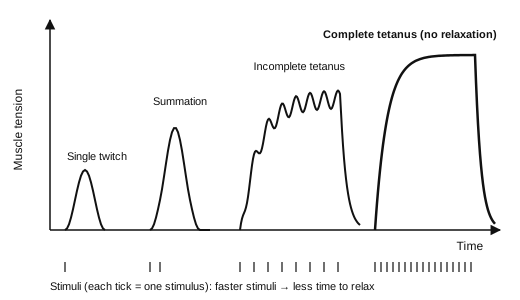
Concept: When stimuli follow each other so quickly that the muscle gets no time to relax, the twitches fuse into one smooth, sustained maximal contraction – tetanus.

  1. Single stimulus → single twitch (contraction + relaxation).
  2. Repeated stimuli before full relaxation → summation; still faster → incomplete, then complete tetanus (no relaxation at all).
  3. (A) Spasm – sudden, involuntary contraction of a muscle, not a response to successive stimuli.
  4. (B) Fatigue – decline in the ability of muscle to contract after repeated activity (lactic acid build-up).
  5. (D) Tonus – mild, continuous partial contraction of muscles at rest that maintains posture.

Short trick: TETanus = Twitches Emerge Together (fused twitches). Tonus = Tone of posture; Fatigue = Failing force.

Answer: (C) Tetanus

अवधारणा: जब उद्दीपन इतनी शीघ्रता से आते हैं कि पेशी को शिथिल होने का समय नहीं मिलता, तब सभी ऐंठनें मिलकर एक सतत, अधिकतम संकुचन बनाती हैं – टिटेनस।

  1. एक उद्दीपन → एक ऐंठन (twitch) (संकुचन + शिथिलन)।
  2. पूर्ण शिथिलन से पहले बार-बार उद्दीपन → संकलन (summation); और तीव्र → अपूर्ण, फिर पूर्ण टिटेनस (बिल्कुल शिथिलन नहीं)।
  3. (A) ऐंठन (Spasm) – पेशी का अचानक, अनैच्छिक संकुचन; क्रमिक उद्दीपनों की प्रतिक्रिया नहीं।
  4. (B) श्रान्ति (Fatigue) – बार-बार कार्य के बाद पेशी की संकुचन क्षमता में कमी (लैक्टिक अम्ल का संचय)।
  5. (D) टोनस (Tonus) – विश्राम अवस्था में पेशियों का हल्का, सतत आंशिक संकुचन जो मुद्रा (posture) बनाए रखता है।

शॉर्ट ट्रिक: टिटेनस = ऐंठनें आपस में जुड़ गईं (fused twitches)। टोनस = मुद्रा का तान; फटीग = घटता बल।

उत्तर: (C) टिटेनस

NEET UGBiologyLocomotion and movement – muscle contraction (tetanus)NEET UG 2016 · 1 May Shift 1
Q2018.
Which of the following is not a stem modification?
निम्नलिखित में से कौन-सा तने का रूपान्तरण नहीं है?
  1. APitcher of NepenthesNepenthes का घट (pitcher)
  2. BThorns of citrusसिट्रस के कंटक (thorns)
  3. CTendrils of cucumberखीरे के प्रतान (tendrils)
  4. DFlattened structures of OpuntiaOpuntia की चपटी संरचनाएँ
Show answer

Concept: A stem modification arises from a bud (axillary/terminal); a leaf modification arises at a node in place of a leaf.

  1. (A) Pitcher of Nepenthes (pitcher plant) is a modified leaf (lamina forms the pitcher, leaf apex forms the lid) – not a stem.
  2. (B) Thorns of Citrus and Bougainvillea – modified axillary buds: stem.
  3. (C) Tendrils of cucumber, pumpkin, watermelon, grapevine – develop from axillary buds: stem.
  4. (D) Opuntia – flattened green stem (phylloclade): stem.

Short trick: NCERT stem list: "Thorns (Citrus), Tendrils (cucurbits), Phylloclade (Opuntia, Euphorbia)". Pitcher and pea tendril = leaf.

Answer: (A) Pitcher of Nepenthes

अवधारणा: तने का रूपान्तरण कलिका (कक्षस्थ/शीर्षस्थ) से बनता है; पत्ती का रूपान्तरण पर्वसन्धि पर पत्ती के स्थान पर बनता है।

  1. (A) Nepenthes (घटपर्णी) का घट रूपान्तरित पत्ती है (पर्णफलक घट और पत्ती का शीर्ष ढक्कन बनाता है) – तना नहीं।
  2. (B) Citrus और Bougainvillea के कंटक – रूपान्तरित कक्षस्थ कलिकाएँ: तना।
  3. (C) खीरा, कद्दू, तरबूज, अंगूर के प्रतान – कक्षस्थ कलिका से बनते हैं: तना।
  4. (D) Opuntia – चपटा हरा तना (पर्णाभ स्तम्भ/phylloclade): तना।

शॉर्ट ट्रिक: NCERT तना सूची: "कंटक (सिट्रस), प्रतान (कुकुरबिट), पर्णाभ स्तम्भ (Opuntia, Euphorbia)"। घट और मटर का प्रतान = पत्ती।

उत्तर: (A) Nepenthes का घट

NEET UGBiologyMorphology of flowering plants – stem modificationsNEET UG 2016 · 1 May Shift 1
Q2019.
Water soluble pigments found in plant cell vacuoles are:
पादप कोशिका की रसधानियों में पाए जाने वाले जल में घुलनशील वर्णक हैं:
  1. AXanthophyllsजैन्थोफिल
  2. BChlorophyllsक्लोरोफिल
  3. CCarotenoidsकैरोटिनॉइड
  4. DAnthocyaninsऐन्थोसायनिन
Show answer

Concept: Anthocyanins are water-soluble flavonoid pigments dissolved in the cell sap of vacuoles; they give red, purple and blue colours to petals, fruits and leaves.

  1. (A) Xanthophylls and (C) carotenoids – fat (lipid)-soluble pigments located in plastids (chloroplast/chromoplast).
  2. (B) Chlorophylls – lipid-soluble, held in thylakoid membranes of chloroplasts.
  3. (D) Anthocyanins – only these are water soluble and lie in the vacuole.

Short trick: Plastid pigments are oily (extracted in acetone); vacuole pigment is watery – boil red cabbage/beetroot in water and the colour leaks out: anthocyanin.

Answer: (D) Anthocyanins

अवधारणा: ऐन्थोसायनिन जल में घुलनशील फ्लेवोनॉइड वर्णक हैं जो रसधानी के कोशिका-रस में घुले रहते हैं; ये दलों, फलों और पत्तियों को लाल, बैंगनी और नीला रंग देते हैं।

  1. (A) जैन्थोफिल और (C) कैरोटिनॉइड – वसा (लिपिड) में घुलनशील वर्णक, लवकों (हरितलवक/वर्णीलवक) में स्थित।
  2. (B) क्लोरोफिल – लिपिड में घुलनशील, हरितलवक की थाइलेकॉइड झिल्लियों में।
  3. (D) ऐन्थोसायनिन – केवल यही जल में घुलनशील हैं और रसधानी में पाए जाते हैं।

शॉर्ट ट्रिक: लवक के वर्णक तैलीय (एसीटोन में निकलते हैं); रसधानी का वर्णक जलीय – लाल पत्तागोभी/चुकन्दर को पानी में उबालें तो रंग पानी में आ जाता है: ऐन्थोसायनिन।

उत्तर: (D) ऐन्थोसायनिन

NEET UGBiologyCell: the unit of life – vacuole pigmentsNEET UG 2016 · 1 May Shift 1
Q2020.
Select the correct statement:
सही कथन का चयन कीजिए:
  1. AGymnosperms are both homosporous and heterosporousअनावृतबीजी समबीजाणुक तथा विषमबीजाणुक दोनों होते हैं
  2. BSalvinia, ginkgo and pinus all are gymnospermsSalvinia, ginkgo और pinus सभी अनावृतबीजी हैं
  3. CSequoia is one of the tallest treesSequoia सबसे ऊँचे वृक्षों में से एक है
  4. DThe leaves of gymnosperms are not well adapted to extremes of climateअनावृतबीजियों की पत्तियाँ जलवायु की चरम स्थितियों के प्रति भली-भाँति अनुकूलित नहीं होती
Show answer

Concept: NCERT: "Gymnosperms include medium-sized trees or tall trees and shrubs. One of the gymnosperms, the giant redwood tree Sequoia, is one of the tallest tree species."

  1. (A) Wrong – all gymnosperms are heterosporous (microspores and megaspores).
  2. (B) Wrong – Salvinia is a water fern (pteridophyte); only Ginkgo and Pinus are gymnosperms.
  3. (C) Correct – Sequoia (giant redwood) exceeds 100 m in height.
  4. (D) Wrong – needle-like leaves with thick cuticle and sunken stomata are well adapted to extremes of temperature, humidity and wind.

Short trick: Seed plants (gymnosperms + angiosperms) are always heterosporous. Salvinia, Selaginella, Marsilea = the heterosporous pteridophytes.

Answer: (C) Sequoia is one of the tallest trees

अवधारणा: NCERT: "अनावृतबीजियों में मध्यम आकार के या लम्बे वृक्ष तथा झाड़ियाँ होती हैं। एक अनावृतबीजी, विशाल रेडवुड वृक्ष Sequoia, सबसे ऊँची वृक्ष जातियों में से एक है।"

  1. (A) गलत – सभी अनावृतबीजी विषमबीजाणुक (लघुबीजाणु और गुरुबीजाणु) होते हैं।
  2. (B) गलत – Salvinia एक जलीय फर्न (टेरिडोफाइट) है; केवल Ginkgo और Pinus अनावृतबीजी हैं।
  3. (C) सही – Sequoia (विशाल रेडवुड) की ऊँचाई 100 m से अधिक होती है।
  4. (D) गलत – मोटी उपत्वचा और गर्तीय रन्ध्रों वाली सुई-जैसी पत्तियाँ ताप, आर्द्रता और वायु की चरम स्थितियों के प्रति भली-भाँति अनुकूलित होती हैं।

शॉर्ट ट्रिक: बीजीय पादप (अनावृतबीजी + आवृतबीजी) सदैव विषमबीजाणुक। Salvinia, Selaginella, Marsilea = विषमबीजाणुक टेरिडोफाइट।

उत्तर: (C) Sequoia सबसे ऊँचे वृक्षों में से एक है

NEET UGBiologyPlant kingdom – gymnospermsNEET UG 2016 · 1 May Shift 1