Q2021.Which of the following is not required for any of the techniques of DNA fingerprinting available at present?
वर्तमान में उपलब्ध DNA फिंगरप्रिंटिंग की किसी भी तकनीक के लिए निम्नलिखित में से किसकी आवश्यकता नहीं होती?
- APolymerase chain reactionपॉलिमरेज़ श्रृंखला अभिक्रिया (PCR)
- BZinc finger analysisज़िंक फिंगर विश्लेषण
- CRestriction enzymesप्रतिबन्धन एन्ज़ाइम
- DDNA – DNA hybridizationDNA – DNA संकरण
Show answer
Concept: DNA fingerprinting (Alec Jeffreys) compares VNTR/satellite DNA: isolate DNA → (amplify by PCR) → cut with restriction enzymes → electrophoresis → Southern blot → hybridise with labelled VNTR probe → autoradiography.
- (A) PCR – used to amplify DNA when the sample is tiny (blood/hair at crime scene).
- (C) Restriction endonucleases – cut DNA into fragments of different lengths (RFLP).
- (D) DNA–DNA hybridisation – the labelled VNTR probe hybridises with complementary fragments on the membrane.
- (B) Zinc finger is a DNA-binding protein motif (in transcription factors); "zinc finger analysis" is not a step of any fingerprinting technique.
Short trick: Remember the order "Isolate – Digest – Separate – Blot – Hybridise – Autoradiograph"; zinc finger never appears.
Answer: (B) Zinc finger analysis
अवधारणा: DNA फिंगरप्रिंटिंग (एलेक जेफ्रीज़) में VNTR/अनुषंगी DNA की तुलना की जाती है: DNA पृथक्करण → (PCR द्वारा प्रवर्धन) → प्रतिबन्धन एन्ज़ाइम से काटना → वैद्युत कण-संचलन → सदर्न ब्लॉट → चिह्नित VNTR प्रोब से संकरण → ऑटोरेडियोग्राफी।
- (A) PCR – नमूना बहुत कम होने पर (अपराध स्थल का रक्त/बाल) DNA प्रवर्धन के लिए।
- (C) प्रतिबन्धन एन्डोन्यूक्लिऐज़ – DNA को भिन्न लम्बाई के खण्डों में काटते हैं (RFLP)।
- (D) DNA–DNA संकरण – चिह्नित VNTR प्रोब झिल्ली पर पूरक खण्डों से संकरित होता है।
- (B) ज़िंक फिंगर एक DNA-बन्धक प्रोटीन संरचना (अनुलेखन कारकों में) है; "ज़िंक फिंगर विश्लेषण" किसी भी फिंगरप्रिंटिंग तकनीक का चरण नहीं है।
शॉर्ट ट्रिक: क्रम याद रखें "पृथक्करण – पाचन – पृथक्करण (जेल) – ब्लॉट – संकरण – ऑटोरेडियोग्राफ"; ज़िंक फिंगर कहीं नहीं आता।
उत्तर: (B) ज़िंक फिंगर विश्लेषण
NEET UGBiologyBiotechnology / molecular basis of inheritance – DNA fingerprintingNEET UG 2016 · 1 May Shift 1
Q2022.Which type of tissue correctly matches with its location?
किस प्रकार का ऊतक अपने स्थान से सही सुमेलित है?
- A
| Tissue | Location |
|---|
| Smooth muscle | Wall of intestine |
| ऊतक | स्थान |
|---|
| चिकनी पेशी | आँत की भित्ति |
- B
| Tissue | Location |
|---|
| Areolar tissue | Tendons |
| ऊतक | स्थान |
|---|
| ऐरिओलर ऊतक | कण्डराएँ (tendons) |
- C
| Tissue | Location |
|---|
| Transitional epithelium | Tip of nose |
| ऊतक | स्थान |
|---|
| संक्रमणकालीन उपकला | नाक का सिरा |
- D
| Tissue | Location |
|---|
| Cuboidal epithelium | Lining of stomach |
| ऊतक | स्थान |
|---|
| घनाकार उपकला | आमाशय का आस्तर |
Show answer
Concept: NCERT: smooth (involuntary, non-striated) muscle is found in the walls of internal organs like blood vessels, stomach and intestine.
- (A) Correct – smooth muscle forms the muscularis of the intestinal wall (peristalsis).
- (B) Wrong – tendons are dense regular connective tissue (collagen fibres in parallel rows); areolar tissue lies beneath the skin.
- (C) Wrong – tip of nose is supported by cartilage; transitional epithelium lines the urinary bladder/ureters.
- (D) Wrong – stomach and intestine are lined by columnar epithelium; cuboidal lines kidney tubules and gland ducts.
Short trick: Smooth muscle = "hollow organs" (gut, vessels, bladder, uterus). Tendon = dense regular; nose/ear tip = cartilage.
Answer: (A) Smooth muscle – Wall of intestine
अवधारणा: NCERT: चिकनी (अनैच्छिक, अरेखित) पेशी आन्तरिक अंगों जैसे रक्त वाहिकाओं, आमाशय और आँत की भित्तियों में पाई जाती है।
- (A) सही – चिकनी पेशी आँत की भित्ति का पेशी स्तर बनाती है (क्रमाकुंचन)।
- (B) गलत – कण्डराएँ सघन नियमित संयोजी ऊतक हैं (कोलैजन तन्तु समानान्तर पंक्तियों में); ऐरिओलर ऊतक त्वचा के नीचे होता है।
- (C) गलत – नाक का सिरा उपास्थि से बना होता है; संक्रमणकालीन उपकला मूत्राशय/मूत्रवाहिनियों का आस्तर बनाती है।
- (D) गलत – आमाशय और आँत का आस्तर स्तम्भाकार उपकला का होता है; घनाकार उपकला वृक्क नलिकाओं और ग्रन्थि वाहिनियों में।
शॉर्ट ट्रिक: चिकनी पेशी = "खोखले अंग" (आहारनाल, वाहिकाएँ, मूत्राशय, गर्भाशय)। कण्डरा = सघन नियमित; नाक/कान का सिरा = उपास्थि।
उत्तर: (A) चिकनी पेशी – आँत की भित्ति
NEET UGBiologyStructural organisation in animals – animal tissuesNEET UG 2016 · 1 May Shift 1
Q2023.A plant in your garden avoids photorespiratory losses, has improved water use efficiency, shows high rates of photosynthesis at high temperatures and has improved efficiency of nitrogen utilization. In which of the following physiological groups would you assign this plant?
आपके बगीचे का एक पौधा प्रकाश-श्वसन (photorespiration) से होने वाली हानि से बचता है, उसकी जल उपयोग दक्षता बेहतर है, उच्च तापमान पर प्रकाश-संश्लेषण की उच्च दर दर्शाता है तथा नाइट्रोजन उपयोग की दक्षता भी बेहतर है। आप इस पौधे को निम्नलिखित में से किस शरीरक्रियात्मक समूह में रखेंगे?
- AC3
- BC4
- CCAM
- DNitrogen fixerनाइट्रोजन स्थिरीकारक
Show answer
Concept: C4 plants (maize, sugarcane, sorghum) fix CO2 first by PEP carboxylase in mesophyll and concentrate it around RuBisCO in bundle-sheath cells (Kranz anatomy).
- High CO2 at RuBisCO → oxygenase activity suppressed → no photorespiration.
- PEPcase has high affinity for CO2 → stomata can stay partly closed → better water-use efficiency.
- Temperature optimum is higher (30–40 °C) → high photosynthesis at high temperature; less RuBisCO protein needed → better nitrogen-use efficiency.
- (A) C3 – suffers photorespiration at high temperature. (C) CAM – saves water but photosynthesis rate is low. (D) Nitrogen fixation has nothing to do with these traits.
Short trick: All four clues "no photorespiration + hot + water + N efficient" = C4. CAM would be hinted by "stomata open at night".
Answer: (B) C4
अवधारणा: C4 पादप (मक्का, गन्ना, ज्वार) मध्यपर्ण में PEP कार्बोक्सिलेज़ द्वारा पहले CO2 स्थिर करते हैं और पूलाच्छद कोशिकाओं में RuBisCO के पास CO2 सान्द्रित करते हैं (क्रान्ज़ शारीरिकी)।
- RuBisCO के पास उच्च CO2 → ऑक्सीजिनेज़ सक्रियता दब जाती है → प्रकाश-श्वसन नहीं।
- PEPcase की CO2 के प्रति उच्च बन्धुता → रन्ध्र आंशिक रूप से बन्द रह सकते हैं → बेहतर जल-उपयोग दक्षता।
- इष्टतम ताप अधिक (30–40 °C) → उच्च ताप पर उच्च प्रकाश-संश्लेषण; कम RuBisCO प्रोटीन चाहिए → बेहतर नाइट्रोजन-उपयोग दक्षता।
- (A) C3 – उच्च ताप पर प्रकाश-श्वसन से हानि। (C) CAM – जल बचाता है पर प्रकाश-संश्लेषण दर कम। (D) नाइट्रोजन स्थिरीकरण का इन गुणों से कोई सम्बन्ध नहीं।
शॉर्ट ट्रिक: चारों संकेत "प्रकाश-श्वसन नहीं + गर्मी + जल + N दक्षता" = C4। CAM का संकेत होता "रात में रन्ध्र खुलना"।
उत्तर: (B) C4
NEET UGBiologyPhotosynthesis in higher plants – C4 plantsNEET UG 2016 · 1 May Shift 1
Q2024.Which of the following structures is homologus to the wing of a bird?
निम्नलिखित में से कौन-सी संरचना पक्षी के पंख के समजात (homologous) है?
- ADorsal fin of a sharkशार्क का पृष्ठ पख
- BWing of a mothशलभ (moth) का पंख
- CHind limb of rabbitखरगोश का पश्चपाद
- DFlipper of whaleव्हेल का फ्लिपर
Show answer
Concept: Homologous organs have the same basic structure and origin but may do different jobs (divergent evolution). Forelimbs of vertebrates – bird wing, whale flipper, bat wing, human arm, cheetah leg – share humerus, radius-ulna, carpals, metacarpals, phalanges.
- (D) Whale flipper = modified forelimb with the same bone plan as the bird wing → homologous.
- (A) Shark dorsal fin – a median fin, not a pectoral limb; not homologous.
- (B) Moth wing – outgrowth of insect body wall, no bones; only analogous (same function, flight).
- (C) Rabbit hind limb – corresponds to the bird's leg, not to its wing (serially, not specially, comparable).
Short trick: Homologous = same origin (Hand bones); analogous = same Action. Bird wing ↔ any vertebrate forelimb.
Answer: (D) Flipper of whale
अवधारणा: समजात अंगों की मूल संरचना और उत्पत्ति समान होती है पर कार्य भिन्न हो सकते हैं (अपसारी विकास)। कशेरुकियों के अग्रपाद – पक्षी का पंख, व्हेल का फ्लिपर, चमगादड़ का पंख, मनुष्य की भुजा, चीते की टाँग – सभी में ह्यूमरस, रेडियस-अल्ना, कार्पल, मेटाकार्पल, फैलेन्जेज़ होती हैं।
- (D) व्हेल का फ्लिपर = रूपान्तरित अग्रपाद, पक्षी के पंख जैसी अस्थि-योजना → समजात।
- (A) शार्क का पृष्ठ पख – मध्य पख है, अंसीय पाद नहीं; समजात नहीं।
- (B) शलभ का पंख – कीट की देहभित्ति का उद्वर्ध, अस्थियाँ नहीं; केवल समवृत्ति (analogous) (समान कार्य – उड़ान)।
- (C) खरगोश का पश्चपाद – पक्षी की टाँग के समतुल्य है, उसके पंख के नहीं।
शॉर्ट ट्रिक: समजात = समान उत्पत्ति (अस्थियाँ समान); समवृत्ति = समान कार्य। पक्षी का पंख ↔ किसी भी कशेरुकी का अग्रपाद।
उत्तर: (D) व्हेल का फ्लिपर
NEET UGBiologyEvolution – homologous organsNEET UG 2016 · 1 May Shift 1
Q2025.Which of the following characteristic features always holds true for the corresponding group of animals?
निम्नलिखित में से कौन-सा अभिलक्षण सम्बन्धित प्राणी-समूह के लिए सदैव सत्य होता है?
- A
| Cartilaginous endoskeleton | Chondrichthyes |
| उपास्थिल अन्तःकंकाल | कॉन्ड्रिक्थीज़ |
- B
| जरायुज (Viviparous) | मैमेलिया |
- C
| Possess a mouth with an upper and a lower jaw | Chordata |
| ऊपरी तथा निचले जबड़े युक्त मुख | कॉर्डेटा |
- D
| 3 – chambered heart with one incompletely divided ventricle | Reptilia |
| एक अपूर्ण विभाजित निलय सहित 3 – कक्षीय हृदय | रेप्टीलिया |
Show answer
Concept: Look for an exception in each group; the one with no exception is "always true".
- (A) Always true – every member of Chondrichthyes (sharks, rays, Scoliodon, Pristis, Torpedo) has a cartilaginous endoskeleton throughout life.
- (B) Exception – prototherians (Ornithorhynchus, platypus; echidna) are egg-laying (oviparous) mammals.
- (C) Exception – Agnatha (cyclostomes: Petromyzon, Myxine) are chordates without jaws.
- (D) Exception – crocodiles (Reptilia) have a 4-chambered heart.
Short trick: Famous exceptions: platypus lays eggs, lamprey has no jaws, crocodile has 4 chambers. Cartilage-fish has no exception.
Answer: (A) Cartilaginous endoskeleton – Chondrichthyes
अवधारणा: प्रत्येक समूह में अपवाद खोजिए; जिसमें कोई अपवाद न हो वही "सदैव सत्य" है।
- (A) सदैव सत्य – कॉन्ड्रिक्थीज़ के सभी सदस्यों (शार्क, रे, Scoliodon, Pristis, Torpedo) में जीवनभर उपास्थिल अन्तःकंकाल होता है।
- (B) अपवाद – प्रोटोथीरिया (Ornithorhynchus, प्लैटिपस; एकिडना) अण्डे देने वाले (अण्डयुज) स्तनधारी हैं।
- (C) अपवाद – एग्नेथा (साइक्लोस्टोम: Petromyzon, Myxine) जबड़े-रहित कॉर्डेट हैं।
- (D) अपवाद – मगरमच्छ (रेप्टीलिया) में 4-कक्षीय हृदय होता है।
शॉर्ट ट्रिक: प्रसिद्ध अपवाद: प्लैटिपस अण्डे देता है, लैम्प्रे में जबड़े नहीं, मगरमच्छ में 4 कक्ष। उपास्थिल मछली में कोई अपवाद नहीं।
उत्तर: (A) उपास्थिल अन्तःकंकाल – कॉन्ड्रिक्थीज़
NEET UGBiologyAnimal kingdom – characteristic features of groupsNEET UG 2016 · 1 May Shift 1
Q2026.Which of the following statements is not true for cancer cells in relation to mutations?
उत्परिवर्तनों के सन्दर्भ में कैंसर कोशिकाओं के लिए निम्नलिखित में से कौन-सा कथन सत्य नहीं है?
- AMutations in proto – oncogenes accelerate the cell cycleआदि-अर्बुदजीनों (proto – oncogenes) में उत्परिवर्तन कोशिका चक्र को त्वरित करते हैं
- BMutations destroy telomerase inhibitorउत्परिवर्तन टीलोमरेज़ अवरोधक को नष्ट करते हैं
- CMutations inactivate the cell controlउत्परिवर्तन कोशिका नियन्त्रण को निष्क्रिय करते हैं
- DMutations inhibit production of telomeraseउत्परिवर्तन टीलोमरेज़ के उत्पादन को रोकते हैं
Show answer
Concept: Cancer cells divide endlessly ("immortal") because telomerase stays active and rebuilds the telomeres that would otherwise shorten at every division.
- (A) True – proto-oncogenes mutated to oncogenes push the cell cycle forward.
- (B) True – loss of telomerase inhibitor keeps telomerase switched on.
- (C) True – mutations knock out checkpoint/tumour-suppressor control (contact inhibition is lost).
- (D) Not true – mutations in cancer cells activate, not inhibit, telomerase; inhibited telomerase would make cells age and stop dividing.
Short trick: Cancer = brakes off (tumour suppressors) + accelerator on (oncogenes) + telomerase on (immortality).
Answer: (D) Mutations inhibit production of telomerase
अवधारणा: कैंसर कोशिकाएँ अनन्त रूप से विभाजित होती हैं ("अमर") क्योंकि टीलोमरेज़ सक्रिय रहता है और उन टीलोमियरों को पुनः बनाता है जो अन्यथा प्रत्येक विभाजन में छोटे होते जाते।
- (A) सत्य – आदि-अर्बुदजीन उत्परिवर्तित होकर अर्बुदजीन बनते हैं और कोशिका चक्र को आगे बढ़ाते हैं।
- (B) सत्य – टीलोमरेज़ अवरोधक नष्ट होने से टीलोमरेज़ सक्रिय रहता है।
- (C) सत्य – उत्परिवर्तन चेकपॉइंट/अर्बुद-निरोधक नियन्त्रण को निष्क्रिय करते हैं (सम्पर्क संदमन समाप्त हो जाता है)।
- (D) असत्य – कैंसर कोशिकाओं में उत्परिवर्तन टीलोमरेज़ को सक्रिय करते हैं, रोकते नहीं; टीलोमरेज़ रुकने पर कोशिकाएँ वृद्ध होकर विभाजन बन्द कर देतीं।
शॉर्ट ट्रिक: कैंसर = ब्रेक बन्द (अर्बुद-निरोधक) + एक्सेलरेटर चालू (अर्बुदजीन) + टीलोमरेज़ चालू (अमरता)।
उत्तर: (D) उत्परिवर्तन टीलोमरेज़ के उत्पादन को रोकते हैं
NEET UGBiologyHuman health and disease – cancerNEET UG 2016 · 1 May Shift 1
Q2027.The amino acid Tryptophan is the precursor for the synthesis of:
ऐमीनो अम्ल ट्रिप्टोफ़ैन किसके संश्लेषण का पूर्ववर्ती (precursor) है?
- AMelatonin and Serotoninमेलाटोनिन और सेरोटोनिन
- BThyroxine and Triiodothyronineथायरॉक्सिन और ट्राइआयोडोथायरोनिन
- CEstrogen and Progesteroneएस्ट्रोजन और प्रोजेस्टेरोन
- DCortisol and Cortisoneकॉर्टिसोल और कॉर्टिसोन
Show answer
Concept: Tryptophan → 5-hydroxytryptophan → serotonin (5-HT) → (in pineal gland) melatonin.
- (A) Correct – serotonin and melatonin are indoleamines derived from tryptophan.
- (B) Thyroxine (T4) and T3 – iodinated derivatives of tyrosine.
- (C) Estrogen, progesterone and (D) cortisol, cortisone – steroid hormones made from cholesterol.
Short trick: TRYPtophan → "sleep & mood" (melatonin, serotonin); TYRosine → thyroxine, adrenaline, dopamine; cholesterol → all steroids.
Answer: (A) Melatonin and Serotonin
अवधारणा: ट्रिप्टोफ़ैन → 5-हाइड्रॉक्सीट्रिप्टोफ़ैन → सेरोटोनिन (5-HT) → (पीनियल ग्रन्थि में) मेलाटोनिन।
- (A) सही – सेरोटोनिन और मेलाटोनिन ट्रिप्टोफ़ैन से बने इन्डोलऐमीन हैं।
- (B) थायरॉक्सिन (T4) और T3 – टायरोसिन के आयोडीनयुक्त व्युत्पन्न।
- (C) एस्ट्रोजन, प्रोजेस्टेरोन तथा (D) कॉर्टिसोल, कॉर्टिसोन – कोलेस्टेरॉल से बने स्टेरॉयड हॉर्मोन।
शॉर्ट ट्रिक: ट्रिप्टोफ़ैन → "नींद और मनोदशा" (मेलाटोनिन, सेरोटोनिन); टायरोसिन → थायरॉक्सिन, एड्रीनलिन, डोपामीन; कोलेस्टेरॉल → सभी स्टेरॉयड।
उत्तर: (A) मेलाटोनिन और सेरोटोनिन
NEET UGBiologyChemical coordination – hormone precursorsNEET UG 2016 · 1 May Shift 1
Q2028.Following are the two statements regarding the origin of life:
(i) The earliest organisms that appeared on the earth were non-green and presumably anaerobes.
(ii) The first autotrophic organisms were the chemoautotrophs that never released oxygen.
Of the above statements which one of the following options is correct?
जीवन की उत्पत्ति से सम्बन्धित दो कथन निम्नलिखित हैं:
(i) पृथ्वी पर प्रकट होने वाले सबसे प्रारम्भिक जीव अहरित तथा सम्भवतः अवायवीय थे।
(ii) प्रथम स्वपोषी जीव रसायन-स्वपोषी थे जिन्होंने कभी ऑक्सीजन नहीं छोड़ी।
उपर्युक्त कथनों के सम्बन्ध में निम्नलिखित में से कौन-सा विकल्प सही है?
- A(i) is correct but (ii) is false(i) सही है परन्तु (ii) गलत है
- B(ii) is correct but (i) is false(ii) सही है परन्तु (i) गलत है
- CBoth (i) and (ii) are correct(i) और (ii) दोनों सही हैं
- DBoth (i) and (ii) are false(i) और (ii) दोनों गलत हैं
Show answer
Concept: The primitive atmosphere was reducing (CH4, NH3, H2, water vapour) with no free O2.
- (i) Correct – first cells were heterotrophic (non-green) and, with no O2 available, anaerobic.
- (ii) Correct – the first autotrophs used chemical energy (chemoautotrophs) and released no O2; O2 came only later with oxygenic photosynthesis (cyanobacteria).
- Hence both statements are correct.
Short trick: Sequence: anaerobic heterotrophs → chemoautotrophs → photoautotrophs (O2 appears) → aerobes.
Answer: (C) Both (i) and (ii) are correct
अवधारणा: आदि वायुमण्डल अपचायक था (CH4, NH3, H2, जलवाष्प) और उसमें मुक्त O2 नहीं थी।
- (i) सही – प्रथम कोशिकाएँ परपोषी (अहरित) थीं और O2 उपलब्ध न होने से अवायवीय थीं।
- (ii) सही – प्रथम स्वपोषी रासायनिक ऊर्जा का उपयोग करते थे (रसायन-स्वपोषी) और O2 नहीं छोड़ते थे; O2 बाद में ऑक्सीजनी प्रकाश-संश्लेषण (सायनोबैक्टीरिया) से आई।
- अतः दोनों कथन सही हैं।
शॉर्ट ट्रिक: क्रम: अवायवीय परपोषी → रसायन-स्वपोषी → प्रकाश-स्वपोषी (O2 प्रकट) → वायवीय जीव।
उत्तर: (C) (i) और (ii) दोनों सही हैं
NEET UGBiologyEvolution – origin of lifeNEET UG 2016 · 1 May Shift 1
Q2029.Reduction in pH of blood will:
रक्त के pH में कमी:
- AReduce the rate of heart beatहृदय स्पंदन की दर को कम करेगी
- BReduce the blood supply to the brainमस्तिष्क को रक्त आपूर्ति को कम करेगी
- CDecrease the affinity of hemoglobin with oxygenहीमोग्लोबिन की ऑक्सीजन के प्रति बन्धुता (affinity) को घटाएगी
- DRelease bicarbonate ions by the liverयकृत द्वारा बाइकार्बोनेट आयन मुक्त कराएगी
Show answer
Concept: Bohr effect: high pCO2, high H+ (low pH) and high temperature shift the O2–Hb dissociation curve to the right, i.e. Hb holds O2 less tightly and unloads it in tissues.
- (C) Correct – lower pH → lower affinity of Hb for O2 → more O2 released to active tissues.
- (A) Acidosis/high CO2 stimulates, not reduces, heart rate and breathing through chemoreceptors.
- (B) Brain blood flow is auto-regulated; CO2/H+ actually dilate cerebral vessels.
- (D) Bicarbonate buffering is handled by blood and kidneys, not released by the liver.
Short trick: Remember "CADET, face Right": CO2, Acid, 2,3-DPG, Exercise, Temperature ↑ → curve shifts Right → affinity ↓.
Answer: (C) Decrease the affinity of hemoglobin with oxygen
अवधारणा: बोर प्रभाव: उच्च pCO2, उच्च H+ (कम pH) और उच्च ताप O2–Hb वियोजन वक्र को दाईं ओर खिसकाते हैं, अर्थात् Hb, O2 को कम दृढ़ता से पकड़ता है और ऊतकों में छोड़ देता है।
- (C) सही – कम pH → Hb की O2 के प्रति बन्धुता कम → सक्रिय ऊतकों को अधिक O2 मुक्त।
- (A) अम्लरक्तता/उच्च CO2 रसायन-ग्राहियों द्वारा हृदय दर और श्वसन को बढ़ाती है, घटाती नहीं।
- (B) मस्तिष्क का रक्त प्रवाह स्वनियमित होता है; CO2/H+ वास्तव में मस्तिष्क वाहिकाओं को फैलाते हैं।
- (D) बाइकार्बोनेट बफ़रण रक्त और वृक्क करते हैं, यकृत इसे मुक्त नहीं करता।
शॉर्ट ट्रिक: "CADET, face Right": CO2, अम्ल, 2,3-DPG, व्यायाम, ताप ↑ → वक्र दाईं ओर → बन्धुता ↓।
उत्तर: (C) हीमोग्लोबिन की ऑक्सीजन के प्रति बन्धुता को घटाएगी
NEET UGBiologyBreathing and exchange of gases – oxygen dissociation (Bohr effect)NEET UG 2016 · 1 May Shift 1
Q2030.Analogous structures are a result of:
समवृत्ति (analogous) संरचनाएँ किसका परिणाम हैं?
- ADivergent evolutionअपसारी विकास
- BConvergent evolutionअभिसारी विकास
- CShared ancestryसाझा पूर्वज
- DStabilizing selectionस्थायीकारी वरण
Show answer
Concept: Analogous organs are structurally and developmentally different but perform the same function, because different lineages adapted to similar habitats – convergent evolution.
- Examples: wings of butterfly and bird, eye of octopus and mammal, flippers of penguin and dolphin, sweet potato (root) and potato (stem).
- (A) Divergent evolution and (C) shared ancestry produce homologous organs.
- (D) Stabilizing selection keeps the mean phenotype constant within a population; it does not create similar organs in unrelated groups.
Short trick: Analogous ↔ Converge (different ancestors come to a similar look); Homologous ↔ Diverge (one ancestor, many forms).
Answer: (B) Convergent evolution
अवधारणा: समवृत्ति अंग संरचना और परिवर्धन में भिन्न होते हैं पर समान कार्य करते हैं, क्योंकि भिन्न वंशक्रम समान आवासों के प्रति अनुकूलित हुए – अभिसारी विकास।
- उदाहरण: तितली और पक्षी के पंख, ऑक्टोपस और स्तनधारी की आँख, पेंगुइन और डॉल्फ़िन के फ्लिपर, शकरकन्द (जड़) और आलू (तना)।
- (A) अपसारी विकास और (C) साझा पूर्वज समजात अंग बनाते हैं।
- (D) स्थायीकारी वरण समष्टि में औसत लक्षणप्ररूप को स्थिर रखता है; असम्बन्धित समूहों में समान अंग नहीं बनाता।
शॉर्ट ट्रिक: समवृत्ति ↔ अभिसरण (भिन्न पूर्वज, समान रूप); समजात ↔ अपसरण (एक पूर्वज, अनेक रूप)।
उत्तर: (B) अभिसारी विकास
NEET UGBiologyEvolution – analogous organsNEET UG 2016 · 1 May Shift 1
Q2031.Which of the following is a restriction endonuclease?
निम्नलिखित में से कौन-सा एक प्रतिबन्धन एन्डोन्यूक्लिऐज़ है?
- AHind II
- BProteaseप्रोटिऐज़
- CDNase I
- DRNase
Show answer
Concept: Restriction endonucleases cut DNA at specific recognition (palindromic) sequences. Hind II, from Haemophilus influenzae, was the first one isolated; it always cuts at a particular six-base-pair sequence.
- (A) Hind II – a restriction endonuclease (correct).
- (B) Protease – digests proteins, not DNA.
- (C) DNase I – a non-specific nuclease that cuts DNA anywhere (no recognition sequence), so it is not a restriction enzyme.
- (D) RNase – digests RNA.
Short trick: Naming rule: first letter = genus, next two = species, then strain, then Roman numeral (EcoRI = Escherichia coli RY13, I). Names like EcoRI, Hind II, BamHI = restriction enzymes.
Answer: (A) Hind II
अवधारणा: प्रतिबन्धन एन्डोन्यूक्लिऐज़ DNA को विशिष्ट पहचान (पैलिन्ड्रोमिक) अनुक्रमों पर काटते हैं। Haemophilus influenzae से प्राप्त Hind II सबसे पहले पृथक किया गया था; यह सदैव एक विशेष छह-क्षारक-युग्म अनुक्रम पर काटता है।
- (A) Hind II – प्रतिबन्धन एन्डोन्यूक्लिऐज़ (सही)।
- (B) प्रोटिऐज़ – प्रोटीन को पचाता है, DNA को नहीं।
- (C) DNase I – अविशिष्ट न्यूक्लिऐज़ जो DNA को कहीं भी काटता है (कोई पहचान अनुक्रम नहीं), अतः प्रतिबन्धन एन्ज़ाइम नहीं।
- (D) RNase – RNA को पचाता है।
शॉर्ट ट्रिक: नामकरण नियम: पहला अक्षर = वंश, अगले दो = जाति, फिर स्ट्रेन, फिर रोमन अंक (EcoRI = Escherichia coli RY13, I)। EcoRI, Hind II, BamHI जैसे नाम = प्रतिबन्धन एन्ज़ाइम।
उत्तर: (A) Hind II
NEET UGBiologyBiotechnology: principles and processes – restriction enzymesNEET UG 2016 · 1 May Shift 1
Q2032.The term ecosystem was coined by:
पारितंत्र (ecosystem) शब्द किसने गढ़ा था?
- AE.P. OdumE.P. ओडम
- BA.G. TansleyA.G. टान्सले
- CE. HaeckelE. हेकल
- DE. WarmingE. वार्मिंग
Show answer
Concept: The word "ecosystem" was introduced by the British ecologist A.G. Tansley in 1935.
- (B) A.G. Tansley – ecosystem (1935). Correct.
- (A) E.P. Odum – "father of modern ecosystem ecology", wrote Fundamentals of Ecology; did not coin the term.
- (C) E. Haeckel – coined the term "ecology" (1866).
- (D) E. Warming – father of plant ecology (ecological plant geography).
Short trick: Haeckel → Ecology (1866); Tansley → Ecosystem (1935): "T for Tansley, T for the System".
Answer: (B) A.G. Tansley
अवधारणा: "पारितंत्र" शब्द ब्रिटिश पारिस्थितिकीविद् A.G. टान्सले ने 1935 में प्रस्तुत किया।
- (B) A.G. टान्सले – पारितंत्र (1935)। सही।
- (A) E.P. ओडम – "आधुनिक पारितंत्र पारिस्थितिकी के जनक", Fundamentals of Ecology के लेखक; यह शब्द उन्होंने नहीं गढ़ा।
- (C) E. हेकल – "पारिस्थितिकी (ecology)" शब्द गढ़ा (1866)।
- (D) E. वार्मिंग – पादप पारिस्थितिकी के जनक।
शॉर्ट ट्रिक: हेकल → इकोलॉजी (1866); टान्सले → इकोसिस्टम (1935)।
उत्तर: (B) A.G. टान्सले
NEET UGBiologyEcosystem – history of the termNEET UG 2016 · 1 May Shift 1
Q2033.Which one of the following statements is wrong?
निम्नलिखित में से कौन-सा कथन गलत है?
- ASucrose is a disaccharideसुक्रोस एक डाइसैकेराइड है
- BCellulose is a polysaccharideसेलुलोस एक पॉलीसैकेराइड है
- CUracil is a pyrimidineयूरेसिल एक पिरिमिडीन है
- DGlycine is a sulphur containing amino acidग्लाइसीन एक सल्फर-युक्त ऐमीनो अम्ल है
Show answer
Concept: Glycine is the simplest amino acid – its R group is just a hydrogen atom (H2N–CH2–COOH); it has no sulphur.
- (A) True – sucrose = glucose + fructose.
- (B) True – cellulose is a homopolymer of β-glucose.
- (C) True – pyrimidines are cytosine, thymine and uracil.
- (D) Wrong – sulphur-containing amino acids are cysteine and methionine.
Short trick: Sulphur amino acids: "Cys-Met" (Cysteine, Methionine). Pyrimidines: "CUT the PY" (C, U, T).
Answer: (D) Glycine is a sulphur containing amino acid
अवधारणा: ग्लाइसीन सबसे सरल ऐमीनो अम्ल है – इसका R समूह केवल एक हाइड्रोजन परमाणु है (H2N–CH2–COOH); इसमें सल्फर नहीं होता।
- (A) सत्य – सुक्रोस = ग्लूकोस + फ्रक्टोस।
- (B) सत्य – सेलुलोस β-ग्लूकोस का समबहुलक है।
- (C) सत्य – पिरिमिडीन हैं साइटोसीन, थायमीन और यूरेसिल।
- (D) गलत – सल्फर-युक्त ऐमीनो अम्ल हैं सिस्टीन और मेथियोनीन।
शॉर्ट ट्रिक: सल्फर ऐमीनो अम्ल: "सिस-मेट" (सिस्टीन, मेथियोनीन)। पिरिमिडीन: "CUT the PY" (C, U, T)।
उत्तर: (D) ग्लाइसीन एक सल्फर-युक्त ऐमीनो अम्ल है
NEET UGBiologyBiomolecules – carbohydrates, nucleotides, amino acidsNEET UG 2016 · 1 May Shift 1
Q2034.In bryophytes and pteridophytes, transport of male gametes requires:
ब्रायोफाइट और टेरिडोफाइट में नर युग्मकों के परिवहन के लिए किसकी आवश्यकता होती है?
- AWindवायु
- BInsectsकीट
- CBirdsपक्षी
- DWaterजल
Show answer
Concept: Bryophytes and pteridophytes produce flagellated (motile) antherozoids that must swim through a film of water to reach the archegonium.
- Antheridia release biflagellate (bryophytes) or multiflagellate (pteridophytes) male gametes.
- They swim in water and are attracted chemically to the egg in the archegonium.
- (A), (B), (C) – wind, insects and birds carry pollen in seed plants; bryophytes and pteridophytes have no pollen.
Short trick: "Amphibians of the plant kingdom" (bryophytes) – need water for fertilisation, just like frogs.
Answer: (D) Water
अवधारणा: ब्रायोफाइट और टेरिडोफाइट कशाभिकायुक्त (चल) पुमणु बनाते हैं जिन्हें स्त्रीधानी तक पहुँचने के लिए जल की परत में तैरना पड़ता है।
- पुंधानियाँ द्विकशाभिक (ब्रायोफाइट) या बहुकशाभिक (टेरिडोफाइट) नर युग्मक मुक्त करती हैं।
- ये जल में तैरते हैं और रासायनिक रूप से स्त्रीधानी के अण्ड की ओर आकर्षित होते हैं।
- (A), (B), (C) – वायु, कीट और पक्षी बीजीय पादपों में परागकण ले जाते हैं; ब्रायोफाइट और टेरिडोफाइट में परागकण नहीं होते।
शॉर्ट ट्रिक: "पादप जगत के उभयचर" (ब्रायोफाइट) – मेंढक की तरह निषेचन हेतु जल आवश्यक।
उत्तर: (D) जल
NEET UGBiologyPlant kingdom – fertilisation in bryophytes and pteridophytesNEET UG 2016 · 1 May Shift 1
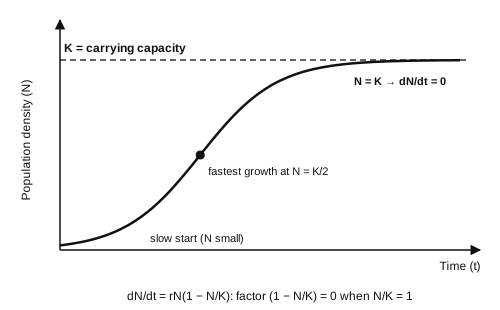
Q2035.When does the growth rate of a population following the logistic model equal zero? The logistic model is given as :
लॉजिस्टिक मॉडल का अनुसरण करने वाली समष्टि की वृद्धि दर कब शून्य के बराबर होती है? लॉजिस्टिक मॉडल के रूप में दिया गया है:
- AWhen is exactly oneजब ठीक एक हो
- BWhen N nears the carrying capacity of the habitatजब N आवास की पोषण क्षमता के निकट पहुँचे
- CWhen equals zeroजब शून्य के बराबर हो
- DWhen death rate is greater than birth rateजब मृत्यु दर जन्म दर से अधिक हो
Show answer
Concept: In the logistic (Verhulst–Pearl) model, ; growth stops when the term becomes zero.
- Put : → growth rate is exactly zero (population at carrying capacity, plateau).
- (B) "Nears" K → is small but still positive, so growth is slow, not zero.
- (C) means N = 0 → no population at all (trivial case, not the plateau the model describes).
- (D) Death rate > birth rate gives a negative growth rate (decline), not zero.
Short trick: S-curve: lag → log (fastest at K/2) → plateau at N = K, where dN/dt = 0.
Answer: (A) When is exactly one
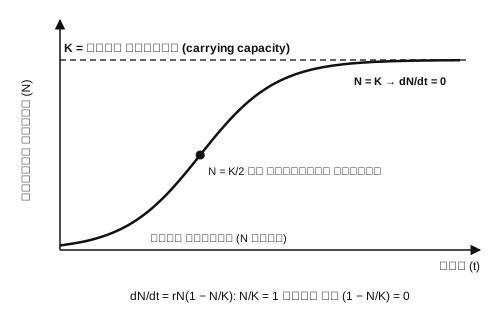
अवधारणा: लॉजिस्टिक (वरहुल्स्ट–पर्ल) मॉडल में ; जब पद शून्य हो जाता है तब वृद्धि रुक जाती है।
- रखने पर: → वृद्धि दर ठीक शून्य (समष्टि पोषण क्षमता पर, स्थिर अवस्था)।
- (B) K के "निकट" → छोटा पर धनात्मक, अतः वृद्धि धीमी है, शून्य नहीं।
- (C) का अर्थ N = 0 → कोई समष्टि ही नहीं (तुच्छ स्थिति, मॉडल की स्थिर अवस्था नहीं)।
- (D) मृत्यु दर > जन्म दर होने पर वृद्धि दर ऋणात्मक (ह्रास) होती है, शून्य नहीं।
शॉर्ट ट्रिक: S-वक्र: लैग → लॉग (K/2 पर सर्वाधिक) → N = K पर स्थिर अवस्था, जहाँ dN/dt = 0।
उत्तर: (A) जब ठीक एक हो
NEET UGBiologyOrganisms and populations – logistic growthNEET UG 2016 · 1 May Shift 1
Q2036.Which one of the following statements is not true?
निम्नलिखित में से कौन-सा कथन सत्य नहीं है?
- ATapetum helps in the dehiscence of antherटेपीटम परागकोश के स्फुटन में सहायता करता है
- BExine of pollen grains is made up of sporopolleninपरागकणों का बाह्यचोल (exine) स्पोरोपोलेनिन का बना होता है
- CPollen grains of many species cause severe allegiesअनेक जातियों के परागकण गम्भीर एलर्जी उत्पन्न करते हैं
- DStored pollen in liquid nitrogen can be used in the crop breeding programmesद्रव नाइट्रोजन में संग्रहित परागकणों का उपयोग फसल प्रजनन कार्यक्रमों में किया जा सकता है
Show answer
Concept: Tapetum is the innermost wall layer of the microsporangium; it nourishes the developing pollen grains. Dehiscence of the anther is brought about by the endothecium (and stomium).
- (A) Not true – tapetum is nutritive, not a dehiscence layer.
- (B) True – exine is made of sporopollenin, the most resistant organic material known.
- (C) True – pollen of Parthenium (carrot grass) and many others cause allergies and asthma.
- (D) True – pollen can be stored for years at −196 °C in liquid nitrogen (pollen banks) for breeding.
Short trick: Anther wall from outside: Epidermis – Endothecium (dehiscence) – Middle layers – Tapetum (nutrition). "E-E-M-T: the last one feeds".
Answer: (A) Tapetum helps in the dehiscence of anther
अवधारणा: टेपीटम लघुबीजाणुधानी की भित्ति की सबसे भीतरी परत है; यह विकासशील परागकणों को पोषण देता है। परागकोश का स्फुटन अन्तःस्थीसियम (endothecium) (और स्टोमियम) द्वारा होता है।
- (A) असत्य – टेपीटम पोषक परत है, स्फुटन परत नहीं।
- (B) सत्य – बाह्यचोल स्पोरोपोलेनिन का बना है, जो ज्ञात सबसे प्रतिरोधी कार्बनिक पदार्थ है।
- (C) सत्य – Parthenium (गाजर घास) तथा अनेक अन्य के परागकण एलर्जी और दमा उत्पन्न करते हैं।
- (D) सत्य – परागकणों को द्रव नाइट्रोजन में −196 °C पर वर्षों तक संग्रहित किया जा सकता है (पराग बैंक), प्रजनन हेतु।
शॉर्ट ट्रिक: परागकोश भित्ति बाहर से: बाह्यत्वचा – अन्तःस्थीसियम (स्फुटन) – मध्य परतें – टेपीटम (पोषण)। "अन्तिम परत भोजन देती है"।
उत्तर: (A) टेपीटम परागकोश के स्फुटन में सहायता करता है
NEET UGBiologySexual reproduction in flowering plants – anther and pollenNEET UG 2016 · 1 May Shift 1
Q2037.Which of the following would appear as the pioneer organisms on bare rocks?
नग्न चट्टानों पर निम्नलिखित में से कौन-से अग्रणी (pioneer) जीव के रूप में प्रकट होंगे?
- ALichensलाइकेन
- BLiverwortsलिवरवर्ट
- CMossesमॉस
- DGreen algaeहरे शैवाल
Show answer
Concept: In primary succession on bare rock (xerarch), lichens are the pioneers: they secrete acids that dissolve rock and help in weathering and soil formation.
- Lichens → (thin soil) bryophytes such as mosses/liverworts → herbs → shrubs → trees (climax forest).
- (B), (C) Liverworts and mosses come after lichens, once a little soil has formed.
- (D) Green algae are pioneers of hydrarch succession (in water: phytoplankton), not of bare rock.
Short trick: Rock → Lichen ("L for Lithosere"); Water → Phytoplankton.
Answer: (A) Lichens
अवधारणा: नग्न चट्टान पर प्राथमिक अनुक्रमण (शुष्कक्रमक) में लाइकेन अग्रणी होते हैं: ये अम्ल स्रावित कर चट्टान को घोलते हैं और अपक्षय तथा मृदा-निर्माण में सहायक होते हैं।
- लाइकेन → (पतली मृदा) ब्रायोफाइट जैसे मॉस/लिवरवर्ट → शाक → झाड़ियाँ → वृक्ष (चरम वन)।
- (B), (C) लिवरवर्ट और मॉस थोड़ी मृदा बन जाने के बाद आते हैं।
- (D) हरे शैवाल जलक्रमक अनुक्रमण (जल में: पादपप्लवक) के अग्रणी हैं, नग्न चट्टान के नहीं।
शॉर्ट ट्रिक: चट्टान → लाइकेन; जल → पादपप्लवक।
उत्तर: (A) लाइकेन
NEET UGBiologyEcosystem – ecological succession (xerarch)NEET UG 2016 · 1 May Shift 1
Q2038.Which one of the following is the starter codon?
निम्नलिखित में से कौन-सा प्रारम्भन (starter) कोडॉन है?
- AAUG
- BUGA
- CUAA
- DUAG
Show answer
Concept: AUG is the initiation codon; it codes for methionine (formyl-methionine in prokaryotes) and has dual function.
- (A) AUG – start codon. Correct.
- (B) UGA, (C) UAA, (D) UAG – stop (nonsense/termination) codons that code for no amino acid.
Short trick: Stops "U Go Away, U Are Away, U Are Gone" = UGA, UAA, UAG. Start = "AUGust starts".
Answer: (A) AUG
अवधारणा: AUG प्रारम्भन कोडॉन है; यह मेथियोनीन (प्रोकैरियोट में फॉर्माइल-मेथियोनीन) का कूट है और इसका दोहरा कार्य होता है।
- (A) AUG – प्रारम्भन कोडॉन। सही।
- (B) UGA, (C) UAA, (D) UAG – समापन (निरर्थक) कोडॉन जो किसी ऐमीनो अम्ल का कूट नहीं हैं।
शॉर्ट ट्रिक: समापन: "U Go Away, U Are Away, U Are Gone" = UGA, UAA, UAG। प्रारम्भ = AUG।
उत्तर: (A) AUG
NEET UGBiologyMolecular basis of inheritance – genetic codeNEET UG 2016 · 1 May Shift 1
Q2039.Which one of the following characteristics is not shared by birds and mammals?
निम्नलिखित में से कौन-सा अभिलक्षण पक्षियों और स्तनधारियों में साझा नहीं है?
- AOssified endoskeletonअस्थिभूत अन्तःकंकाल
- BBreathing using lungsफेफड़ों द्वारा श्वसन
- CViviparityजरायुजता (Viviparity)
- DWarm blooded natureनियततापी (warm blooded) स्वभाव
Show answer
Concept: Birds and mammals are both bony (ossified) vertebrates, breathe by lungs and are homeotherms; but all birds are oviparous.
- (A) Shared – both have a bony endoskeleton (birds: pneumatic bones).
- (B) Shared – both breathe through lungs (birds have air sacs as accessory).
- (C) Not shared – birds lay eggs (oviparous); most mammals give birth to young ones (viviparous).
- (D) Shared – both are warm-blooded (homeothermous).
Short trick: No bird is viviparous; the only egg-laying mammals are prototherians (platypus, echidna).
Answer: (C) Viviparity
अवधारणा: पक्षी और स्तनधारी दोनों अस्थिल (अस्थिभूत) कशेरुकी हैं, फेफड़ों से श्वसन करते हैं और नियततापी हैं; परन्तु सभी पक्षी अण्डयुज हैं।
- (A) साझा – दोनों में अस्थिल अन्तःकंकाल (पक्षियों में वातिल अस्थियाँ)।
- (B) साझा – दोनों फेफड़ों से श्वसन करते हैं (पक्षियों में सहायक वायुकोष)।
- (C) साझा नहीं – पक्षी अण्डे देते हैं (अण्डयुज); अधिकांश स्तनधारी शिशु को जन्म देते हैं (जरायुज)।
- (D) साझा – दोनों नियततापी हैं।
शॉर्ट ट्रिक: कोई भी पक्षी जरायुज नहीं; अण्डे देने वाले स्तनधारी केवल प्रोटोथीरियन (प्लैटिपस, एकिडना)।
उत्तर: (C) जरायुजता
NEET UGBiologyAnimal kingdom – Aves and MammaliaNEET UG 2016 · 1 May Shift 1
Q2040.Nomenclature is governed by certain universal rules. Which one of the following is contrary to the rules of nomenclature?
नामपद्धति कुछ सार्वभौमिक नियमों द्वारा नियन्त्रित होती है। निम्नलिखित में से कौन-सा नामपद्धति के नियमों के विपरीत है?
- ABiological names can be written in any languageजैविक नाम किसी भी भाषा में लिखे जा सकते हैं
- BThe first words in a biological name represents the genus name, and the second is a specific epithetजैविक नाम का पहला शब्द वंश नाम तथा दूसरा जाति संकेतपद (specific epithet) को दर्शाता है
- CThe names are written in Latin and are italicizedनाम लैटिन में लिखे जाते हैं और तिरछे (italic) होते हैं
- DWhen written by hand, the names are to be underlinedहाथ से लिखते समय नामों को रेखांकित किया जाता है
Show answer
Concept: NCERT rules (ICBN/ICZN): biological names are generally in Latin (or Latinised) and written in italics; the first word is the genus, the second the specific epithet; handwritten names are underlined separately; the genus begins with a capital letter.
- (A) Contrary – names cannot be in "any language"; they must be Latin or Latinised, irrespective of origin.
- (B), (C), (D) – all are the standard rules of binomial nomenclature.
Short trick: Example: Mangifera indica Linn. → Latin, italic, Genus capital + species small, author abbreviated.
Answer: (A) Biological names can be written in any language
अवधारणा: NCERT नियम (ICBN/ICZN): जैविक नाम सामान्यतः लैटिन (या लैटिनीकृत) में तथा तिरछे अक्षरों में लिखे जाते हैं; पहला शब्द वंश, दूसरा जाति संकेतपद; हाथ से लिखे नाम अलग-अलग रेखांकित; वंश का पहला अक्षर बड़ा।
- (A) विपरीत – नाम "किसी भी भाषा" में नहीं हो सकते; उत्पत्ति चाहे जो हो, नाम लैटिन या लैटिनीकृत होने चाहिए।
- (B), (C), (D) – ये सभी द्विनाम पद्धति के मानक नियम हैं।
शॉर्ट ट्रिक: उदाहरण: Mangifera indica Linn. → लैटिन, तिरछा, वंश बड़े अक्षर से + जाति छोटे से, लेखक का संक्षिप्त नाम।
उत्तर: (A) जैविक नाम किसी भी भाषा में लिखे जा सकते हैं
NEET UGBiologyThe living world – binomial nomenclatureNEET UG 2016 · 1 May Shift 1

