Q1681.AGGTATCGCAT is a sequence from the coding strand of a gene. What will be the corresponding sequence of the transcribed mRNA?
AGGTATCGCAT किसी जीन के कोडिंग रज्जुक (coding strand) का अनुक्रम है। अनुलेखित mRNA का संगत अनुक्रम क्या होगा?
- AACCUAUGCGAU
- BUGGTUTCGCAT
- CAGGUAUCGCAU
- DUCCAUAGCGUA
Show answer
Concept: mRNA is complementary to the template strand, hence has the same sequence as the coding strand, with U in place of T.
- Coding strand: A G G T A T C G C A T.
- Replace every T by U: A G G U A U C G C A U = AGGUAUCGCAU → (C).
- (D) is the complement (that would pair with the coding strand); (B) contains T, impossible in RNA; (A) is a wrong mix.
Short trick: Coding strand → mRNA: just "T → U", nothing else changes.
Answer: (C) AGGUAUCGCAU
अवधारणा: mRNA टेम्पलेट रज्जुक का पूरक होता है, अतः इसका अनुक्रम कोडिंग रज्जुक के समान होता है, केवल T के स्थान पर U।
- कोडिंग रज्जुक: A G G T A T C G C A T।
- प्रत्येक T को U से बदलें: A G G U A U C G C A U = AGGUAUCGCAU → (C)।
- (D) पूरक अनुक्रम है (जो कोडिंग रज्जुक से युग्मित होगा); (B) में T है, जो RNA में असंभव है; (A) गलत मिश्रण है।
शॉर्ट ट्रिक: कोडिंग रज्जुक → mRNA: केवल "T → U", और कुछ नहीं बदलता।
उत्तर: (C) AGGUAUCGCAU
NEET UGBiologyMolecular basis of inheritance – transcriptionNEET UG 2018 · 6 May Shift 1
Q1682.Match the items given in Column I with those in Column II and select the correct option given below:
| Column I | Column II |
|---|
| a. Proliferative Phase | i. Breakdown of endometrial lining |
| b. Secretory Phase | ii. Follicular Phase |
| c. Menstruation | iii. Luteal Phase |
स्तंभ I में दी गई मदों का स्तंभ II की मदों से मिलान कीजिए और नीचे दिए गए विकल्पों में से सही विकल्प चुनिए:
| स्तंभ I | स्तंभ II |
|---|
| a. प्रचुरोद्भवन प्रावस्था (Proliferative Phase) | i. गर्भाशय-अंतःस्तर का विघटन |
| b. स्रावी प्रावस्था (Secretory Phase) | ii. पुटकीय प्रावस्था |
| c. आर्तव स्राव (Menstruation) | iii. पीतपिंड प्रावस्था |
- Aa-ii, b-iii, c-i
- Ba-i, b-iii, c-ii
- Ca-iii, b-ii, c-i
- Da-iii, b-i, c-ii
Show answer
Concept: Ovarian and uterine events run in parallel: follicular phase ↔ proliferative endometrium; luteal phase ↔ secretory endometrium; fall of progesterone → menstruation.
- a. Proliferative phase = follicular phase (estrogen from growing follicles regenerates endometrium) → ii.
- b. Secretory phase = luteal phase (progesterone from corpus luteum) → iii.
- c. Menstruation = breakdown of endometrial lining → i.
- a-ii, b-iii, c-i = (A).
Short trick: Follicle ↔ Proliferation (both "growth"); Luteal ↔ Secretory (progesterone).
Answer: (A) a-ii, b-iii, c-i
अवधारणा: अंडाशयी और गर्भाशयी घटनाएँ साथ-साथ चलती हैं: पुटकीय प्रावस्था ↔ प्रचुरोद्भवन; पीतपिंड प्रावस्था ↔ स्रावी अंतःस्तर; प्रोजेस्टेरोन घटने पर → आर्तव स्राव।
- a. प्रचुरोद्भवन प्रावस्था = पुटकीय प्रावस्था (बढ़ते पुटकों का एस्ट्रोजन अंतःस्तर का पुनर्जनन करता है) → ii।
- b. स्रावी प्रावस्था = पीतपिंड प्रावस्था (पीत पिंड का प्रोजेस्टेरोन) → iii।
- c. आर्तव स्राव = गर्भाशय-अंतःस्तर का विघटन → i।
- a-ii, b-iii, c-i = (A)।
शॉर्ट ट्रिक: पुटक ↔ प्रचुरोद्भवन (दोनों "वृद्धि"); पीतपिंड ↔ स्रावी (प्रोजेस्टेरोन)।
उत्तर: (A) a-ii, b-iii, c-i
NEET UGBiologyHuman reproduction – menstrual cycleNEET UG 2018 · 6 May Shift 1
Q1683.Match the items given in Column I with those in Column II and select the correct option given below:
| Column I | Column II |
|---|
| a. Glycosuria | i. Accumulation of uric acid in joints |
| b. Gout | ii. Mass of crystallised salts within the kidney |
| c. Renal calculi | iii. Inflammation in glomeruli |
| d. Glomerular nephritis | iv. Presence of glucose in urine |
स्तंभ I में दी गई मदों का स्तंभ II की मदों से मिलान कीजिए और नीचे दिए गए विकल्पों में से सही विकल्प चुनिए:
| स्तंभ I | स्तंभ II |
|---|
| a. ग्लाइकोसूरिया | i. जोड़ों में यूरिक अम्ल का संचय |
| b. गाउट | ii. वृक्क में क्रिस्टलीकृत लवणों का पिंड |
| c. वृक्क अश्मरी (Renal calculi) | iii. गुच्छों (glomeruli) में शोथ |
| d. गुच्छ वृक्कशोथ (Glomerular nephritis) | iv. मूत्र में ग्लूकोस की उपस्थिति |
- Aa-ii, b-iii, c-i, d-iv
- Ba-i, b-ii, c-iii, d-iv
- Ca-iii, b-ii, c-iv, d-i
- Da-iv, b-i, c-ii, d-iii
Show answer
Concept: Name tells the disorder: -uria = in urine; -itis = inflammation; calculi = stones.
- a. Glycosuria = glucose in urine → iv.
- b. Gout = uric acid crystals in joints → i.
- c. Renal calculi = stone (crystallised salts, e.g. oxalates) in kidney → ii.
- d. Glomerulonephritis = inflammation of glomeruli → iii.
- a-iv, b-i, c-ii, d-iii = (D).
Short trick: Glyco + uria = sugar in urine → a-iv; only (D) has it.
Answer: (D) a-iv, b-i, c-ii, d-iii
अवधारणा: नाम से ही विकार पता चलता है: -यूरिया = मूत्र में; -इटिस = शोथ; अश्मरी = पथरी।
- a. ग्लाइकोसूरिया = मूत्र में ग्लूकोस → iv।
- b. गाउट = जोड़ों में यूरिक अम्ल क्रिस्टल → i।
- c. वृक्क अश्मरी = वृक्क में पथरी (क्रिस्टलीकृत लवण, जैसे ऑक्सलेट) → ii।
- d. गुच्छ वृक्कशोथ = गुच्छों का शोथ → iii।
- a-iv, b-i, c-ii, d-iii = (D)।
शॉर्ट ट्रिक: ग्लाइको + यूरिया = मूत्र में शर्करा → a-iv; केवल (D) में है।
उत्तर: (D) a-iv, b-i, c-ii, d-iii
NEET UGBiologyExcretory products – disordersNEET UG 2018 · 6 May Shift 1
Q1684.Match the items given in Column I with those in Column II and select the correct option given below:
| Column I (Function) | Column II (Part of Excretory system) |
|---|
| a. Ultrafiltration | i. Henle's loop |
| b. Concentration of urine | ii. Ureter |
| c. Transport of urine | iii. Urinary bladder |
| d. Storage of urine | iv. Malpighian corpuscle |
| v. Proximal convoluted tubule |
स्तंभ I में दी गई मदों का स्तंभ II की मदों से मिलान कीजिए और नीचे दिए गए विकल्पों में से सही विकल्प चुनिए:
| स्तंभ I (कार्य) | स्तंभ II (उत्सर्जन तंत्र का भाग) |
|---|
| a. परानिस्यंदन (Ultrafiltration) | i. हेनले लूप |
| b. मूत्र का सांद्रण | ii. मूत्रवाहिनी |
| c. मूत्र का परिवहन | iii. मूत्राशय |
| d. मूत्र का संग्रह | iv. मैल्पीघियन कणिका |
| v. समीपस्थ संवलित नलिका |
- Aa-v, b-iv, c-i, d-ii
- Ba-iv, b-i, c-ii, d-iii
- Ca-iv, b-v, c-ii, d-iii
- Da-v, b-iv, c-i, d-iii
Show answer
Concept: Nephron division of labour (NCERT): glomerulus/Malpighian corpuscle filters, Henle's loop maintains medullary gradient (counter-current) for concentration, ureter carries, bladder stores.
- a. Ultrafiltration → Malpighian corpuscle (glomerulus + Bowman's capsule) → iv.
- b. Concentration of urine → Henle's loop (counter-current mechanism) → i.
- c. Transport of urine → ureter → ii.
- d. Storage of urine → urinary bladder → iii.
- PCT (v) is the distractor – it reabsorbs, does not filter. a-iv, b-i, c-ii, d-iii = (B).
Short trick: Follow urine's path: filter (corpuscle) → concentrate (loop) → carry (ureter) → store (bladder).
Answer: (B) a-iv, b-i, c-ii, d-iii
अवधारणा: नेफ्रॉन में कार्य-विभाजन (NCERT): गुच्छ/मैल्पीघियन कणिका निस्यंदन करती है, हेनले लूप सांद्रण हेतु अंतस्था प्रवणता (प्रतिधारा) बनाए रखता है, मूत्रवाहिनी परिवहन और मूत्राशय संग्रह करता है।
- a. परानिस्यंदन → मैल्पीघियन कणिका (गुच्छ + बोमन संपुट) → iv।
- b. मूत्र का सांद्रण → हेनले लूप (प्रतिधारा क्रियाविधि) → i।
- c. मूत्र का परिवहन → मूत्रवाहिनी → ii।
- d. मूत्र का संग्रह → मूत्राशय → iii।
- PCT (v) भ्रामक विकल्प है – यह पुनरवशोषण करती है, निस्यंदन नहीं। a-iv, b-i, c-ii, d-iii = (B)।
शॉर्ट ट्रिक: मूत्र का मार्ग: निस्यंदन (कणिका) → सांद्रण (लूप) → परिवहन (मूत्रवाहिनी) → संग्रह (मूत्राशय)।
उत्तर: (B) a-iv, b-i, c-ii, d-iii
NEET UGBiologyExcretory products – parts of the excretory systemNEET UG 2018 · 6 May Shift 1
Q1685.Which of the following gastric cells indirectly help in erythropoiesis?
निम्नलिखित में से कौन-सी जठर कोशिकाएँ अप्रत्यक्ष रूप से रक्ताणु-उत्पत्ति (erythropoiesis) में सहायता करती हैं?
- AGoblet cellsगॉब्लेट कोशिकाएँ
- BMucous cellsश्लेष्म कोशिकाएँ
- CChief cellsमुख्य (Chief) कोशिकाएँ
- DParietal cellsभित्तीय (Parietal) कोशिकाएँ
Show answer
Concept: Parietal (oxyntic) cells secrete HCl and Castle's intrinsic factor (NCERT). Intrinsic factor is essential for absorption of vitamin B12, needed for RBC formation.
- Intrinsic factor → vitamin B12 absorption in ileum → normal erythropoiesis (its lack → pernicious anaemia).
- HCl also helps convert dietary Fe3+ to absorbable Fe2+.
- Chief (peptic) cells secrete pepsinogen; mucous/goblet cells secrete mucus – no role in RBC formation.
Short trick: Parietal = "P for Production of RBC help" – HCl + Intrinsic factor (B12).
Answer: (D) Parietal cells
अवधारणा: भित्तीय (ऑक्सिंटिक) कोशिकाएँ HCl और कैसल का नैज कारक (intrinsic factor) स्रावित करती हैं (NCERT)। नैज कारक विटामिन B12 के अवशोषण हेतु आवश्यक है, जो RBC निर्माण में लगता है।
- नैज कारक → शेषांत्र में विटामिन B12 का अवशोषण → सामान्य रक्ताणु-उत्पत्ति (कमी से → घातक अरक्तता)।
- HCl आहारीय Fe3+ को अवशोषणयोग्य Fe2+ में बदलने में भी सहायक है।
- मुख्य (पेप्टिक) कोशिकाएँ पेप्सिनोजन स्रावित करती हैं; श्लेष्म/गॉब्लेट कोशिकाएँ श्लेष्म – RBC निर्माण में कोई भूमिका नहीं।
शॉर्ट ट्रिक: भित्तीय कोशिका = HCl + नैज कारक (B12) → RBC।
उत्तर: (D) भित्तीय (Parietal) कोशिकाएँ
NEET UGBiologyDigestion and absorption – gastric glandsNEET UG 2018 · 6 May Shift 1
Q1686.Match the items given in Column I with those in Column II and select the correct option given below:
| Column I | Column II |
|---|
| a. Fibrinogen | (i) Osmotic balance |
| b. Globulin | (ii) Blood clotting |
| c. Albumin | (iii) Defence mechanism |
स्तंभ I में दी गई मदों का स्तंभ II की मदों से मिलान कीजिए और नीचे दिए गए विकल्पों में से सही विकल्प चुनिए:
| स्तंभ I | स्तंभ II |
|---|
| a. फाइब्रिनोजन | (i) परासरणी संतुलन |
| b. ग्लोबुलिन | (ii) रुधिर स्कंदन |
| c. एल्बुमिन | (iii) रक्षा क्रियाविधि |
- Aa-(i), b-(iii), c-(ii)
- Ba-(i), b-(ii), c-(iii)
- Ca-(iii), b-(ii), c-(i)
- Da-(ii), b-(iii), c-(i)
Show answer
Concept: NCERT: fibrinogen – coagulation; globulins – defence mechanisms; albumins – osmotic balance.
- a. Fibrinogen → converted to fibrin → blood clotting → (ii).
- b. Globulin (γ-globulins = antibodies) → defence → (iii).
- c. Albumin → maintains colloidal osmotic pressure → (i).
- a-(ii), b-(iii), c-(i) = (D).
Short trick: "FGA = Clot, Combat, Osmo-control" in that order.
Answer: (D) a-(ii), b-(iii), c-(i)
अवधारणा: NCERT: फाइब्रिनोजन – स्कंदन; ग्लोबुलिन – रक्षा क्रियाविधि; एल्बुमिन – परासरणी संतुलन।
- a. फाइब्रिनोजन → फाइब्रिन में परिवर्तित → रुधिर स्कंदन → (ii)।
- b. ग्लोबुलिन (γ-ग्लोबुलिन = प्रतिरक्षी) → रक्षा → (iii)।
- c. एल्बुमिन → कोलॉइडी परासरण दाब बनाए रखता है → (i)।
- a-(ii), b-(iii), c-(i) = (D)।
शॉर्ट ट्रिक: F-G-A = थक्का, रक्षा, परासरण – इसी क्रम में।
उत्तर: (D) a-(ii), b-(iii), c-(i)
NEET UGBiologyBody fluids and circulation – plasma proteinsNEET UG 2018 · 6 May Shift 1
Q1687.Which of the following is an occupational respiratory disorder?
निम्नलिखित में से कौन-सा एक व्यावसायिक श्वसन विकार है?
- ABotulismबोटुलिज़्म
- BSilicosisसिलिकोसिस
- CAnthracisएंथ्रेसिस
- DEmphysemaवातस्फीति (Emphysema)
Show answer
Concept: NCERT: in industries involving grinding or stone-breaking, long exposure to dust causes occupational respiratory disorders such as silicosis and asbestosis (lung fibrosis).
- Silicosis – inhalation of silica dust by stone-cutters/miners → fibrosis → occupational.
- Botulism – food poisoning by Clostridium botulinum toxin (not respiratory/occupational).
- Anthrax – infectious disease by Bacillus anthracis.
- Emphysema – mainly due to cigarette smoking, not occupation-specific.
Short trick: Occupational = dust of the job: SILica → SILicosis, ASBEStos → ASBEStosis.
Answer: (B) Silicosis
अवधारणा: NCERT: पत्थर पीसने या तोड़ने वाले उद्योगों में धूल के लंबे संपर्क से सिलिकोसिस और एस्बेस्टॉसिस जैसे व्यावसायिक श्वसन विकार (फेफड़ों का फाइब्रोसिस) होते हैं।
- सिलिकोसिस – पत्थर काटने वालों/खनिकों द्वारा सिलिका धूल का अंतःश्वसन → फाइब्रोसिस → व्यावसायिक।
- बोटुलिज़्म – Clostridium botulinum के आविष से खाद्य विषाक्तता (न श्वसन, न व्यावसायिक)।
- एंथ्रेक्स – Bacillus anthracis से संक्रामक रोग।
- वातस्फीति – मुख्यतः धूम्रपान से, व्यवसाय-विशिष्ट नहीं।
शॉर्ट ट्रिक: व्यावसायिक = काम की धूल: सिलिका → सिलिकोसिस, एस्बेस्टस → एस्बेस्टॉसिस।
उत्तर: (B) सिलिकोसिस
NEET UGBiologyBreathing and exchange of gases – occupational disordersNEET UG 2018 · 6 May Shift 1
Q1688.Calcium is important in skeletal muscle contraction because it
कंकाल पेशी संकुचन में कैल्सियम महत्वपूर्ण है, क्योंकि यह
- ADetaches the myosin head from the actin filament.मायोसिन शीर्ष को एक्टिन तंतु से अलग करता है।
- BActivates the myosin ATPase by binding to it.मायोसिन ATPase से जुड़कर उसे सक्रिय करता है।
- CBinds to troponin to remove the masking of active sites on actin for myosin.ट्रोपोनिन से जुड़कर मायोसिन के लिए एक्टिन के सक्रिय स्थलों का आवरण हटाता है।
- DPrevents the formation of bonds between the myosin cross bridges and the actin filament.मायोसिन क्रॉस-ब्रिज और एक्टिन तंतु के बीच बंधों के बनने को रोकता है।
Show answer
Concept: Sliding filament theory (NCERT): Ca2+ released from the sarcoplasmic reticulum binds to troponin C on actin filaments and removes the masking of active sites for myosin.
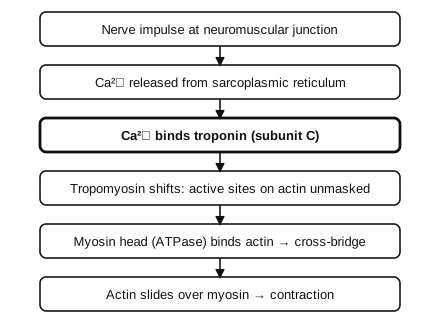
- Impulse → Ca2+ level rises in sarcoplasm → binds troponin → tropomyosin moves → active sites on F-actin exposed.
- Myosin head (an ATPase, energised by ATP hydrolysis) binds the exposed sites → cross-bridge → power stroke.
- (A) Detachment of myosin head needs a new ATP, not Ca2+. (B) Myosin ATPase activity is intrinsic to the head; Ca2+ does not bind myosin in skeletal muscle. (D) Ca2+ promotes, not prevents, cross-bridge formation.
Short trick: Ca2+ "unlocks the door" (troponin–tropomyosin lock on actin); ATP "releases the hand" (myosin head).
Answer: (C) Binds to troponin to remove the masking of active sites on actin for myosin.
अवधारणा: सर्पी तंतु सिद्धांत (NCERT): पेशीद्रव्यी जालिका से मुक्त Ca2+ एक्टिन तंतु पर ट्रोपोनिन C से जुड़ता है और मायोसिन के लिए सक्रिय स्थलों का आवरण हटाता है।
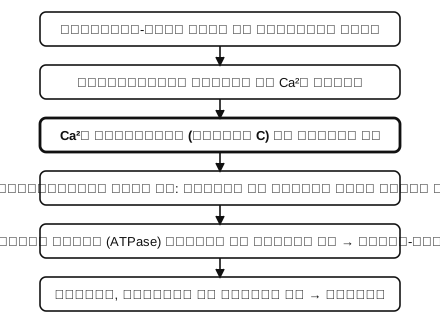
- आवेग → पेशीद्रव्य में Ca2+ स्तर बढ़ता है → ट्रोपोनिन से बंधन → ट्रोपोमायोसिन खिसकता है → F-एक्टिन के सक्रिय स्थल खुलते हैं।
- मायोसिन शीर्ष (एक ATPase, ATP जल-अपघटन से ऊर्जित) खुले स्थलों से जुड़ता है → क्रॉस-ब्रिज → शक्ति आघात।
- (A) मायोसिन शीर्ष के अलग होने हेतु नया ATP चाहिए, Ca2+ नहीं। (B) ATPase सक्रियता मायोसिन शीर्ष का अपना गुण है; कंकाल पेशी में Ca2+ मायोसिन से नहीं जुड़ता। (D) Ca2+ क्रॉस-ब्रिज बनने को बढ़ावा देता है, रोकता नहीं।
शॉर्ट ट्रिक: Ca2+ "ताला खोलता है" (एक्टिन पर ट्रोपोनिन–ट्रोपोमायोसिन का ताला); ATP "हाथ छुड़ाता है" (मायोसिन शीर्ष)।
उत्तर: (C) ट्रोपोनिन से जुड़कर मायोसिन के लिए एक्टिन के सक्रिय स्थलों का आवरण हटाता है।
NEET UGBiologyLocomotion and movement – mechanism of muscle contractionNEET UG 2018 · 6 May Shift 1
Q1689.Nissl bodies are mainly composed of
निसल पिंड (Nissl bodies) मुख्य रूप से किनसे बने होते हैं?
- ANucleic acids and SERन्यूक्लिक अम्ल और SER
- BDNA and RNADNA और RNA
- CProteins and lipidsप्रोटीन और लिपिड
- DFree ribosomes and RERमुक्त राइबोसोम और RER
Show answer
Concept: Nissl's granules (in cyton and dendrites, absent in axon) are clusters of rough endoplasmic reticulum with free ribosomes – sites of protein synthesis.
- They stain with basic dyes because of ribosomal RNA, but structurally they are RER + free ribosomes → (D).
- They contain no SER (A), are not DNA (B) and are not lipid bodies (C).
Short trick: Nissl = protein factory of neuron → ribosomes + RER (both protein-makers).
Answer: (D) Free ribosomes and RER
अवधारणा: निसल कणिकाएँ (कोशिकाकाय और द्रुमिकाओं में, तंत्रिकाक्ष में अनुपस्थित) मुक्त राइबोसोम सहित खुरदरी अंतःप्रद्रव्यी जालिका के समूह हैं – प्रोटीन संश्लेषण के स्थल।
- राइबोसोमल RNA के कारण ये क्षारीय रंजकों से रंगती हैं, पर संरचना में ये RER + मुक्त राइबोसोम हैं → (D)।
- इनमें SER (A) नहीं, ये DNA (B) नहीं और लिपिड पिंड (C) भी नहीं हैं।
शॉर्ट ट्रिक: निसल = तंत्रिका कोशिका की प्रोटीन फैक्ट्री → राइबोसोम + RER।
उत्तर: (D) मुक्त राइबोसोम और RER
NEET UGBiologyStructural organisation in animals – neuron (Nissl granules)NEET UG 2018 · 6 May Shift 1
Q1690.Which of these statements is incorrect?
इनमें से कौन-सा कथन गलत है?
- AGlycolysis operates as long as it is supplied with NAD that can pick up hydrogen atomsग्लाइकोलिसिस तब तक चलता है जब तक उसे हाइड्रोजन परमाणु ग्रहण करने वाला NAD मिलता रहता है
- BGlycolysis occurs in cytosolग्लाइकोलिसिस कोशिकाद्रव्य (cytosol) में होता है
- CEnzymes of TCA cycle are present in mitochondrial matrixTCA चक्र के एंजाइम माइटोकॉन्ड्रियल आधात्री (matrix) में उपस्थित होते हैं
- DOxidative phosphorylation takes place in outer mitochondrial membraneऑक्सीकरणी फॉस्फोरिलेशन माइटोकॉन्ड्रिया की बाह्य झिल्ली में होता है
Show answer
Concept: ETS and oxidative phosphorylation (complexes I–V, ATP synthase F0–F1) are located in the inner mitochondrial membrane.
- (A) Correct – glycolysis needs NAD+ to accept H; that is why NADH must be re-oxidised (by ETS or fermentation).
- (B) Correct – glycolysis is cytoplasmic.
- (C) Correct – TCA enzymes are in the matrix (except succinate dehydrogenase, on the inner membrane).
- (D) Incorrect – the outer membrane has no ETS/ATP synthase.
Short trick: Matrix = Krebs; Inner membrane = ETS + ATP synthase; Cytosol = glycolysis.
Answer: (D) Oxidative phosphorylation takes place in outer mitochondrial membrane
अवधारणा: ETS और ऑक्सीकरणी फॉस्फोरिलेशन (सम्मिश्र I–V, ATP सिंथेज़ F0–F1) माइटोकॉन्ड्रिया की आंतरिक झिल्ली में स्थित होते हैं।
- (A) सही – ग्लाइकोलिसिस में H ग्रहण करने हेतु NAD+ चाहिए; इसीलिए NADH का पुनः ऑक्सीकरण (ETS या किण्वन से) आवश्यक है।
- (B) सही – ग्लाइकोलिसिस कोशिकाद्रव्य में होता है।
- (C) सही – TCA एंजाइम आधात्री में हैं (सक्सिनेट डीहाइड्रोजिनेज़ को छोड़कर, जो आंतरिक झिल्ली पर है)।
- (D) गलत – बाह्य झिल्ली में ETS/ATP सिंथेज़ नहीं होते।
शॉर्ट ट्रिक: आधात्री = क्रेब्स; आंतरिक झिल्ली = ETS + ATP सिंथेज़; कोशिकाद्रव्य = ग्लाइकोलिसिस।
उत्तर: (D) ऑक्सीकरणी फॉस्फोरिलेशन माइटोकॉन्ड्रिया की बाह्य झिल्ली में होता है
NEET UGBiologyRespiration in plants – glycolysis, TCA and ETSNEET UG 2018 · 6 May Shift 1
Q1691.Select the incorrect match :
गलत सुमेल का चयन कीजिए:
- ASubmetacentric chromosomes – L-shaped chromosomesउपमध्यकेन्द्री गुणसूत्र – L-आकार के गुणसूत्र
- BAllosomes – Sex chromosomesएलोसोम – लिंग गुणसूत्र
- CLampbrush chromosomes – Diplotene bivalentsलैम्पब्रश गुणसूत्र – डिप्लोटीन द्विसंयोजक
- DPolytene chromosomes – Oocytes of amphibiansपॉलिटीन गुणसूत्र – उभयचरों के अंडक (oocytes)
Show answer
Concept: Giant chromosomes: polytene chromosomes occur in salivary glands of dipteran insect larvae (e.g. Drosophila, Chironomus); lampbrush chromosomes occur in amphibian oocytes at diplotene.
- (A) Correct – submetacentric (centromere slightly off-centre) appear L-shaped (NCERT).
- (B) Correct – allosomes = sex chromosomes (rest are autosomes).
- (C) Correct – lampbrush chromosomes are diplotene bivalents of meiosis I in oocytes.
- (D) Incorrect – oocytes of amphibians have lampbrush, not polytene, chromosomes.
Short trick: Polytene = "Poly-salivary" of flies; Lampbrush = "Lamp in the egg" (amphibian oocyte).
Answer: (D) Polytene chromosomes – Oocytes of amphibians
अवधारणा: विशाल गुणसूत्र: पॉलिटीन गुणसूत्र द्विपंखी (Diptera) कीट-लार्वा की लार ग्रंथियों में (जैसे Drosophila, Chironomus); लैम्पब्रश गुणसूत्र उभयचर अंडकों में डिप्लोटीन अवस्था पर पाए जाते हैं।
- (A) सही – उपमध्यकेन्द्री (गुणसूत्रबिंदु केंद्र से थोड़ा हटकर) L-आकार के दिखते हैं (NCERT)।
- (B) सही – एलोसोम = लिंग गुणसूत्र (शेष अलिंग गुणसूत्र)।
- (C) सही – लैम्पब्रश गुणसूत्र अंडकों में अर्धसूत्री-I के डिप्लोटीन द्विसंयोजक हैं।
- (D) गलत – उभयचर अंडकों में लैम्पब्रश गुणसूत्र होते हैं, पॉलिटीन नहीं।
शॉर्ट ट्रिक: पॉलिटीन = मक्खियों की लार ग्रंथि; लैम्पब्रश = अंडक (उभयचर)।
उत्तर: (D) पॉलिटीन गुणसूत्र – उभयचरों के अंडक
NEET UGBiologyCell: the unit of life – types of chromosomesNEET UG 2018 · 6 May Shift 1
Q1692.Which of the following terms describe human dentition?
निम्नलिखित में से कौन-से पद मानव दंतविन्यास का वर्णन करते हैं?
- APleurodont, Monophyodont, Homodontपार्श्वदंती, एकबारदंती, समदंती
- BThecodont, Diphyodont, Heterodontगर्तदंती, द्विबारदंती, विषमदंती
- CThecodont, Diphyodont, Homodontगर्तदंती, द्विबारदंती, समदंती
- DPleurodont, Diphyodont, Heterodontपार्श्वदंती, द्विबारदंती, विषमदंती
Show answer
Concept: NCERT: humans have thecodont, diphyodont and heterodont dentition.
- Thecodont – each tooth embedded in a socket (alveolus) of the jaw bone (pleurodont = attached to inner side of jaw, as in lizards).
- Diphyodont – two sets: 20 milk (deciduous) teeth replaced by 32 permanent teeth (monophyodont = one set).
- Heterodont – different types: incisors, canines, premolars, molars (homodont = all alike).
- Only (B) has all three correct.
Short trick: "TDH" – Thecodont, Diphyodont, Heterodont ("The Dentist's Habit").
Answer: (B) Thecodont, Diphyodont, Heterodont
अवधारणा: NCERT: मनुष्य का दंतविन्यास गर्तदंती (thecodont), द्विबारदंती (diphyodont) और विषमदंती (heterodont) है।
- गर्तदंती – प्रत्येक दाँत जबड़े की अस्थि के गर्त (कूपिका) में धँसा (पार्श्वदंती = जबड़े के भीतरी पार्श्व से जुड़े, जैसे छिपकली)।
- द्विबारदंती – दो समुच्चय: 20 दूध (पर्णपाती) दाँत 32 स्थायी दाँतों से प्रतिस्थापित (एकबारदंती = एक समुच्चय)।
- विषमदंती – भिन्न प्रकार: कृंतक, रदनक, अग्रचर्वणक, चर्वणक (समदंती = सभी समान)।
- केवल (B) में तीनों सही हैं।
शॉर्ट ट्रिक: "TDH" – Thecodont, Diphyodont, Heterodont।
उत्तर: (B) गर्तदंती, द्विबारदंती, विषमदंती
NEET UGBiologyDigestion and absorption – human dentitionNEET UG 2018 · 6 May Shift 1
Q1693.Which of the following events does not occur in rough endoplasmic reticulum?
निम्नलिखित में से कौन-सी घटना खुरदरी अंतःप्रद्रव्यी जालिका (RER) में नहीं होती?
- ACleavage of signal peptideसंकेत पेप्टाइड का विदलन
- BProtein glycosylationप्रोटीन ग्लाइकोसिलेशन
- CProtein foldingप्रोटीन वलन (folding)
- DPhospholipid synthesisफॉस्फोलिपिड संश्लेषण
Show answer
Concept: NCERT: RER is actively involved in protein synthesis and secretion; SER is the major site for synthesis of lipids (steroidal hormones in animals).
- (A) Signal peptide of secretory proteins is cleaved by signal peptidase in the RER lumen.
- (B) N-linked glycosylation begins in the RER.
- (C) Proteins fold (with chaperones) in the RER lumen.
- (D) Lipid/phospholipid synthesis is the job of SER → does not occur in RER (as per NCERT).
Short trick: Rough = Ribosomes = pRotein work; Smooth = Lipids ("Smooth like oil").
Answer: (D) Phospholipid synthesis
अवधारणा: NCERT: RER प्रोटीन संश्लेषण और स्रवण में सक्रिय है; SER लिपिड (जंतुओं में स्टेरॉयडी हॉर्मोन) संश्लेषण का मुख्य स्थल है।
- (A) स्रावी प्रोटीनों का संकेत पेप्टाइड RER की गुहा में सिग्नल पेप्टिडेज़ द्वारा काटा जाता है।
- (B) N-संयुक्त ग्लाइकोसिलेशन RER में आरंभ होता है।
- (C) प्रोटीन RER की गुहा में (चैपेरोन की सहायता से) वलित होते हैं।
- (D) लिपिड/फॉस्फोलिपिड संश्लेषण SER का कार्य है → RER में नहीं होता (NCERT के अनुसार)।
शॉर्ट ट्रिक: Rough = राइबोसोम = प्रोटीन कार्य; Smooth = लिपिड ("तेल जैसा चिकना")।
उत्तर: (D) फॉस्फोलिपिड संश्लेषण
NEET UGBiologyCell: the unit of life – endoplasmic reticulumNEET UG 2018 · 6 May Shift 1
Q1694.Many ribosomes may associate with a single mRNA to form multiple copies of a polypeptide simultaneously. Such strings of ribosomes are termed as
अनेक राइबोसोम एक ही mRNA से जुड़कर एक साथ एक पॉलिपेप्टाइड की कई प्रतियाँ बना सकते हैं। राइबोसोमों की ऐसी शृंखलाएँ कहलाती हैं
- APlastidomeप्लास्टिडोम
- BPolyhedral bodiesबहुफलकीय पिंड
- CPolysomeपॉलीसोम
- DNucleosomeन्यूक्लियोसोम
Show answer
Concept: NCERT: several ribosomes may attach to a single mRNA and form a chain called polyribosome or polysome.
- Polysome increases the rate of translation – each ribosome makes its own copy of the polypeptide.
- Plastidome = all plastids of a cell; polyhedral bodies = carboxysomes/viral inclusion bodies.
- Nucleosome = DNA wrapped around histone octamer – unit of chromatin.
Short trick: Poly + some = many ribosomes on one mRNA.
Answer: (C) Polysome
अवधारणा: NCERT: अनेक राइबोसोम एक ही mRNA से जुड़कर एक शृंखला बनाते हैं जिसे पॉलीराइबोसोम या पॉलीसोम कहते हैं।
- पॉलीसोम अनुवादन की दर बढ़ाता है – प्रत्येक राइबोसोम पॉलिपेप्टाइड की अपनी प्रति बनाता है।
- प्लास्टिडोम = कोशिका के सभी लवक; बहुफलकीय पिंड = कार्बोक्सीसोम/विषाणु अंतर्विष्ट पिंड।
- न्यूक्लियोसोम = हिस्टोन अष्टक पर लिपटा DNA – क्रोमैटिन की इकाई।
शॉर्ट ट्रिक: Poly + some = एक mRNA पर अनेक राइबोसोम।
उत्तर: (C) पॉलीसोम
NEET UGBiologyMolecular basis of inheritance – polysomeNEET UG 2018 · 6 May Shift 1
Q1695.In which disease does mosquito transmitted pathogen cause chronic inflammation of lymphatic vessels?
किस रोग में मच्छर द्वारा संचरित रोगजनक लसीका वाहिकाओं में दीर्घकालिक शोथ उत्पन्न करता है?
- ARingworm diseaseदाद (Ringworm)
- BAscariasisऐस्केरिऐसिस
- CElephantiasisफ़ीलपाँव (Elephantiasis)
- DAmoebiasisअमीबता (Amoebiasis)
Show answer
Concept: NCERT: Wuchereria (W. bancrofti, W. malayi) cause chronic inflammation of organs in which they live for many years, usually the lymphatic vessels of lower limbs – elephantiasis/filariasis; transmitted by female mosquito (Culex).
- Elephantiasis → mosquito vector + lymphatic inflammation → (C).
- Ringworm – fungal skin infection by contact (Microsporum, Trichophyton, Epidermophyton).
- Ascariasis – intestinal roundworm, via contaminated food/water.
- Amoebiasis – Entamoeba histolytica in large intestine; houseflies are mechanical carriers.
Short trick: Swollen "elephant" legs = blocked lymph by worms carried by Culex.
Answer: (C) Elephantiasis
अवधारणा: NCERT: Wuchereria (W. bancrofti, W. malayi) कई वर्षों तक जिन अंगों में रहते हैं, सामान्यतः निचले अंगों की लसीका वाहिकाओं में, दीर्घकालिक शोथ करते हैं – फ़ीलपाँव/फाइलेरियता; मादा मच्छर (Culex) द्वारा संचरित।
- फ़ीलपाँव → मच्छर वाहक + लसीका शोथ → (C)।
- दाद – संपर्क से त्वचा का कवक संक्रमण (Microsporum, Trichophyton, Epidermophyton)।
- ऐस्केरिऐसिस – आंत्र गोलकृमि, दूषित भोजन/जल से।
- अमीबता – बड़ी आंत में Entamoeba histolytica; घरेलू मक्खी यांत्रिक वाहक।
शॉर्ट ट्रिक: हाथी जैसे सूजे पैर = Culex द्वारा लाए कृमियों से अवरुद्ध लसीका।
उत्तर: (C) फ़ीलपाँव (Elephantiasis)
NEET UGBiologyHuman health and disease – filariasisNEET UG 2018 · 6 May Shift 1
Q1696.Which of the following is not an autoimmune disease?
निम्नलिखित में से कौन-सा एक स्व-प्रतिरक्षा (autoimmune) रोग नहीं है?
- AAlzheimer's diseaseऐल्ज़ाइमर रोग
- BRheumatoid arthritisआमवाती संधिशोथ (Rheumatoid arthritis)
- CPsoriasisसोरायसिस
- DVitiligoविटिलिगो (श्वित्र)
Show answer
Concept: Autoimmunity = immune system attacks self cells. Rheumatoid arthritis (NCERT example), psoriasis and vitiligo are autoimmune.
- Alzheimer's disease is a neurodegenerative disorder associated with deficiency of the neurotransmitter acetylcholine – not autoimmune → (A).
- Rheumatoid arthritis – antibodies against synovial membrane/cartilage.
- Psoriasis – T-cell–mediated attack causing thick red scaly skin patches.
- Vitiligo – immune destruction of melanocytes → white patches.
Short trick: Three skin/joint diseases are autoimmune; the brain-degeneration one (Alzheimer's – low acetylcholine) is the odd one out.
Answer: (A) Alzheimer's disease
अवधारणा: स्व-प्रतिरक्षा = प्रतिरक्षा तंत्र का अपनी ही कोशिकाओं पर आक्रमण। आमवाती संधिशोथ (NCERT उदाहरण), सोरायसिस और विटिलिगो स्व-प्रतिरक्षा रोग हैं।
- ऐल्ज़ाइमर रोग तंत्रिका-अपह्रासी विकार है जो तंत्रिकाप्रेषी ऐसीटिलकोलीन की कमी से जुड़ा है – स्व-प्रतिरक्षा नहीं → (A)।
- आमवाती संधिशोथ – साइनोवियल झिल्ली/उपास्थि के विरुद्ध प्रतिरक्षी।
- सोरायसिस – T-कोशिका मध्यस्थ आक्रमण से त्वचा पर मोटे लाल शल्की धब्बे।
- विटिलिगो – मेलेनोसाइटों का प्रतिरक्षी विनाश → सफेद धब्बे।
शॉर्ट ट्रिक: तीन त्वचा/जोड़ रोग स्व-प्रतिरक्षी हैं; मस्तिष्क-अपह्रास वाला (ऐल्ज़ाइमर – कम ऐसीटिलकोलीन) अलग है।
उत्तर: (A) ऐल्ज़ाइमर रोग
NEET UGBiologyHuman health and disease – autoimmunityNEET UG 2018 · 6 May Shift 1
Q1697.Among the following sets of examples for divergent evolution, select the incorrect option :
अपसारी विकास के उदाहरणों के निम्नलिखित समूहों में से गलत विकल्प चुनिए:
- ABrain of bat, man and cheetahचमगादड़, मनुष्य और चीता का मस्तिष्क
- BHeart of bat, man and cheetahचमगादड़, मनुष्य और चीता का हृदय
- CForelimbs of man, bat and cheetahमनुष्य, चमगादड़ और चीता के अग्रपाद
- DEye of octopus, bat and manऑक्टोपस, चमगादड़ और मनुष्य की आँख
Show answer
Concept: Divergent evolution → homologous organs (same origin, different functions), e.g. vertebrate hearts, brains, forelimbs. Convergent evolution → analogous organs (different origin, similar function).
- (A), (B), (C) – structures of vertebrates (mammals) with common ancestry → homologous → divergent: correct examples.
- (D) Eye of octopus (mollusc) and of mammals have different origins but similar function → analogous → convergent evolution → incorrect as a divergent example.
Short trick: If an invertebrate (octopus) is mixed with vertebrates → analogy/convergent.
Answer: (D) Eye of octopus, bat and man
अवधारणा: अपसारी विकास → समजात अंग (समान उत्पत्ति, भिन्न कार्य), जैसे कशेरुकियों के हृदय, मस्तिष्क, अग्रपाद। अभिसारी विकास → समरूप अंग (भिन्न उत्पत्ति, समान कार्य)।
- (A), (B), (C) – समान पूर्वज वाले कशेरुकियों (स्तनधारियों) की संरचनाएँ → समजात → अपसारी: सही उदाहरण।
- (D) ऑक्टोपस (मोलस्क) और स्तनधारियों की आँख की उत्पत्ति भिन्न पर कार्य समान → समरूप → अभिसारी विकास → अपसारी के उदाहरण के रूप में गलत।
शॉर्ट ट्रिक: यदि अकशेरुकी (ऑक्टोपस) कशेरुकियों के साथ मिला हो → समरूपता/अभिसारी।
उत्तर: (D) ऑक्टोपस, चमगादड़ और मनुष्य की आँख
NEET UGBiologyEvolution – divergent and convergent evolutionNEET UG 2018 · 6 May Shift 1
Q1698.Conversion of milk to curd improves its nutritional value by increasing the amount of
दूध के दही में परिवर्तन से उसका पोषण मान किसकी मात्रा बढ़ने से सुधरता है?
- AVitamin B12विटामिन B12
- BVitamin Aविटामिन A
- CVitamin Dविटामिन D
- DVitamin Eविटामिन E
Show answer
Concept: NCERT: Lactic acid bacteria (LAB, e.g. Lactobacillus) convert milk to curd and also improve its nutritional quality by increasing vitamin B12.
- LAB produce acids that coagulate and partially digest milk proteins → curd.
- They synthesise vitamin B12 → (A); A, D, E are fat-soluble vitamins not increased by LAB. LAB in the stomach also check disease-causing microbes.
Short trick: LAB → "Lactobacillus Adds B12".
Answer: (A) Vitamin B12
अवधारणा: NCERT: लैक्टिक अम्ल जीवाणु (LAB, जैसे Lactobacillus) दूध को दही में बदलते हैं और विटामिन B12 बढ़ाकर इसकी पोषण गुणवत्ता भी सुधारते हैं।
- LAB अम्ल बनाते हैं जो दूध प्रोटीनों को स्कंदित व आंशिक पचित करते हैं → दही।
- ये विटामिन B12 संश्लेषित करते हैं → (A); A, D, E वसा-विलेय विटामिन हैं जिन्हें LAB नहीं बढ़ाते। आमाशय में LAB रोगकारक सूक्ष्मजीवों को भी नियंत्रित करते हैं।
शॉर्ट ट्रिक: LAB → "Lactobacillus B12 बढ़ाता है"।
उत्तर: (A) विटामिन B12
NEET UGBiologyMicrobes in human welfare – household productsNEET UG 2018 · 6 May Shift 1
Q1699.The similarity of bone structure in the forelimbs of many vertebrates is an example of
अनेक कशेरुकियों के अग्रपादों की अस्थि संरचना में समानता किसका उदाहरण है?
- AConvergent evolutionअभिसारी विकास
- BAnalogyसमरूपता (Analogy)
- CHomologyसमजातता (Homology)
- DAdaptive radiationअनुकूली विकिरण
Show answer
Concept: NCERT: forelimbs of whales, bats, cheetah and human share the same pattern of bones (humerus, radius-ulna, carpals, metacarpals, phalanges) though they perform different functions → homology.
- Same anatomical plan + common ancestry = homologous organs → homology → (C).
- Analogy/convergent evolution = different structures doing similar function (e.g. wings of butterfly and bird) – opposite case.
- Adaptive radiation is a process (e.g. Darwin's finches) leading to many forms; the question asks what the bone similarity itself represents.
Short trick: HOMology = "same HOMe (origin)"; ANAlogy = "ANother origin, same job".
Answer: (C) Homology
अवधारणा: NCERT: व्हेल, चमगादड़, चीता और मनुष्य के अग्रपादों में अस्थियों का समान प्रतिरूप (ह्यूमरस, रेडियस-अल्ना, कार्पल, मेटाकार्पल, फैलेंजेज़) होता है, यद्यपि कार्य भिन्न हैं → समजातता।
- समान शारीरिक योजना + समान पूर्वज = समजात अंग → समजातता → (C)।
- समरूपता/अभिसारी विकास = भिन्न संरचनाएँ समान कार्य करती हैं (जैसे तितली और पक्षी के पंख) – विपरीत स्थिति।
- अनुकूली विकिरण एक प्रक्रिया है (जैसे डार्विन की फिंच) जिससे अनेक रूप बनते हैं; प्रश्न पूछता है कि अस्थि समानता स्वयं क्या दर्शाती है।
शॉर्ट ट्रिक: समजात = "समान जन्म (उत्पत्ति)"; समरूप = "भिन्न उत्पत्ति, समान कार्य"।
उत्तर: (C) समजातता (Homology)
NEET UGBiologyEvolution – homologous organsNEET UG 2018 · 6 May Shift 1
Q1700.Which of the following characteristics represent ‘Inheritance of blood groups’ in humans?
a. Dominance
b. Co-dominance
c. Multiple allele
d. Incomplete dominance
e. Polygenic inheritance
निम्नलिखित में से कौन-से लक्षण मनुष्यों में ‘रुधिर वर्गों की वंशागति’ को दर्शाते हैं?
a. प्रभाविता
b. सहप्रभाविता
c. बहु-युग्मविकल्पी (Multiple allele)
d. अपूर्ण प्रभाविता
e. बहुजीनी वंशागति
- Ab, d and eb, d और e
- Ba, b and ca, b और c
- Cb, c and eb, c और e
- Da, c and ea, c और e
Show answer
Concept: ABO blood group is controlled by one gene I with three alleles IA, IB, i (NCERT).
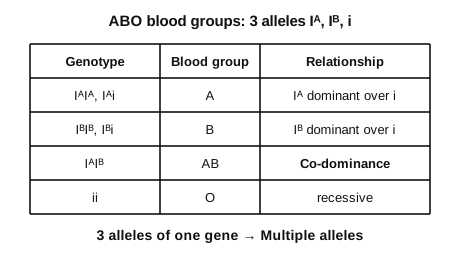
- a. Dominance: IA and IB are dominant over i (IAi → A, IBi → B). ✔
- b. Co-dominance: IAIB expresses both A and B antigens → AB. ✔
- c. Multiple alleles: three alleles of the same gene in the population. ✔
- d. Incomplete dominance (blended intermediate, e.g. snapdragon) – not seen. ✘
- e. Polygenic inheritance needs several genes (e.g. skin colour) – ABO is a single gene. ✘
- Hence a, b and c → (B).
Short trick: ABO shows "all three Ds except the blended one": Dominance, co-Dominance, Diverse (multiple) alleles.
Answer: (B) a, b and c
अवधारणा: ABO रुधिर वर्ग एक जीन I द्वारा नियंत्रित होता है जिसके तीन युग्मविकल्पी IA, IB, i हैं (NCERT)।
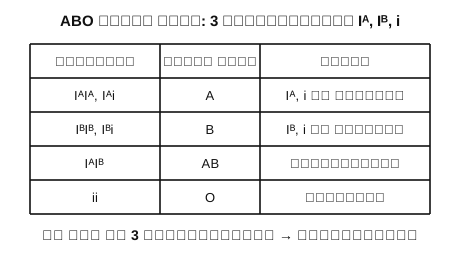
- a. प्रभाविता: IA और IB, i पर प्रभावी हैं (IAi → A, IBi → B)। ✔
- b. सहप्रभाविता: IAIB में A और B दोनों प्रतिजन व्यक्त → AB। ✔
- c. बहुविकल्पता: समष्टि में एक ही जीन के तीन युग्मविकल्पी। ✔
- d. अपूर्ण प्रभाविता (मिश्रित मध्यवर्ती, जैसे स्नैपड्रैगन) – नहीं दिखती। ✘
- e. बहुजीनी वंशागति में अनेक जीन चाहिए (जैसे त्वचा का रंग) – ABO एक जीन है। ✘
- अतः a, b और c → (B)।
शॉर्ट ट्रिक: ABO में: प्रभाविता, सहप्रभाविता, बहुविकल्पता – पर मिश्रण (अपूर्ण प्रभाविता) नहीं।
उत्तर: (B) a, b और c
NEET UGBiologyPrinciples of inheritance – ABO blood groupsNEET UG 2018 · 6 May Shift 1

