Q261.In the following number-pairs, the second number is obtained by applying certain mathematical operation(s) to the first number. Which numbers should replace X and Y, so that the pattern followed by the two numbers on the left side of :: is the same as that on the right side of ::?
(NOTE: Operations should be performed on the whole numbers, without breaking down the numbers into their constituent digits. E.g. 13 – Operations on 13 such as adding to/subtracting from/multiplying with 13 can be performed. Breaking down 13 into 1 and 3 and then performing mathematical operations on 1 and 3 is not allowed.)
X : 24 :: 13 : Y
निम्नलिखित संख्या-युग्मों में, पहली संख्या पर कुछ गणितीय संक्रिया/संक्रियाएँ करके दूसरी संख्या प्राप्त की जाती है। X और Y के स्थान पर कौन-सी संख्याएँ आनी चाहिए, ताकि :: के बाईं ओर की दोनों संख्याओं द्वारा अनुसरित पैटर्न वही हो जो :: के दाईं ओर की संख्याओं द्वारा अनुसरित है?
(ध्यान दें: संक्रियाएँ पूर्ण संख्याओं पर की जानी चाहिए, संख्याओं को उनके घटक अंकों में तोड़े बिना। उदाहरण 13 – 13 पर संक्रियाएँ जैसे 13 में जोड़ना/घटाना/गुणा करना आदि किया जा सकता है। 13 को 1 और 3 में तोड़कर फिर 1 और 3 पर गणितीय संक्रियाएँ करने की अनुमति नहीं है।)
X : 24 :: 13 : Y
- AX = 12, Y = 26
- BX = 7, Y = 130
- CX = 8, Y = 36
- DX = 8, Y = 130
Show answer
Concept: The same operation must turn X into 24 and 13 into Y.
- Option A: 12 × 2 = 24 and 13 × 2 = 26 ✓
- Option D: 8 × 3 = 24 but 13 × 3 = 39 ≠ 130; B and C fail similarly.
- So X = 12, Y = 26 (rule: × 2).
Short trick: Try the simplest rule (×2, ×3) with each option; the option where one rule fits both sides is the answer.
Answer: (A) X = 12, Y = 26
अवधारणा: एक ही संक्रिया X को 24 में और 13 को Y में बदलनी चाहिए।
- विकल्प A: 12 × 2 = 24 और 13 × 2 = 26 ✓
- विकल्प D: 8 × 3 = 24 परंतु 13 × 3 = 39 ≠ 130; B और C भी असफल।
- अतः X = 12, Y = 26 (नियम: × 2)।
शॉर्ट ट्रिक: सबसे सरल नियम (×2, ×3) प्रत्येक विकल्प पर आज़माएँ; जहाँ एक नियम दोनों ओर लागू हो वही उत्तर।
उत्तर: (A) X = 12, Y = 26
RRB ALP CBT 1General Intelligence and ReasoningNumber analogyRRB ALP CBT 1 2025 · 18 Feb Shift 1
Q262.Each vowel in the word WICKED is changed to the letter immediately following it in the English alphabetical order and each consonant is changed to the letter immediately preceding it in the English alphabetical order. How many letters will appear exactly twice in the new group of letters thus formed?
शब्द WICKED में प्रत्येक स्वर को अंग्रेज़ी वर्णमाला क्रम में उसके ठीक बाद वाले अक्षर से और प्रत्येक व्यंजन को अंग्रेज़ी वर्णमाला क्रम में उसके ठीक पहले वाले अक्षर से बदल दिया जाता है। इस प्रकार बने अक्षरों के नए समूह में कितने अक्षर ठीक दो बार आएँगे?
- A1
- B3
- C2
- D0
Show answer
Concept: Vowel → next letter, consonant → previous letter.
- New group VJBJFC: only J appears twice.
Short trick: I (vowel) → J and K (consonant) → J both land on J — vowel+1 and consonant−1 collide when they are two letters apart (I, K).
Answer: (A) 1
अवधारणा: स्वर → अगला अक्षर, व्यंजन → पिछला अक्षर।
- नया समूह VJBJFC: केवल J दो बार आता है।
शॉर्ट ट्रिक: I (स्वर) → J और K (व्यंजन) → J दोनों J बनते हैं — जब स्वर और व्यंजन में दो अक्षर का अंतर हो (I, K) तो टकराव होता है।
उत्तर: (A) 1
RRB ALP CBT 1General Intelligence and ReasoningCoding – vowel/consonant shiftRRB ALP CBT 1 2025 · 18 Feb Shift 1
Q263.Each of N, K, J, R, P, S and M has an exam on a different day of a week starting from Monday and ending on Sunday of the same week. M has an exam on Wednesday. N has exam on the day immediately after S. Only 2 people have exams between P and R. K has exam on the day immediately before M. R's exam is neither on Sunday nor on Monday. J has exam on the day immediately before S. Who among the following has exam on Monday?
N, K, J, R, P, S और M में से प्रत्येक की परीक्षा एक ही सप्ताह के सोमवार से शुरू होकर रविवार तक, अलग-अलग दिन है। M की परीक्षा बुधवार को है। N की परीक्षा S के ठीक बाद वाले दिन है। P और R के बीच केवल 2 व्यक्तियों की परीक्षाएँ हैं। K की परीक्षा M के ठीक पहले वाले दिन है। R की परीक्षा न तो रविवार को है और न ही सोमवार को। J की परीक्षा S के ठीक पहले वाले दिन है। निम्नलिखित में से किसकी परीक्षा सोमवार को है?
- AJ
- BK
- CP
- DM
Show answer
Concept: Fix M and K first, then place the J–S–N block.
- M = Wednesday, K = Tuesday.
- J, S, N are on three consecutive days: either Thu–Fri–Sat or Fri–Sat–Sun.
- If J–S–N = Thu–Sat, P and R would have to be Mon and Sun — but R is on neither. ✗
- So J–S–N = Fri–Sat–Sun; P and R take Mon and Thu (2 people between ✓); R ≠ Mon ⇒ R = Thu, P = Mon.
| Mon | Tue | Wed | Thu | Fri | Sat | Sun |
| P | K | M | R | J | S | N |
Short trick: The 3-day block J–S–N can only fit in the last four days; testing the two cases settles it.
Answer: (C) P
अवधारणा: पहले M और K तय करें, फिर J–S–N समूह रखें।
- M = बुधवार, K = मंगलवार।
- J, S, N लगातार तीन दिन: गुरु–शुक्र–शनि या शुक्र–शनि–रवि।
- यदि J–S–N = गुरु–शनि, तो P और R को सोम और रवि लेने होंगे — परंतु R इनमें से किसी पर नहीं। ✗
- अतः J–S–N = शुक्र–शनि–रवि; P और R = सोम और गुरु (बीच में 2 ✓); R ≠ सोम ⇒ R = गुरु, P = सोम।
| सोम | मंगल | बुध | गुरु | शुक्र | शनि | रवि |
| P | K | M | R | J | S | N |
शॉर्ट ट्रिक: 3 दिन का समूह J–S–N केवल अंतिम चार दिनों में आ सकता है; दो स्थितियाँ जाँचें।
उत्तर: (C) P
RRB ALP CBT 1General Intelligence and ReasoningScheduling puzzle – days of the weekRRB ALP CBT 1 2025 · 18 Feb Shift 1
Q264.Refer to the following letter, symbol series and answer the question that follows. Counting to be done from left to right only.
(Left) A & # W Z € % © H M O # $ U £ F * H D € © H (Right)
How many such symbol are there, each of which is immediately preceded by a letter and also immediately followed by a letter?
निम्नलिखित अक्षर, प्रतीक शृंखला को देखिए और नीचे दिए गए प्रश्न का उत्तर दीजिए। गिनती केवल बाएँ से दाएँ की जानी है।
(बाएँ) A & # W Z € % © H M O # $ U £ F * H D € © H (दाएँ)
ऐसे कितने प्रतीक हैं, जिनमें से प्रत्येक के ठीक पहले एक अक्षर है और ठीक बाद भी एक अक्षर है?
- A3
- B2
- C1
- D4
Show answer
Concept: Look for the pattern letter–SYMBOL–letter.
- Scan each symbol and check both neighbours.
- U £ F ✓ and F * H ✓
- All other symbols have a symbol on at least one side (e.g. Z € %, H D € ©).
Short trick: Only single symbols sandwiched between letters count — runs of 2+ symbols are skipped at once.
Answer: (B) 2
अवधारणा: पैटर्न अक्षर–प्रतीक–अक्षर खोजें।
- प्रत्येक प्रतीक के दोनों पड़ोसी जाँचें।
- U £ F ✓ और F * H ✓
- अन्य सभी प्रतीकों के कम से कम एक ओर प्रतीक है (जैसे Z € %, H D € ©)।
शॉर्ट ट्रिक: केवल दो अक्षरों के बीच अकेले प्रतीक गिने जाते हैं — 2 या अधिक प्रतीकों के समूह तुरंत छोड़ दें।
उत्तर: (B) 2
RRB ALP CBT 1General Intelligence and ReasoningLetter–symbol seriesRRB ALP CBT 1 2025 · 18 Feb Shift 1
Q265.In a certain code language,
'A + B' means 'A is the father of B',
'A - B' means 'A is the mother of B',
'A * B' means 'A is the sister of B' and
'A / B' means 'A is the brother of B'.
Based on the above, how is L related to N if 'P + L / R - N'?
एक निश्चित कूट भाषा में,
'A + B' का अर्थ है 'A, B का पिता है',
'A - B' का अर्थ है 'A, B की माता है',
'A * B' का अर्थ है 'A, B की बहन है' और
'A / B' का अर्थ है 'A, B का भाई है'।
उपरोक्त के आधार पर, यदि 'P + L / R - N' है, तो L का N से क्या संबंध है?
- ABrotherभाई
- BMother's fatherनाना (माता के पिता)
- CHusbandपति
- DMother's brotherमामा (माता के भाई)
Show answer
Concept: Decode P + L / R − N step by step.

- P + L: P is the father of L.
- L / R: L is the brother of R (so L is male, a child of P).
- R − N: R is the mother of N.
- L is the brother of N’s mother → mother’s brother (maternal uncle).
Short trick: Read the chain from N backwards: N ← mother R ← her brother L.
Answer: (D) Mother’s brother
अवधारणा: P + L / R − N को चरणबद्ध रूप से समझें।
- P + L: P, L का पिता है।
- L / R: L, R का भाई है (L पुरुष है)।
- R − N: R, N की माता है।
- L, N की माता का भाई है → मामा।
शॉर्ट ट्रिक: शृंखला को N से पीछे पढ़ें: N ← माता R ← उसका भाई L।
उत्तर: (D) मामा (माता के भाई)
RRB ALP CBT 1General Intelligence and ReasoningCoded blood relationRRB ALP CBT 1 2025 · 18 Feb Shift 1
Q266.Seven people, J, K, L, M, N, O and P, are sitting around a circular table facing the centre. J sits third to the right of M and second to the left of N. K is an immediate neighbour of both M and N. O is second to the left of P. How many people sit between M and P when counted from the left of M?
सात व्यक्ति J, K, L, M, N, O और P एक वृत्ताकार मेज़ के चारों ओर केंद्र की ओर मुख करके बैठे हैं। J, M के दाईं ओर तीसरे स्थान पर और N के बाईं ओर दूसरे स्थान पर बैठा है। K, M और N दोनों का निकटतम पड़ोसी है। O, P के बाईं ओर दूसरे स्थान पर है। M के बाईं ओर से गिनने पर M और P के बीच कितने व्यक्ति बैठे हैं?
- ATwoदो
- BThreeतीन
- COneएक
- DNoneकोई नहीं
Show answer
Concept: Facing the centre: left = clockwise, right = anticlockwise. Fix M and place the others.
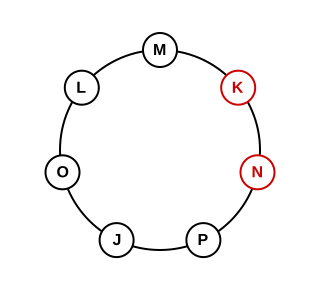
- J is 3rd to the right of M, and N is 2nd to the right of J → N is 2nd to the left of M.
- K is a neighbour of both M and N → K sits between them.
- Remaining seats: one between N and J (P or O) and two between J and M. O is 2nd to the left of P ⇒ P next to N, then J, then O, then L next to M.
- Clockwise from M: M, K, N, P, J, O, L. From the left of M: K, N, then P → 2 people between.
Short trick: Seat M at the top; J three seats to one side and N two seats beyond J means only one empty seat remains between M and N — that is K.
Answer: (A) Two
अवधारणा: केंद्र की ओर मुख: बाएँ = दक्षिणावर्त, दाएँ = वामावर्त। M को स्थिर करके दूसरों को रखें।
- J, M के दाएँ तीसरा है और N, J के दाएँ दूसरा है → N, M के बाएँ दूसरा है।
- K, M और N दोनों का पड़ोसी → K उनके बीच।
- O, P के बाएँ दूसरा है ⇒ P, N के पास, फिर J, फिर O, फिर L (M के पास)।
- M से दक्षिणावर्त: M, K, N, P, J, O, L। M के बाएँ से: K, N, फिर P → बीच में 2 व्यक्ति।
शॉर्ट ट्रिक: M को ऊपर रखें; J तीन स्थान एक ओर और N, J से दो स्थान आगे — M और N के बीच केवल एक सीट बचती है, वह K की है।
उत्तर: (A) दो
RRB ALP CBT 1General Intelligence and ReasoningCircular seating arrangementRRB ALP CBT 1 2025 · 18 Feb Shift 1
Q267.In the following triads, each group of letters is related to the subsequent one following a certain logic. Select from the given options, the one which follows the same logic.
NOSE - ENOS - SENO
HAND - DHAN - NDHA
निम्नलिखित त्रिकों में, अक्षरों का प्रत्येक समूह एक निश्चित तर्क का अनुसरण करते हुए अगले समूह से संबंधित है। दिए गए विकल्पों में से उस विकल्प का चयन कीजिए जो उसी तर्क का अनुसरण करता है।
NOSE - ENOS - SENO
HAND - DHAN - NDHA
- ATREK - KRTE - EKTR
- BTREK - KRTE - ETKR
- CTREK - KTRE - EKTR
- DTREK - KTRE - ETKR
Show answer
Concept: Each step moves the last letter to the front.
- NOSE → ENOS → SENO; HAND → DHAN → NDHA
- TREK → KTRE (K to front) → EKTR (E to front)
Short trick: Just check the second term: it must be K + TRE = KTRE; then E + KTR = EKTR.
Answer: (C) TREK - KTRE - EKTR
अवधारणा: प्रत्येक चरण में अंतिम अक्षर आगे आ जाता है।
- NOSE → ENOS → SENO; HAND → DHAN → NDHA
- TREK → KTRE (K आगे) → EKTR (E आगे)
शॉर्ट ट्रिक: केवल दूसरा पद जाँचें: K + TRE = KTRE; फिर E + KTR = EKTR।
उत्तर: (C) TREK - KTRE - EKTR
RRB ALP CBT 1General Intelligence and ReasoningLetter triads – rotationRRB ALP CBT 1 2025 · 18 Feb Shift 1
Q268.Select the set in which the numbers are related in the same way as are the numbers of the following sets.
(NOTE: Operations should be performed on the whole numbers, without breaking down the numbers into their constituent digits. E.g. 13 – Operations on 13 such as adding/subtracting/multiplying to 13 can be performed. Breaking down 13 into 1 and 3 and then performing mathematical operations on 1 and 3 is not allowed.)
(4, 8, 36)
(3, 3, 18)
उस समुच्चय का चयन कीजिए जिसकी संख्याएँ उसी प्रकार संबंधित हैं जिस प्रकार निम्नलिखित समुच्चयों की संख्याएँ संबंधित हैं।
(ध्यान दें: संक्रियाएँ पूर्ण संख्याओं पर की जानी चाहिए, संख्याओं को उनके घटक अंकों में तोड़े बिना। उदाहरण 13 – 13 पर संक्रियाएँ जैसे 13 में जोड़ना/घटाना/गुणा करना आदि किया जा सकता है। 13 को 1 और 3 में तोड़कर फिर 1 और 3 पर गणितीय संक्रियाएँ करने की अनुमति नहीं है।)
(4, 8, 36)
(3, 3, 18)
- A(11, 5, 49)
- B(15, 1, 32)
- C(5, 2, 21)
- D(6, 3, 28)
Show answer
Concept: Find a rule linking the first two numbers with the third.
- (4 + 8) × 3 = 36; (3 + 3) × 3 = 18
- (5 + 2) × 3 = 21 ✓
- Check others: (11+5)×3 = 48 ≠ 49; (15+1)×3 = 48 ≠ 32; (6+3)×3 = 27 ≠ 28.
Short trick: The third number must be a multiple of 3 — only 21 among 49, 32, 21, 28.
Answer: (C) (5, 2, 21)
अवधारणा: पहली दो संख्याओं और तीसरी संख्या के बीच नियम खोजें।
- (4 + 8) × 3 = 36; (3 + 3) × 3 = 18
- (5 + 2) × 3 = 21 ✓
- अन्य: (11+5)×3 = 48 ≠ 49; (15+1)×3 = 48 ≠ 32; (6+3)×3 = 27 ≠ 28।
शॉर्ट ट्रिक: तीसरी संख्या 3 का गुणज होनी चाहिए — 49, 32, 21, 28 में केवल 21।
उत्तर: (C) (5, 2, 21)
RRB ALP CBT 1General Intelligence and ReasoningNumber sets – relationshipRRB ALP CBT 1 2025 · 18 Feb Shift 1
Q269.What should come in place of the question mark (?) in the given series based on the English alphabetical order?
PTC KOX FJS AEN ?
अंग्रेज़ी वर्णमाला क्रम के आधार पर दी गई शृंखला में प्रश्नवाचक चिह्न (?) के स्थान पर क्या आना चाहिए?
PTC KOX FJS AEN ?
- AVIZ
- BVSZ
- CVZS
- DVZI
Show answer
Concept: Track each letter position separately.
| PTC | KOX | FJS | AEN | ? |
| 1st | P | K | F | A | V |
| 2nd | T | O | J | E | Z |
| 3rd | C | X | S | N | I |
- Each letter moves back by 5: A−5 = V, E−5 = Z, N−5 = I.
Short trick: Every letter goes −5 (with wrap-around): AEN → VZI.
Answer: (D) VZI
अवधारणा: प्रत्येक स्थान के अक्षर अलग-अलग देखें।
| PTC | KOX | FJS | AEN | ? |
| पहला | P | K | F | A | V |
| दूसरा | T | O | J | E | Z |
| तीसरा | C | X | S | N | I |
- प्रत्येक अक्षर 5 पीछे जाता है: A−5 = V, E−5 = Z, N−5 = I।
शॉर्ट ट्रिक: हर अक्षर −5 (चक्रीय): AEN → VZI।
उत्तर: (D) VZI
RRB ALP CBT 1General Intelligence and ReasoningLetter seriesRRB ALP CBT 1 2025 · 18 Feb Shift 1
Q270.This question is based on the following words:
PAN BIT SOG RUB
In each of the words, each vowel is changed to the letter immediately following it in the English alphabetical order and each consonant is changed to the letter immediately preceding it in the English alphabetical order. In how many letter-clusters thus formed, will no vowel appear?
यह प्रश्न निम्नलिखित शब्दों पर आधारित है:
PAN BIT SOG RUB
प्रत्येक शब्द में, प्रत्येक स्वर को अंग्रेज़ी वर्णमाला क्रम में उसके ठीक बाद वाले अक्षर से और प्रत्येक व्यंजन को उसके ठीक पहले वाले अक्षर से बदल दिया जाता है। इस प्रकार बने कितने अक्षर-समूहों में कोई स्वर नहीं आएगा?
- ATwoदो
- BOneएक
- CNoneकोई नहीं
- DThreeतीन
Show answer
Concept: Vowel → next letter, consonant → previous letter.
- OBM has O, AJS has A, QVA has A; only RPF has no vowel.
Short trick: A vowel appears in the new word when a consonant just after a vowel (P, B) becomes that vowel. Only SOG has no such consonant.
Answer: (B) One
अवधारणा: स्वर → अगला अक्षर, व्यंजन → पिछला अक्षर।
- OBM में O, AJS में A, QVA में A; केवल RPF में कोई स्वर नहीं।
शॉर्ट ट्रिक: नए शब्द में स्वर तब आता है जब स्वर के ठीक बाद वाला व्यंजन (P, B) उस स्वर में बदलता है। केवल SOG में ऐसा व्यंजन नहीं है।
उत्तर: (B) एक
RRB ALP CBT 1General Intelligence and ReasoningCoding – vowel/consonant shiftRRB ALP CBT 1 2025 · 18 Feb Shift 1
Q271.Among five people named V, W, X, Y and Z, each have a certain age. X is twice the age of V. V is three times the age of Y. Y is one-fifth the age of W. The age of W is 15. If Z's age is equal the age of X, what is the age of Z?
V, W, X, Y और Z नामक पाँच व्यक्तियों में से प्रत्येक की एक निश्चित आयु है। X की आयु, V की आयु की दोगुनी है। V की आयु, Y की आयु की तीन गुनी है। Y की आयु, W की आयु का पाँचवाँ भाग है। W की आयु 15 है। यदि Z की आयु X की आयु के बराबर है, तो Z की आयु क्या है?
- A18
- B20
- C16
- D22
Show answer
Concept: Start from the known age and move along the chain.
- W = 15 ⇒ Y = 15 ÷ 5 = 3
- V = 3 × 3 = 9 ⇒ X = 2 × 9 = 18
- Z = X = 18
Short trick: Z = X = 2 × 3 × (15/5) = 18.
Answer: (A) 18
अवधारणा: ज्ञात आयु से शुरू करके शृंखला में आगे बढ़ें।
- W = 15 ⇒ Y = 15 ÷ 5 = 3
- V = 3 × 3 = 9 ⇒ X = 2 × 9 = 18
- Z = X = 18
शॉर्ट ट्रिक: Z = X = 2 × 3 × (15/5) = 18।
उत्तर: (A) 18
RRB ALP CBT 1General Intelligence and ReasoningAges – chain relationsRRB ALP CBT 1 2025 · 18 Feb Shift 1
Q272.Based on the English alphabetical order, three of the following four letter-clusters are alike in a certain way and thus form a group. Which letter-cluster DOES NOT belong to that group? (Note: The odd one out is not based on the number of consonants/vowels or their position in the letter-cluster.)
अंग्रेज़ी वर्णमाला क्रम के आधार पर, निम्नलिखित चार अक्षर-समूहों में से तीन किसी प्रकार से समान हैं और इस प्रकार एक समूह बनाते हैं। कौन-सा अक्षर-समूह उस समूह से संबंधित नहीं है? (ध्यान दें: असंगत अक्षर-समूह, उस अक्षर-समूह में व्यंजनों/स्वरों की संख्या या उनके स्थान पर आधारित नहीं है।)
- AQTV
- BMPR
- CFIL
- DSVX
Show answer
Concept: Check gaps between consecutive letters.
- QTV: +3, +2; MPR: +3, +2; SVX: +3, +2
- FIL: +3, +3 ✗
Short trick: All start with +3; only the second gap differs, and FIL has +3 instead of +2.
Answer: (C) FIL
अवधारणा: क्रमागत अक्षरों के बीच का अंतर देखें।
- QTV: +3, +2; MPR: +3, +2; SVX: +3, +2
- FIL: +3, +3 ✗
शॉर्ट ट्रिक: सभी में पहला अंतर +3; केवल दूसरा अंतर अलग है, FIL में +2 के स्थान पर +3।
उत्तर: (C) FIL
RRB ALP CBT 1General Intelligence and ReasoningOdd one out – letter clustersRRB ALP CBT 1 2025 · 18 Feb Shift 1
Q273.A question is followed by two statements numbered (I) and (II). You have to decide whether the data provided in the statements are sufficient to answer the question. Read both the statements and select the most appropriate answer.
Question:
Among 5 poles, I, L, O, M and D each having a different height, which pole is the tallest?
Statements:
(I) I is shorter than L but taller than O.
(II) O is taller than M but shorter than D.
एक प्रश्न के बाद दो कथन (I) और (II) दिए गए हैं। आपको निर्णय करना है कि कथनों में दिए गए आँकड़े प्रश्न का उत्तर देने के लिए पर्याप्त हैं या नहीं। दोनों कथनों को पढ़िए और सबसे उपयुक्त उत्तर का चयन कीजिए।
प्रश्न:
5 खंभों I, L, O, M और D में से प्रत्येक की ऊँचाई अलग-अलग है, कौन-सा खंभा सबसे ऊँचा है?
कथन:
(I) I, L से छोटा है लेकिन O से ऊँचा है।
(II) O, M से ऊँचा है लेकिन D से छोटा है।
- AData in statement I alone is sufficient to answer the question while data in statement II is not.कथन I के आँकड़े अकेले प्रश्न का उत्तर देने के लिए पर्याप्त हैं, जबकि कथन II के आँकड़े पर्याप्त नहीं हैं।
- BData in both statements I and II together (and not statement I alone or statement II alone) are sufficient to answer the question.कथन I और II दोनों के आँकड़े एक साथ (और न तो अकेले कथन I और न ही अकेले कथन II) प्रश्न का उत्तर देने के लिए पर्याप्त हैं।
- CData in both statements I and II together are not sufficient to answer the question.कथन I और II दोनों के आँकड़े एक साथ भी प्रश्न का उत्तर देने के लिए पर्याप्त नहीं हैं।
- DData in statement II alone is sufficient to answer the question while data in statement I is not.कथन II के आँकड़े अकेले प्रश्न का उत्तर देने के लिए पर्याप्त हैं, जबकि कथन I के आँकड़े पर्याप्त नहीं हैं।
Show answer
Concept: Combine both statements and see if one pole is surely above all others.
- (I): O < I < L
- (II): M < O < D
- Together: M < O < I < L and O < D — the relation between L and D is unknown.
- The tallest could be L or D ⇒ not sufficient even together.
Short trick: Two "top" candidates (L and D) with no comparison between them ⇒ data insufficient.
Answer: (C) Data in both statements I and II together are not sufficient to answer the question.
अवधारणा: दोनों कथनों को मिलाकर देखें कि क्या कोई खंभा निश्चित रूप से सबसे ऊँचा है।
- (I): O < I < L
- (II): M < O < D
- मिलाकर: M < O < I < L और O < D — L और D का संबंध अज्ञात।
- सबसे ऊँचा L या D हो सकता है ⇒ दोनों मिलाकर भी पर्याप्त नहीं।
शॉर्ट ट्रिक: दो "शीर्ष" उम्मीदवार (L और D) जिनकी आपस में तुलना नहीं ⇒ आँकड़े अपर्याप्त।
उत्तर: (C) कथन I और II दोनों के आँकड़े एक साथ भी पर्याप्त नहीं हैं।
RRB ALP CBT 1General Intelligence and ReasoningData sufficiency – rankingRRB ALP CBT 1 2025 · 18 Feb Shift 1
Q274.Which of the given letter-number clusters will replace the question mark (?) in the following series to make it logically complete?
WDX14, CKD27, IRJ40, OYP53, ?
निम्नलिखित शृंखला को तार्किक रूप से पूर्ण करने के लिए दिए गए अक्षर-संख्या समूहों में से कौन-सा प्रश्नवाचक चिह्न (?) को प्रतिस्थापित करेगा?
WDX14, CKD27, IRJ40, OYP53, ?
- AFFV66
- BUFV66
- CUPV66
- DUFO66
Show answer
Concept: Track each position separately.
- 1st letter: W, C, I, O, U (+6 each)
- 2nd letter: D, K, R, Y, F (+7; Y + 7 = F after wrapping)
- 3rd letter: X, D, J, P, V (+6)
- Number: 14, 27, 40, 53, 66 (+13)
Short trick: Numbers +13 → 66 leaves all four options; first letter +6 → U removes A; 2nd letter F and 3rd letter V ⇒ UFV66.
Answer: (B) UFV66
अवधारणा: प्रत्येक स्थान को अलग-अलग देखें।
- पहला अक्षर: W, C, I, O, U (+6)
- दूसरा अक्षर: D, K, R, Y, F (+7; Y + 7 = F चक्रीय)
- तीसरा अक्षर: X, D, J, P, V (+6)
- संख्या: 14, 27, 40, 53, 66 (+13)
शॉर्ट ट्रिक: संख्या +13 → 66 सभी में है; पहला अक्षर U → A हटता है; दूसरा F और तीसरा V ⇒ UFV66।
उत्तर: (B) UFV66
RRB ALP CBT 1General Intelligence and ReasoningAlphanumeric seriesRRB ALP CBT 1 2025 · 18 Feb Shift 1
Q275.Based on the English alphabetical order, three of the following four letter-cluster pairs are alike in a certain way and thus form a group. Which letter-cluster pair DOES NOT belong to that group? (Note: The odd one out is not based on the number of consonants/vowels or their position in the letter-cluster.)
अंग्रेज़ी वर्णमाला क्रम के आधार पर, निम्नलिखित चार अक्षर-समूह युग्मों में से तीन किसी प्रकार से समान हैं और इस प्रकार एक समूह बनाते हैं। कौन-सा अक्षर-समूह युग्म उस समूह से संबंधित नहीं है? (ध्यान दें: असंगत अक्षर-समूह, उस अक्षर-समूह में व्यंजनों/स्वरों की संख्या या उनके स्थान पर आधारित नहीं है।)
- ALP - KO
- BUY - TX
- CGK - FJ
- DRU - QV
Show answer
Concept: Check the gap inside each cluster and between the pairs.
- LP - KO: +4, +4 (second = first − 1)
- UY - TX: +4, +4; GK - FJ: +4, +4
- RU - QV: +3 and +5 ✗
Short trick: Inside-cluster gap must be +4 in both halves; RU (+3) fails at once.
Answer: (D) RU - QV
अवधारणा: प्रत्येक समूह के भीतर और युग्मों के बीच अंतर देखें।
- LP - KO: +4, +4 (दूसरा = पहला − 1)
- UY - TX: +4, +4; GK - FJ: +4, +4
- RU - QV: +3 और +5 ✗
शॉर्ट ट्रिक: दोनों भागों में अंतर +4 होना चाहिए; RU (+3) तुरंत बाहर।
उत्तर: (D) RU - QV
RRB ALP CBT 1General Intelligence and ReasoningOdd one out – letter-cluster pairsRRB ALP CBT 1 2025 · 18 Feb Shift 1
Q276.Below are given two sets of numbers. In each set of numbers, a certain mathematical operation on the first number results in the second number. Similarly, certain mathematical operation on the second number results in the third number and so on. Which of the given options follows the same set of operations as in the given sets? (NOTE – A two/three digit number cannot be broken into individual digits for operations e.g. if 37 is followed by 10, the operation cannot be 3+7 as a two digit number cannot be broken into individual digits)
2 - 10 - 20 - 25 ; 1 - 5 - 10 - 15
नीचे संख्याओं के दो समुच्चय दिए गए हैं। संख्याओं के प्रत्येक समुच्चय में, पहली संख्या पर एक निश्चित गणितीय संक्रिया करने से दूसरी संख्या प्राप्त होती है। इसी प्रकार, दूसरी संख्या पर एक निश्चित गणितीय संक्रिया करने से तीसरी संख्या प्राप्त होती है, और इसी तरह आगे भी। दिए गए विकल्पों में से कौन-सा विकल्प दिए गए समुच्चयों के समान संक्रियाओं का अनुसरण करता है? (ध्यान दें – दो/तीन अंकों की संख्या को संक्रियाओं के लिए अलग-अलग अंकों में नहीं तोड़ा जा सकता, उदाहरण के लिए यदि 37 के बाद 10 आता है, तो संक्रिया 3+7 नहीं हो सकती क्योंकि दो अंकों की संख्या को अलग-अलग अंकों में नहीं तोड़ा जा सकता)
2 - 10 - 20 - 25 ; 1 - 5 - 10 - 15
- A4 - 20 - 40 - 45
- B5 - 25 - 50 - 60
- C3 - 15 - 20 - 40
- D9 - 45 - 90 - 105
Show answer
Concept: Find the operations in the given sets.
- 2 ×5 → 10 ×2 → 20 +5 → 25; 1 ×5 → 5 ×2 → 10 +5 → 15
- 4 ×5 → 20 ×2 → 40 +5 → 45 ✓
- B: 50 + 5 = 55 ≠ 60; C: 15 × 2 = 30 ≠ 20; D: 90 + 5 = 95 ≠ 105
Short trick: Last step is always +5: only 40 → 45 (A) fits.
Answer: (A) 4 - 20 - 40 - 45
अवधारणा: दिए गए समुच्चयों में संक्रियाएँ खोजें।
- 2 ×5 → 10 ×2 → 20 +5 → 25; 1 ×5 → 5 ×2 → 10 +5 → 15
- 4 ×5 → 20 ×2 → 40 +5 → 45 ✓
- B: 50 + 5 = 55 ≠ 60; C: 15 × 2 = 30 ≠ 20; D: 90 + 5 = 95 ≠ 105
शॉर्ट ट्रिक: अंतिम चरण सदैव +5: केवल 40 → 45 (A) सही।
उत्तर: (A) 4 - 20 - 40 - 45
RRB ALP CBT 1General Intelligence and ReasoningNumber sets – operationsRRB ALP CBT 1 2025 · 18 Feb Shift 1
Q277.Seven people, A, B, C, D, E, F and G, are sitting in a row, facing north. Only F sits to the left of E. Only four people sit between F and G. Only B sits between D and A, and D is not an immediate neighbour of G. How many people live between C and D?
सात व्यक्ति A, B, C, D, E, F और G एक पंक्ति में उत्तर की ओर मुख करके बैठे हैं। केवल F, E के बाईं ओर बैठा है। F और G के बीच केवल चार व्यक्ति बैठे हैं। D और A के बीच केवल B बैठा है, और D, G का निकटतम पड़ोसी नहीं है। C और D के बीच कितने व्यक्ति हैं?
- A4
- B3
- C2
- D1
Show answer
Concept: Facing north, left = west end. Fix F, E, G first.
- Only F is to the left of E ⇒ F = 1, E = 2.
- Four people between F and G ⇒ G = 6.
- D _ A with only B between: D–B–A in 3–4–5 or A–B–D in 3–4–5; D cannot be next to G (6) ⇒ D = 3, B = 4, A = 5.
- C = 7.
- Between C (7) and D (3): B, A, G = 3.
Short trick: Once F, E, G are fixed, only seats 3, 4, 5, 7 remain; the D–B–A block must take 3–5.
Answer: (B) 3
अवधारणा: उत्तर की ओर मुख, बायाँ = पश्चिमी छोर। पहले F, E, G तय करें।
- केवल F, E के बाएँ ⇒ F = 1, E = 2।
- F और G के बीच चार ⇒ G = 6।
- D और A के बीच केवल B: 3–4–5 में D–B–A या A–B–D; D, G (6) का पड़ोसी नहीं ⇒ D = 3, B = 4, A = 5।
- C = 7।
- C (7) और D (3) के बीच: B, A, G = 3।
शॉर्ट ट्रिक: F, E, G तय होने पर केवल 3, 4, 5, 7 बचते हैं; D–B–A समूह 3–5 पर ही आएगा।
उत्तर: (B) 3
RRB ALP CBT 1General Intelligence and ReasoningLinear seating arrangementRRB ALP CBT 1 2025 · 18 Feb Shift 1
Q278.What should come in place of ? in the given series?
58 59 61 65 73 ?
दी गई शृंखला में ? के स्थान पर क्या आना चाहिए?
58 59 61 65 73 ?
- A86
- B88
- C89
- D87
Show answer
Concept: Find the differences.
- 58 +1 → 59 +2 → 61 +4 → 65 +8 → 73
- Next difference = +16 ⇒ 73 + 16 = 89
Short trick: Differences are powers of 2: 1, 2, 4, 8, 16.
Answer: (C) 89
अवधारणा: अंतर निकालें।
- 58 +1 → 59 +2 → 61 +4 → 65 +8 → 73
- अगला अंतर = +16 ⇒ 73 + 16 = 89
शॉर्ट ट्रिक: अंतर 2 की घातें हैं: 1, 2, 4, 8, 16।
उत्तर: (C) 89
RRB ALP CBT 1General Intelligence and ReasoningNumber series – doubling differenceRRB ALP CBT 1 2025 · 18 Feb Shift 1
Q279.If ‘P’ stands for ‘×’, ‘Q’ stands for ‘÷’, ‘R’ stands for ‘−’ and ‘S’ stands for ‘+’, then what will come in place of the question mark (?) in the following equation?
13 P 7 R (45 Q 5) P 2 = ?
यदि ‘P’ का अर्थ ‘×’, ‘Q’ का अर्थ ‘÷’, ‘R’ का अर्थ ‘−’ और ‘S’ का अर्थ ‘+’ है, तो निम्नलिखित समीकरण में प्रश्नवाचक चिह्न (?) के स्थान पर क्या आएगा?
13 P 7 R (45 Q 5) P 2 = ?
- A82
- B34
- C49
- D73
Show answer
Concept: Replace letters by signs, solve the bracket first.
- 13 × 7 − (45 ÷ 5) × 2
- = 91 − 9 × 2 = 91 − 18
- = 73
Short trick: Units digit check: 91 − 18 ends in 3 → only 73 fits.
Answer: (D) 73
अवधारणा: अक्षरों के स्थान पर चिह्न रखें, पहले कोष्ठक हल करें।
- 13 × 7 − (45 ÷ 5) × 2
- = 91 − 9 × 2 = 91 − 18
- = 73
शॉर्ट ट्रिक: इकाई अंक: 91 − 18 का अंतिम अंक 3 → केवल 73।
उत्तर: (D) 73
RRB ALP CBT 1General Intelligence and ReasoningMathematical operations – symbol substitutionRRB ALP CBT 1 2025 · 18 Feb Shift 1
Q280.S, T, U, V, W, X and Y live on seven different floors of the same building. The lowermost floor in the building is numbered 1, the floor above it is numbered 2 and so on till the topmost floor is numbered 7. V lives on second floor. Only two persons live between V and U. X lives immediately below U. S lives immediately above T. Y does not live on the lowermost floor. On which floor number does Y live?
S, T, U, V, W, X और Y एक ही इमारत की सात अलग-अलग मंज़िलों पर रहते हैं। इमारत की सबसे निचली मंज़िल की संख्या 1 है, उसके ऊपर वाली मंज़िल की संख्या 2 है और इसी प्रकार सबसे ऊपरी मंज़िल की संख्या 7 है। V दूसरी मंज़िल पर रहता है। V और U के बीच केवल दो व्यक्ति रहते हैं। X, U के ठीक नीचे रहता है। S, T के ठीक ऊपर रहता है। Y सबसे निचली मंज़िल पर नहीं रहता है। Y किस मंज़िल पर रहता है?
- AFloor number 4मंज़िल संख्या 4
- BFloor number 3मंज़िल संख्या 3
- CFloor number 6मंज़िल संख्या 6
- DFloor number 7मंज़िल संख्या 7
Show answer
Concept: Fix V, then U and X, then the S–T pair.
- V = 2; two persons between V and U ⇒ U = 5; X just below U ⇒ X = 4.
- Free floors: 1, 3, 6, 7. S just above T needs two adjacent free floors ⇒ T = 6, S = 7.
- Y and W on 1 and 3; Y not on 1 ⇒ Y = 3, W = 1.
Short trick: After V, U, X the only adjacent free pair is 6–7, which forces Y to 3.
Answer: (B) Floor number 3
अवधारणा: पहले V, फिर U और X, फिर S–T युग्म तय करें।
- V = 2; V और U के बीच दो ⇒ U = 5; X, U के ठीक नीचे ⇒ X = 4।
- खाली मंज़िलें: 1, 3, 6, 7। S, T के ठीक ऊपर — दो लगातार खाली मंज़िलें ⇒ T = 6, S = 7।
- Y और W, 1 और 3 पर; Y, 1 पर नहीं ⇒ Y = 3, W = 1।
शॉर्ट ट्रिक: V, U, X के बाद केवल 6–7 लगातार खाली हैं, जिससे Y = 3 तय होता है।
उत्तर: (B) मंज़िल संख्या 3
RRB ALP CBT 1General Intelligence and ReasoningFloor puzzleRRB ALP CBT 1 2025 · 18 Feb Shift 1

